In 2026, traders are asking what the next Solana is because Solana proved that speed, low fees, and culture can turn infrastructure into a market.

The next Solana crypto story is now a race between emerging blockchain projects built around execution, modular design, AI, and developer ecosystems.
Contents
- Why Investors Are Searching for “The Next Solana”
- The Biggest Blockchain Narratives Dominating 2026
- Monad — The High-Speed EVM Chain Competing With Solana
- Eclipse — Combining Solana Speed With Ethereum Security
- Berachain — The Community-Driven Blockchain Explosion
- Celestia and the Modular Blockchain Revolution
- Fuel Network — The Blockchain Focused on Execution Efficiency
- AI-Powered Blockchain Projects Gaining Momentum
- Key Factors That Could Create the “Next Solana”
- Risks Investors Should Consider Before Buying Emerging Blockchains
- FAQ
Why Investors Are Searching for “The Next Solana”
What Made Solana One of the Biggest Crypto Success Stories
Solana won attention because it felt usable. Traders could swap, mint, and speculate without gas fees crushing small positions. DeFi brought liquidity, NFTs and memecoins brought attention, and developers followed users. That is why Solana competitors are judged on usage, culture, and staying power.
Speed, Low Fees, and Ecosystem Growth as Key Metrics
The fastest blockchain networks are not automatically the best blockchain projects. Speed matters when it supports real demand. Investors now watch active wallets, DEX volume, bridge flows, liquidity, app revenue, and fees during stress.
Why Traders Are Looking Beyond Ethereum in 2026
Ethereum remains crypto’s key settlement layer, but users still want cheaper execution for DeFi, gaming, payments, and apps. Blockchain projects in 2026 are not only chasing the next Ethereum killer label. The next big blockchain may work beside Ethereum.
Read more: Top Solana Updates in 2026: Network Upgrades, Ecosystem Growth, and Institutional Adoption Trends
The Biggest Blockchain Narratives Dominating 2026
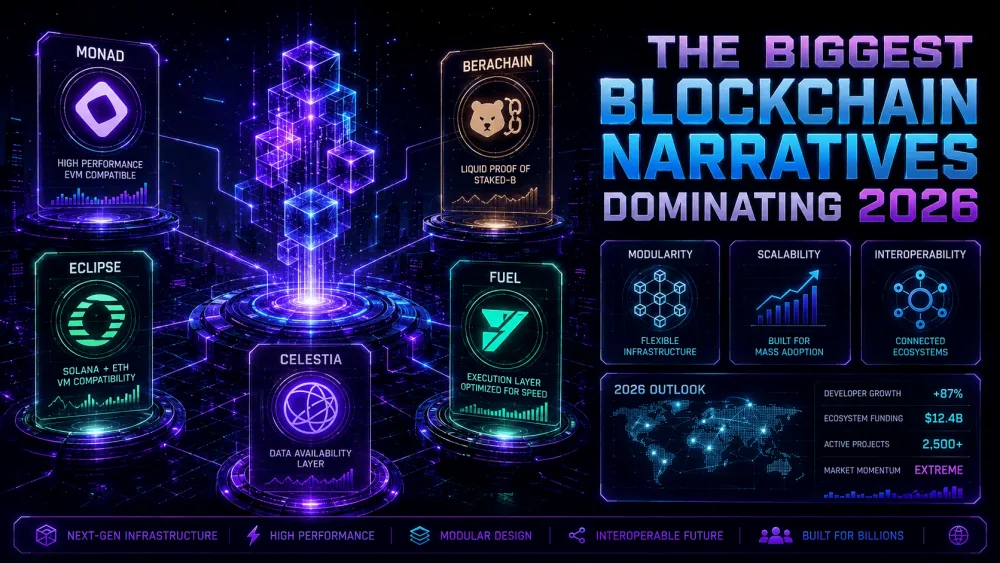
The top blockchain projects of 2026 are shaped by modular architecture, parallel execution, AI infrastructure, rollups, appchains, and developer-first tooling. These blockchain narratives for 2026 show a market moving beyond simple Layer 1 hype.
Modular Blockchain Architecture
A modular blockchain separates execution, settlement, consensus, and data availability. Instead of one network doing everything, each layer specializes. This is why modular crypto projects are gaining attention. They offer a scaling path where rollups and appchains can launch faster without building a full stack from scratch.
Parallel Execution and High-Performance Chains
A parallel execution blockchain processes independent transactions at the same time. That reduces bottlenecks when activity spikes. Monad, Fuel, Eclipse, and other high-performance blockchain platforms use this idea to attack blockchain scalability. In 2026, parallel execution is one of the clearest answers to congestion.
AI-Native Blockchain Ecosystems
AI blockchain projects are moving from hype to infrastructure. Serious use cases involve compute, data, verification, agents, and machine payments. AI needs expensive resources, and decentralized infrastructure crypto can create open markets around them. The winners will be networks with real demand, not tokens with AI branding.
Related: Top 5 AI Crypto Coins to Watch in May 2026
Rollups, Appchains, and Shared Security Models
Rollups and appchains let teams build custom environments without full independent networks. Shared security models help smaller chains borrow protection from larger ecosystems. The best alternatives to Solana may be Layer 2s, appchains or modular networks.
The Rise of Developer-First Ecosystems
Developer-first ecosystems win because builders hate friction. Grants, documentation, SDKs, audits, liquidity support, and distribution matter. The fastest-growing blockchain networks make it easy to ship apps and reach users.
Monad — The High-Speed EVM Chain Competing With Solana
Monad is one of the most watched Layer 1 blockchain projects because its pitch is simple: Solana-like speed with EVM compatibility. Ethereum developers already understand Solidity, wallets, and tooling. If Monad delivers fast execution without abandoning the EVM, it becomes one of the strongest crypto projects similar to Solana.
How Parallel Execution Improves Scalability
Monad’s core idea is parallel execution. Instead of pushing every transaction through one lane, the network aims to process independent actions at the same time. For users, the promise is faster DeFi and lower costs. For builders, it offers performance with familiar Ethereum tools.
Why Developers Are Watching Monad Closely
Developers are watching Monad because it tries to remove the trade-off between speed and EVM familiarity. That makes it one of the most discussed new blockchain projects and one of the blockchain projects with high growth potential.
Ecosystem Growth, Funding, and Community Momentum
Monad already has social momentum, but hype is only the opening act. To become a true next Solana crypto candidate, it needs live applications, sticky liquidity, stable infrastructure, and returning users.
Related: Best Solana-Based Tokens to Watch in 2026: Top SOL Projects with Explosive Growth Potential
Eclipse — Combining Solana Speed With Ethereum Security
Eclipse is not trying to replace Ethereum or Solana. It borrows from both. The idea is to use the Solana Virtual Machine for execution while staying close to Ethereum’s liquidity base. That makes Eclipse one of the most interesting SVM blockchain stories of 2026.
What Makes Eclipse Different From Traditional Layer-2s
Most Layer-2s keep the EVM. Eclipse brings Solana-style execution into Ethereum’s orbit. That gives it a sharper identity than another generic rollup. For investors tracking blockchain projects gaining attention, Eclipse sits at the intersection of two major ecosystems.
Solana Virtual Machine (SVM) Advantages
The SVM was built for high-throughput activity. It suits apps that need frequent, cheap transactions, including DeFi, games, payments, and consumer crypto. Eclipse is betting that developers want this performance without losing access to Ethereum liquidity.
Why Eclipse Is Becoming a Major Narrative in 2026
Eclipse has a clean story: Ethereum security, Solana speed, and modular infrastructure. That makes it one of the best emerging blockchain projects to invest in for investors who believe execution environments will fragment.
Berachain — The Community-Driven Blockchain Explosion
Berachain blends meme energy with DeFi design. Its Proof-of-Liquidity model aims to align users, validators, and applications around liquidity. That puts it among emerging blockchain projects with real community force.
Proof-of-Liquidity Explained
Proof-of-Liquidity tries to solve a familiar problem. In many networks, users stake tokens to secure the chain, but that capital does little for applications. Berachain makes liquidity part of the incentive system, so DeFi activity and network security can reinforce each other.
Meme Culture and Real DeFi Utility
Crypto is not only code. It is culture, timing, and belief. Berachain understands that. Memes bring attention, while DeFi gives users a reason to stay. If both sides work, Berachain could become one of the top crypto ecosystems in 2026.
Can Berachain Build a Sustainable Ecosystem?
The hard question is sustainability. Can Berachain keep users after early rewards cool and attract serious protocols? If yes, it may become one of the underrated blockchain projects of 2026. If not, activity can fade quickly.
Celestia and the Modular Blockchain Revolution
Celestia is trying to become an infrastructure for many chains. That makes it one of the important crypto infrastructure projects of this cycle. Its focus is on data availability, a crucial piece of modular scaling.
What Is a Modular Blockchain?
A modular blockchain separates core functions into specialized layers. Execution can happen on one layer, settlement on another, and data availability somewhere else. This helps teams launch rollups or appchains without building a complete Layer 1 from scratch.
Why Data Availability Layers Matter
Data availability ensures that transaction data can be accessed and checked. Without it, users and validators cannot confidently verify what happened. As more rollups and appchains appear, data availability becomes a central part of blockchain scalability.
How Celestia Changed Blockchain Infrastructure Trends
Celestia changed how builders think about launching networks. Not every project needs its own full blockchain stack. That shift may define next-generation blockchain platforms connected by shared infrastructure.
Fuel Network — The Blockchain Focused on Execution Efficiency
Fuel Network focuses on execution efficiency through parallel transaction processing and a performance-focused virtual machine. It is one of the more technically serious scalable blockchain projects.
Parallel Transaction Processing Explained
Parallel transaction processing lets a network handle transactions at the same time when they do not conflict. This can increase throughput and reduce congestion. This is why Fuel belongs in the broader parallel execution blockchain conversation.
FuelVM vs Traditional EVM Architecture
FuelVM is not an EVM clone. It uses a different architecture and the Sway programming language. That creates opportunity and friction. New tools may improve performance, but they also require developer education and strong documentation.
Why Developers Are Paying Attention to Fuel
Developers are paying attention because Fuel fits the modular future. If it supports useful apps at scale, it could become one of the blockchain projects of 2026 that investors revisit after louder narratives cool.
AI-Powered Blockchain Projects Gaining Momentum
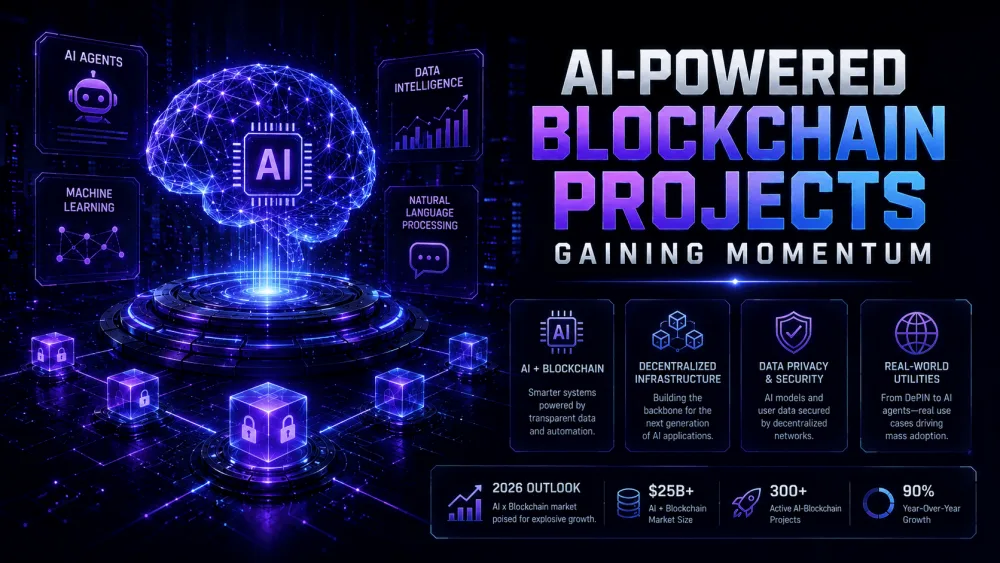
AI is one of tech’s biggest narratives, and crypto wants to build around it. The strongest AI blockchain projects focus on compute, data ownership, verification, agents, and decentralized markets.
Why AI and Blockchain Are Converging
AI is expensive and centralized. Compute sits with large cloud providers, data is siloed, and models are hard to audit. Blockchain can offer open markets, transparent incentives and programmable payments. That does not make every AI token valuable, but it explains why capital keeps flowing into the sector.
Emerging AI-Native Networks to Watch
Investors are watching decentralized compute networks, AI agent platforms, data networks and Bittensor-style ecosystems. Their role is different: they aim to become infrastructure for AI workloads and machine-driven economies.
The Role of Decentralized Compute Infrastructure
Decentralized compute could give developers alternative access to GPUs and cloud resources. It will not replace Big Tech overnight, but it can create more open markets for blockchain innovation in 2026.
| Project | Category | Main Features | Why It Looks Promising | Key Risk |
|---|---|---|---|---|
| Monad | High-performance Layer 1 | EVM compatibility, parallel execution, faster transaction processing, Ethereum-style developer tooling | Could attract Solidity developers who want Solana-like speed without leaving the EVM ecosystem | Needs real apps, liquidity, users and stable mainnet performance |
| Eclipse | SVM-based Ethereum Layer 2 | Solana Virtual Machine execution, Ethereum liquidity access, modular infrastructure, high-throughput design | Combines two strong narratives: Solana speed and Ethereum security/liquidity | Must prove developers and users want SVM execution inside Ethereum |
| Berachain | DeFi-focused Layer 1 | Proof-of-Liquidity, meme-driven community, DeFi-native incentives, validator-user-app alignment | Strong culture plus a unique liquidity model could create sticky ecosystem activity | Incentives may become circular farming if real utility does not follow |
| Celestia | Modular blockchain infrastructure | Data availability layer, modular blockchain architecture, rollup and appchain support | Benefits from the shift toward modular crypto projects and app-specific chains | Value depends on continued demand from rollups and modular ecosystems |
| Fuel Network | Modular execution layer | Parallel transaction processing, FuelVM, Sway language, execution efficiency | Technically serious approach to blockchain scalability and high-performance execution | New architecture may slow developer adoption compared with EVM chains |
| AI-Native Blockchain Networks | AI and crypto infrastructure | Decentralized compute, data ownership, verification, AI agents, machine payments | AI demand could push crypto infrastructure into real-world compute and data markets | Many AI tokens are narrative-driven and may lack real usage |
| Decentralized Compute Projects | DePIN / AI infrastructure | GPU access, open compute markets, cloud alternatives, decentralized resource coordination | Could benefit from rising AI infrastructure costs and demand for non-Big-Tech compute | Hard to compete with centralized cloud providers on reliability and scale |
| Bittensor-style Ecosystems | Decentralized AI networks | Incentivized machine learning, subnet models, open AI markets, tokenized intelligence networks | Strong fit with the AI blockchain projects narrative in 2026 | Complex economics and uncertain long-term demand for decentralized AI services |
Key Factors That Could Create the “Next Solana”
The next Solana will win because users return, developers build, and liquidity stays. Key signals are developer activity, user growth, revenue, funding, institutional support, and community strength.
Developer Activity and Ecosystem Funding
Developers are the first serious signal. A chain without builders is just a token. Grants and venture funding help, but they are not enough. The best blockchain projects attract builders who keep shipping after incentives slow.
User Growth and On-Chain Metrics
Investors should watch active wallets, DEX volume, stablecoin supply, bridge flows, app revenue, and transaction quality. A chain full of bots is not the next big blockchain. A chain with sticky users and growing applications might be.
Institutional Interest and Venture Capital Support
Institutional and venture support can bring capital, credibility, and connections. It can also create future selling pressure. Even the best emerging blockchain projects to invest in can struggle if token supply grows faster than demand.
Community Strength and Social Momentum
Solana proved that the community can defend a network through brutal market conditions. Strong communities onboard users, create culture, and keep attention alive. For young ecosystems, social momentum can be a real competitive advantage.
Risks Investors Should Consider Before Buying Emerging Blockchains
The hunt for the next Solana crypto is exciting, but risky. Not every fast chain becomes Solana. Not every modular network becomes essential. Not every AI project captures real demand.
Token Inflation and Unlock Schedules
Token unlocks are one of the biggest risks in new blockchain projects. Low float can make early price action look stronger than it is. Investors should check emissions, foundation allocations, investor unlocks, and ecosystem incentives before buying.
Competition Between Layer 1 Ecosystems
Competition is brutal. Ethereum, Solana, Sui, Aptos, Avalanche, Cosmos, Base, and Arbitrum all fight for developers and liquidity. New Layer 1 blockchain projects need a clear reason to exist.
Scalability Claims vs Real Adoption
Scalability claims are easy. Adoption is hard. Testnet numbers and theoretical TPS should be treated carefully. The real test is whether users get better apps, lower costs, and smoother activity.
Market Volatility and Narrative Rotation
Crypto narratives rotate quickly: AI, modular chains, memecoins, DePIN, and restaking can all take turns. A strong project can still be a bad buy at the wrong valuation. Timing matters.
FAQ
What Is the Next Solana?
The next Solana is likely to be a project that combines fast execution, low fees, developer activity, deep liquidity, and community momentum. Monad, Eclipse, Berachain, Celestia, and Fuel are among the names investors are watching.
What Are the Best Alternatives to Solana?
The best alternatives to Solana depend on the use case. Monad targets high-speed EVM execution. Eclipse brings SVM performance to Ethereum. Berachain focuses on liquidity incentives. Celestia supports modular infrastructure. Fuel focuses on execution efficiency.
Which Blockchain Projects Are Gaining Attention in 2026?
Major blockchain projects gaining attention include Monad, Eclipse, Berachain, Celestia, Fuel Network, and several AI-native infrastructure networks. They sit at the center of speed, modular design, AI, and parallel execution narratives.
Are Emerging Blockchain Projects Good Investments?
Some emerging blockchain projects may offer high growth potential, but they carry major risks. Investors should study adoption, developer activity, liquidity, token unlocks, valuation, and competition before buying.
What Makes a Blockchain Project Scalable?
A scalable blockchain can handle growing activity without extreme fees, congestion or poor user experience. Strong blockchain scalability usually combines efficient execution, reliable infrastructure, security, developer tools, and real demand.