OXT crypto is the native utility token for Orchid, a decentralized bandwidth marketplace built on Ethereum blockchain. Rather than a customary VPN that relies on a single provider, Orchid connects providers of bandwidth, using freelancers, to users through pay-as-you-go access.
Contents
What Is OXT Crypto?
What Is Orchid Network?
The answer to what is Orchid Network goes beyond a traditional VPN. Orchid combines an open-source VPN client, a set of Ethereum smart contracts, stake-weighting for provider selection, and probabilistic nanopayments, creating a decentralized privacy services marketplace. The protocol also supports Orchid’s VPN along with WireGuard and OpenVPN.
What Is OXT Used For?
The economic model powering Orchid consists of OXT token, which is staked by bandwidth providers for visibility, and probabilistic nanopayments for bandwidth billed to user accounts in OXT tokens.
Read More: Ethereum Technical Analysis: ETH Tests Key Resistance as Breakout Momentum Builds
In contrast to speculative digital assets, Orchid crypto was designed to allow for market incentives, providing rewards for bandwidth providers as well as payments.
How Orchid’s Decentralized VPN Works
In other words, rather than a centralized VPN, those interested in how does Orchid work can imagine a marketplace of nodes. Orchid creates a marketplace of providers by letting them stake OXT on Ethereum, while the client selects providers via a stake-weighted lottery.
Orchid VPN crypto model allows users to replace monthly subscriptions with a pay-as-you-go model, sending probabilistic nanopayment tickets with encrypted traffic, substantially reducing on-chain Ethereum transactions and fees.
| Feature | Details |
| Project | Orchid |
| Native Token | OXT |
| Blockchain | Ethereum |
| Token Standard | ERC-20 |
| Primary Use Case | Decentralized bandwidth marketplace and VPN payments |
| Consensus Role | Not used for blockchain consensus |
| Staking Purpose | Provider selection and network incentives |
| Payment Model | Probabilistic nanopayments (pay-as-you-go) |
| VPN Type | Decentralized VPN (dVPN) |
| Maximum Supply | 1,000,000,000 OXT |
OXT Tokenomics at a Glance
OXT tokenomics are straightforward. OXT is an ERC-20-based utility token on Ethereum, with a total supply of 1 billion tokens. Moreover, the protocol is incentivized through staking, as well as the utility of the network.
Providers stake OXT to signal themselves for user traffic, so OXT utility is closely tied to activity within Orchid network itself.
How Does OXT Crypto Work?
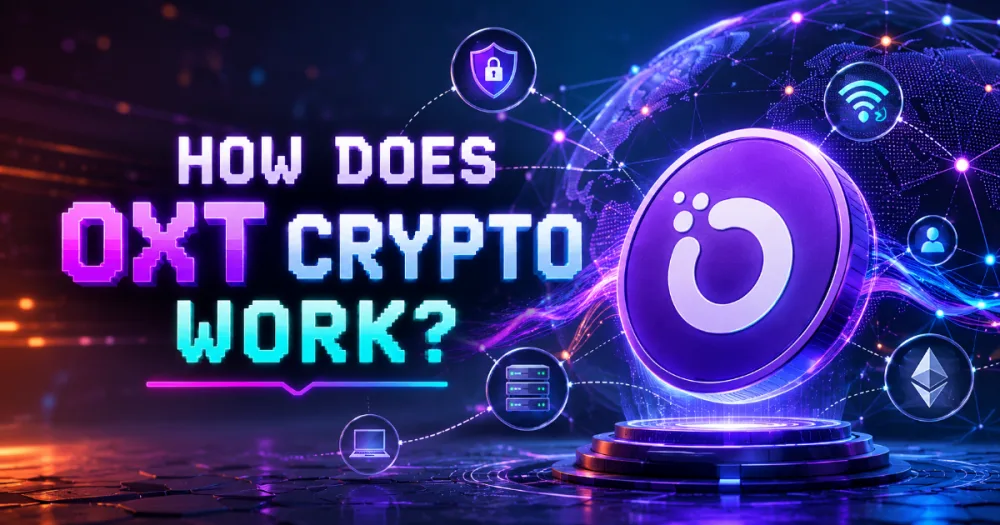
OXT crypto is used to coordinate payments and provider incentives in Orchid’s decentralized, open marketplace for bandwidth, in which providers advertise services with staked OXT while users pay providers with probabilistic payments to avoid sending multiple microtransactions over Ethereum.
OXT Staking for Bandwidth Providers
OXT is locked in Orchid’s Ethereum directory contract by bandwidth providers. The client selects tiered bandwidth providers at random according to the proportion that each provider contributes to the system’s total stake. A larger stake will improve visibility, but won’t guarantee revenue.
Orchid, unlike most proof-of-stake cryptocurrencies, does not reward users for staking; instead, providers are paid when users purchase bandwidth. Staking is mostly used to find providers and resist Sybil attacks.
Probabilistic Nanopayments Explained
Instead of settling each bandwidth payment on-chain, Orchid uses probabilistic nanopayments, which are cryptographic tickets that have a small probability of creating a larger bandwidth payment, to match the bandwidth used with an expected payment.
Winning tickets are redeemed against the payment contract taking place on-chain, which reduces the number of Ethereum transactions required, while maintaining the pay-as-you-go price. Orchid accounts have a spending balance backed by a deposit.
Why Orchid Uses Its Own Token Instead of ETH
To enable payment and the stake-weighted selection of providers, Orchid created OXT, which allows providers to lock value into the directory contract and the network’s original nanopayment system.
Though ETH▲$1,761.17 is still required to pay gas fees, Orchid states that the network’s incentive model based on OXT will be used to encourage providers and resist Sybil attacks. The payment network can be deployed on EVM-compatible chains, though staking will always use OXT.
Why Orchid Price Remains Near Record Lows

Weak Long-Term User Adoption
One of the reasons why is Orchid price down is that the network has not enjoyed the same level of adoption as considerably larger blockchain ecosystems. Although Orchid continues to develop both its decentralized bandwidth marketplace and its VPN application, neither has generated enough traction to create sustained demand for the native token.
Read More: Ethereum ETF Update: Could Staking ETFs Become ETH’s Biggest Catalyst?
Like other utility tokens, Orchid’s value is expected to be sustained through the continued use of its network; however, although it remains operational, the uptake of its network was slower than investors had previously expected.
Declining Demand for OXT Utility
Aside from provider staking and purchases on Orchid’s payment infrastructure, OXT token demand driven by utility is relatively low because the market for active bandwidth has not grown to keep up with the growth of the broader crypto market.
Historically, the demand for tokens has often been driven by market speculation rather than usage of the protocol, making it difficult to sustain price appreciation.
Competition From Other Privacy and DePIN Projects
Since Orchid’s launch, the privacy and decentralized infrastructure landscape has become more crowded with an abundance of VPN providers, privacy-preserving protocols, and DePIN projects attempting to provide decentralized storage, bandwidth, and computing services and capture attention from users and investors.
Despite the growing interest in decentralized physical infrastructure, this competition has had a dampening effect on Orchid crypto growth.
Market Cycles and Bitcoin Dominance
Like most mid-cap altcoins, Orchid price is subject to trends in the cryptocurrency market. During periods of increased Bitcoin dominance, liquidity tends to leave smaller cap cryptocurrencies behind, making it difficult for adoption at smaller scales to lift the price of the currency.
Outside of its development projects, OXT has been affected by changes in macro sentiment, risk appetite, and capital rotation (the movement of capital in and out of an asset class) for several cycles.
Recent Price Volatility After the July Rally
The subsequent fall, even as the news wasn’t bad for the project, was attributed to the fact OXT had risen over 300% and the token was overbought. Short-term traders were said to have decided to cash in their profits once the momentum slowed.
No major negative announcements accompanied the correction, which was viewed by market analysts as the result of a natural correction after an exceptionally strong advance, after which consolidation and a cooling off in trading activity was to be expected.
OXT Tokenomics Explained
Total Supply and Circulating Supply
OXT tokenomics are fixed. According to CoinMarketCap and Orchid’s whitepaper, 1 billion OXT tokens were minted at network launch. No further minting is expected.
OXT circulating supply is roughly 997.2 million OXT. This constitutes almost all of the token supply, meaning dilution from token unlocks will be minimal in the future.
Is OXT Inflationary?
No. The protocol does not create new tokens through mining, staking rewards or validator rewards, thus OXT token is not inflationary. As all tokens were created at genesis, the supply is effectively fixed.
While Orchid does document token burn functions in some of the protocol’s more direct features, it does not cite any sort of inflation schedule to ensure network participation, instead relying on the existing supply of tokens and activity in the marketplace.
How Staking Creates Network Incentives
Orchid staking differs from that of proof-of-stake blockchains in that providers stake OXT to improve their chances of being selected by users who are trying to buy bandwidth, rather than to validate blocks or collect newly minted tokens. Their documentation states that staking is an economic signal that distributes traffic across the network.
Because consumers pay by purchasing bandwidth from providers rather than through protocol emissions, staking aligns economic incentives with network usage: as Orchid services increase in demand, network providers will have a greater incentive to compete for traffic by staking more OXT on the network.
What Drives OXT Price?

Network Usage
The most basic demand for OXT price comes from users accessing Orchid network: users purchase bandwidth, and OXT must be staked by a provider to compete for traffic.
Since Orchid is a niche decentralized marketplace, earlier growth in network traffic had less impact on price than other market dynamics, and sustainable growth in the number of users and bandwidth providers over time would support the long-term value of the token.
Exchange Liquidity
Like most mid-cap digital assets, OXT is subject to liquidity on exchanges, and being listed on a major exchange increases access to the asset. Higher liquidity means less slippage, therefore minimizing the price impact during periods of high volatility.
As a result, large orders can move the markets more than for other large-volume cryptocurrencies like BTC▲$62,630.00 or ETH when trading volumes are low.
Investor Sentiment
Orchid price moves on daily, weekly, and hourly timeframes are therefore often the result of sentiment, and the project’s value as a vehicle for privacy, or DePIN (decentralized infrastructure), attracts or repels speculative capital. In stronger risk-off scenarios, traders typically rotate into larger, established assets.
Read More: PONS Launchpad: Why It Could Become Robinhood Chain’s Flagship Launchpad
However, this was also true in past rallies, where drastic price increases were also followed by price corrections as investors sold their stock when momentum began to slow.
Broader Crypto Market Trends
Broader crypto market conditions have impacted OXT. Overall, altcoins outperform in broader altcoin-friendly conditions, especially in a risk-on environment. At other times during the timeframe, Bitcoin’s high dominance metrics led to the rotation of money out of mid and small caps towards Bitcoin.
Therefore, Orchid price prediction may be affected by larger trends in the crypto market, and potential macroeconomic events may dampen the positive impact of a promising Orchid network development.
| Price Driver | Impact on OXT |
| Network Usage | Higher bandwidth demand and provider activity can increase token utility. |
| Exchange Liquidity | Better liquidity generally reduces volatility and improves price discovery. |
| Investor Sentiment | Bullish or bearish market sentiment often drives short-term price movements. |
| Bitcoin Dominance | Rising BTC dominance can divert capital away from mid-cap altcoins like OXT. |
| Crypto Market Cycle | Risk-on markets typically support stronger altcoin performance. |
| Orchid Ecosystem Growth | Increased adoption of Orchid services may strengthen long-term token demand. |
Is OXT Crypto a Good Investment?
OXT Bull Case
The strongest argument for is OXT a good investment is how Orchid sits at the intersection of decentralized privacy and decentralized physical infrastructure networks (DePIN). Unlike most utility tokens, OXT fuels an actual marketplace where providers stake their own tokens for bandwidth demand, and users pay for the service via probabilistic nanopayments.
Advocates have pointed to fixed token supply, absence of inflation, and the aim to act as a decentralized marketplace for bandwidth, storage, and artificial intelligence infrastructure outside of a VPN as reasons for utility to increase with demand for the network.
OXT Bear Case
Pessimistic view is tempered by the fact that Orchid’s infrastructure is functioning effectively, the network enjoys moderate usage, and OXT has a clear use case. However, the utilization and demand for OXT are less than predicted.
Competition is another issue. Centralized VPN services, privacy-oriented blockchain projects, and a new wave of DePIN protocols all compete for users and investment capital, making sustained growth difficult to achieve even in bullish conditions.
Biggest Risks for Investors
The only concern for OXT holders is that its utilization is based on marketplace demand rather than inflationary staking rewards. Orchid’s documentation indicates that providers are compensated when users purchase bandwidth. Therefore, more users are needed for better tokenomics.
Like most mid-cap altcoins, OXT prices are subject to important speculative trading, sentiment, and macro conditions, meaning that despite Orchid’s continued development activity and building out of its ecosystem, price performance may remain more correlated with liquidity-driven and macro conditions than other aspects of the protocol.
OXT Price Prediction: Can Orchid Recover?

Short-Term Outlook
OXT price prediction in the near term remains highly volatile. Following a massive July rally, OXT price consolidated following more than 300% price climb from late June lows, instead of tanking on negative news about the project.
If the price holds the $0.015 area, it may improve market sentiment, but if it breaks below, support is likely at the $0.012 level.
Read More: Robinhood Chain Memecoin Season: Top 10 Coins to Watch in Summer 2026
On the other hand, a sustained move above the $0.020 mark could tilt the short-term balance in buyers’ favor. The $0.025-$0.030 zone is the next major area of resistance, as it was formed during the recent price surge. This level is, however, only a technical target.
Long-Term Growth Catalysts
Ultimately, Orchid price predictions based on short-term speculation may be less important than the network’s adoption.
If adoption, demand for bandwidth, and participation from providers continue to grow, and Orchid’s underlying decentralized technology platform continues to improve, the fundamentals of the token may improve over time.
Because nearly all of the 1 billion OXT are already in circulation, any price increase is likely instead to depend on demand, rather than the token’s release schedule.
If adoption picks up during the next crypto bull run, OXT may partly recover its 2021 price levels. But it would likely take a surge in network usage to send OXT back to its all-time high.
Key Levels to Watch
In the short term, OXT price level near to $0.015 is a critical price point that has become a strong support zone after the rally. If the level breaks this strongly, a $0.012 retest would be more likely, though holding the $0.015 level would suggest reducing selling pressure over time.
On the upside, price action had strong resistance around $0.020 and at the $0.025-$0.030 levels.
A convincing move above those levels would signal a resumption of bullish momentum, though the outlook for pricing is heavily dependent on the status of the crypto market and Orchid adoption.
| Bullish Factors | Bearish Factors |
| Increasing Orchid network adoption | Limited real-world network usage |
| Higher demand for decentralized privacy | Strong competition in the DePIN and VPN sectors |
| Fixed supply of 1 billion OXT | Dependence on overall crypto market sentiment |
| Rising bandwidth demand | High Bitcoin dominance reducing altcoin inflows |
| Favorable crypto bull market | Low liquidity compared with large-cap cryptocurrencies |
How to Buy OXT Crypto

Where to Buy OXT
Investors looking for where to buy OXT can purchase the token on several major cryptocurrency exchanges. According to Orchid’s website, trading exchanges include Binance, Huobi Global, OKX, Bittrex, Upbit, Gate.io, Uniswap, TOR, KuCoin, Coinbase, Poloniex, Hotbit, and Kraken.
Because OXT is an ERC-20 token, when acquiring OXT, users will typically fund the exchange with fiat or another cryptocurrency, then buy OXT through the exchange’s spot market, and then withdraw OXT to an external wallet. Orchid maintains a list of exchanges that have listed OXT.
How to Store OXT Securely
OXT tokens, being an ERC-20 token on Ethereum, can be stored in any Ethereum wallet supporting the ERC-20 token standard. Long-term OXT holders are generally encouraged to store their OXT in a reputable software or hardware wallet of their choice, rather than an exchange, if recovery phrases are secured.
Users who want to use OXT in Orchid ecosystem are required to create an Orchid account via the official dApp, and according to the project’s documentation, a small ETH amount is needed to pay for transaction fees on Ethereum. Supported wallets to create accounts include MetaMask, Trust Wallet, and Coinbase Wallet.
FAQ
What Is OXT Crypto?
OXT is Orchid’s native utility token and eases the staking of providers and the decentralized bandwidth payment system within Orchid protocol.
Is Orchid a VPN?
Yes, Orchid is a decentralized blockchain-based virtual private network (VPN) that does not operate servers but instead connects users to independent bandwidth providers through a decentralized marketplace, which blockchain technology drives.
Why Is Orchid Price So Low?
The token price is a small portion of its all time high due to the low adoption rate of privacy coins, high competition among privacy coins, and bear markets across the cryptocurrency industry. The price correction followed a price hike of the token for 300%, resulting from profit-taking rather than developments of the project.
Does OXT Have a Fixed Supply?
Yes. There will only be 1 billion OXT in total, with no inflationary token rewards or staking to mint more.
Is OXT an ERC-20 Token?
Yes, as OXT is an ERC-20 token on Ethereum blockchain, it can be held in any compatible Ethereum wallet or service.
Can Orchid Reach Its Previous All-Time High Again?
While this is an option, it would likely require a lot more network adoption, demand for decentralized privacy services, or favorable crypto market conditions, and it is not guaranteed that the token will reach the previous peak.