Stablecoins are crypto tokens designed to track an outside asset, usually the US dollar. Among the three largest dollar stablecoins, each serves a different type of user. USDT▼$0.9994 offers the deepest exchange liquidity and the widest trading pair coverage. USDC▲$0.9998 provides tighter reserve reporting and a more regulated structure. DAI▲$0.9998 runs on an onchain, protocol-based model with stronger DeFi utility. This guide compares their backing, transparency, decentralization, risks, buying process, and daily use.
| Coin | Peg target | Backing model | Approx. market cap | Main strength | Main trade-off |
| USDT | 1 USD | Fiat-backed reserves | 184.1B USD | Deep liquidity and broad exchange support | Less granular public reserve detail than USDC |
| USDC | 1 USD | Fiat-backed reserves | 78.9B USD | Strong reporting and regulated structure | Higher compliance and freeze risk |
| DAI | 1 USD | Crypto-collateralized | 4.3B USD | Strong DeFi integration and protocol design | Collateral and protocol risk |
This article is for educational purposes only and does not provide investment, legal, tax, or financial advice. Any decision involving stablecoins should be based on independent research and risk assessment.
Contents
- 1.What Are Stablecoins and How Do They Work?
- 2.What Is the Point of Stablecoins and Why They Matter
- 3.How Stablecoins Work in Practice
- 4.Types of Stablecoins Explained
- 5.Stablecoins List: USDT, USDC, DAI, and Other Examples
- 6.USDT vs USDC: Top Stablecoins Compared
- 7.Benefits of Stablecoins and Key Stablecoin Risks
- 8.How to Choose the Best Stablecoins for Your Needs
- 9.How to Buy Stablecoins Safely
- 10.How to Invest in Stablecoins
- 11.Stablecoin Regulation: What Actually Moves USDT, USDC, and DAI
- 12.FAQ
What Are Stablecoins and How Do They Work?
A stablecoin is a blockchain token built to track a reference asset — most often one US dollar. The stablecoin meaning is straightforward: digital value with a stability target. A more precise stablecoin definition is an onchain asset that uses reserves, collateral, or code to hold its price near $1, unlike Bitcoin, which has no price anchor.
Many transfers happen on public chains, but a large share of user activity also happens off-chain inside exchanges and apps. Stablecoins can look simple on the wallet screen while relying on a broader settlement stack behind the scenes.
What Is the Point of Stablecoins and Why They Matter
The short answer to what is the point of stablecoins is utility. Most users encounter stablecoins first as a trading bridge — a way to hold dollar liquidity, move funds between countries, post collateral, settle trades, and step out of market swings without leaving crypto rails. Some users ask about bitcoin stablecoins, but most dollar-pegged tokens are not issued by Bitcoin. They are separate tokens that sit beside Bitcoin markets and make trading, remittance, and payments easier.
Beyond individual use, stablecoins have become core market infrastructure. They connect exchanges, wallets, lending markets, and payment apps through a shared dollar unit. A less obvious effect shows up in Treasury markets: BIS research indicates that large issuers already influence demand for short-dated government paper, a sign of how far the sector has moved beyond niche crypto tooling.
Christopher J. Waller, Governor at the Federal Reserve, notes in Reflections on a Maturing Stablecoin Market that stablecoins matter when they solve payment problems, especially as a store of value, a dollar access tool, and a cross-border payment rail.

How Stablecoins Work in Practice
How do stablecoins work? The process comes down to minting, redeeming, and arbitrage. New tokens enter circulation when an issuer or protocol creates them against reserves or collateral. Tokens leave circulation when they are redeemed or burned. The peg does not hold by itself — it holds because someone can usually create or redeem at around $1, and traders step in when the market price drifts from that level.
Access matters too. Stablecoins live on blockchains, but users reach them through wallets, exchanges, and payment apps. A trader may never redeem directly with the issuer. Instead, large intermediaries handle that process, and secondary markets reflect it. This explains why price can move slightly around parity even when the underlying model still functions.
How the Dollar Peg Holds
A stablecoin stays near $1 when the market believes the backing is there and redemption still works. When price drops below $1, traders can buy cheap units and redeem or use them at par. When price rises above $1, new issuance increases supply and pushes price back down. DAI uses overcollateralized vaults and liquidations instead of a corporate reserve account.
The peg usually depends on several moving parts:
- Reserve assets or collateral with enough value
- A mint and redeem path near par
- Arbitrageurs with access to capital
- Blockchain settlement that stays live
- User trust that the mechanism will still work tomorrow
Why a Stablecoin Can Lose Its Peg
A stablecoin peg break is usually not one event — it is a chain reaction. Panic redemptions, weak reserves, legal action, network congestion, and bad smart-contract design can each widen the gap from $1. In crypto-backed models, falling collateral prices add pressure fast. In centrally issued models, delays in redemption or banking access produce the same effect.
Common causes include:
- Panic selling and redemption stress
- Doubts about reserves or collateral quality
- Limits on minting or redemption
- Regulatory action against issuer or platform
- Network fees or congestion during stress
- Smart-contract bugs, oracle errors, or liquidation failures
The real question is not price on a calm day. It is whether the mechanism survives pressure.
Types of Stablecoins Explained
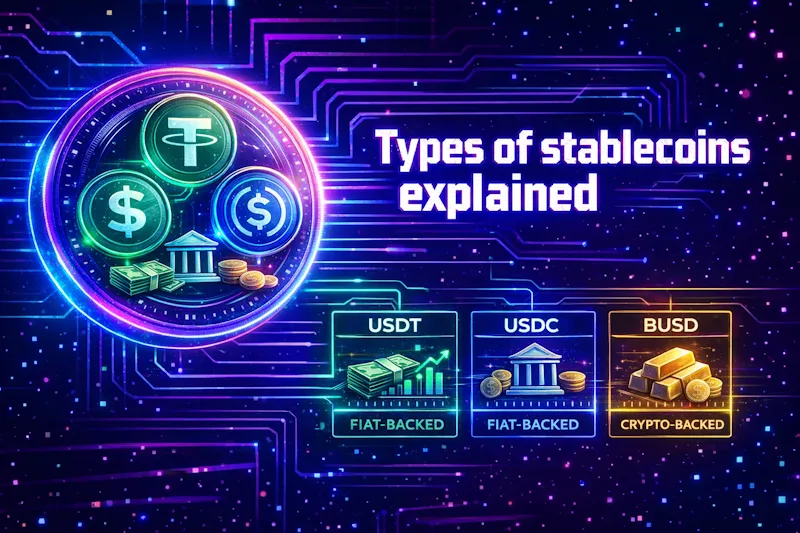
The main types of stablecoins are fiat-backed, crypto-backed, commodity-backed, and algorithmic. These categories carry different risk profiles. USDT and USDC are fiat-backed stablecoins, so their promise depends on reserve assets and issuer operations. DAI is a crypto-backed stablecoin, so its promise depends on collateral, liquidation rules, and protocol governance. Commodity-backed coins track assets like gold. Algorithmic designs try to hold price through supply rules alone, but history shows that mechanism design without real backing tends to be fragile.
Algorithmic Stablecoins Explained in Simple Terms
Algorithmic stablecoins try to defend a peg through issuance logic, incentives, and market behavior instead of fully matching reserves or overcollateralized vaults. A reflexive design can look stable in calm periods and fail quickly when trust breaks. DAI should not be confused with a pure algorithmic model — it uses posted collateral, vault mechanics, and liquidation rules.
A simple way to separate them:
- Fiat-backed models rely on issuer reserves
- Crypto-backed models rely on excess collateral and liquidations
- Algorithmic models rely more on demand incentives and market reflexes
- DAI belongs in the crypto-backed group, not the pure algorithmic group
Stablecoins List: USDT, USDC, DAI, and Other Examples
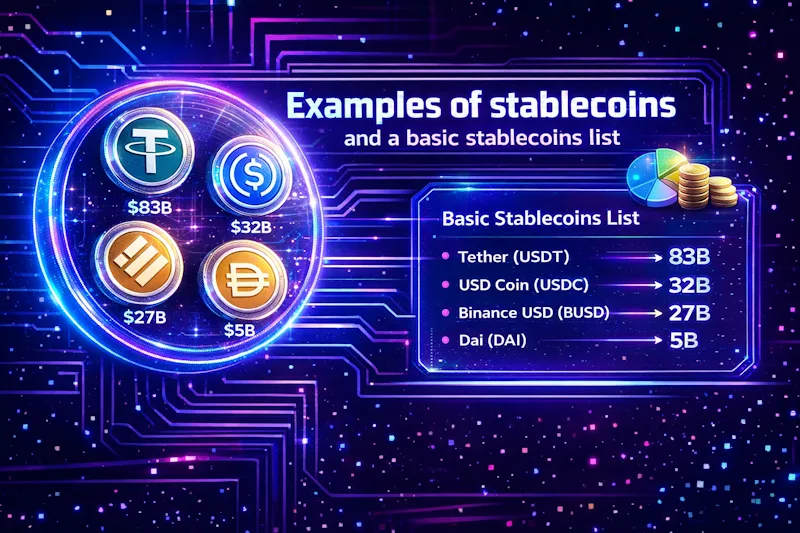
A practical market view helps more than theory. This stablecoins list centers on USDT, USDC, and DAI, then adds secondary names for context. DAI remains active, but the newer Sky stablecoin USDS▲$0.9997 is now larger by market cap and supply. That does not erase DAI — it shifts where DAI sits in the market map.
The table below gives a compact market snapshot of the most popular stablecoins.
| Coin | Type | Issuer or protocol | Approx. market cap | Key risk | Common use |
| USDT | Fiat-backed | Tether | 184.1B USD | Reserve transparency and issuer control | Trading, transfers, exchange liquidity |
| USDC | Fiat-backed | Circle | 78.9B USD | Compliance freeze and banking dependence | Treasury-style cash use, payments, regulated platforms |
| DAI | Crypto-backed | Maker and Sky ecosystem | 4.3B USD | Collateral stress and protocol risk | DeFi collateral, onchain dollar use |
| USDS | Crypto-backed | Sky ecosystem | 11.6B USD | Protocol and governance risk | DeFi savings and ecosystem use |
| PYUSD▼$0.9996 | Fiat-backed | Paxos and PayPal | 4.1B USD | Platform concentration | Payments and app distribution |
| RLUSD▲$1.0000 | Fiat-backed | Ripple | 1.5B USD | Newer market footprint | Institutional and network payments |
What Is USDT
USDT is the scale play in the stablecoin market. It has the broadest exchange presence, the deepest spot and derivatives liquidity, and the strongest role in moving dollar value across crypto venues. Tether’s January 2026 attestation reported more than 186 billion USDT in circulation and about 141 billion dollars of total Treasury exposure at year-end 2025.
What users typically like about USDT:
- Very high exchange liquidity
- Strong support across major chains
- Familiar quote asset for trading pairs
- Wide use in cross-border crypto transfers
The usual concern is not access — it is how much detail users get from reserve reporting and issuer controls.
Paolo Ardoino, CEO of Tether, says in Tether’s January 2026 reserve update that USDT keeps growing because global demand for dollars is moving beyond traditional banking rails, especially where local financial systems remain slow, fragmented, or hard to access.
What Is USDC
USDC is the compliance-first stablecoin option. Circle says USDC is fully backed by highly liquid cash and cash-equivalent assets. The majority sits in the Circle Reserve Fund, while the rest stays in cash at regulated banks. Circle also publishes monthly attestations and daily portfolio reporting through BlackRock’s fund disclosures.
USDC often works better for these cases:
- Holding blockchain dollars with stronger public reporting
- Working with regulated firms and payment products
- Moving between chains with native support
- Using a coin that maps clearly to reserve disclosures
The trade-off is straightforward: compliance strength usually brings higher address-control and freeze risk.
Jeremy Allaire, Co-Founder, Chairman, and CEO of Circle, writes in Circle’s 2025 State of the USDC Economy that digital dollars work best when they become internet-native infrastructure for payments, treasury, remittances, and value transfer rather than a trading product.
What Is DAI
DAI is different from a corporate digital dollar. Maker documentation describes it as a collateral-backed stablecoin generated against posted crypto collateral in protocol vaults. This design gives DAI a stronger onchain identity and deep DeFi integration. It also means DAI depends on collateral value, liquidations, oracle inputs, and governance quality during stress.
DAI is often chosen for these reasons:
- Strong fit for DeFi borrowing and lending
- Onchain collateral model instead of a pure company reserve
- Broad support in Ethereum-based protocols
- A long operating history in decentralized finance
The main weakness is sensitivity to collateral shocks and protocol design choices, not day-to-day usability.
USDT vs USDC: Top Stablecoins Compared
In a side-by-side comparison, the answer is clearer than it looks. The best stablecoins are task-specific, not universal. USDT still leads on raw exchange depth. USDC leads on reserve clarity and regulated structure. DAI still matters in DeFi, but its scale is much smaller than USDT and USDC in 2026. For most users, these remain the most popular stablecoins because wallets, exchanges, and protocols already route around them.
This table compares the top stablecoins across the criteria that matter most for choosing between exchange use, payments, and DeFi.
| Criterion | USDT | USDC | DAI |
| Liquidity on exchanges | Highest | High | Lower |
| Reserve transparency | Moderate | High | Onchain collateral visibility |
| Decentralization | Low | Low | Higher at protocol layer |
| Freeze risk | High | High | Lower at token level, but protocol risk stays |
| Ease for exchange trading | Very high | High | Moderate |
| Ease for DeFi | Moderate | High | Very high |
| Regulatory alignment | Improving, but issuer-led | Strongest among the three | Mixed, protocol structure differs |
| Best fit | Active trading and transfers | Cash management and regulated use | DeFi-native use and onchain collateral |
Benefits of Stablecoins and Key Stablecoin Risks
The core value of stablecoins is not price growth — it is function. They give users a dollar-like unit that moves on blockchains, settles fast, and plugs into exchanges and DeFi. The main benefit of crypto stablecoins appears when a user needs liquidity now, not after bank hours. The main cost is that each model carries reserve, collateral, legal, platform, or code risk.
| Benefit | Why it matters | Matching risk |
| Stable pricing near $1 | Easier accounting and trade exits | Peg can still break in stress |
| Fast transfers | 24/7 settlement across chains | Wrong network or bad address can destroy funds |
| Dollar liquidity | Users can hold a dollar proxy onchain | Redemption access varies by issuer or platform |
| Exchange utility | Common quote asset for crypto trading | Centralized issuers can freeze addresses |
| DeFi access | Collateral, lending, and liquidity pools | Smart-contract and liquidation risk |
| Global reach | Useful where banking rails are slow | Legal treatment differs by country |

How to Choose the Best Stablecoins for Your Needs
A ranking without context misleads. Stablecoins should be matched to a specific task. For trading, liquidity matters most, so USDT often wins. For treasury-style storage, USDC usually makes more sense. For DeFi collateral and protocol use, DAI still has a strong place. Some users also search for bitcoin stablecoins, but the real choice is usually which dollar token works best alongside Bitcoin markets or Bitcoin-denominated strategies.
| Goal | Better fit | Why |
| Active trading | USDT | Deepest liquidity and broad pair support |
| Long dollar parking | USDC | Clearer reserve reporting and regulated posture |
| DeFi borrowing and collateral | DAI | Protocol-native design and deep DeFi use |
| Cross-platform payments | USDC or USDT | Broad support and fast settlement |
| Onchain strategies | DAI or USDC | Strong protocol and app integration |
| Centralized platform use | USDT or USDC | Broad wallet and exchange support |

How to Buy Stablecoins Safely
For a beginner, the safest flow is simple: pick a reputable exchange, pass KYC, buy the token, check the network, and move funds to a wallet if the amount is meaningful. A wrong chain choice can turn a simple transfer into a permanent loss, and large balances left on an exchange add platform risk on top of token risk.
A practical checklist:
- Confirm the token ticker and issuer
- Confirm the network before sending
- Test with a small transfer first
- Check withdrawal fees and destination support
- Avoid storing large sums on exchanges for long periods
Stablecoin regulation, redemption rights, blockchain support, custody conditions, and platform risks differ by issuer, wallet, exchange, and jurisdiction, so users should verify current terms before buying, moving, or holding funds.
How to Invest in Stablecoins
The phrase “how to invest in stablecoins” can mislead beginners. The coin price is not the growth story. The real choice is between holding a dollar-like asset for liquidity and placing that asset into a yield source. Stablecoins are usually a cash tool first and an income tool second. The return, if any, comes from the platform, borrower, or protocol — not from the peg itself.
Two paths dominate in practice. The conservative path is holding a stablecoin as dry powder, ready for deployment when opportunity comes. The riskier path is deploying it through exchange lending, DeFi pools, or structured products to earn stablecoin yield. The yield can look attractive, but now platform solvency, smart contracts, collateral quality, and liquidity lockups all matter as much as the token choice. Stablecoin interest rates vary by platform and carry their own risk layer.

Stablecoin Regulation: What Actually Moves USDT, USDC, and DAI
Not every headline matters. The events worth tracking are reserve rules, redemption rights, public disclosures, issuer licensing, custody standards, and legal limits on who may issue payment stablecoins. In the United States, the GENIUS Act was signed on July 18, 2025. It sets 100 percent reserve backing, monthly public reserve disclosures, and legal freeze capability for covered issuers. The SEC also said in April 2025 that certain fully backed payment stablecoins are not securities in the described structure.
In Europe, MiCA requires authorization for ART and EMT issuers, and ESMA pushed national authorities to address non-compliant stablecoins by the end of Q1 2025. For DAI-style systems, the relevant events are different: watch collateral composition, liquidation performance, governance changes, and whether protocol upgrades shift users toward USDS. That is the narrow set of events that changes real risk, not just sentiment.
Hester Peirce, SEC Commissioner, says in Cutting by Two Would Do that payment stablecoins are becoming essential on blockchain rails, so clear rules for reserves, disclosures, and broker-dealer treatment now shape how usable these assets become in regulated markets.
FAQ
Are stablecoins safe compared to Bitcoin for short-term cash parking?
Usually yes for price stability, but not for every kind of risk. Stablecoins target a steady value near $1, while Bitcoin does not. Yet stablecoins still carry reserve, issuer, platform, or smart-contract risk, so safety depends on the specific model and where you hold them.
Can stablecoins lose value or break the dollar peg?
Yes. USDT, USDC, and DAI can all trade away from $1 under stress. The triggers differ: USDT and USDC depend on reserves and redemption access, while DAI depends on collateral values, liquidations, oracles, and protocol design. The peg matters most when markets move fast.
Do stablecoins pay yield or earn interest on their own?
By themselves, usually no. A standard payment stablecoin is mainly a transfer and storage tool. Stablecoin yield appears when you lend, stake, pool, or place the token with a platform — and that adds counterparty, liquidity, or smart-contract risk. Stablecoin interest rates vary widely and are not guaranteed.
Which stablecoin fits DeFi better: USDC, USDT, or DAI?
DAI often fits native DeFi use best because it was built around protocol collateral and onchain mechanics. USDC is also used widely in DeFi but carries stronger compliance controls. USDT is common too, yet many DeFi users prefer clearer reserve detail or more protocol-native design.
Should I hold large amounts of stablecoins on an exchange long term?
Usually not. Exchange storage adds platform risk to token risk. A self-custody wallet reduces exchange exposure, but only if you control keys securely and send on the correct network. For large sums, many users split storage and test transfers first.
Are USDT and USDC more centralized than DAI?
Yes, in an important sense. USDT and USDC are issuer-controlled tokens with freeze and compliance powers built in. DAI has a more protocol-based structure, though it still depends on governance, collateral, and risk systems. Decentralization here is a spectrum, not a binary.