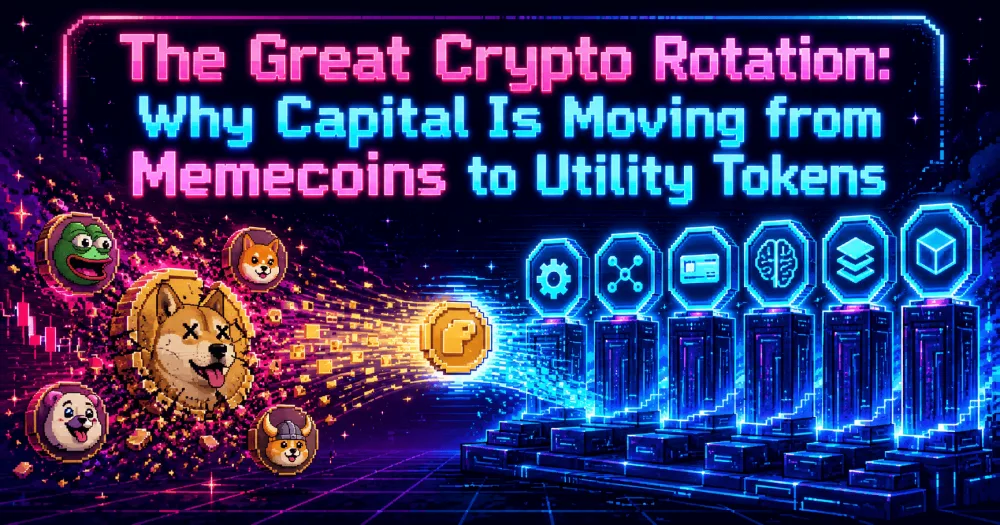
After a long stretch of crypto market where memecoins dominated attention, traders are pivoting toward utility tokens with clear use cases. This happens because the market mood in 2026 is different, with tighter liquidity and struggling prices. In a weaker market, capital tends to move beyond speculation toward projects that can explain why they should exist. And that’s what utility tokens shine at.
Contents
- What Are Utility Tokens?
- Why Memecoins Dominated the Last Cycle
- Why the Memecoin Trade Is Losing Momentum
- Why Capital Rotates Toward Utility Tokens
- Why Institutions Prefer Utility Over Memes
- Why Memecoins Will Not Disappear
- What Makes a Strong Utility Token?
- What Makes a Weak Utility Token?
- Best Utility Token Categories to Watch in 2026
- How to Track the Rotation
- Risks of the Utility Token Rotation
- Final Thoughts
- FAQ
What Are Utility Tokens?
Utility tokens are crypto assets designed to serve a function inside a blockchain network, protocol, or application. They may be used for fees, staking, governance, or rewards.
A utility token is not automatically valuable just because it has a use case. Real utility means the token is tied to activity that users actually need.
Strong utility tokens usually have at least one of these features:
- Real protocol usage
- Fee generation
- Staking demand
- Governance power
- Network access
- Collateral value
- Token buybacks or burns
- Developer and user adoption
- Clear role in the product
Utility tokens should connect token demand to network demand. If the network grows but the token does not benefit, the “utility” is mostly decoration.
Why Memecoins Dominated the Last Cycle
Memecoins became popular because they were simple. No complex roadmap, confusing tokenomics, or long whitepapers. A memecoin could be understood instantly.
That simplicity made them powerful. In bull markets, traders often want speed more than fundamentals. Memecoins offer low unit prices, viral branding, easy narratives, and huge upside dreams.
They also fit social media perfectly. A utility token needs explanation. A memecoin needs a dog, a frog, a celebrity, or one good joke. That travels faster.
But memecoin strength is also its weakness. When liquidity is abundant, attention is enough. When liquidity dries up, attention becomes expensive. Traders start asking harder questions:
- Who is still buying?
- Is there real liquidity?
- Are insiders dumping?
- Does the project have any reason to survive?
- Can this token recover without another viral wave?
That is where memecoins struggle.
Why the Memecoin Trade Is Losing Momentum
The memecoin market has become crowded, automated, and extractive. Launchpads made token creation extremely easy. That created massive supply. When anyone can launch a coin in minutes, attention becomes the scarce asset.
The result is brutal competition. Thousands of tokens fight for the same wallets. Most fail quickly. Many never build communities beyond the initial pump. Others become insider games where early buyers and bots capture most of the upside before regular traders arrive. As a result, about 86% of coins launched in 2025 are dead today.
This does not kill the memecoin sector. It changes the risk-reward profile. Earlier cycles rewarded traders who found viral coins before the crowd. In 2026, the crowd often arrives at the same time as bots, snipers, influencers, and automated trading systems.
That makes the average memecoin trade harder. Not impossible. Just nastier.
Why Capital Rotates Toward Utility Tokens
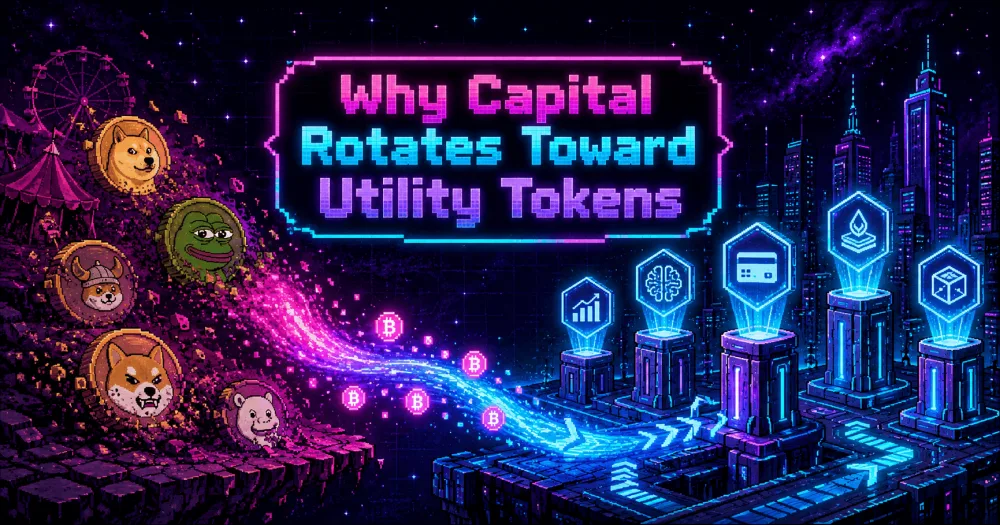
Capital rotates when the market changes what it rewards. During euphoric phases, traders reward speed, memes, leverage, and vibes. During uncertain phases, they look for revenue, users, liquidity, and durability.
That is the core of the move from memecoins to utility tokens. Investors are not suddenly becoming saints. They still want upside. They just want upside with a stronger reason behind it.
The rotation is driven by several forces:
- Falling appetite for pure speculation
- Weak performance from low-quality memecoins
- More focus on revenue and fees
- Growth in AI, RWA, DeFi, and infrastructure narratives
- Institutional preference for assets with measurable use
- Higher awareness of insider and launch risks
- Demand for tokens tied to real network activity
In plain English: traders are tired of buying punchlines that rug them by lunch.
Read more: How VELVET Became Top Crypto Gainer in June 2026 — VELVET Price Forecast
Utility Tokens Benefit from the “Show Me Revenue” Market
The 2026 crypto market is increasingly asking projects to show revenue, not just promise community. This is good for utility tokens linked to exchanges, perps platforms, staking protocols, lending markets, payment rails, and infrastructure networks.
Revenue does not guarantee token price growth. Plenty of protocols make money while their tokens underperform. But revenue gives analysts something to measure. It turns the conversation from “will this go viral?” to “what is this network worth?”
That matters because serious capital needs metrics. Institutions, funds, and disciplined traders look at fees, active users, total value locked, volumes, retention, developer activity, and token emissions.
Utility tokens that score well on those metrics may attract capital as the market matures.
The AI Token and Infrastructure Angle
AI-related crypto projects are one reason utility tokens are regaining attention. Traders are looking for tokens tied to compute, data, agents, decentralized model access, automation, and AI infrastructure.
Some AI tokens are overhyped. But the stronger projects at least connect to a real demand story: machines, apps, agents, and users that need decentralized coordination, payments, data access, or compute markets.
This gives AI utility tokens a better pitch than most memecoins. They are still risky, but they can point to a future use case beyond “number go up because the mascot is funny.”
RWA and Tokenization Tokens Are Gaining Attention
Real-world asset (RWA) tokenization is another major reason capital is moving toward utility tokens. RWA projects connect crypto rails to treasuries, credit, commodities, real estate, invoices, private markets, and institutional settlement. The total RWA market has reached $32 billion.
The RWA thesis is attractive because it links crypto to the real economy. Instead of relying only on retail traders, tokenization projects aim at institutions, asset managers, and fintech infrastructure.
That does not mean every RWA token is a winner. Some will capture little value. Some will be buried under compliance. But the category has a clearer long-term logic than most memecoins.
If crypto wants to become financial infrastructure, RWA and tokenization utility tokens will remain part of the conversation.
DeFi Tokens Are Trying to Become Productive Assets
DeFi tokens had a rough reputation after earlier cycles. Many governance tokens gave holders voting rights but little economic upside. Users paid fees, protocols grew, and token holders got diluted. Great deal, unless you were the holder.
That is changing slowly. Some DeFi projects are improving token economics through fee sharing, buybacks, burns, staking, or real yield models. Perp DEX tokens, lending tokens, liquid staking tokens, and restaking tokens are all trying to show better value capture.
This is why DeFi utility tokens are back in the rotation. Traders want exposure to activity that already exists: trading, borrowing, staking, liquidity, and settlement.
The strongest DeFi utility tokens are not just governance coupons. They are claims on ecosystems where users keep showing up.
Related: What Is Bitcoin DeFi (BTCFi)? Complete Guide
Stablecoin and Payment Infrastructure Tokens
Stablecoins are one of the clearest product-market fits in crypto. People use them for trading, settlement, remittances, payments, savings, payroll, and cross-border transfers.
Not every stablecoin ecosystem needs a token. In fact, some of the best stablecoin businesses may not pass value to a public token at all. But payment and infrastructure networks around stablecoins can still create demand for utility tokens.
Tokens tied to low-cost settlement, liquidity routing, compliance tooling, payment apps, or cross-chain stablecoin infrastructure may benefit if stablecoin usage keeps growing. This is where utility tokens can become exposure to payment flows.
Why Institutions Prefer Utility Over Memes
Institutional capital does not completely ignore memes. If a token has liquidity, volatility, and market structure, someone will trade it. But long-term institutional allocation usually needs a stronger thesis.
Utility tokens give institutions more to work with:
- Business model
- Network activity
- Token economics
- Revenue potential
- User growth
- Competitive positioning
- Regulatory framing
- Comparable valuation metrics
A memecoin may produce massive short-term gains, but it is harder to justify in an investment committee. “The frog is culturally inevitable” may be true, but try putting that into a risk memo without hearing silence so loud it needs subtitles.
Utility tokens make the conversation easier.
Why Memecoins Will Not Disappear
The rotation into utility tokens does not mean memecoins vanish. They serve a different market function. They are social trading assets, attention markets, community games, and high-risk speculation vehicles.
As long as crypto has retail traders, memecoins will exist. They are too easy to launch, too easy to understand, and too tempting during risk-on phases.
The better argument is that memecoins may become more selective. The market may keep rewarding the biggest, most liquid, most culturally durable names while ignoring thousands of low-effort clones.
In other words, the memecoin casino stays open. The cover charge just got higher.
What Makes a Strong Utility Token?
The best utility tokens usually have a clear answer to one question: why must this token exist?
A strong utility token should not feel bolted onto the product. It should be necessary or at least strongly connected to how the system works.
Key traits include:
- Clear token function
- Sustainable user demand
- Reasonable emissions
- Strong liquidity
- Real fees or revenue
- Product-market fit
- Developer traction
- Low dependence on hype
- Transparent unlock schedule
- Governance that actually matters
The more boxes a token checks, the stronger its case becomes.
What Makes a Weak Utility Token?
A weak utility token usually hides behind buzzwords. It claims governance, rewards, AI, RWA, gaming, or DeFi exposure, but the token itself has no strong reason to gain value.
Warning signs include:
- No clear value capture
- Heavy insider allocations
- Endless emissions
- Fake or incentive-driven usage
- Weak liquidity
- Vague roadmap
- No real users
- Governance theater
- Revenue that never reaches holders
- Community built mostly on price promises
A bad utility token is not better than a memecoin. It is just a memecoin wearing a tie.
Best Utility Token Categories to Watch in 2026
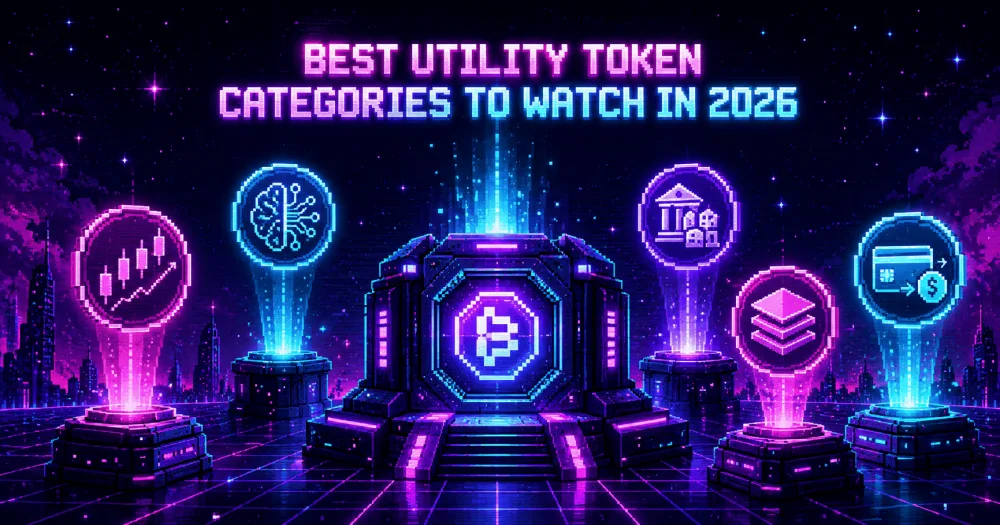
The strongest utility token categories in 2026 are the ones tied to real demand:
- Perp DEX Tokens: Perpetual futures generate massive trading volume. If more derivatives activity moves on-chain, perp DEX tokens could benefit from fees, buybacks, staking, and governance.
- AI Infrastructure Tokens: AI tokens connected to compute, agents, data, and automation could attract capital if they show real usage rather than only narrative heat.
- RWA and Tokenization Tokens: RWA tokens benefit from the institutional push to bring assets on-chain. The best projects will need compliance, distribution, and clear value capture.
- Liquid Staking and Restaking Tokens: Staking and restaking tokens remain important because they connect to blockchain security, yield, and infrastructure demand.
- Payment and Stablecoin Infrastructure Tokens: Tokens tied to stablecoin settlement, payments, liquidity routing, and cross-border transfer may benefit as digital dollars become more common.
How to Track the Rotation
Investors can track the move from memecoins to utility tokens by watching where liquidity goes.
Useful signals include:
- Memecoin market cap dominance
- DEX volume by sector
- Perp DEX fees and open interest
- Stablecoin supply growth
- RWA total value locked
- AI token revenue and user activity
- Token Terminal protocol revenue
- DeFiLlama TVL and fees
- Exchange listings and delistings
- Developer activity
- Unlock schedules
The most important signal is whether capital sticks. A one-week pump is not rotation. A multi-month shift in volume, liquidity, and relative strength is.
Risks of the Utility Token Rotation
The utility token rotation can fail. That needs to be said plainly.
Utility narratives can become overcrowded. AI tokens can overpromise. RWA tokens can face regulatory delays. DeFi tokens can fail to capture value. Infrastructure tokens can become expensive without user growth. Payment tokens can lose to stablecoin issuers that do not need public tokens at all.
The biggest risk is narrative laundering: projects use “utility” as a prettier word for speculation.
Investors should not assume utility tokens are safe. They are still crypto assets. They can fall 80%, dilute holders, lose users, or get crushed by regulation.
The difference is that the good ones at least have something to measure.
Final Thoughts
The great crypto rotation from memecoins to utility tokens is not about morality. It is about market conditions.
When liquidity is loose and traders are fearless, memecoins can dominate. When liquidity tightens and investors demand proof, utility tokens look more attractive. In 2026, the market is clearly asking harder questions: who has users, who has revenue, who has infrastructure, and who can survive without constant hype?
Memecoins will remain part of crypto culture. Some will still explode. But the broader capital shift is moving toward tokens tied to real products: DeFi, AI, RWA, staking, payments, and exchange infrastructure.
That does not make utility tokens risk-free. It simply means the market is starting to reward function again.
The next winning crypto trade may not be the loudest coin on social media. It may be the token quietly collecting fees while everyone else argues about the mascot.
FAQ
What are utility tokens?
Utility tokens are crypto assets designed to perform a function inside a network, protocol, or application. They may be used for fees, staking, governance, rewards, collateral, access, or liquidity incentives.
Why is capital moving from memecoins to utility tokens?
Capital is moving because investors are becoming more selective. In 2026, traders are paying more attention to revenue, real users, infrastructure, and durable token demand instead of pure viral speculation.
Are utility tokens safer than memecoins?
Not automatically. Utility tokens can still fail, dilute holders, or lose value. The difference is that strong utility tokens have measurable usage, revenue, and token mechanics, while many memecoins rely mostly on attention.
Which utility token sectors look strongest in 2026?
The strongest sectors include perp DEX tokens, AI infrastructure tokens, RWA and tokenization tokens, staking and restaking tokens, and payment or stablecoin infrastructure tokens.
Are memecoins dead in 2026?
No. Memecoins are not dead. They remain high-risk attention markets and can still rally during speculative phases. But capital is becoming more selective, and low-effort memecoins face a harder environment.