The crypto market enters July 2026 in one of its most fragile positions since the post-FTX bear cycle. Bitcoin is in the low-$60,000 area after briefly slipping below $60,000. ETH▲$1,699.04 is near $1,600, while SOL▲$80.62 has fallen into the high-$70s. ETF outflows, macro pressure, weaker retail interest, and rotation into AI-related assets have all damaged confidence. So the question is blunt: is another crypto crash coming?

The short answer is that the market is at a breaking point, but not yet at a confirmed collapse point. The bearish case is strong enough to take seriously, but the bullish case is still not dead. What happens next depends on whether Bitcoin can defend the high-$50,000 to low-$60,000 range, whether ETF outflows stabilize, and whether macro liquidity stops working against risk assets.
Related: How VELVET Became Top Crypto Gainer in June 2026 — VELVET Price Forecast
Contents
The Bearish Case: Why Another Crypto Crash Is Possible

The strongest argument for another crypto crash is: Bitcoin has lost momentum where it was supposed to find support.
Earlier in 2026, many investors treated the $70,000 area as a key consolidation zone. But since then, Bitcoin has slipped toward $60,000, and that makes the market structurally weaker. When a major asset fails to hold a widely watched level, that can further depress market sentiment.
Citi’s latest downgrade captures this shift. The bank cut its 12-month Bitcoin forecast from $112,000 to $82,000 and lowered its Ether target from $3,175 to $2,240, citing negative ETF flows and weaker investor appetite. Its bear case puts Bitcoin at $53,000 and Ether near $1,094.
That is not apocalyptic, but it is clearly not a “buy everything” market.
ETF Outflows Are the Biggest Warning Sign
The most important July 2026 crypto update is massive ETF outflows.
Spot Bitcoin ETFs were supposed to make the market deeper, more institutional, and less fragile. They did help during the bull phase. Now the same structure is being tested in reverse. If ETFs keep bleeding capital after shedding about $7 billion in May-June 2026, Bitcoin loses one of its strongest post-2024 demand engines.
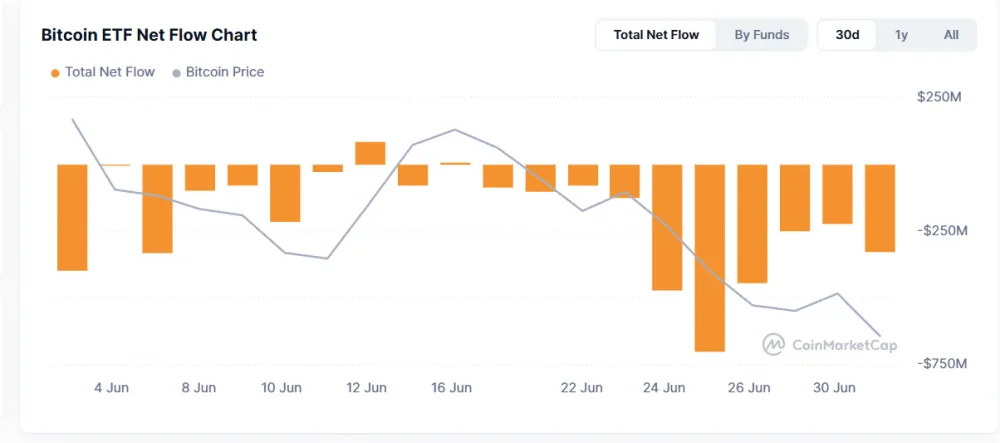
Source: CoinMarketCap
The bearish read is that ETF investors are no longer treating every Bitcoin dip as a buying opportunity. Some are cutting exposure or waiting for clearer macro conditions. That creates a dangerous feedback loop: price weakness causes outflows, and outflows create more price weakness. If this loop continues, another leg lower becomes realistic.
Ethereum Looks Weaker Than Bitcoin
Ethereum’s setup is worse. ETH is trading near $1,600: far below the $2,000–$2,200 zone that earlier forecasts treated as the main support band.
Ethereum still has strong fundamentals and practical utility as leading blockchain infrastructure. But the token itself has a value-capture problem. Layer-2 growth does not automatically translate into ETH price strength. Lower fees help users, but they can also weaken the direct revenue story for ETH.
This is why Ethereum’s weakness matters for the broader market. If ETH continues toward $1,400 or lower, it would likely signal broader altcoin stress.
Altcoins Are Already in Bear Market Mode
Another argument for a crash is that much of the crypto market has already crashed below the surface.
Bitcoin is down hard from its 2025 peak, but many altcoins are in far worse shape. Liquidity has narrowed. Traders are no longer buying every dip across the board. Capital is concentrating in Bitcoin, stablecoins, and a few survival narratives. Over the first half of 2026, the total crypto market cap excluding BTC▲$61,732.00 and ETH has shed 22.84% of value: down to $666.58 billion as of July 2, 2026.
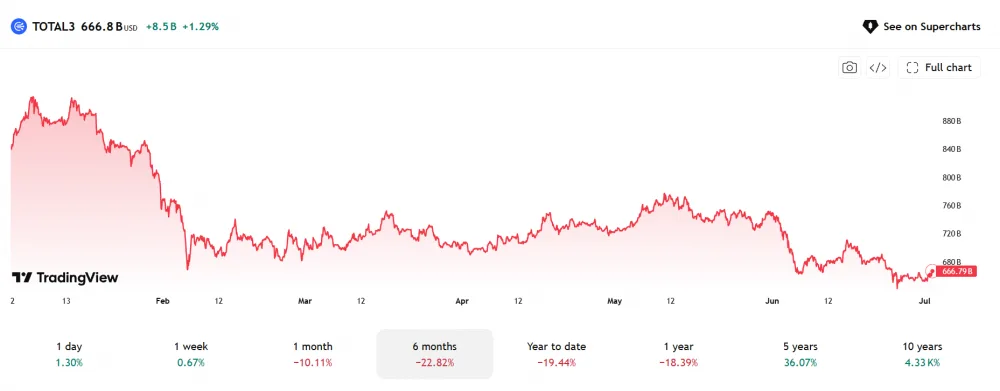
Source: TradingView
That is typical late-cycle behavior. When markets are healthy, risk spreads outward. When markets are scared, liquidity retreats inward.
This is why the phrase “crypto market crash” can be misleading. For many altcoin holders, the crash has already happened. The real question is whether Bitcoin now joins the deeper breakdown or stabilizes before the damage spreads further.
Related: CLARITY Act Blocked Before July 4: Senate Delay Sparks Uncertainty — What Happens Next?
Macro Conditions Are Not Helping
The July 2026 crypto market is being hit by a rough macro mix: sticky rates, a stronger dollar, weaker risk appetite, geopolitical tension, and intense competition from AI-related equities.
Arthur Hayes has argued that Bitcoin’s next major bull run depends on fiat liquidity and may accelerate after capital rotates away from an overheated AI trade. That is a bullish long-term thesis, but it also admits the near-term problem: if liquidity is still being pulled into AI and away from crypto, Bitcoin may stay under pressure.
Crypto bulls often say Bitcoin is independent money. Markets keep rudely replying that it still trades like a high-beta liquidity asset.
Strategy and Treasury-Bitcoin Risk
Another July concern is the role of corporate Bitcoin treasury companies. Strategy, still the symbolic leader of the corporate BTC trade, has come under pressure as Bitcoin fell below its average cost basis. Even small Bitcoin sales or monetization plans can damage sentiment because the market had treated these companies as permanent buyers.
The risk is not that every treasury company dumps Bitcoin tomorrow. That is too simplistic. The risk is that a once-reliable source of bullish narrative becomes uncertain. If treasury firms stop buying, hedge exposure, or sell small amounts to manage balance sheets, the market loses another psychological support.
The Bullish Case: Why This May Not Become Another Crash

The case against another crash starts with the same fact bears use: Bitcoin is near $60,000.
That level has already attracted attention from major analysts. Standard Chartered’s Geoffrey Kendrick has argued that Bitcoin may have already marked a cycle low around $59,000, partly because ETF-related selling pressure may ease after one-off liquidity events pass.
Related: Can Bitcoin Crash to $20K in 2026? What Could Trigger a Historic Crypto Market Collapse
This is the core bullish argument: the market is damaged, but oversold. If ETF outflows slow, Bitcoin could stabilize in the $58,000–$62,000 area and rebuild toward the mid-$60,000s before attempting a larger recovery.
That would not be a new bull run yet. It would be a bottoming process. Boring, ugly, and probably full of fakeouts. In other words, markets behaving normally.
Institutional Holders Have Not Fully Capitulated
Bitwise CIO Matt Hougan has made an important counterpoint: institutional ETF holders have not behaved like panicked tourists. Even after major drawdowns, ETF outflows have been smaller than the total inflows accumulated during the previous cycle.
This matters because crypto’s structure has changed. The old market was dominated by leverage, offshore exchanges, and retail emotion. The new market has more institutional exposure, more ETF plumbing, and more regulated products. That does not remove volatility, but it can reduce the chance of a full disorderly collapse.
The bearish reply is obvious: ETF holders can still sell more. True. But the bullish reply is also fair: they have not all run for the exits.
Bitcoin Is Still Above the Worst Bear-Case Levels
Another reason not to declare a crash yet: Bitcoin has not broken the deepest downside zones analysts are watching.
Galaxy Research has warned that Bitcoin could still fall toward $40,000–$46,000. Citi’s bear case sits around $53,000. Those numbers are ugly, but they also define the risk map. As of July 2, Bitcoin is still above them.
That means the current market is not a freefall yet. It can only become a crash if support fails, liquidity disappears, ETF outflows accelerate, and forced selling spreads. Until then, the market remains fragile but undecided.
Solana Is Weak, But Not Broken
Solana near the high-$70s is painful for anyone who bought the 2025 hype, but SOL remains one of the few major assets with a clear usage narrative. Its practical utility spans high-throughput trading, consumer apps, and fast payment settlement.
That does not protect it from downside. If Bitcoin loses the $58,000 level, Solana probably falls too. But if the market stabilizes, Solana could recover faster than slower-moving majors because of its strong developer and user narrative.
Read more: Bitcoin and Ethereum in Crisis: Can Solana Become the Main Global Payments Network in 2026?
In other words, SOL is not the market’s safe asset. Rather, it is the market’s risk-on signal. If Solana starts outperforming while Bitcoin stabilizes, that would be one of the first signs that fear is easing.
What Would Confirm Another Crash?
Another crypto crash becomes more likely if several things happen at once:
- Bitcoin loses the $58,000 area and cannot reclaim $60,000 quickly.
- ETF outflows continue through July instead of slowing.
- Ethereum fails to hold $1,500–$1,600.
- Solana breaks below the low-$70s with no buyer response.
- AI and mega-cap equities keep absorbing capital that might otherwise rotate into crypto.
- Regulatory progress in the U.S. remains stalled.
- Corporate Bitcoin treasury firms become sellers or stop acting like structural buyers.
Right now, several risks are lining up, but not all of them have fired at once.
What Would Kill the Crash Thesis?
The crash thesis weakens if Bitcoin reclaims $61,000–$62,000 and holds it, ETF outflows slow, ETH stabilizes above $1,600, and Solana avoids a deeper breakdown.
A stronger signal would be Bitcoin retaking the mid-$60,000s with rising volume. That would suggest the latest move below $60,000 was a capitulation wick rather than the start of a new leg lower.
The biggest bullish catalyst would be ETF stabilization. If flows stop bleeding, the market can start looking forward again instead of obsessing over forced selling.
A second catalyst would be macro relief: lower rate expectations or weaker dollar pressure.
Analyst Split: Crash, Bottom, or Reset?
The analyst landscape is unusually divided.
Citi is clearly more cautious, cutting BTC and ETH targets and warning that ETF flows and legislative delays have weakened the market. Galaxy Research sees room for Bitcoin to fall further into the $40,000–$46,000 range if pressure continues. That supports the “another crash is possible” thesis.
Standard Chartered’s Geoffrey Kendrick is closer to the bottoming camp, arguing that Bitcoin’s move near $59,000 may have marked the cycle low if ETF selling pressure eases. Arthur Hayes remains structurally bullish but frames the next rally around liquidity and the eventual rotation away from AI. Matt Hougan’s institutional-holder argument also supports the idea that the market is bruised, not broken.
So the real split is not “bulls vs bears.” It is timing. Bears think the market has not finished repricing. Bulls think most of the damage has already happened.
Final Verdict: Is Another Crash Coming?
The crypto market is at a breaking point, but another crash is not guaranteed.
The bearish case is serious: ETF outflows, broken support, weak ETH, cautious institutions, AI rotation, and macro pressure all point to a market that can still fall. Bitcoin below $58,000 would make the crash thesis much stronger. Ethereum below $1,500 would add confirmation. Solana breaking the low-$70s would show risk appetite is fading fast.
But the bullish case is also credible. Bitcoin is near levels where some analysts see a bottom. Institutional holders have not fully capitulated, and the market may already have priced in a lot of bad news. If ETF outflows slow and BTC reclaims $61,000–$62,000, July could become a stabilization month rather than the start of a deeper collapse.
If buyers defend the current zone, crypto may build a base for a late-2026 recovery. If they fail, the next leg down could be fast, ugly, and broad. The market is standing on thin glass. It has not shattered yet, but nobody should pretend the cracks are decorative.
FAQ
Is another crypto crash coming in July 2026?
Another crash is possible but not confirmed. The key levels to watch are Bitcoin near $58,000–$60,000, Ethereum near $1,500–$1,600, and Solana near the low-$70s.
Why is the crypto market weak right now?
The main reasons are ETF outflows, weak risk appetite, macro pressure, regulatory delays, rotation into AI-related assets, and falling confidence after Bitcoin lost the low-$70,000 range.
What are analysts saying about Bitcoin now?
Citi has cut its 12-month Bitcoin target to $82,000, while Galaxy Research has warned about possible downside toward $40,000–$46,000. Standard Chartered’s Geoffrey Kendrick is more optimistic and has argued that Bitcoin may already be near a cycle bottom.
Is Ethereum in worse shape than Bitcoin?
Short term, yes. Ethereum has fallen toward the $1,600 area and has lost the earlier $2,000–$2,200 support zone. Its long-term fundamentals remain strong, but the token needs stronger ETF demand and better liquidity.
What would signal that the market is recovering?
The strongest early recovery signals would be Bitcoin reclaiming $61,000–$62,000, ETF outflows slowing, Ethereum holding above $1,600, and Solana stabilizing above the low-$70s.