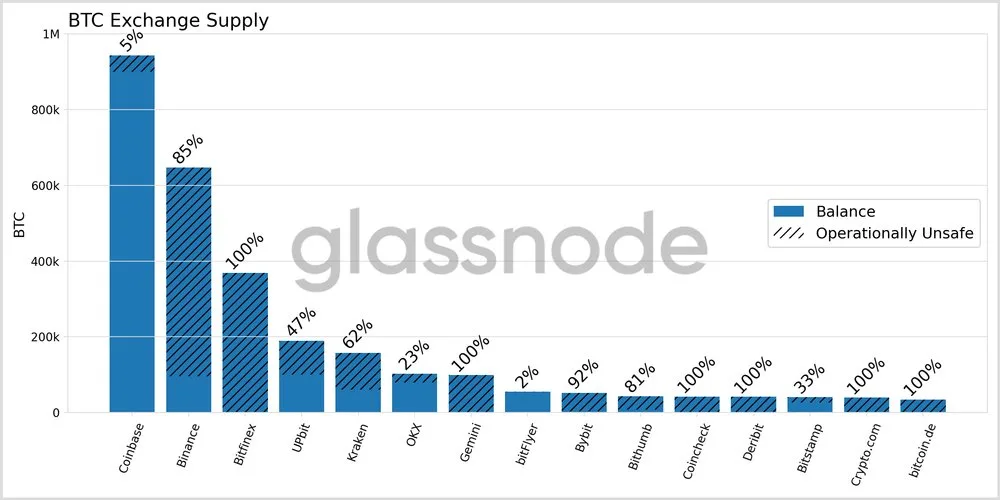
Binance Bitcoin wallets show 85% public-key exposure in Glassnode’s quantum-risk dataset, far above Coinbase’s 5% exposure.
Binance and Bitfinex, two of the largest crypto exchanges, show unusually high Bitcoin public-key exposure in a new Glassnode analysis of quantum-related wallet risk.
Glassnode, the blockchain analytics firm, wrote in an X post today that more than 6 million BTC▲$62,630.00, or about 30% of issued Bitcoin supply, is exposed under its “at-rest” model, meaning those coins already have their public keys visible on-chain.
Read also: Quantum-Proof Bitcoin Without a Fork: Post-Quantum Transaction Model Proposal
That visibility is the issue because a powerful enough future quantum computer could, in theory, use a visible public key to calculate the private key needed to spend the coin.
The firm split the exposure into two buckets:
- Structural exposure, where the address type reveals the public key by design, accounts for 1.92 million BTC, or about 9.6% of supply.
- Operational exposure, mostly tied to address reuse and custody behavior, is larger at 4.12 million BTC, or around 20%.
Crypto exchanges represent the largest single cohort in the second category. Glassnode said over 1.6 million BTC, or more than 8% of total supply, is exchange-related operational exposure.
Not a Solvency Signal
According to Glassnode, the Coinbase-marked balances exhibit only 5% exposure when analyzed using the same model, but Binance and Bitfinex reveal significantly larger proportions of their exposed balances, which are 85% and 100%, respectively.
That doesn’t mean Binance or Bitfinex are unsafe today. Glassnode explicitly warned that the figures shouldn’t be read as an “immediate risk ranking” or anything similar because the statistics only indicate the presence of publicly visible keys.
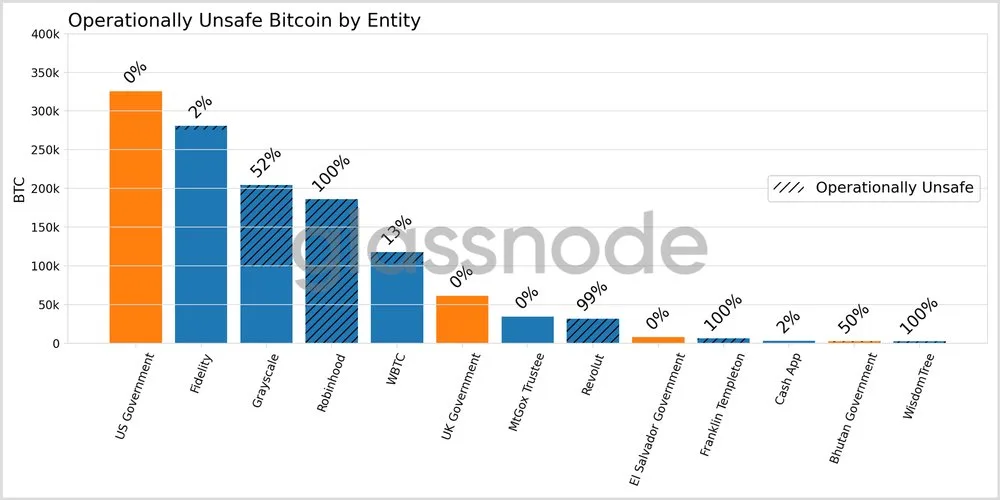
Moreover, if the vulnerability is rooted in wallet management techniques, the exchanges will still be able to minimize it by employing proper address hygiene and migration.
Glassnode said exchange wallets have become less operationally safe over time, falling from about 55% safe in 2018 to around 45% today. Governments looked very different in the same dataset, with the U.S., UK and El Salvador showing 0% quantum exposure.
Read more: Bitcoin Price May Avoid Classic Bear Rally Pattern, Analysts Say