Bitcoin price may not be repeating past bear-market rallies, even after moving back toward its 200-day average.
Bitcoin‘s move back toward its 200-day moving average has revived comparisons with past bear-market rallies, but Vetle Lunde, head of research at crypto brokerage and research firm K33, says the current setup differs from the 2014, 2018 and 2022 patterns.
In a new research note, Lunde pointed out that even though the comparison with older bear markets is tempting, it’s still not clean. According to Lunde, Bitcoin experienced steep price rallies during the bear market in 2014, 2018, and 2022. However, the rallies always peaked at the 200-day moving average level, after which the market declined further.
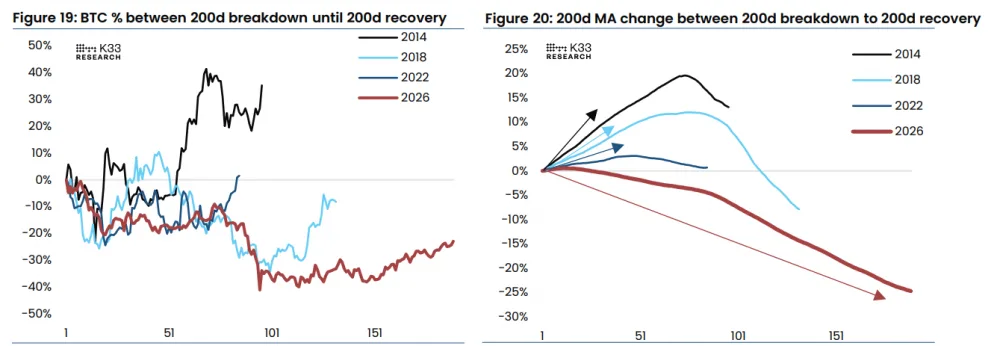
However, the current trend is different, according to the note. It took Bitcoin 189 days to go from being below its 200-day moving average, as was seen in November, until coming close to it on May 10.
For comparison, similar periods lasted 96 days in 2014, 132 days in 2018 and 85 days in 2022.
On top of that, Bitcoin is still down 22% from the point where it broke below the 200-day moving average. In 2014 and 2022, BTC▲$62,630.00 had positive returns over the same type of window, while in 2018 it was down 8.2%.
Read also: Bitcoin and Recession Signals in 2026: Is BTC Entering a Macro Slowdown Phase?
K33 Sees a Slower Cycle
As Lunde explains, during the bear-market rallies of 2014, 2018 and 2022, the 200-day average was generally rising as price recovered toward it. However, in 2026 it has been falling, thereby changing the whole market setup.
Past rallies were faster and helped rebuild risk appetite. That allowed leverage to grow before being flushed out later. This time, however, K33 says the move has been slower. As a result, derivatives sentiment remains “uniquely pessimistic.” Lunde wrote:
“Past rallies recovered quickly, rebuilding risk appetite and leverage and setting up the unwind that fueled the next leg lower. The current slow grind has not.”
According to K33’s base case, $60,000 in February marked Bitcoin’s maximum drawdown for this cycle, noting though that the softer bull market of 2025 may lead to a more moderate bear market in 2026, rather than a repeat of the sharper breakdowns seen in earlier cycles.
Read more: Bitcoin Hashrate Hits All-Time Highs in 2026: Why Price Is Disconnecting From Fundamentals