For those digging into Bitcoin in 2026, the question “Is Bitcoin mining legal today?” keeps coming up again and again. The short answer is: it is allowed across plenty of large nations today, though not quite the wild frontier some recall. Officials care less about outlawing coins and more about power, taxes, grid stability, and local compliance.

Bitcoin mining legal status in 2026 hinges on location, power usage, permits, taxes, and energy supply. The top countries for legal bitcoin mining are not only about affordable electricity. The best countries for bitcoin mining combine low costs, solid infrastructure, and clear policies.
Contents
- Is Bitcoin Mining Legal in 2026? Global Legal Status Overview
- What Actually Makes Bitcoin Mining Legal or Illegal Today
- Top 5 Countries for Low-Cost, Legal Bitcoin Mining in 2026
- Why These Countries Dominate Global Bitcoin Mining
- Electricity Cost vs Regulation — The Real Mining Profit Equation
- Legal Risks and Regulatory Limits in Mining-Friendly Countries
- How Governments Regulate Bitcoin Mining in Practice
- Institutional Mining vs Small-Scale Mining Reality
- Key Factors to Evaluate Before Choosing a Mining Country
- FAQ
Is Bitcoin Mining Legal in 2026? Global Legal Status Overview
Why Bitcoin mining is legal in most countries by default
Most places allow Bitcoin mining since it does not involve printing cash, operating financial institutions, or trading investment assets. Instead, miners apply computer resources to protect the network while earning compensation over time. When nations lack targeted restrictions, such operations typically follow standard rules tied to commerce, server facilities, electricity usage, or revenue reporting.
That is why crypto mining legality usually sounds wilder in headlines than it looks in law. Even when mining is allowed, power agreements, paperwork, taxes, and ecological standards still need to line up.
Full legal vs regulated vs restricted mining jurisdictions
Some countries allow full legal mining operations without strict limits. Others regulate the activity through permissions, registration, power conditions, or special fees. Restricted regions may allow mining in some cases, yet block it in certain areas, cap electricity, or impose special tariffs.
This is why asking “where is bitcoin mining legal” misses the point. Profit depends on more than permission. The sharper question is where is crypto mining legal and profitable after power, taxes, hosting fees, and rules.
How governments classify mining: business, energy use, or financial activity
Mining gets sorted differently by governments. One approach sees it like any market activity. Another focuses on power use. A rarer approach ties it to financial activity when coins hit exchanges or change hands.
That is why BTC▲$77,246.00 mining legality can differ inside one nation. Running gear at home might slide under ordinary household rules. Big operations often need permits, energy clearance, and paperwork trails.
The shift from bans to licensing and energy-control frameworks
Power rules now matter more than blanket prohibitions worldwide. Since stopping mining outright often fails, officials prefer managing electricity networks instead. Mining farms need strong connections, space, cooling, steady current, and online links. When authorities shape who gets these, oversight follows.
Because of this, bitcoin mining regulations in 2026 emphasize power sourcing, taxes, disclosure, and clear business practices.
Related: Top 5 Bitcoin Mining Methods: How People Are Still Earning BTC in 2026
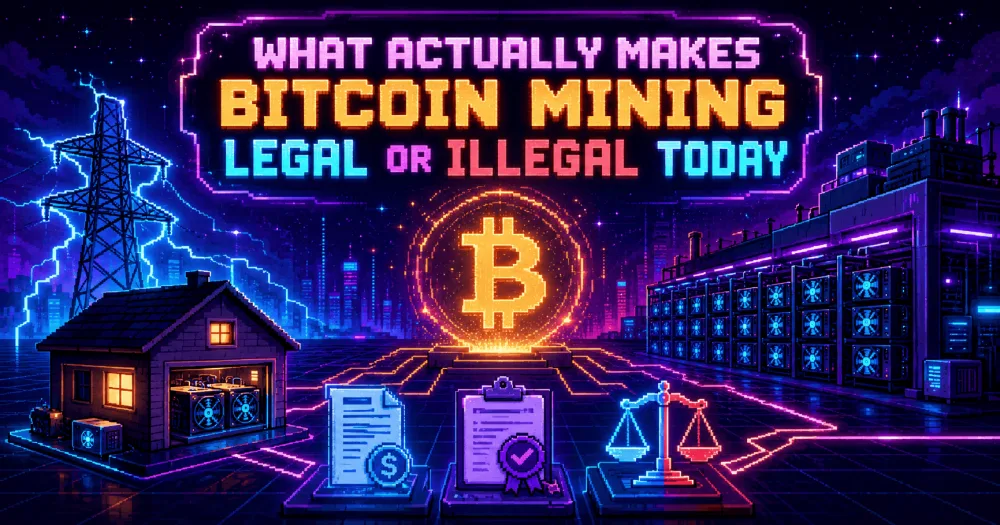
What Actually Makes Bitcoin Mining Legal or Illegal Today
Energy regulation and grid access as the main legal factor
These days, power rules shape how Bitcoin mining gets limited. Owning ASIC machines might be allowed, yet plugging into the electrical network could remain off limits. Hardware permission does not mean grid permission.
Power struggles hit harder where grids are weak, energy is subsidized, or winters need heat. Officials rarely target Bitcoin head on. When miners strain grids, rules tighten.
Tax obligations on mining rewards across jurisdictions
Most places tax mining payouts. How that works differs: some treat rewards as regular earnings, others as asset profit, and some use a mixed approach. Big operations track machine wear, power bills, hosting fees, and coin sales.
Clear tax rules matter for bitcoin mining profitability countries. Low power costs help, but poor tax handling can wipe out those savings fast.
Licensing requirements for industrial mining operations
Lots of big mining operations now need a permit to run. Getting one may require business registration, approved machines, verified power, tax compliance, cybersecurity controls, and proof the setup will not overload the grid.
Licensing might surprise you: it can actually help. Gray areas bring stress, while clear rules let miners move forward without guessing what comes next.
Differences between home mining and industrial-scale mining legality
Home setups feel nothing like big operations. One machine usually means regular power costs and tax paperwork. Stretch that into rows of hardware, thousands humming in unison, and it becomes a data center pumping out heat day after day.
So, is crypto mining legal in all countries? Not as a clean yes-or-no answer. In some places, small-scale mining may fly while going big hits roadblocks, wait times, or grid sign-off.
Top 5 Countries for Low-Cost, Legal Bitcoin Mining in 2026
United States — largest legal mining hub with state-level incentives (Texas, Wyoming, Georgia)
Bitcoin mining remains legal in the United States. With deep financial markets, public mining firms, and flexible energy markets, the U.S. remains one of the major Bitcoin mining countries, accounting for about 40% of the global hashrate.
Texas holds big sway thanks to vast energy markets, wind and solar growth, and demand-response programs. Wyoming offers a crypto-friendly policy environment. Georgia pulls miners through competitive power and industrial infrastructure.
The catch is fragmentation: state choices, zoning maps, power deals, and environmental debates all shape what is allowed.
Canada — hydroelectric mining zones with stable regulatory framework (Quebec, Manitoba)
Hydro-powered mining thrives across parts of Canada where rules stay predictable. Quebec and Manitoba tap water energy under steady oversight, while cold air helps cool machines.
Canada is not a free-for-all. Provincial power decisions set the real conditions. Some regions guard electricity tightly when cities and industries need more. Still, miners seeking stable setups keep turning north.
Read more: Bitcoin Mining Difficulty Crashes 10% — What Happened?
Russia — regulated mining with regional restrictions and low energy costs
Russia keeps a tight grip on crypto mining: some regions allow it, others restrict it. Power is cheap, winter helps cooling, and industrial capacity is large.
Mining gets the green light only if local power supply holds up. Where grids run thin, limits show up fast. Tax rules shift, and big operations must stay registered and compliant.
Russia works for cheap electricity bitcoin mining, but brings political, sanctions, payment, and regulatory risk.
Kazakhstan — industrial-scale mining with licensing and energy quotas
After China cracked down on mining, Kazakhstan rose fast. Then miner demand strained grids, and rules shifted sharply.
Mining is permitted, yet licenses, energy caps, and special power fees shape the whole setup. Kazakhstan works for serious players who lock down legal supply and follow paperwork demands. Miners gambling on shaky power are walking into trouble.
Paraguay — hydroelectric surplus powering low-cost BTC mining operations
Bitcoin mining finds an unusual edge in Paraguay thanks to extra hydroelectric power. With abundant dam power, operations tap the key input: low-cost electricity. In mid-2026, this small country accounts for 4.3% of Bitcoin’s global hashrate.
Paraguay offers renewable-heavy surplus power, but long-term success depends on steady rules and grid connections.
Why These Countries Dominate Global Bitcoin Mining
Access to cheap electricity as the primary profitability driver
The cheapest electricity for bitcoin mining countries usually share one trait: abundant power priced low for big users. Machines count, but power bills decide survival.
Low power lets miners keep running through weak markets. High bills force shutdowns when Bitcoin falls or difficulty rises.
Role of renewable energy (hydro, wind, nuclear) in mining hubs
Cleaner energy keeps gaining ground. Canada and Paraguay rely on hydro. Some U.S. areas use wind and solar. Nuclear and stranded energy can also help.
Renewables do not guarantee profit, but can improve acceptance and reduce fuel-price exposure.
Climate advantage and cooling cost reduction in mining farms
Cool places reduce the cost of keeping machines cold. Canada, Russia, and Kazakhstan benefit from that. Hotter regions need smarter cooling, immersion systems, or carefully shaped airflow.
Heat control affects equipment life, downtime, repairs, and energy efficiency.
Post-China hashrate redistribution and global mining relocation
After China’s crackdown, Bitcoin mining moved across North America, Central Asia, Latin America, and parts of the Middle East.
Electricity price alone does not decide it anymore. Legal stability, hosting partners, customs procedures, and political risk matter too.
Related: What Is AI Mining in Crypto? Top 5 Best AI Mining Platforms to Earn in 2026
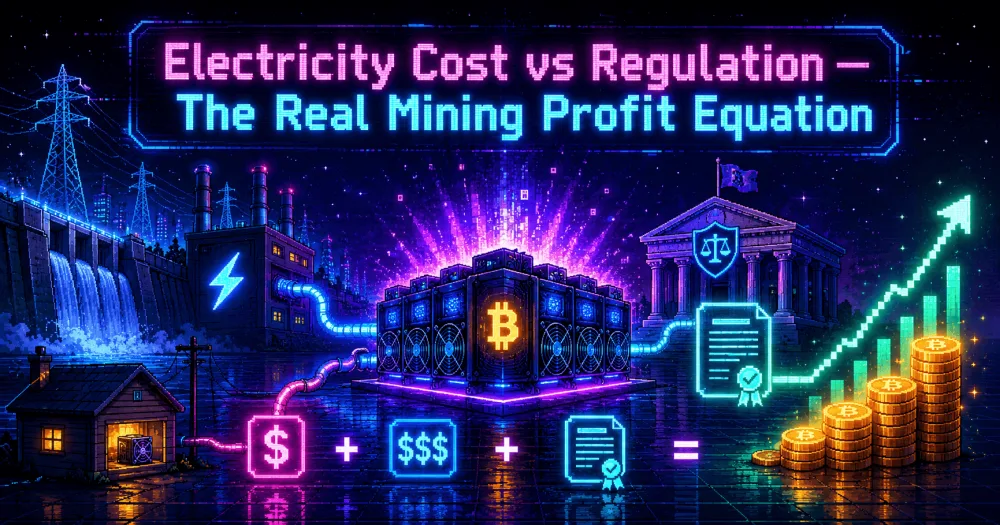
Electricity Cost vs Regulation — The Real Mining Profit Equation
Why electricity cost determines mining survival margins
Most of what decides if mining pays off comes down to the daily power bill. Bitcoin price, difficulty, and ASIC efficiency matter, but electricity never stops.
Low-cost power keeps miners afloat. High electricity costs erase profits fast even with top-tier hardware.
Break-even thresholds for industrial BTC mining operations
Large miners model costs by cents per kilowatt-hour. Profitability shifts with Bitcoin price, fees, difficulty, and hardware efficiency.
Low electricity means wider margins. When rates climb, miners need perfect uptime, efficient hardware, and a strong Bitcoin price.
Industrial vs residential electricity pricing gap
Homes usually pay too much for power. Big operators lock in cheaper supply through bulk deals, long-term contracts, flexible usage, or on-site generation.
That gap is why industrial bitcoin mining dominates. Small operators usually lose without rare cheap power, free heat reuse, or a hobbyist approach.
Energy subsidies and state-supported mining zones
Miners may move where governments offer subsidies, industrial zones, or cheap official power. Costs drop, but political risk rises.
Support can vanish, tariffs can change, and grid managers can cut access. Stable power backed by binding agreements matters more.
Legal Risks and Regulatory Limits in Mining-Friendly Countries
Russia — regional bans and evolving taxation rules
Russia’s low electricity prices draw interest, yet local restrictions can bite. Some areas say no outright, while others demand paperwork. Tax rules shift, and unapproved operations can face legal trouble.
Russia shows that mining legality must be checked nationally and regionally.
Kazakhstan — quota system and energy caps for miners
Kazakhstan sets tight mining rules. If approved power is not locked in, machines may sit idle, costs may jump, and growth may stall.
This suits compliant industrial operators better than casual newcomers.
USA — state-by-state regulatory fragmentation and zoning laws
The U.S. offers opportunity, but rules shift by state, county, and town. Some areas welcome miners; others restrict noise, land use, water use, or electricity draw.
Fragmentation works for experts. For new sites, local rule checks are mandatory.
Canada — provincial restrictions on new mining grid connections
Canada offers clear laws, but utilities can block new mine setups when demand grows. The main risk is failing to secure profitable power.
How Governments Regulate Bitcoin Mining in Practice
Energy consumption monitoring and grid prioritization rules
When grids come under pressure, officials may ask big mining setups to scale back. Oversight tracks electricity use, connections, and peak loads.
Some operators join programs that adjust output based on supply needs. Mining becomes a flexible industrial load.
Environmental regulations and carbon reporting requirements
Environmental rules are gaining weight. Miners may need to show power sources, report emissions, control noise, handle heat, or follow data-center standards.
These rules keep spreading through modern Bitcoin mining regulations.
Mining registration and corporate compliance frameworks
Mining registration lets officials see operators, locations, power use, and tax treatment.
Industrial miners now face facility-style rules: company paperwork, power agreements, taxes, imported machinery, property rights, and power reporting.
Why enforcement focuses on electricity access rather than Bitcoin itself
Electricity is visible. Bitcoin can move across borders, but rigs reveal heat, noise, power draw, equipment, and grid stress.
So when people ask how is bitcoin mining regulated, the answer is usually power access, not ideology.
Institutional Mining vs Small-Scale Mining Reality
Why industrial mining farms dominate global hash rate
Large-scale operations dominate because bulk ASIC purchases, negotiated power, better cooling, skilled workers, and easier capital all favor scale.
Small-scale mining is possible, but going head-to-head with big public firms is brutal.
ASIC competition and declining profitability for small miners
ASIC miners cost a lot, make noise, use heavy electricity, and get beaten by newer models. When difficulty rises, older gear earns less.
Home miners face higher power bills and weaker bargaining power. Buying Bitcoin directly is often simpler.
Publicly traded mining companies and their geographic strategies
Public miners pick locations with low power, legal clarity, adaptable grids, available capital, and manageable government risk.
Many spread operations across regions so one authority, grid, or policy shift cannot drag down the business.
Transition from retail mining to infrastructure-scale operations
Big players now run the sector. Leaders lock down cheap electricity, follow rules, upgrade gear, and survive boom-and-bust seasons.
The best mining locations let operators think years ahead, not chase cheap power that vanishes.
Key Factors to Evaluate Before Choosing a Mining Country
Electricity price stability and long-term contracts
A cheap deal falls apart when rates shift, hidden limits appear, or contracts fail to protect the miner.
Mining costs must hold steady.
Legal clarity and licensing predictability
Laws beat slogans. The best place to mine bitcoin legally and cheaply is a country with clear, consistent license terms.
Fuzzy guidelines may look appealing, then cost more once oversight shifts.
Infrastructure quality and grid reliability
A steady power supply matters, but so do transformers, cooling, internet, repairs, and security. Cheap rates mean nothing if outages leave machines idle.
Infrastructure separates real mining hubs from guesswork.
Tax structure and profit repatriation rules
Taxes matter as much as power prices. Import fees, corporate rules, coin-sale treatment, and banking access can change the outcome.
Operators need affordable electricity, clear rules, manageable taxes, and smooth operations.
FAQ
Is Bitcoin mining still legal in 2026?
Yes. Is Bitcoin mining still legal in 2026? In many major countries, yes, but it depends on local rules for power use, taxes, permits, and scale.
Which countries allow Bitcoin mining?
Which countries allow Bitcoin mining depends on the size of the setup. The U.S., Canada, Russia, Kazakhstan, and Paraguay allow mining in different forms, while rules vary by region.
What countries allow Bitcoin mining cheaply?
What countries allow Bitcoin mining cheaply? The usual shortlist includes Paraguay, Kazakhstan, Russia, Canada, and parts of the United States, though each comes with different legal and infrastructure risks.
Where is Bitcoin mining most profitable?
Where is Bitcoin mining most profitable depends on electricity cost, ASIC efficiency, Bitcoin price, network difficulty, taxes, and uptime. Low-cost power plus clear laws usually wins.
Why is Bitcoin mining legal in some countries but restricted in others?
Why is Bitcoin mining legal in some countries but restricted in others? Officials often treat mining as a normal power-using business, but restrict it when miners overload grids, avoid taxes, use subsidized electricity, or operate without permits.