The KuCoin vs OKX comparison 2026 does not come down to one clear winner. Both support international crypto trading activity, but differences appear beneath the surface. Spot markets exist on both, along with derivatives that attract active traders. Their real divergence becomes visible in fees, liquidity depth, trading tools, mobile functionality, Web3 access, and regional availability.

KuCoin remains popular among altcoin hunters and retail traders wanting wide token availability. OKX looks stronger in derivatives, institutional recognition, order book depth, Web3 integration, and structured compliance. The better platform depends less on brand loyalty than specific trader behavior.
Contents
- KuCoin vs OKX 2026 Overview: Key Market Positioning in Crypto Exchange Battle
- KuCoin vs OKX Fees Comparison 2026: Which Exchange Is Cheaper for Traders?
- Trading Features Comparison: KuCoin vs OKX Platform Capabilities
- Supported Cryptocurrencies: KuCoin vs OKX Coin Listings Battle
- Security and Trust Factor: KuCoin vs OKX Safety Comparison
- User Experience (UX/UI): Which Exchange Is Easier to Trade On?
- Liquidity and Market Depth: Where Traders Prefer to Execute Orders
- Passive Income Features: KuCoin vs OKX Earn Ecosystems
- Web3 Integration and Ecosystem Expansion
- KuCoin vs OKX Mobile Trading Experience in 2026
- Regional Accessibility and Restrictions
- KuCoin vs OKX for Different Trader Types
- Fee Efficiency vs Feature Depth Trade-off in 2026 Exchanges
- KuCoin vs OKX 2026 Comparison Table
- FAQ
KuCoin vs OKX 2026 Overview: Key Market Positioning in Crypto Exchange Battle
Global adoption and trading volume comparison
Despite varied rankings, OKX often appears near the top tier because of large derivatives trading volume and institutional usage. KuCoin continues to serve a wide international retail base through active spot markets and broad token access.
A trading volume comparison chart KuCoin OKX often shows higher activity on OKX for derivatives contracts. Meanwhile, KuCoin maintains solid spot market activity favored by individual traders. One platform leads in complex instruments; the other holds ground where straightforward trades occur.
User base growth and regional popularity trends
For years, KuCoin presented itself as accessible to everyone, drawing interest across Asia and developing economies. Individual traders often use it to explore alternative digital assets and less conventional crypto paths.
OKX has expanded across Europe, Asia, and Web3 markets, driven by compliance efforts and alliances with financial entities. Regulatory clarity opens doors, and partnerships follow quietly.
Exchange positioning in spot vs derivatives markets
KuCoin stands out most clearly in spot markets, especially through access to lesser-known cryptocurrencies and tools aimed at retail users. OKX builds strength in derivatives, order handling, Web3 wallets, and professional-grade features shaped with more precision.
Related: Crypto Exchange Battle 2026: Binance vs Bybit — Where Do Traders Prefer to Trade?
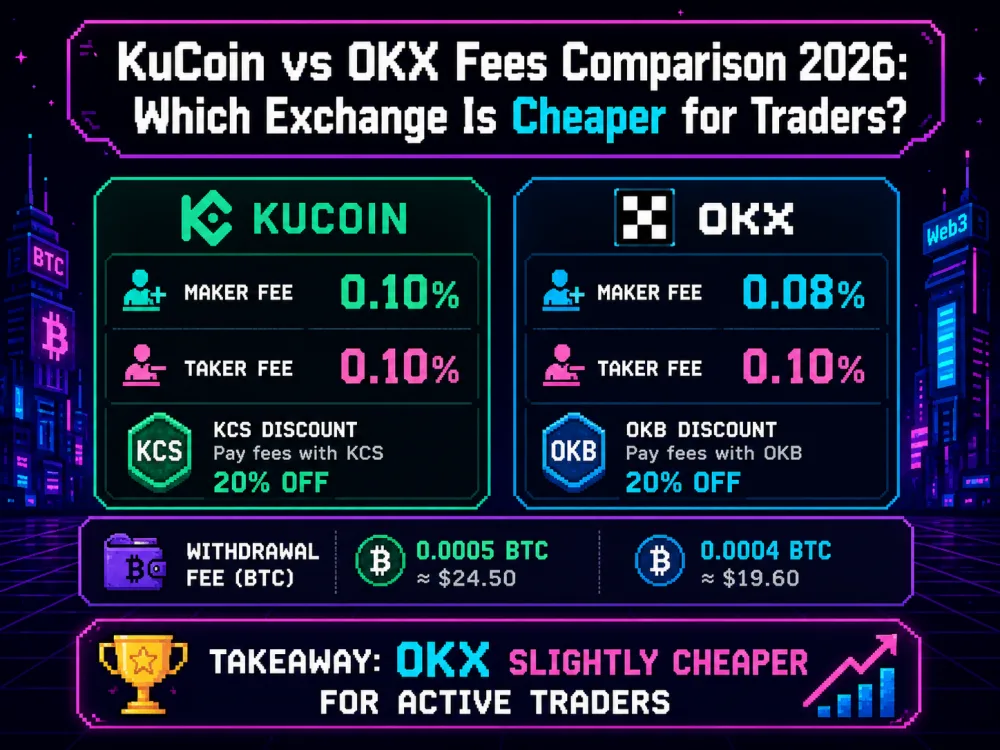
KuCoin vs OKX Fees Comparison 2026: Which Exchange Is Cheaper for Traders?
Spot trading fees (maker vs taker structure)
Pricing structures can look similar across both venues. A maker taker fee comparison KuCoin OKX often shows close base rates. Higher trading volume or ownership of native tokens may reduce costs, but initial rates remain broadly competitive.
Hidden details shape real expenses. Advertised rates may look similar, but differences emerge through user tiers, token discounts, order type, slippage, and spread behavior.
Futures and derivatives trading costs
For futures trading dashboard crypto leverage users, OKX tends to offer more robust derivatives conditions. Execution speed often favors OKX where volume is concentrated. Strong pair liquidity typically aligns with its infrastructure.
KuCoin’s futures platform still holds ground among retail users, but OKX steps ahead through systems built for serious derivatives activity.
Fee discounts, token utility (KCS vs OKB)
With KuCoin, KCS brings lower fees and perks within its network. OKX applies OKB▼$80.80 through fee tiers, promotions, and platform functions.
KCS▲$7.16 links closely to KuCoin’s retail user identity. OKB relates more strongly to OKX’s wider trading and Web3 ecosystem.
Hidden costs: withdrawals, conversions, and spreads
Unexpected fees appear during fund transfers. Exchange-rate adjustments apply during conversions. Pricing gaps emerge between buying and selling values.
For assessing total cost, withdrawal fees matter as much as trading charges. Beyond trade pricing, review blockchain transfer costs, fiat deposit fees, conversion rates, and spreads.
A crypto exchange fees breakdown chart should include maker fees, taker fees, funding rates, withdrawal costs, and slippage. A crypto withdrawal fees comparison table is useful because headline trading fees rarely tell the full story.
Trading Features Comparison: KuCoin vs OKX Platform Capabilities

Spot trading experience and interface usability
The KuCoin exchange interface trading screen appears straightforward at first glance: crowded, but built around everyday traders. With multiple markets visible, navigation stays smooth when scanning options quickly.
The OKX trading platform dashboard feels more refined. Its layout favors clarity without excess ornamentation. For users moving between spot markets, derivatives, options, or decentralized applications, navigation remains consistent.
Futures, margin, and leverage trading tools
Futures, margin, and leverage tools appear on both platforms. Among the two, OKX presents a more developed suite for derivatives. KuCoin supports futures and margin trading, but depth favors OKX when volume and precision matter most.
Automated trading bots and copy trading systems
Automation appears on both platforms. KuCoin offers trading bots that support grid-based strategies and feel approachable for retail traders. OKX extends automated functions toward copy trading, algorithmic setups, and a broader trading resource suite.
Advanced order types and execution speed
For complex orders, rapid trade completion, and larger volume, OKX tends to perform better. Trading execution speed comparison crypto exchanges often favors venues where liquidity pools are broader, routing is more efficient, and futures infrastructure is stronger.
Supported Cryptocurrencies: KuCoin vs OKX Coin Listings Battle
Number of listed assets (altcoins vs major tokens)
KuCoin usually includes a broader range of tokens than OKX, especially lower-market-cap altcoins. OKX focuses more on established assets, deeper order books, and professional trading environments.
For early access, KuCoin has appeal. When precision in execution matters most, OKX holds greater relevance.
Early listings and access to new tokens
KuCoin tends to attract traders focused on emerging tokens before broader availability. Early placement opportunities draw users who prioritize timing over mainstream presence.
OKX is often more selective, reducing noise but possibly delaying initial access.
Liquidity depth across trading pairs
Liquidity depth heatmap crypto markets often shows OKX leading in key pairs and derivative contracts. KuCoin remains strong across numerous spot altcoin pairings.
Impact of token variety on trader strategy
A broad token selection allows earlier access to emerging narratives. Yet too many thinly traded pairs can widen spreads and increase slippage exposure. Discovery favors KuCoin; precise order fulfillment favors OKX.
Security and Trust Factor: KuCoin vs OKX Safety Comparison
Proof of reserves and transparency policies
Both platforms share proof-of-reserves information. OKX emphasizes reserve transparency and zero-knowledge validation methods. KuCoin also provides reserve proofs and user verification access.
In any centralized crypto exchanges comparison chart, proof of reserves is now a standard expectation rather than an added benefit.
Cold storage and asset protection systems
Both services use safeguards such as offline reserves, account protection, withdrawal controls, and threat monitoring. Still, users should activate two-factor authentication and approved withdrawal destinations.
Regulatory compliance and licensing footprint
OKX has pushed further into regulated markets, especially across Europe. After earlier oversight challenges, KuCoin has adopted stricter compliance practices.
In 2026, licensing footprint matters more than before. Where an exchange can legally operate now shapes its advantage.
Historical security incidents and risk perception
KuCoin continues to carry reputational weight from prior security and regulatory concerns. OKX also faces region-specific limits, but its recent compliance alignment supports a stronger trust narrative.
User Experience (UX/UI): Which Exchange Is Easier to Trade On?
Desktop and mobile app usability comparison
KuCoin has many features, but its layout can feel cluttered. OKX presents a smoother visual flow, especially on desktop.
For users who prefer a crypto trading terminal interface dark mode, both platforms provide strong chart displays, order-book panels, and market monitoring layouts.
Beginner vs advanced trader experience
For beginners, KuCoin may fit when exploring basic spot trades and lesser-known coins. For experienced users, OKX stands out through advanced charting, futures markets, precise order handling, and blockchain integrations.
Interface design and navigation speed
Navigation feels faster on OKX because of clearer structure. KuCoin offers robust features, but mastery takes more time because of interface density. Simplicity gives OKX a slight lead in user flow.
Order execution flow during high volatility
When prices shift quickly, execution matters more than design. OKX often performs better across key pairs, especially derivatives. KuCoin remains useful for spot traders, but its advantage weakens when speed and depth dominate.
Liquidity and Market Depth: Where Traders Prefer to Execute Orders
Spot market liquidity comparison
KuCoin still serves retail spot traders well through broad altcoin availability. For leading pairs, OKX takes the edge because denser order flow narrows price gaps.
A spot trading order book visualization makes the contrast visible: KuCoin offers breadth, while OKX usually offers deeper liquidity.
Derivatives liquidity and open interest
OKX stands out in derivatives trading. Its lead shows through open interest, professional participation, and consistent execution performance.
Slippage and spread differences in 2026
Slippage comparison crypto exchanges depends heavily on the pair. With BTC▲$62,630.00, ETH▲$1,761.17, SOL▲$82.41, and prominent futures contracts, OKX tends toward tighter spreads. On less common altcoins, KuCoin may provide availability, though liquidity might lag.
Before entering large positions, order book liquidity visualization crypto tools help clarify market conditions. Clear liquidity maps reveal imbalances otherwise hidden in raw order data.
Passive Income Features: KuCoin vs OKX Earn Ecosystems
Staking, savings, and yield products
Both platforms provide Earn options such as staking, savings, and yield initiatives. OKX often presents these through an interface resembling portfolio management tools. KuCoin keeps access more retail-friendly and direct.
Launchpads and token sales (KuCoin Spotlight vs OKX Jumpstart)
KuCoin Spotlight stands alongside OKX Jumpstart for token launch access. KuCoin may suit users drawn to early-stage ventures. OKX may suit users who prefer more curated project releases.
Crypto lending and structured products
OKX presents a wider set of structured financial products. KuCoin provides lending and yield tools, but OKX often feels fuller when assessing built-in earning methods tied to exchanges.
Web3 Integration and Ecosystem Expansion
OKX Web3 wallet and DeFi integrations
Among exchange-linked platforms, OKX stands out through its Web3 wallet capabilities. Trading connects directly to DeFi tools within the same environment. Swaps, NFTs, on-chain activity, and cross-chain movement are integrated more smoothly.
KuCoin ecosystem tools and NFT marketplace
KuCoin provides ecosystem tools, Web3 access, and NFT-related services. Even so, its focus remains retail asset discovery rather than controlling broad Web3 infrastructure.
Cross-chain access and on-chain connectivity
Smooth transitions from centralized exchange activity to DeFi often happen more naturally through OKX. Cross-chain connectivity is clearer there because of its wallet and on-chain structure.
KuCoin vs OKX Mobile Trading Experience in 2026
App performance and stability
In a crypto trading app comparison mobile review, OKX often appears smoother in daily use. KuCoin delivers strong functionality, but its layout tends toward complexity.
Mobile trading tools and charting features
Both apps offer charting, alerts, portfolio tracking, market depth views, and trade execution features. OKX has the more refined crypto trading mobile app UI design, while KuCoin offers fast access to a wider range of markets.
Alerts, notifications, and portfolio tracking
Alerts and portfolio tools appear on both platforms. While trading flows into Web3 more seamlessly at OKX, KuCoin serves users watching lesser-known coins closely.
Regional Accessibility and Restrictions
Availability in Europe, Asia, and emerging markets
Both platforms maintain global presence. OKX advances into Europe with a stronger compliance focus. KuCoin continues to appeal across Asia and emerging markets.
KYC requirements and onboarding differences
Stricter identity checks now apply to both systems. What matters most is not just KYC itself, but which features open afterward depending on user location.
Fiat support and payment methods
Where OKX operates, its fiat and banking links tend to be more developed. KuCoin reaches many areas, but availability and payment methods shift more noticeably by region.
KuCoin vs OKX for Different Trader Types
Best choice for altcoin hunters
KuCoin serves traders focused on lesser-known digital assets. Its broader listings and earlier access appeal to users tracking emerging tokens.
Best choice for futures and derivatives traders
OKX stands out for futures and derivatives trading. Liquidity tends to run deeper there, aiding consistent order fulfillment. Execution quality often shows greater reliability under pressure.
Best choice for beginners vs professionals
KuCoin can fit beginners who want simple spot trading and wide coin selection. OKX aligns better with experienced users through deeper markets, advanced tools, and broader infrastructure support.
Institutional vs retail usage trends
KuCoin remains more retail-focused. OKX places stronger emphasis on compliance, institutional access, professional tools, and regulated offerings.
Fee Efficiency vs Feature Depth Trade-off in 2026 Exchanges
When lower fees matter more than features
For traders executing many orders each day, cost efficiency becomes central. When position size is modest, tiny savings add up over time. Automation tools amplify sensitivity to fee structures. Narrow spreads support better outcomes, as do maker/taker discounts.
When ecosystem and liquidity outweigh cost savings
For larger volume, access to steady order flow matters more than minimal cost reductions. Slippage, delayed fills, or wide bid-ask spreads can cost more than the trading fee itself. Execution quality begins to outweigh nominal savings at scale.
Long-term trader preferences shift
By 2026, exchange selection has moved beyond cost alone. Liquidity, mobile performance, Web3 access, regulatory alignment, earning products, and execution precision all matter.
For this reason, no single victor emerges from the KuCoin vs OKX comparison 2026.
KuCoin is better for token variety, altcoin discovery, and retail spot trading.
OKX is better for derivatives, liquidity depth, institutional positioning, Web3 integration, and advanced traders.
Here lies the core contrast in this crypto exchange battle infographic: KuCoin spreads wide; OKX digs deep.
KuCoin vs OKX 2026 Comparison Table
| Category | KuCoin | OKX | Edge |
|---|---|---|---|
| Core positioning | Retail-friendly exchange with broad altcoin access | Advanced exchange with stronger derivatives, liquidity, and Web3 depth | Depends on trader type |
| Best for | Altcoin hunters, retail spot traders, early-token seekers | Futures traders, professionals, Web3 users, larger-volume traders | Split |
| Spot trading | Strong for many altcoin pairs | Stronger on major pairs with deeper execution | KuCoin for variety; OKX for depth |
| Derivatives | Available, retail-friendly | More advanced, deeper liquidity, stronger professional tools | OKX |
| Fees | Competitive maker/taker model; KCS discounts available | Competitive maker/taker model; OKB/VIP benefits available | Close |
| Token utility | KCS supports fee discounts and KuCoin ecosystem perks | OKB supports fee tiers, campaigns, and broader OKX ecosystem use | Split |
| Coin listings | Wider selection of altcoins and smaller tokens | More selective, stronger depth on major assets | KuCoin |
| Liquidity | Good retail spot liquidity across many pairs | Stronger major-pair and derivatives liquidity | OKX |
| Web3 tools | KuCoin Web3 wallet, ecosystem tools, NFT access | Strong OKX Web3 wallet, DeFi, swaps, cross-chain access | OKX |
| Mobile app | Powerful but busier | Cleaner, more polished, smoother navigation | OKX |
| Passive income | Staking, savings, lending, Spotlight | Earn, structured products, Jumpstart, broader suite | OKX |
| Trust and compliance | Improving compliance, but past regulatory issues affect perception | Stronger current compliance and institutional narrative | OKX |
| Main weakness | Interface density, liquidity gaps on smaller pairs, regulatory baggage | More selective listings, less ideal for early altcoin hunting | Split |
| Best summary | Better for breadth | Better for depth | KuCoin spreads wide; OKX digs deep |
FAQ
Which is better in 2026, KuCoin or OKX?
OKX is better for derivatives, liquidity, Web3 tools, and professional trading. KuCoin is better for altcoin discovery, retail spot trading, and broad token access.
Which exchange has lower fees, KuCoin or OKX?
Both use maker/taker pricing. Which costs less depends on trading volume, VIP tier, token discounts, spreads, withdrawal costs, and conversion fees. Total expense matters more than headline rates.
Is KuCoin better for altcoins?
Yes. KuCoin tends to list a wider variety of altcoins earlier than many platforms, making it useful for traders tracking less common tokens.
Is OKX better for futures trading?
Yes. OKX generally shows stronger derivatives liquidity, deeper open interest, and more advanced futures tools.
Which platform is safer?
Both provide proof-of-reserves and security systems, but OKX currently benefits from a stronger trust narrative due to regulatory expansion and institutional positioning. KuCoin remains widely used, though past regulatory and security concerns still affect perception.