The Bitcoin macroeconomic impact is now closely tied to broad economic forces. In 2026, understanding why Bitcoin reacts to US data — such as inflation figures or Federal Reserve decisions — matters greatly. Instead of shifting solely due to digital currency developments, Bitcoin moves with worldwide market currents. Interest trends, available capital, U.S. dollar strength, stock markets, ETF activity, and large investor positioning all shape its course. These elements define the macro drivers of Bitcoin 2026.

For investors tracking Federal Reserve interest rates Bitcoin impact 2026, the key issue is how monetary policy changes risk appetite, liquidity, and demand for non-yielding assets.
Contents
- Why U.S. Macroeconomic Data Drives Bitcoin Price in 2026
- Federal Reserve Rates and Bitcoin Prices
- Inflation Metrics: CPI, PCE, and Bitcoin Swings
- Liquidity Conditions and Global Money Supply
- U.S. Dollar Strength and Bitcoin
- Spillover From Traditional Markets
- Institutional Money Moves and ETF Effects
- Bitcoin Tracks Liquidity Shifts
- FAQ
Why U.S. Macroeconomic Data Drives Bitcoin Price in 2026
Bitcoin Moves With Economic Shifts
Though built to replace conventional finance, Bitcoin now moves within it. Institutional money, exchange-traded funds, and algorithmic strategies handle it like stocks, debt instruments, raw materials, and national currencies. When markets favor growth, Bitcoin gains tend to outpace equities; under pressure, losses deepen more sharply. This Bitcoin risk assets macro dynamic is shaped less by Bitcoin’s original intent than by its current usage patterns.
Should inflation data come in high, markets may shift. When that happens, Bitcoin sometimes drops even if nothing changes in its own ecosystem. A sharp rise in yields might prompt rebalancing. In those cases, digital assets get treated like tech stocks or risky ventures. Speeches from central bankers, especially firm ones, weigh on sentiment. During such times, correlations tilt toward broader financial patterns. So BTC▲$62,630.00 moves not due to internal factors, but because of external monetary signals. Position adjustments unfold across asset classes at once. This dynamic places Bitcoin alongside equities when fear spreads. Its price reacts less to blockchain updates and more to economic tones.
From Crypto Updates to Broader Financial Flows
When liquidity outweighs news, the Bitcoin macroeconomic impact becomes most visible.
Though crypto-related developments — such as regulatory moves, exchange stability, mining trends, or adoption — remain relevant, broader financial currents tend to weigh heavier in 2026. Now it is global money flow shaping outcomes more than isolated digital asset news. Questions once reserved for traditional markets increasingly steer sentiment here. Rate decisions by central banks set tones early. Shifts in price pressures alter expectations quietly. Currency strength enters calculations without announcement. Movement of capital into approved investment vehicles signals direction ahead. What drives equities begins defining volatility below. Not every shift originates within blockchain circles anymore.
Bitcoin responds to shifts in the U.S. economy across five areas: actions by the Federal Reserve, reports on rising prices, strength of the dollar, availability of funds in markets, and movements in ETF investments. These factors convert broad economic outlooks into market activity. Though separate, their combined effect shapes investor behavior.
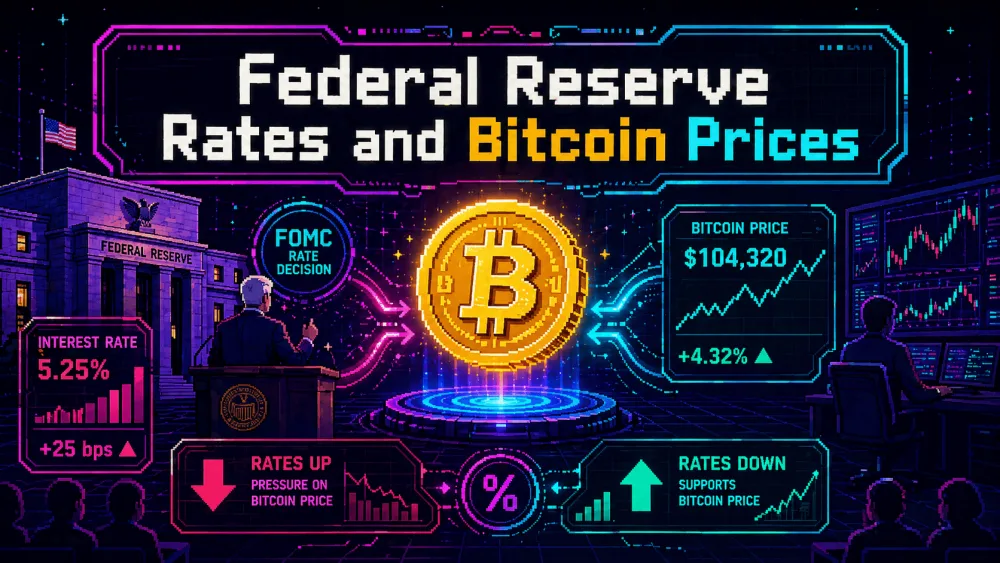
Federal Reserve Rates and Bitcoin Prices
How FOMC Choices Influence Bitcoin
Fed interest rates Bitcoin dynamics work mainly through liquidity and opportunity cost. When the Fed raises interest rates, money moves more slowly through markets. Cash gains stronger appeal when yields rise on government debt. This shift often weakens demand for assets that pay no income, like Bitcoin. As borrowing costs climb, spending power shrinks across sectors. Money parked in secure instruments becomes harder to leave behind.
In contrast, falling rates make idle funds less rewarding. Investors then look beyond safe options into riskier alternatives. With lower returns on stable holdings, attention drifts elsewhere. Reduced incentives in traditional savings open space for digital currencies.
Bitcoin tends to move most during FOMC events like policy releases, press meetings, dot plot updates, or published notes. FOMC Bitcoin volatility depends not only on the main rate call. Even pausing rates may boost Bitcoin if officials sound softer. A rate decrease might weaken it when paired with concern about persistent price pressures. Reaction depends less on the action itself and more on the signals given alongside it.
Opportunity Cost Meets Fed Outlook
The Bitcoin macroeconomic impact grows when rate expectations shift quickly.
Interest does not come from Bitcoin, nor do coupons or dividend payments. Should risk-free returns rise, steady income finds easier paths than riding Bitcoin’s swings. This sets a tougher bar for choosing crypto exposure. Yet when yields drop, the trade-off softens, making Bitcoin weigh better in balance.
Should the Federal Reserve take a firm stance — elevated interest rates, shrinking its holdings, and focus on inflation — it often weighs on Bitcoin. In contrast, when policy softens through lower rates, expanded money flow, or concern about economic expansion, such conditions tend to benefit cryptocurrency markets.
Inflation Metrics: CPI, PCE, and Bitcoin Swings
How CPI Announcements Affect Cryptocurrency Markets
The CPI impact on Bitcoin comes from how inflation data shapes central bank expectations. Beyond the number itself, markets interpret CPI through what it signals about Federal Reserve direction. When figures exceed forecasts, confidence in near-term easing fades. This often weighs on speculative assets. Instead of immediate relief, higher prints spark concern over prolonged tightening cycles.
On balance, softer data tends to ease financial conditions through revised interest-rate outlooks. Lower bond returns then elevate alternative stores of value. With reduced pressure on monetary restraint, demand for decentralized systems gains subtle support.
For short-term traders, Bitcoin macro analysis CPI inflation April 2026 can be especially useful when inflation surprises reset expectations for rate cuts or renewed tightening.
Thus, the US inflation Bitcoin price relationship is not merely “rising prices lift Bitcoin.” Instead, focus shifts to how inflation shapes Federal Reserve behavior. Should rising prices prompt stricter monetary steps, Bitcoin may decline despite popular claims of it being a hedge. Perception often lags behind central bank signals.
Real Yields Over Inflation Numbers
The Bitcoin macroeconomic impact depends more on real yields than headline inflation.
Interest-adjusted returns matter most. When these rise, owning Bitcoin becomes less favorable due to higher alternatives. Should they decline, assets without income grow relatively appealing. The period between 2021 and 2022 showed this pattern clearly: prices climbed fast, yet central bank moves drained market ease. For such moments, actual return levels guided investor choices.
PCE holds weight because it ranks highest among the Fed’s inflation tools, yet CPI often shakes markets more immediately. Starting from scarcity, Bitcoin’s unchanging supply backs lasting value erosion ideas. Still, its near-term moves answer mostly to cash flow, borrowing levels, and how eager traders feel.
What about Bitcoin inflation if widely adopted long term? Most analysts agree that Bitcoin’s fixed supply could matter more to prevent inflation if its usage becomes broad enough to influence savings behavior, pricing expectations, or monetary competition.

Liquidity Conditions and Global Money Supply
Fed Balance Sheet: QE vs. QT
Bitcoin gains strength during periods of rising market liquidity. When central banks ease monetary policy, funds flow into financial systems. Yet when they tighten, that support fades away. Performance tends to rise with expanding access to capital and weaken when liquidity contracts.
During the 2020–2021 surge in prices, the Bitcoin liquidity correlation emerged clearly, shaped by rapid money supply growth. When central banks raised rates and began quantitative tightening, markets turned downward in 2022. Simply put, rising liquidity supports Bitcoin; shrinking balance sheets undermine it.
Global M2 and Bitcoin
Bitcoin’s economic influence ties closely to worldwide monetary conditions, far beyond decisions made by the Federal Reserve alone.
The global liquidity Bitcoin price relationship reflects not only U.S. monetary shifts but also wider trends. Across large economies, total money in circulation forms global M2. Simultaneous growth in that measure tends to support higher valuations. Yet coordinated reductions typically bring downward influence. Movements depend less on one institution than collective action.
Though imperfect, global M2 draws attention from macro watchers due to its tendency to precede Bitcoin moves by weeks. One U.S. report alone cannot reflect wider conditions quite like this aggregate measure. Factors such as inflation readings, dollar strength, swings in equities, and central bank messaging hold weight — yet each ties back to a single force: available liquidity.
U.S. Dollar Strength and Bitcoin
DXY and Bitcoin
When the dollar’s direction shifts, effects on Bitcoin tend to grow more noticeable. Economic movements tied to digital currency gain weight amid changing fiat patterns. As traditional money weakens, alternative systems see increased influence. Shifts in monetary flow reveal deeper ties between asset classes.
The DXY Bitcoin correlation is usually inverse. As the dollar gains value, Bitcoin tends to decline. A weaker dollar frequently supports higher Bitcoin prices. The DXY reflects the greenback’s performance versus key foreign currencies. Since the U.S. currency serves as a dominant medium for international financing, shifts in its value influence how investors approach risk worldwide.
US dollar strength Bitcoin pressure comes from tighter financial conditions. When the dollar strengthens, debts owed in dollars become harder to manage abroad. Capital flows shift, favoring investments within America instead. Riskier markets tend to shrink under such movement. Priced everywhere in greenbacks, Bitcoin typically declines when these forces build.
For a wider market view, Fed policy DXY dollar BTC dominance crypto market outlook April 2026 connects interest-rate expectations, dollar strength, Bitcoin’s relative market share, and overall crypto risk appetite.
Bitcoin tends to weaken when the dollar strengthens over time. A prolonged decline in the dollar typically benefits BTC instead. What matters most in 2026 is how the Federal Reserve’s interest rate direction compares with that of other leading central banks, since this comparison may influence shifts in the dollar’s trend.
Spillover From Traditional Markets
Bitcoin Tied to Stock Market Moves
Despite its digital roots, Bitcoin moves alongside the S&P 500 when markets tense up. Notably tied to the Nasdaq, their paths cross due to shared reactions: interest shifts, cash flow trends, and future growth expectations shape them alike. Rising bond returns tend to weigh on extended-growth plays. Dipping yields may lift these longer-term value carriers together.
Though Bitcoin follows a fixed emission plan, user growth pattern, fund movements, and digital asset vulnerabilities, during downturns it tends to move more closely with broader markets. When sentiment turns defensive, linkages usually grow stronger.
Risk-On, Risk-Off, and Liquidations
When markets lean risky, equities rise alongside crypto, credit instruments, and raw materials. Cash gains appeal during cautious phases, together with Treasury debt and greenback strength. Payroll numbers shift sentiment; so do inflation prints and central bank signals. Bond market moves guide trader decisions, and Bitcoin often reacts without delay.
Occasionally, Bitcoin derivatives intensify conditions. As equity, bond, or currency markets turn volatile, positions using borrowed funds face closure. Leverage links broad financial strain to digital assets. Stress migrates into cryptocurrency markets when margin calls mount.
This is where Bitcoin risks macro risks 2026 become most visible, because leverage, equity weakness, rising yields, and dollar strength can reinforce one another quickly.
Institutional Money Moves and ETF Effects
ETFs Shaping Market Movements
Now shaping Bitcoin’s economic influence: exchange-traded funds guide movement alongside real-time trading activity. Derivatives markets follow closely behind, adjusting pace. Flows shift without central direction, yet patterns emerge across these channels.
Bitcoin ETF inflows macro dynamics now shape how prices form within broader economic patterns. Daily movements in spot ETFs reveal shifts in investor mood toward macro conditions. As interest rates decline, financial conditions ease alongside a softer dollar, prompting added demand via ETF channels. Deteriorating global economic signals tend to reverse these trends, leading instead to fund withdrawals. Selling pressure emerges directly when holdings exit the exchange-traded structure.
Bitcoin felt shifts in macro thinking via futures, OTC platforms, and public trading sites prior to spot ETFs. With their arrival, tracking the flow grew simpler and more direct.
Institutional Demand Meets Macroeconomic Frameworks
Institutional Bitcoin demand now often ties to broad economic indicators. When actual returns on assets drop, availability of cash grows, or the value of the currency declines, investment in BTC tends to rise. Shifts toward higher borrowing costs, increased net gains after inflation, or a firmer national currency typically lead to scaled-back positions. Decisions follow patterns linked to financial environment changes.
Now Bitcoin responds faster to economic reports. When CPI numbers differ from expectations, trading activity begins immediately. Algorithms start executing trades shortly afterward. ETF investments shift direction because of it. Derivatives positions get closed automatically sometimes. This creates a stronger Bitcoin market reaction economic data pattern today compared to past periods.
When rates decline, money often shifts faster into ETFs while people move away from cash and fixed income. Should policy tighten, withdrawals could grow because higher returns on cash start drawing interest.
Bitcoin Tracks Liquidity Shifts
Bitcoin Shifts From Store of Value to Liquidity Signal
Though often called digital gold, Bitcoin now signals market liquidity by 2026. Fixed supply gains relevance across years, yet adoption shapes its role slowly. In shorter spans — weeks or months — it reacts more to available capital instead. Markets lift when central bank easing appears likely, well ahead of policy shifts. Even without altering scarcity, prices dip after inflation data surprise upward.
Future views shape markets. Although policy stays unchanged, Bitcoin may climb ahead of an anticipated rate reduction. Even without fresh increases, prices might drop when outlooks change. Expectations drive moves more than today’s rules.
Big Economic Shifts Shake Markets
Bitcoin does not react to each data point equally. What shifts its path are unexpected outcomes. When inflation figures match forecasts, impact tends to be minimal. Should numbers deviate sharply — higher or lower — the effect spreads quickly. Rates adjust first. Yields follow. The dollar responds. Stock markets feel pressure. Exchange-traded funds shift. Derivatives tied to BTC reflect the change soon after.
This is the reason Bitcoin sometimes shifts sharply, even without events tied to cryptocurrency. Macroeconomic conditions drive it instead.
Investors assessing Bitcoin risks macro economic headwinds 2026 should watch whether slower growth, sticky inflation, and tighter liquidity appear at the same time.
Macro Effects and Halving Patterns
One reason the halving cycle retains relevance lies in its constraint on fresh Bitcoin issuance. Still, by 2026, broader economic forces stand alongside it — sometimes even outweighing it — for mid-range trends. Though expectations around the 2024 event built steadily, what followed emerged from central bank direction, appetite for exchange-traded funds, worldwide monetary flow, and strength of the U.S. currency.
Bitcoin’s value may increasingly reflect broad economic trends as more institutions invest. Because these investors prioritize market depth, interest levels, inflation-adjusted returns, and overall exposure rather than isolated events like supply reductions, their influence shifts how prices form. Movement might stem less from internal triggers and more from external financial conditions when large players dominate trading activity.
At the same time, Bitcoin risks macro regulatory 2026 remain important because ETF oversight, tax treatment, banking rules, and securities policy can all influence institutional access.
FAQ
Why does Bitcoin react so strongly to U.S. CPI data?
CPI changes expectations for Fed policy. Hot inflation can delay rate cuts and pressure Bitcoin. Cool inflation supports easier policy and risk appetite. Unexpected shifts in data can reset the timeline for policy adjustments and trigger sharp moves across Bitcoin, ETFs, derivatives, and broader risk assets.
Is Bitcoin a reliable inflation hedge?
Not in the short term. The idea of limited supply still stands over time; however, immediate prices depend on available funds, interest levels, leverage, and willingness to take risk. Bitcoin may support a long-term scarcity thesis, but short-term price action is driven more by liquidity than inflation alone. Bitcoin risks macro regulation 2026 also matters because regulatory pressure can amplify market weakness when liquidity conditions are already tight.
What is the relationship between Bitcoin and the DXY?
Bitcoin often trends opposite the DXY. When the dollar gains strength, financial conditions tighten, and this tends to weigh on BTC. In contrast, a softer dollar creates more space for risk assets to stabilize or rise. Movement in one often echoes quietly in the other.
How do ETF flows affect Bitcoin’s macro sensitivity?
Macro positioning becomes more visible through spot ETFs. When circumstances align favorably, money begins arriving and creates direct demand for Bitcoin. Under pressure, markets respond through ETF withdrawals, which can translate into direct selling pressure. T
Are halvings still important for Bitcoin price?
Yes, but their role has shifted. Halvings are no longer the sole dominant driver. Central bank decisions, global capital movements, currency trends, ETF activity, and institutional allocation now carry major weight. These elements combine to alter Bitcoin’s overall price dynamic.