The Bitcoin mining industry is turning away from its core business as AI becomes the dominant revenue target.
Public Bitcoin mining companies are starting to resemble AI infrastructure firms, at least based on how they describe their future income streams.
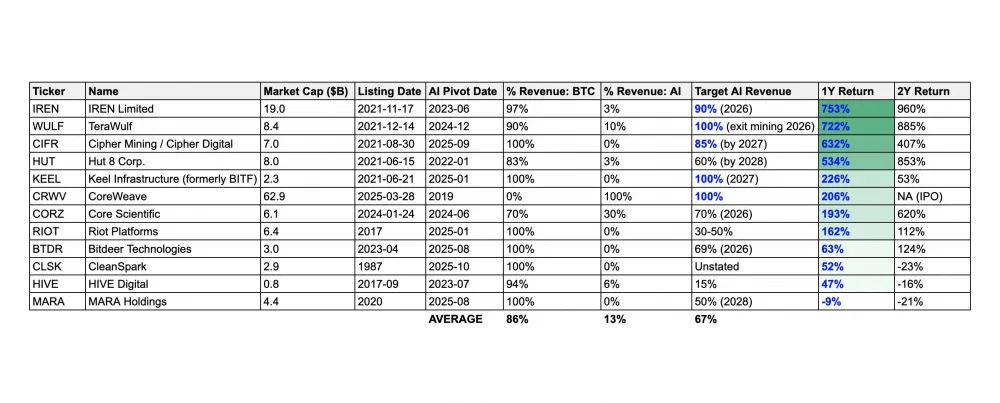
A new snapshot shared by Capriole Investments founder Charles Edwards on X shows a full lineup of major listed miners. And every single one of them, as Edwards claims, is now pivoting toward artificial intelligence in some form.
“ALL have made statements to pivot to AI,” Edwards wrote, adding that companies are increasingly targeting AI, not BTC▲$62,630.00.
Read also: Bitcoin on April 17: Price Holds Near $75K as ETF Inflows Cool
From Bitcoin Mining to AI
For now, the business still leans heavily on Bitcoin. Edwards’ dataset suggests roughly 86% of revenue comes from BTC, compared with about 13% from AI based on company disclosures.
That mix may not hold for long, though. Edwards estimates Bitcoin-related revenue could drop to around 30% within two to three years.
- For instance, IREN Limited, a Nasdaq-listed Bitcoin mining company formerly known as Iris Energy, is increasingly positioning itself as an AI infrastructure provider.
- TeraWulf, another U.S.-listed Bitcoin mining firm, has also signaled a deep pivot toward AI-focused data center operations.
- Core Scientific, one of the largest publicly traded miners, is also generating a growing share of revenue from AI and high-performance computing.
Even traditionally mining-heavy names like Hut 8 and Bitdeer are pushing further into AI and high-performance computing.
Stocks Already Picking Winners
Companies targeting higher AI exposure have posted average gains above 500%, according to Edwards’ breakdown. IREN is up 753% over one year, TeraWulf 722%, and Cipher Mining 632%.
Firms moving more slowly are lagging. Some show flat or negative two-year returns, including CleanSpark (-23%) and MARA (-21%). As Edwards put it, the market “has been voting with its feet.”
He also noted that some miners aren’t planning to upgrade Bitcoin mining hardware, choosing instead to run existing machines to the end of their lifespan while directing new capital into AI data centers.
But that shift has implications beyond company earnings. Mining activity underpins the Bitcoin network. The thing is that slower reinvestment could affect how quickly computing power expands, particularly if AI continues to deliver stronger returns.
Not everyone sees it as a problem. In response to Edwards’ post, Adam Back wrote in a follow-up X post that a drop in hashrate “is actually good for miners,” arguing that lower competition can lift margins and reduce the need to sell Bitcoin to cover costs.
Read more: Bitdeer Overtakes MARA in Mining Power, Becoming Top Public Miner