For users still asking what is AERO▲$0.5508, the asset serves as the utility token of Aerodrome Finance, a decentralized exchange and liquidity protocol built on the Base network.

Contents
What Is AERO?
AERO Token Overview and Core Purpose
Aerodrome uses the vote-lock governance model; this means users can lock their tokens to gain governance voting rights and rewards, as well as provide liquidity for the whole protocol.
Throughout Base’s growth as a DeFi platform in 2025-2026, the DeFi token Aerodrome Finance AERO has been associated with the network’s trading and liquidity, serving as one of the largest DeFi tokens native to Base by market cap and on-chain activity.
Which Blockchain Is AERO Built On?
For those asking what is AERO crypto and how does it work – the protocol is built on Base, which is an Ethereum Layer-2 network of Coinbase that allows cheaper and faster transactions compared to Ethereum mainnet, which makes it suitable for decentralized trading and liquidity applications.
The larger AERO blockchain project also benefits from the success of the Base ecosystem, with more protocols being built on the Base network and more trading flow going to Aerodrome via liquidity pools, swap routing, and governance rewards.
Related: Top 5 Sui Tokens to Watch in 2026: Best Picks for Early Investors
AERO vs Other DeFi Tokens in 2026
Unlike many speculative DeFi assets, the AERO governance token gives holders voting rights, fee exposure, and influence over liquidity incentives. AERO governance tokens provide economic value to protocol revenue and liquidity coordination by providing voting rights and revenue sharing when locked.
Another advantage of the active DEX token rally 2026 was Aerodrome infrastructural positioning within the Base ecosystem, as the accelerating trading volumes and the growing liquidity positioned AERO as a utility DeFi token rather than a trend-driven altcoin.
Why Is AERO Gaining Investor Attention in 2026?

Rising Trading Volume and Market Momentum
One of the main reasons why is AERO going up has become so popular in 2026 may be the increasing protocol activity on Base. Data from earlier weeks show that Aerodrome accounts for over 50% of Base DEX trading volume. Some reports estimated that daily trading volumes exceeded $10 billion at some points.
In the meantime, the token’s liquidity continued to improve, such that AERO consistently maintained a market cap above $430 million in May 2026, and a 24-hour trading volume of around $50 million, during higher-volatility periods.
Analysts, crediting the momentum to the growing adoption of Base and renewed interest in mid-cap DeFi assets, noted this as part of the continuing altcoin season 2026 narrative.
Related: Top 5 DEX Wallets in 2026: Which Crypto Wallet Is Best for DeFi and Swaps?
Increased Interest in DeFi and DEX Ecosystems
As part of the larger recovery in decentralized finance and the Ethereum Layer-2 ecosystems, AERO crypto saw an increase in users as people searched for more affordable and faster alternatives to Ethereum’s blockchain. Base became one of the fastest-growing Layer-2 networks by transaction volumes and total value locked.
This environment catalyzed the wider DeFi summer 2026 trend, where traders rotated capital back into decentralized exchanges, liquidity protocols, and governance tokens.
Because Aerodrome is the primary liquidity hub on Base, the accelerated growth of activity in the ecosystem translated to an increase in swaps, fees, and demand for liquidity on the protocol.
Whale Accumulation and Smart Money Activity
Another reason why are investors buying AERO in 2026 is due to on-chain accumulation, in which large whales amassed over 3.59 million AERO tokens worth over $5 million. Whale accumulation generally indicates that institutional and high-net-worth investors are looking to buy more AERO tokens and are bullish on the tokens’ future.
Read Also: Altseason Signals Return: Why Traders Are Rotating Back Into Mid-Caps
Moreover, market reports indicated that with circulating supply tightening, larger holders had been amassing during consolidation periods, driven by multichain expansion expectations with Aerodrome and continued development in the Base ecosystem.
Broader Crypto Market Recovery Impacting AERO
Bitcoin and Ethereum sentiment recovered throughout 2026 and helped risk-on DeFi tokens. Renewed ETF inflows, improving liquidity status, and trading volume in major cryptocurrencies also impacted the recovery of appetite for alternative cryptocurrencies and decentralized finance protocols.
These macroeconomic conditions led to increased enthusiasm for AERO investment 2026, as traders seek assets that both serve a purpose within the ecosystem and have speculative value. Despite volatility, today Aerodrome is considered one of the most sought-after beneficiaries of Base’s expansion cycle.
How Does AERO Work?
Role of AERO in Liquidity and Governance
The AERO token powers an automated market maker system that concentrates protocol liquidity on Base. Users can swap tokens in liquidity pools, and liquidity providers can provide token pairs to liquidity pools to earn rewards by providing liquidity to the protocol. Aerodrome routes trade through stable and volatile pools to improve pricing efficiency and reduce slippage.
On a governance layer, holders of veAERO (obtained by locking AERO tokens for a fixed time period) vote on the allocation of weekly emissions to pools in which liquidity will be incentivized. This corresponds governance’s participation with the ecosystems’ long-term work processes, rather than short-term speculation.
Token Utility Within the Ecosystem
AERO governance tokens can additionally be staked/locked to mint governance tokens, veAERO NFTs. veAERO tokens represent governance voting rights, protocol fees, and allocation of incentives, and have higher voting power the longer they are locked for.
For investors asking how does AERO token work in DeFi ecosystem, its role is mainly driven by emissions, governance voting, and liquidity pool activity. Protocols launching on Base have been utilizing Aerodrome to bootstrap liquidity, allocating incentives to certain pools to draw capital and activity into the Ecosystem.
Incentives, Rewards, and Fee Distribution
One of the main AERO staking rewards is a trading fee-sharing mechanism where Aerodrome documentation and various analyses have reported that 100% of the trading fees go to holders of the veAERO governance token rather than being kept on Aerodrome platform.
In the larger AERO liquidity pools, pools are issued every week, and token rewards for liquidity providers are dependent on their pool’s voting weight from veAERO holders. This creates a feedback loop between the governance, liquidity depth, and trading volume of a given pool.
AERO Tokenomics Explained

Total Supply and Emission Model
AERO tokenomics are based on a dynamic emission system to balance liquidity expansion and to encourage long-term governance participation.
According to the Aerodrome documentation, AERO emissions are distributed to liquidity providers, while token holders can lock up their tokens into veAERO for governance and exposure to protocol fees.
By contrast, AERO has a flexible mechanism controlled by the so-called AERO Fed, where veAERO holders can vote to increase, decrease, or maintain emissions based on market demand and ecosystem needs. Current protocol parameters allow for annualized issuance equivalent to 0.52% to 52% of the total supply annually.
The circulating supply is estimated by recent blockchain analysis tools to be around 940 million, while the fully diluted supply has various estimates due to emissions occurring over multiple years.
Related: Top SOL Tokens Dominating the Market: Solana Memecoins Pumping Again
Staking and Yield Mechanisms
AERO staking rewards are based on veAERO minting via locked tokens. veAERO is an NFT that governs AERO and gives basic governance rights and a share of the protocol’s revenue. Longer veAERO lock durations grant more voting power for weekly emissions and liquidity distribution.
Read Also: NEAR Protocol Price Prediction 2026: Why Is NEAR Price Surging and Can It Hit New Highs?
Liquidity providers earn swap fees and token rewards, with pools that receive greater governance support receiving higher token rewards. This leads to a competition between ecosystems and projects for deeper liquidity on Base.
Additionally, the design has been adopted by the wider AERO ecosystem, where protocols launching on Base typically allocate liquidity incentives to pools on Aerodrome platform.
Inflation vs Deflation Dynamics
One of the largest disagreements about AERO token future outlook 2026 is whether the emissions model dilutes the asset too much; additional AERO enters circulation through liquidity incentives and its emissions model, causing the token to be diluted during bear markets.
At the same time, the protocol includes mechanisms to combat selling pressure, including removing locked tokens from circulation, as well as incentives for governance participants to hold tokens in the form of rebases and fee distributions.
Many DeFi analysts believe that Aerodrome’s mix of emissions, fee-sharing, and governance utility creates a more compelling retention system than most DEX reward systems, especially during times of increased on-chain activity.
AERO Price Performance and Market Trends
Historical Price Movements
AERO crypto price has moved in lockstep with Base activity and DeFi market attitude for the last few months. Following the bearish price action in late 2025, the market reversed course early in 2026 as trading activity and liquidity returned to decentralized exchanges.
On 22 May, the token traded near $0.46, while AERO market cap remained above $430 million alongside daily trading volume near $50 million.
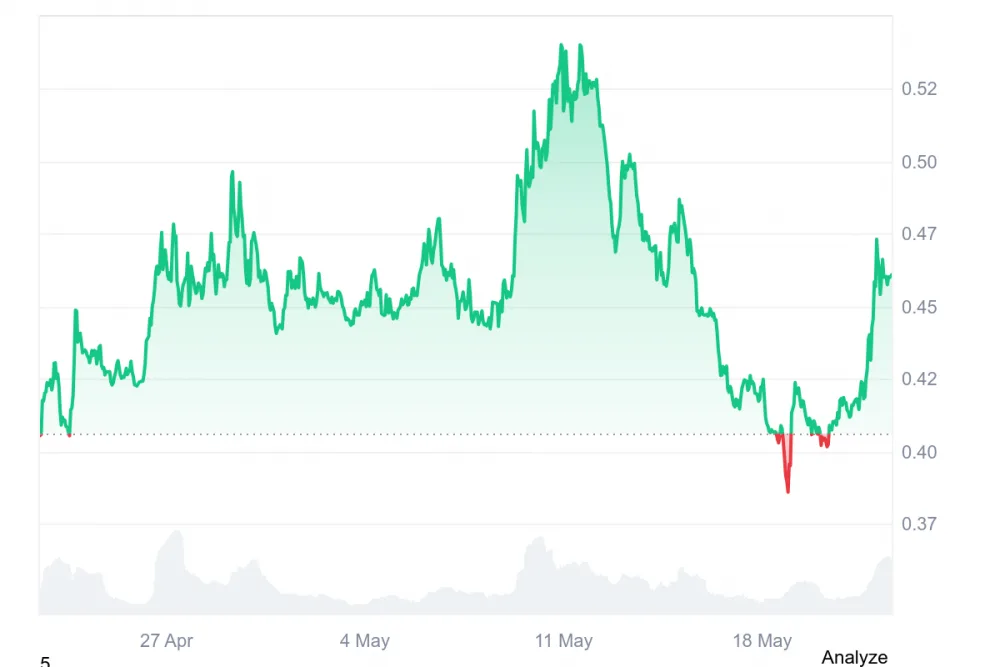
The pattern of this chart also explains a handful of spikes in momentum during the year, such as a spike into the $0.40 resistance range in March before a market-wide pullback. More recently, the token broke out by 11% within 24 hours, with trading volume nearly doubling, showing a return of speculation and institutional interest.
At the same time, AERO’s correlation with Bitcoin was increasing, with analysts noting a rotation into mid-cap DeFi assets during broader market rallies and traders searching for exposure to the growing Base ecosystem.
Key Support and Resistance Levels
Near-term technicals identify the $0.40 level as critical support, with buyers appearing on dips towards this psychologically important mark in recent sessions, adding to near-term sentiment stabilization and a wider market selloff avoidance.
On the positive side, bulls are still focused on the $0.45 to $0.47 resistance area. On the daily charts, a sustained rally above this area could begin a larger bullish wave and allow retracement to higher levels.
Other momentum indicators also generally increased during May 2026, with market trackers showing a growing RSI without hitting overbought territory, and MACD signals growing increasingly positive from a period of sideways trading.
Related: Top Crypto Trends and Narratives That Could Explode in H2 2026
Short-Term vs Long-Term Trend Analysis
In the short term, AERO price prediction after market rally discussions remains dependent on whether the recent increase in trading volume can stay sustainable. Essential metrics to watch for price direction include liquidity flows, Bitcoin dominance, and activity within the Base ecosystem.
Longer term, the price of AERO token future outlook 2026 will be more closely tied to Aerodrome’s adoption as the leading liquidity hub for Base, with demand-side factors such as protocol usage growth, governance participation, and multichain expansion serving as the primary structural drivers of bullish sentiment.
| Metric | Current Data (May 2026) |
| AERO Price | ~$0.46 |
| Market Cap | ~$430M |
| 24h Trading Volume | ~$50M |
| Main Blockchain | Base |
| Protocol Type | DEX / Liquidity Hub |
| Governance Model | veAERO |
| Major Competitors | Uniswap, Velodrome, Curve |
| Key Support Level | ~$0.40 |
| Key Resistance Level | ~$0.45-0.47 |
Is AERO a Good Investment in 2026?
Bull Case for AERO
Bulls also argue is AERO a good investment in 2026, as Aerodrome remains the largest protocol in the Base ecosystem, benefiting from increased DeFi use, high fee generation, and meaningful liquidity inflows on the Base chain. Analysts pointed out the mechanics of veAERO locking as a method to decrease circulating supply, encouraging long-term holding.
Among the main AERO crypto bullish reasons explained by analysts are rising interest in Ethereum Layer-2 infrastructure and growing demand for revenue-generating DeFi protocols.
As traders enter revenue-generating DeFi protocols, Aerodrome has risen in prominence, being one of the best DeFi protocols on Base.
Bear Case and Risk Factors
However, AERO is still a speculative and volatile asset that requires the continued growth of the Base ecosystem. If growth slows or trading volume decreases, the rewards and liquidity incentives for the token may also decrease, which may impact demand.
Another risk is inflationary tokenomics. Token emissions are still the primary way the protocol rewards liquidity providers, which leads to inflation. The protocol also competes with larger DEXs like Uniswap, Velodrome, and others. Other risks of the DeFi space, including smart contract exploits and regulatory risks, are also present.
Comparison With Competing DeFi Coins
In AERO vs other DEX tokens comparison, Aerodrome’s key advantage is becoming the leading liquidity pool on Base. Other DeFi platforms deliver different governance models and fee and liquidity structures for tokens on the Base ecosystem. All three components are combined in the ecosystem of an emerging Layer-2 known as Aerodrome.
Read Also: Bitcoin Pizza Day 2026: Top 5 Biggest Celebrations in Crypto History
Compared to other DEXes featuring governance token lockups (e.g., Curve’s, Velodrome’s ve(3,3) model), veAERO gives a much stronger incentive to holders to stay invested in the protocol via control over fees and emissions; however, Aerodrome has tied governance strongly to Base ecosystem adoption.
What Could Drive AERO Price Higher?
Expansion of DeFi Adoption
One of the clearest answers to what drives AERO price higher represents the ongoing growth of decentralized finance on Ethereum Layer-2 networks.
As users migrate to cheaper networks such as Base, it has become one of the fastest-growing layer-2 networks in terms of transaction volume and DeFi activity.
As a direct beneficiary of the trend, the protocol serves as the main liquidity layer on Base, resulting in regular trading activity, token launches, and demand for decentralized swaps that drive fees and liquidity on the protocol.
The wider DeFi summer 2026 narrative has also supported the rise in interest in governance tokens linked to real on-chain revenue rather than hype.
Fee-generating DeFi infrastructure projects are increasingly considered one of the strongest performers this crypto market cycle, according to analysts.
Ecosystem Partnerships and Integrations
Protocol integrations across Base drive the growth of AERO ecosystem as new DeFi apps utilize Aerodrome pools to bootstrap liquidity, users, and trading spreads for their token. This generates a network effect that strengthens Aerodrome market share across the Base ecosystem.
More recently, it has been reported that Aerodrome has scaled to support other infrastructure products, including MEV-resistant trading tools or more complex routing functionality, and that market commentators expect wallet integrations, bridge integrations, and lending protocol integrations to increase liquidity concentration on the platform.
Liquidity Growth and User Expansion
An increase in liquidity to AERO liquidity pools remains one of the clearest short-term indicators of a bullish market outlook towards the protocol, as it allows more optimized trading, greater depth (less slippage), and greater volume of players. Market data indicates Aerodrome retains the majority of decentralized exchange volume on Base.
This increase in active wallets and increased trading activity has been viewed as evidence that AERO trading volume is increasing. Experts have observed that increasing activity within the ecosystem provides liquidity and attracts protocols, traders, and liquidity providers into the ecosystem.
Risks to Consider Before Investing in AERO
Market Volatility and Liquidity Risks
Like many DeFi coins, AERO coin price is correlated with the general sentiment of the crypto markets. The price of the coin can be affected by volatility in Bitcoin and Ethereum, the price of trading on Layer-2s, and the demand for governance tokens. In other corrections, AERO price quickly declined by double digits, coinciding with a decline in decentralized exchange volumes.
Liquidity concentration is a risk. Though not a large market, Aerodrome runs the Base market, which means holders and liquidity providers can still impact markets in the short term. Low liquidity in times of increased price volatility can lead to slippage.
Regulatory Uncertainty in DeFi
Another continuing obstacle for decentralized finance is the regulatory environment, with regulators in the United States, Europe, and Asia considering or enacting additional regulations for DeFi protocols and decentralized exchanges.
Read Also: Arthur Hayes Market Outlook 2026: Why He Still Thinks Bitcoin Can Go Parabolic
Future regulation affecting the AERO protocol could impact governance structures, DeFi liquidity, and access to certain markets, while analysts continue warning about uncertainty surrounding governance-token regulation.
Competition From Major DEX Platforms
Despite the DEX token rally 2026 cycle, the DEX market remains very competitive, with Aerodrome competing against industry leaders, including Uniswap, Curve, PancakeSwap, and Velodrome, on market share, liquidity, users, and ecosystem collaboration.
Aerodrome benefits from being on Base, but could face competition from protocols that offer lower trading fees, higher liquidity rewards, or a multichain approach. Slower growth within the Base ecosystem could also affect trading volume and token demand.
AERO Price Prediction Outlook for 2026
Bullish Scenario
The most optimistic AERO price prediction 2026 is related to the continued growth of the Base ecosystem and the ever-increasing popularization of DeFi. Analysts at Bitget believe that in a bullish price cycle, AERO price range can be between $1.38 and $7.00 owing to high TVL, volume, and Aerodrome’s presence on Base.
More positively, analysts at the Godex exchange estimated that if Base ecosystem developments accelerated, AERO could exceed $5.00. Traders Union’s projection models, meanwhile, imply the price could rise into the $2.5-$2.6 range in a bullish market.
These bullish predictions presume that liquidity will remain, participation will increase in Ethereum Layer-2 ecosystems, and the anticipated 2026 altcoin season will continue.
Neutral Scenario
More conservative analysts expect AERO accumulation phase to occur until well into 2026, and current forecasts on AERO price from exchanges like Coinbase and Kraken indicate it will trade sideways from $0.45-$0.47 in reasonable growth scenarios.
CoinCodex and CryptoNews had similar forecasts, showing a neutral price target of $0.38 to $0.54 for late 2026, depending on price volatility and the Base network’s growth.
Thus, AERO crypto price growth in the future is expected to depend on the continuing development of AERO ecosystem itself.
Bearish Scenario
For the bear case, DeFi activity is assumed to decline, or the volume of the entire crypto market begins to decline. Some models on the exchanges MEXC and CoinCodex predicted that the downside scenario is under the current level in the condition of an illiquid market and a negative market mood.
Analysts indicated that institutional positioning could add to volatility. CoinMarketCap AI research noted that Grayscale’s AERO exclusion from its DeFi Fund in May 2026 could reduce institutional exposure.
However, most consensus is that the token’s long-term performance will be influenced by the rate of adoption of Base, the revenue of the protocol it is associated with, and the overall state of the DeFi market.
FAQ
What Is AERO Crypto Used For?
AERO token is used mostly for governance, liquidity mining, and profit sharing in Aerodrome Finance protocol on Base. Holders can lock it in exchange for voting power, add liquidity, and earn a share of the trading fees of the protocol.
Why Is AERO Going Up?
The price increase has been attributed to an increase in activity on Base, decentralized trading volume, and growing interest in DeFi infrastructure projects, as well as Aerodrome role itself in the market, and its increased fees.
Is AERO a Safe Investment in 2026?
AERO still is a high-risk crypto because of general market volatility, competition with other DeFi tokens, and regulatory uncertainty. For traders wondering should you invest in AERO coin now, analysts generally describe the project as fundamentally stronger than smaller speculative DeFi tokens because of its usefulness and protocol revenue generation.
Can AERO Reach New All-Time Highs?
The bullish scenarios anticipate AERO reaching all-time price levels or higher if Base adoption and DeFi activity continue growing through 2026. These scenarios require prolonged growth of liquidity and positive market conditions.
What Makes AERO Different From Other DeFi Tokens?
Aerodrome combines liquidity incentives, governance voting, and fee sharing into a single veToken model closely related to the Base ecosystem. Contrary to other DEX tokens, Aerodrome distributes 100% of trading fees to users who lock tokens for governance voting on the protocol.