Crypto markets move when a story finds liquidity, timing, and a reason for users to care. That is the lens for H2 2026. The strongest crypto trends for 2026 are not just loud tickers. They are themes where capital, regulation, and real usage begin to overlap.
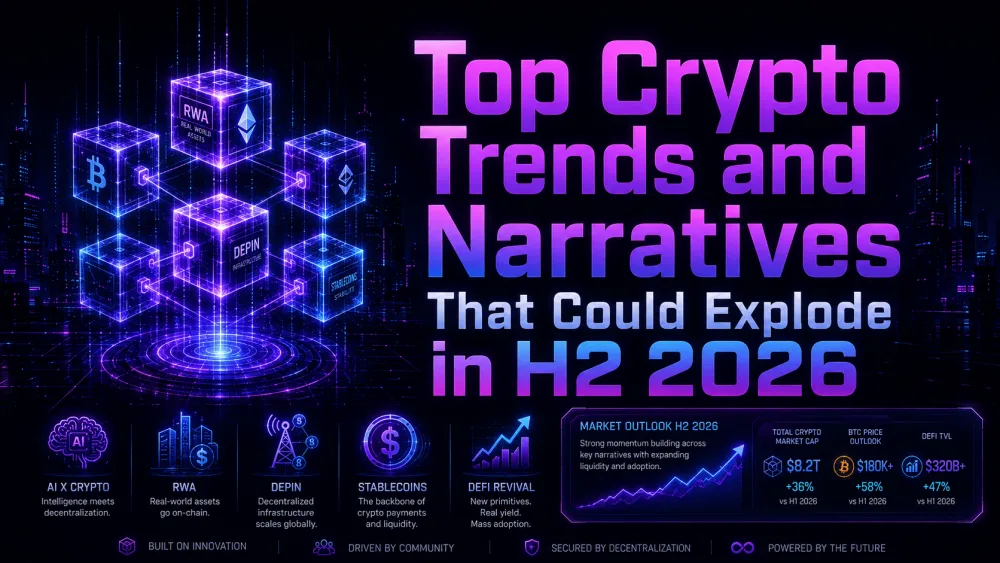
The list is already forming: stablecoins as payment rails, real-world assets as collateral, AI x DePIN as infrastructure, modular blockchains as scaling plumbing, restaking as shared security, prediction markets as live information, and zero-knowledge tools as the bridge between privacy and compliance.
Contents
H2 2026 Crypto Market Outlook
The second half of 2026 looks built for narrative rotation. Bitcoin remains the liquidity anchor, Ethereum still dominates institutional settlement, and traders are hunting for the next pocket of growth.
| Narrative | H2 catalyst | What to watch | Main risk |
|---|---|---|---|
| Stablecoins | Payments, AI agents | Supply, wallets | Reserve rules |
| RWAs | Tokenized funds | Volume, collateral | Permissioned liquidity |
| AI x DePIN | GPU demand | Utilization | Fake usage |
| Modular chains | Appchains | DA demand | Fragmentation |
| Restaking | Shared security | AVS demand | Slashing |
| Prediction markets | Event trading | Liquidity | Regulation |
| ZK privacy | Identity | Simple products | Friction |
Stablecoins Become the Internet’s Settlement Layer
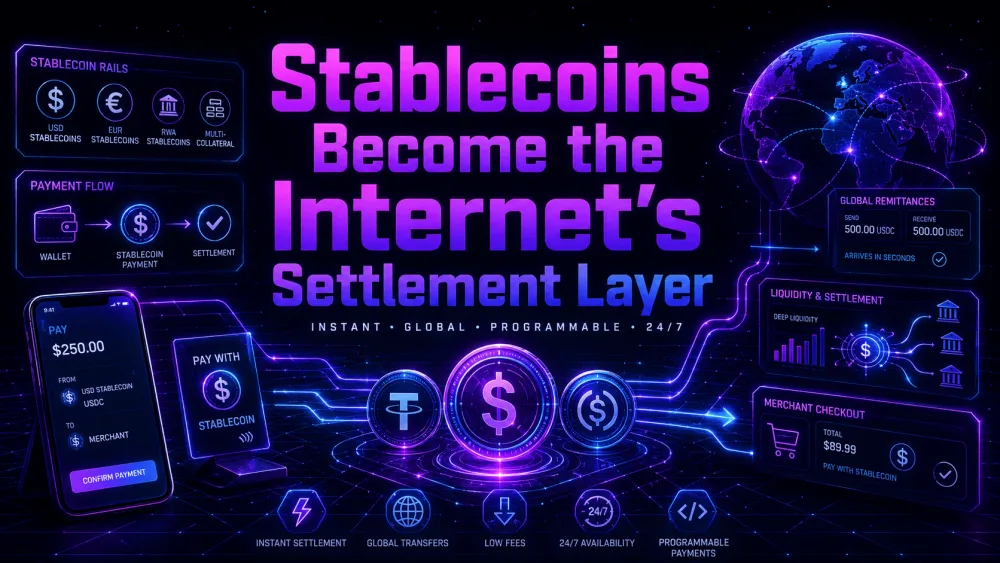
The most obvious crypto market narrative for H2 2026 is stablecoins. The story used to be narrow: traders needed dollars on exchanges. Now stablecoins are payment rails, settlement assets, remittance tools, DeFi collateral, and a possible money layer for AI agents.
DefiLlama showed a total stablecoin market capitalization of around $323 billion in May 2026, with USDT▲$0.9991 still dominant. Reuters also reported that USDC▲$0.9999 circulation rose 28% year over year to $77 billion as demand for dollar liquidity increased during volatile markets.
Read more: Top SOL Tokens Dominating the Market: Solana Memecoins Pumping Again
Why Stablecoin Adoption Could Accelerate
Stablecoin adoption no longer means only crypto-native volume. Fintechs, wallets, merchant platforms, and payment APIs are exploring stablecoins because they settle quickly and move across borders without banking hours.
If regulation becomes clearer, stablecoins could spread through payroll, remittances, creator payments, and B2B settlement. The winners may be compliant issuers, wallets, chains with deep dollar liquidity, and apps that make stablecoins invisible.
Real-World Assets Move Into Market Structure
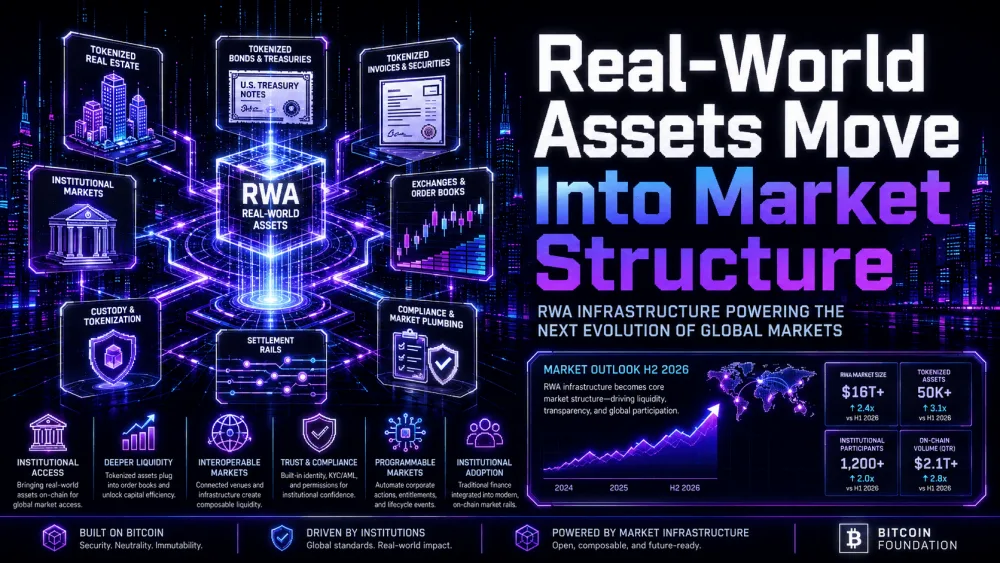
The second major trend is real-world assets in crypto. Tokenized Treasuries, money market funds, private credit, commodities, and fund shares are turning tokenization from a conference slogan into financial infrastructure.
RWA.xyz showed roughly $26.7 billion in distributed tokenized asset value in May 2026 and listed tokenized US Treasuries as a multi-billion-dollar category. Treasuries are not a meme. They are collateral, yield, and institutional comfort food.
Why RWA Tokenization Matters
RWA tokenization gives crypto a link to assets with familiar cash flows. Tokenized Treasuries can be used as collateral. Tokenized money market funds can offer blockchain-native yield. Tokenized commodities can settle around the clock.
The strongest H2 2026 RWA story is collateral mobility. If institutions use tokenized funds inside trading, lending, and settlement systems, blockchains become plumbing rather than a speculative casino.
AI Crypto Projects Meet DePIN Infrastructure
AI is the loudest technology story in the world, and crypto wants a seat at the table. The serious trade is not every token with “AI” in the name. The serious trade is infrastructure.
AI crypto projects and DePIN crypto overlap around compute, data, storage, identity, and machine payments. AI needs expensive resources. Crypto networks can coordinate those resources through open markets and incentives.
Read more: Top 5 Crazy Bitcoin Price Predictions: Will BTC Hit $1M?
Decentralized Compute Becomes the Battleground
The decentralized compute thesis is simple. GPU access is expensive and concentrated. Networks such as Akash present themselves as open marketplaces where users can buy and sell compute resources.
The winners will show utilization, paying customers, and reliable service. The losers will show only dashboards, token emissions, and vague AI language.
Data, Agents, and Machine Payments
AI also needs data provenance, identity, and payment rails. That leaves room for data networks, agent platforms, and verification layers.
Modular Blockchains and Appchains Keep Scaling Crypto
The modular blockchain thesis remains one of the most important infrastructure stories. Instead of a single chain handling execution, settlement, consensus, and data availability, modular systems split those functions across specialist layers.
Celestia describes its role as a data availability layer that rollups and Layer 2s can publish transaction data to, reducing data availability as a core scaling bottleneck.
Related: What is DeFi 2.0? The Upgrade That Will Redefine Crypto Markets
Why Modular Crypto Projects Still Matter
Modular crypto projects matter because they make it easier to launch custom environments. Games, exchanges, social apps, and DeFi protocols may prefer their own rollups or appchains rather than a crowded general-purpose chain.
The catch is fragmentation. Too many chains split liquidity and confuse users. The winners will make modular infrastructure feel simple through better wallets, bridges, and liquidity routing.
Layer 2 Scaling Becomes User Experience
Layer 2 scaling is no longer only an Ethereum engineer topic. It is a user-experience topic. People do not care whether an app is a rollup, appchain, or Layer 1. They care whether it is fast, cheap, and safe.
Restaking Enters Its Reality Check
Restaking crypto was one of the hottest infrastructure narratives because the idea is powerful: reuse staked assets to secure additional services. In theory, this makes capital more efficient and helps new networks launch faster.
EigenLayer documentation describes slashing as a penalty that can burn or redistribute funds when operators break commitments to an actively validated service. That single detail is the whole trade in miniature: extra yield, extra risk.
Why Shared Security Is Attractive
Shared security can help oracles, bridges, data layers, and middleware avoid the cold-start problem. Instead of bootstrapping a full validator economy, they borrow economic security from larger ecosystems.
The opportunity is real. But restaking must be tied to actual service demand. Yield without demand is financial theater.
The Risks Investors Should Not Ignore
Restaking adds complexity. Slashing, smart-contract bugs, correlated failures, and opaque reward sources are not minor issues.
Bitcoin ETFs and Institutional Crypto Adoption
Bitcoin is not a new trend, but the market structure around it has changed. The SEC approved spot Bitcoin exchange-traded product listings in January 2024, opening a regulated access route for a wider class of investors.
That matters for H2 2026 because Bitcoin ETF inflows can set the tone for risk appetite. When flows are strong, capital often spreads into Ethereum, infrastructure tokens, and higher-beta narratives.
Read more: Bitcoin ETF Flows May 2026: $1.25B Outflows Hit Bitcoin and Ethereum ETFs This Week
Why Institutional Crypto Adoption Matters
Institutional crypto adoption changes what the market rewards. Asset managers, advisers, and funds care about custody, compliance, reporting, liquidity, and risk controls.
This favors Bitcoin, Ethereum, stablecoins, RWAs, tokenized funds, and regulated infrastructure. It does not kill speculation. It makes the market more selective.
Prediction Markets Become Crypto’s Information Layer
Prediction markets crypto may be one of the most human narratives in the market. People already argue about elections, rates, sports, geopolitics, and token prices. Prediction markets turn those arguments into tradable probabilities.
Polymarket describes itself as a prediction market with live markets across crypto, politics, sports, finance, technology, and other categories. The attraction is obvious: markets update faster than surveys and often faster than headlines.
Why This Narrative Could Explode
H2 2026 brings macro uncertainty, regulatory debates, and constant crypto catalysts. That is perfect fuel for event markets. If liquidity improves and onboarding gets smoother, prediction markets could become a mainstream crypto use case.
The risk is legal pressure. Event markets sit near gambling, derivatives, and political betting.
Privacy, ZK, and Verifiable Identity Return
Privacy is back, but not in the old cypherpunk-only form. The new version is practical: prove something without exposing everything. That is why zero-knowledge crypto matters for scaling, identity, and compliance.
Ethereum’s documentation describes zero-knowledge rollups as systems that execute transactions off-chain and submit proofs for verification, allowing more throughput without increasing computation on the base layer.
Why ZK Could Matter in H2 2026
Crypto needs better identity tools. Users may need to prove age, jurisdiction, solvency or compliance status without publishing private data on-chain. ZK can help.
The challenge is usability. Most users do not want to understand proofs. The winning ZK projects will make privacy and verification feel invisible.
Comparative Table of H2 2026 Crypto Narratives
| Trend | Best use case | Strong signal | Red flag |
|---|---|---|---|
| Stablecoins | Settlement | Payment usage | Regulation |
| RWAs | Collateral | Institutional volume | Low liquidity |
| AI x DePIN | Compute | Real customers | Empty branding |
| Modular chains | App scaling | Active rollups | Bridge risk |
| Restaking | Security | Paid AVS demand | Bad yield |
| ETFs | Regulated exposure | Net inflows | Flow reversal |
| Prediction markets | Event odds | Depth | Legal pressure |
| ZK/privacy | Identity | Simple UX | Developer friction |
Risks That Could Break the H2 2026 Crypto Narratives
The biggest risk is confusing a strong story with a strong business. Narratives can move prices quickly, but they can reverse even faster.
Token unlocks remain dangerous. So do inflated valuations, thin liquidity, bridge hacks, fake activity, and regulatory surprises. Many crypto projects to watch in 2026 will look strong in dashboards but weak in revenue.
FAQ
What Are the Top Crypto Trends to Watch in H2 2026?
The top crypto trends to watch in H2 2026 are stablecoins, real-world asset tokenization, AI crypto projects, DePIN infrastructure, modular blockchains, restaking, prediction markets, and zero-knowledge privacy tools.
Which Crypto Narratives Could Explode in Late 2026?
The strongest crypto narratives in 2026 may be AI x DePIN, stablecoin payments, RWA tokenization, modular blockchain infrastructure, and prediction markets. These themes combine demand, capital, and improving technology.
Why Are Stablecoins Such a Major Crypto Trend in 2026?
Stablecoins are becoming settlement rails for payments, remittances, DeFi collateral, cross-border transfers, and AI-agent transactions. If regulation becomes clearer, stablecoin adoption could accelerate further.
What Is the RWA Crypto Narrative?
The real-world assets crypto narrative focuses on bringing traditional assets on-chain, including tokenized Treasuries, money market funds, commodities, private credit, and fund shares.
Are AI Crypto Projects Still Worth Watching?
Yes, but investors should be selective. The strongest AI crypto projects are tied to decentralized compute, data networks, agents, and verification tools.
Why Are Modular Blockchains Important?
A modular blockchain separates execution, settlement, consensus, and data availability. This helps developers launch rollups, appchains, and specialized networks faster.
What Risks Should Investors Consider Before Following Crypto Trends?
The biggest risks are token unlocks, inflated valuations, weak revenue, fake activity, regulatory pressure, bridge hacks, and sudden narrative rotation.