The best multisig wallet addresses one of crypto’s critical vulnerabilities — the centralization of a single private key. Rather than having one seed phrase control all funds, multisignature wallets require multiple approvals to move digital assets.
However, the multisig wallet category is highly varied. Some are free Bitcoin apps, some are assisted self-custody services, while Safe and Squads use smart accounts to implement multi-party control on Ethereum and Solana.
Related: MPC Wallet: Is Crypto Finally Moving Beyond Seed Phrases?
Contents
- Best Multisig Wallets Table
- How We Ranked Best Multisig Options
- 1. Safe — Best Multisig Wallet for Ethereum and EVM Networks
- 2. Casa — Best Assisted Multisig Wallet for Individuals
- 3. Unchained — Best Collaborative Bitcoin Multisig
- 4. Sparrow Wallet — Best Free Multisig Wallet for Bitcoin
- 5. Nunchuk — Best for Collaborative Bitcoin Self-Custody
- 6. Squads — Best Multisig Wallet for Solana
- 7. Specter Desktop — Best for Bitcoin Full-Node Users
- 8. Electrum — Best Lightweight Bitcoin Multisig
- Native Multisig vs Smart-Contract Multisig
- Is Multisig Safer Than Hardware Wallets?
- How to Choose the Best Multisig Wallet in 2026
- FAQ
Best Multisig Wallets Table
| Rank | Wallet | Best For | Networks | Model |
|---|---|---|---|---|
| 1 | Safe | EVM teams and treasuries | Ethereum and EVM networks | Smart-contract multisig |
| 2 | Casa | Assisted personal self-custody | Bitcoin, Ethereum | 2-of-3 / 3-of-5 vaults |
| 3 | Unchained | High-value Bitcoin custody | Bitcoin | Collaborative 2-of-3 |
| 4 | Sparrow Wallet | Advanced Bitcoin users | Bitcoin | Native multisig |
| 5 | Nunchuk | Collaborative Bitcoin custody | Bitcoin | Native multisig |
| 6 | Squads | Solana teams and treasuries | Solana | Smart-account multisig |
| 7 | Specter Desktop | Bitcoin node users | Bitcoin | Native multisig |
| 8 | Electrum | Lightweight Bitcoin multisig | Bitcoin | Native multisig |
How We Ranked Best Multisig Options
The best multisig wallet is not always what you expect, because factors beyond the number of signatories determine the value of a multisig setup.
We evaluated multisig wallets and services based on:
- Whether users retain their keys
- Ease of wallet recovery
- Hardware-wallet compatibility
- Supported networks
- Signing flexibility
- Collaboration features
- Setup complexity
A 2-of-3 setup is common because any two signers can approve a transaction, while one lost key does not make funds inaccessible and one stolen key does not allow immediate theft of the assets.
1. Safe — Best Multisig Wallet for Ethereum and EVM Networks
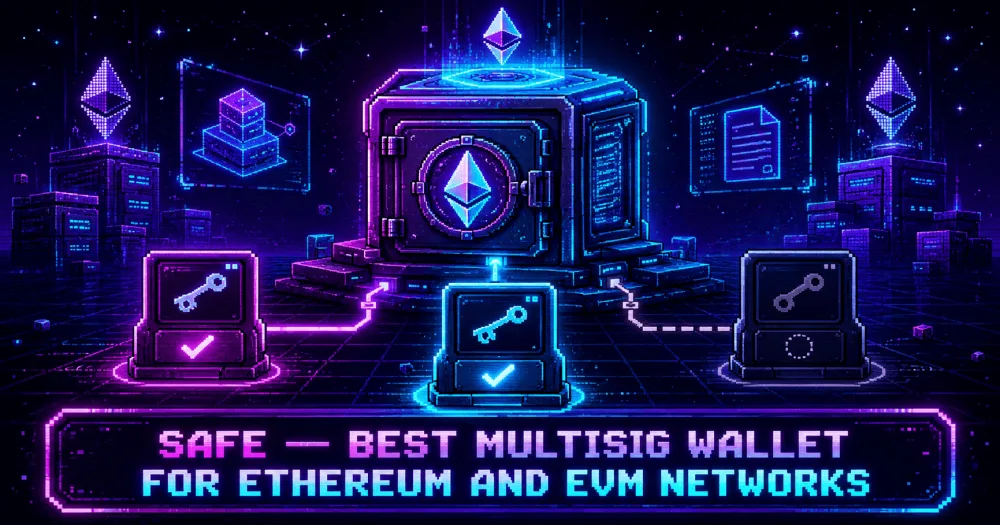
Safe achieves the top spot for Ethereum and EVM-based assets.
Rather than being a Bitcoin-native multisig wallet, Safe implements programmable smart accounts for managing ETH▲$1,761.17 and other EVM-compatible tokens.
A Safe has multiple owners and a configurable spending threshold. For example, three owners can set a 2-of-3 requirement, where any two signatories can approve a transaction.
Safe itself does not hold the private keys. Users authorize transactions through connected signer wallets. This makes Safe particularly attractive to businesses, DAOs, investment groups, protocol treasuries, and individuals managing assets across DeFi.
The limitation is that Safe is not a Bitcoin wallet and has value inside the Ethereum ecosystem.
Related: Best Crypto Wallets: Hot & Cold Options Reviewed
2. Casa — Best Assisted Multisig Wallet for Individuals
Casa is one of the easiest ways for individuals to adopt a multisig without managing the entire setup alone.
Its Standard vault uses the common 2-of-3 design. A typical execution would be one mobile key, one hardware key, and one Casa Recovery Key, while advanced users can replace the mobile key with another hardware device.
Casa also offers 3-of-5 vaults for larger sums of money.
The important note is that Casa cannot move the assets by itself: it holds only one recovery key in the standard configuration, while the user controls enough keys to spend independently.
That combination of sovereignty and support makes Casa a strong candidate for the best multisig wallet for people who want high security without learning multisig intricacies.
The downside is price — multisig vaults are membership products, rather than free software.
3. Unchained — Best Collaborative Bitcoin Multisig
Unchained focuses on collaborative Bitcoin custody.
Its vaults use three keys and require two signatures. The customer controls two keys, while Unchained holds the third as a backup. That means Unchained cannot move the Bitcoin on its own.
The customer can spend using both personal keys, without the company’s involvement. Meanwhile, Unchained can help recover access, should one customer key be lost.
The trade-off is specialization — this is a Bitcoin service, rather than a general-purpose wallet for Ethereum, Solana, stablecoins, and DeFi.
4. Sparrow Wallet — Best Free Multisig Wallet for Bitcoin
Sparrow is one of the strongest options for users who want full control without paying an assisted-custody provider.
It supports native Bitcoin single-signature and multisig wallets, PSBTs, hardware wallets, air-gapped signing, Bitcoin Core, private Electrum servers, Tor, coin control, and detailed UTXO management.
The advantage is sovereignty — Sparrow is not a collaborative custody provider, but rather a software, meaning the user determines the entire security architecture.
For experienced Bitcoin users, Sparrow may be the best multisig wallet without a subscription.
Related: Top 5 DEX Wallets in 2026: Which Crypto Wallet Is Best for DeFi and Swaps?
5. Nunchuk — Best for Collaborative Bitcoin Self-Custody
Nunchuk combines native Bitcoin multisig with a more collaborative UX.
It allows users to build multisig wallets, manage Bitcoin with family members or business partners, communicate around transactions, and sign using supported hardware wallets.
Nunchuk has also adopted the Bitcoin Secure Multisig Setup standard, or BSMS, for interoperable wallet configuration backups. That matters because the multisig recovery involves more than keeping seed phrases: users also need enough information to reconstruct the exact key combination.
The platform offers both do-it-yourself and assisted custody options, making it flexible for users who want support without completely abandoning self-custody.
6. Squads — Best Multisig Wallet for Solana
Squads is the strongest specialized choice for Solana.
It uses on-chain smart accounts rather than Bitcoin-style multisig scripts. Members are added through their Solana wallet addresses, and transactions require a predefined number of approvals.
Squads supports treasury management, tokens, NFTs, program administration, spending limits, time locks, roles, and other programmable controls. Its protocol has become widely used by Solana companies and projects.
Because the rules are enforced on-chain, Squads does not need to custody users’ private keys.
Its limitation is obvious: it is built around Solana and the SVM, rather than being a universal cross-chain vault.
For a Solana organization, it is arguably the best multisig wallet available.
Related: Best Web3 Wallets 2026: Secure Picks for DeFi, XRP and Beginners
7. Specter Desktop — Best for Bitcoin Full-Node Users
Specter Desktop is designed around self-sovereign Bitcoin custody and works particularly well for Bitcoin Core users.
The service provider recommends multi-device setups and makes it possible to export the information required to reconstruct the wallet elsewhere, reducing the importance of Specter itself.
The main drawback is complexity — Specter is most attractive to Bitcoin users who already understand full nodes, hardware signers, PSBTs, and wallet backups.
8. Electrum — Best Lightweight Bitcoin Multisig
Electrum has supported Bitcoin multisig for years and remains a practical lightweight option.
Users can create configurations such as 2-of-2 wallets, distributing signing keys across different devices or people.
Its advantages are maturity, portability, and low system requirements.
But Electrum provides fewer guardrails than assisted platforms such as Casa or Unchained. Users are responsible for correctly creating and backing up their multisig configuration.
For experienced users wanting proven Bitcoin software without running a full node, Electrum remains a strong choice.
Native Multisig vs Smart-Contract Multisig
Bitcoin wallets such as Sparrow, Unchained, Specter, Electrum, Nunchuk, and Casa’s Bitcoin vaults use Bitcoin’s native scripting capabilities.
Safe and Casa’s Ethereum vaults use smart contracts, while Squads uses programmable Solana smart accounts.
The technical risks are different, however — native Bitcoin multisig will depend heavily on correct key and wallet-configuration backups, while smart-account multisig introduce contract and protocol risk, enabling richer controls such as changing signers, roles, spending limits, and policies.
Is Multisig Safer Than Hardware Wallets?
Multisig can be safer than relying on a single hardware wallet because it removes one key from being a point of failure.
But multisig adds operational complexity. Users have to protect several keys, preserve wallet-configuration information, test recovery, and have a backup plan for device loss.
A badly-designed multisig setup can therefore be harder to recover than a well-managed single-signature wallet.
How to Choose the Best Multisig Wallet in 2026
There is no universal winner.
Safe is the best choice for Ethereum and EVM smart accounts, while Casa offers one of the best combinations of multisig security, recovery assistance, and usability for individuals. Unchained is particularly compelling for high-value Bitcoin collaborative custody.
Read more: Best Smart Wallets 2026: Safe, Argent, Coinbase Smart Wallets Ranked for Security and Ease of Use
Ultimately, choosing the best multisig wallet is less about trusting one company, and more about designing a system where no single key, device, person, or provider can become the point of failure.
FAQ
What is the best multisig wallet in 2026?
Safe is one of the strongest options for Ethereum and EVM assets, while Casa and Unchained are strong assisted-custody choices. Sparrow is a leading free Bitcoin multisig wallet, and Squads specializes in Solana.
What does 2-of-3 multisig mean?
A 2-of-3 multisig wallet has three independent signing keys. To authorize a transaction, you need any two of them. Losing or compromising one key does not automatically compromise the funds.
Can a multisig provider steal my crypto?
It depends on the setup. Services such as Casa and Unchained are designed so the provider controls fewer keys than the threshold required to move assets, meaning they cannot unilaterally spend the funds.
Do I need multiple hardware wallets for multisig?
Not always, but using independent hardware devices can improve security. A multi-vendor setup can reduce the risk that one hardware-wallet vulnerability compromises enough keys to move funds.
Is multisig worth using for small crypto holdings?
Often not. Multisig adds complexity, hardware costs, backup requirements, and more complicated recovery. It is most useful when the value being protected justifies that additional operational burden.