Standard Chartered says Uniswap price can rise nearly 40 times by 2030, but the call depends on tokenized assets moving into DeFi at scale.
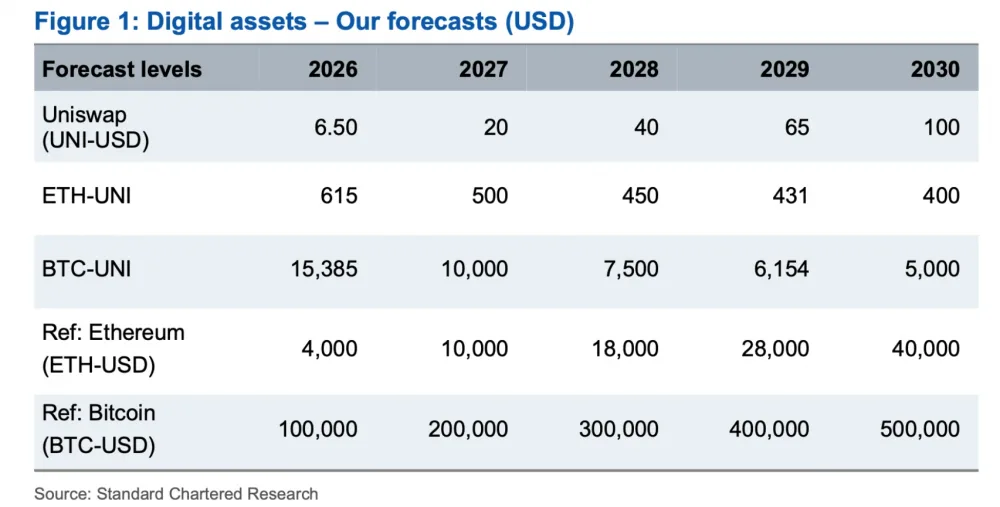
Standard Chartered, a London-based banking group, added Uniswap to its research list in a June 15 note from Geoff Kendrick, the bank’s global head of digital assets research, seeing the UNI▲$3.25 token rising to $100 by the end of 2030 under a specific scenario.
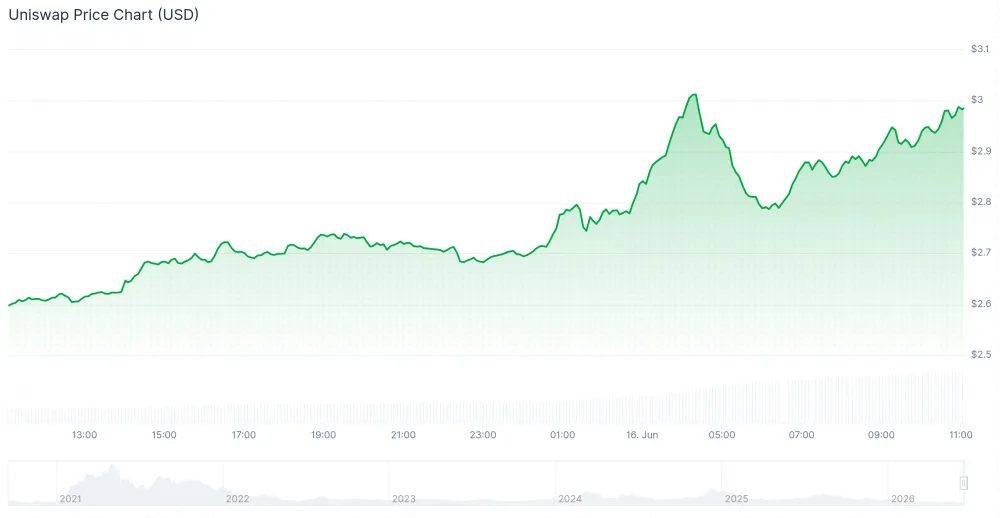
That would imply a roughly 40x move from the $2.50 level cited in the note. As of press time, UNI, the governance token of Uniswap, trades near $3, up about 15% after the research note was published, according to CoinGecko data.
Read also: Scammers Stole Over $400K via Fake Uniswap Ads on Google
Growth Scenarios
However, such growth relies on a certain scenario. Specifically, the bank estimates tokenized assets will grow to $4 trillion by the end of 2028 from the current level of around $340 billion.
In such a scenario, about $2.7 trillion worth of assets will enter DeFi by 2030 which is roughly 37 times compared to their current level, the bank notes.
Uniswap could benefit from that rally if banks and asset managers adopt neutral on-chain liquidity rather than closed trading venues, the analysts say. Kendrick wrote:
“For TradFi institutions, Uniswap should be viewed less as a retail DEX app and more as market infrastructure that TradFi can integrate with once tokenised assets scale and TradFi operators want to plug them into DeFi.”
Fee Burns Give UNI Part of the Setup
The bank also pointed to Uniswap’s fee changes. After the late-2025 UNIfication upgrade, protocol fees began routing into UNI burns, reducing supply from about 1 billion tokens to roughly 895 million.
The current burn rate is near 1% a year, but higher DeFi trading volume could make those burns more meaningful, the bank argues, noting that UNI could “outperform both ETH▲$1,761.17 and BTC▲$62,630.00 through end-2030.”
But the forecast still depends on several uncertain pieces. For instance, tokenized assets still need to move into public DeFi markets, Uniswap needs to keep its liquidity position, and institutions need to be comfortable settling activity on open smart contracts.
Competition in the decentralized crypto exchange market and DeFi risks including compliance issues may also hamper such developments, per the note.
Read more: How to Invest in Tokenized Treasuries: Step-by-Step Guide