Contents
What Is Altcoin Season?
Altcoin season represents an overall market period where alternative cryptocurrencies (altcoins) generate greater returns compared to Bitcoin. When this happens, it generally indicates money flowing from bitcoin into higher-risk assets. Importantly, altcoin season can occur while bitcoin rises, but at a lower rate of return than altcoins.
In order to study the trend of the altcoin season, investors utilize an Altcoin Season Index. The Altcoin Season Index measures how many of the top altcoins are performing better than Bitcoin for each day over a 90-day window. A confirmed altcoin season occurs when at least 75% of the leading altcoins (i.e., have performed better) than Bitcoin. The altcoin season index April 2026 is watched closely by traders trying to judge whether rotation is actually broadening.
Altcoin season usually includes widespread price increases and speculative activity as well as increased investment throughout the entire cryptocurrency marketplace. Unlike a random or non-structural increase in price, the Altcoin Season represents a structural change in the overall of the crypto cycles, with the movement of money from one asset (Bitcoin), to another (altcoins), in an attempt to find higher returns.
For traders checking the altcoin season index current 2026, the main question is whether altcoins are merely bouncing or genuinely outperforming Bitcoin across a broad sample.
Why Altcoin Season Still Matters in 2026
The relevance of the altcoin season in 2026 will continue to be relevant by virtue of current positioning and cyclical dynamics — regardless of Bitcoin’s dominance of the market space.
As we enter 2026, Bitcoin’s dominance over the cryptocurrency markets is currently at or around 58-60%, and the altcoin season index has declined to approximately 30, suggesting most alternative cryptocurrencies are performing below Bitcoin. The volatility of the 2025 Bitcoin cycle, coupled with increasing institutional investment flows, has resulted in capital being concentrated in Bitcoin. In practical terms, the Bitcoin dominance April 2026, the current Bitcoin dominance April 2026, and the Bitcoin dominance current percentage April 2026 all point to a market that is still led by BTC▲$62,630.00 rather than by altcoins. This makes altcoin season index May 2026 an important follow-up metric for judging whether April’s weak rotation begins to improve or remains stuck below confirmation levels.
However, it is precisely this disequilibrium that continues to justify the significance of an altcoin season. Historically, extended periods of Bitcoin dominance have preceded the eventual rotation of capital from Bitcoin into other cryptocurrencies as investors search for higher returns once they believe that Bitcoin has stabilized.
Altcoin market patterns in 2026 indicate that instead of widespread rallies, there will be a trend toward selectivity (i.e., narrative-driven) for individual assets; therefore, while some sub-sectors may continue to perform better than others, investor success during altcoin season will depend on selecting the right asset at the right time.
Understanding Crypto Market Cycles
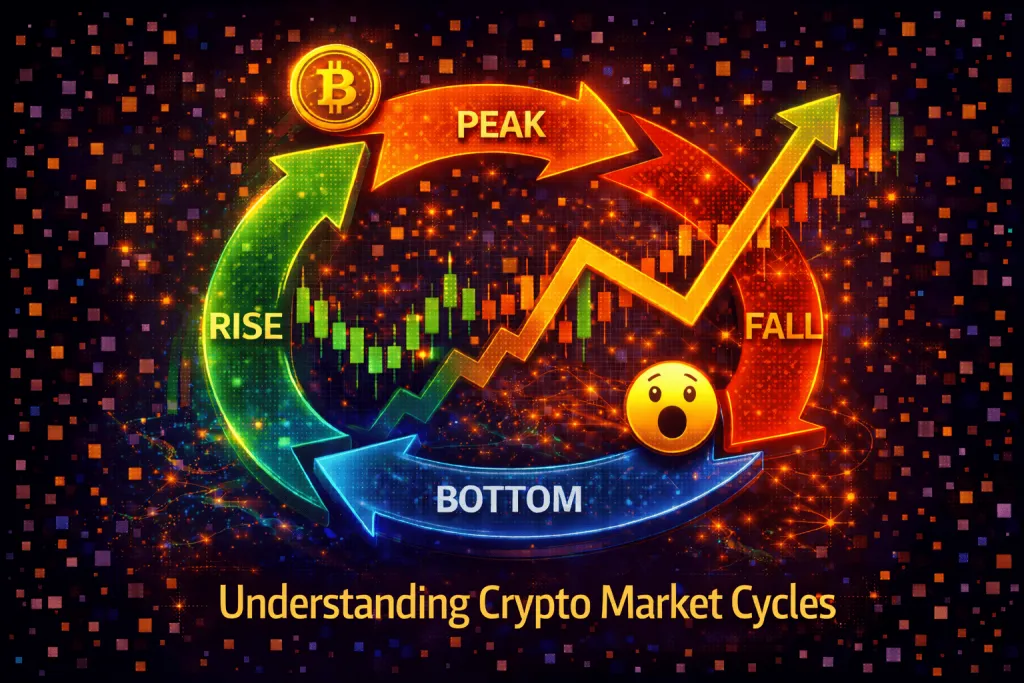
Understanding crypto market cycles is complex and must be seen as a structured phased process with influences from liquidity, sentiment, and Bitcoin’s role as the primary capital entry point for the market.
The Four Phases of a Crypto Cycle
A typical crypto cycle consists of four phases, which have defined characteristics for each stage:
- Accumulation – the price begins to stabilize at the bottom of the down cycle, and early participants start to accumulate positions.
- Rally led by Bitcoin – as money enters the market and flows primarily into BTC, it creates the first phase of upward momentum.
- Altcoin expansion – capital rotation becomes apparent when an altcoin rally starts to emerge; this is indicated by the improved performance of alts compared to Bitcoin.
- Distribution – early participants realize profit, volatility rises, and the market nears a more general correction.
Where Altcoin Season Fits
Within that framework, an altcoin season 2026 will likely occur during the middle to latter stages of its cycle, after Bitcoin has clearly displayed substantial appreciation in price.
Related: How to Buy Solana (SOL) in 2026: Full Beginner’s Guide
Capital is rotated from BTC into other (higher risk) asset classes as BTC’s price begins to stabilize or consolidate. As such, the price of the Altcoin Season Index increases along with the rotation of capital, which signals a directional change in the overall momentum of the market. That means the current altcoin season index April 2026 matters less as a standalone number than as a signal of whether capital rotation is broadening or still stuck in a Bitcoin-led phase.
The current altcoin season index 2026 should therefore be viewed as a timing tool, not a guarantee that every altcoin is about to rally.
Key Indicators of Altcoin Season
Identifying altcoin rally signals entails monitoring several indicators simultaneously rather than just one. Altcoin season is confirmed by all indicators showing capital flows out of Bitcoin and into altcoins.
- Bitcoin dominance – most common metric for altcoin analysis (altcoins vs. BTC). Declines in Bitcoin’s dominance rate typically indicate capital is flowing into altcoins.
- Altcoin Season Index – is an indicator that tracks the performance of altcoins compared to Bitcoin. Values over 75 confirm altseason (current levels for 2026 indicate values in the 30-40 region, denoting a bearish trend or price movement led by bitcoin). It changes dynamically, which is why traders keep checking the “altcoin season index current April 2026” and the “altcoin season index current value April 2026” instead of relying on vibes and Twitter noise.
- ETH▲$1,761.17/BTC ratio – the ETH/BTC ratio has been one of the earliest indicators of broad-based momentum in altcoins.
- BTC dominance chart meaning in context – the level of BTC’s dominance is not as significant as how the trend has been going. Trends are what matter most when it comes to a decline in dominance, and a long-term downtrend is far more important than a one or two-day drop.
- Liquidity and capital inflows – stablecoins with growing supplies, higher levels of trading volumes, and an increase in overall on-chain transactions (and other forms of data) have historically indicated that Alt coins will begin to grow.
Not a single metric indicates that altseason has begun by itself. Investors instead look at which metrics correspond to each other to help validate that a larger, more broad-based change in crypto market cycles is occurring.
The Role of Bitcoin Dominance

Bitcoin dominance is also another very important measure in tracking the relationship between bitcoin dominance and altcoin markets. The ratio of the total cryptocurrency market cap to that of Bitcoin represents where capital currently resides.
Typically, dominance increases initially with each cycle because there is always more money flowing into the asset class via the largest and most liquid coin (bitcoin), which has been proven over time to have the least amount of risk compared to altcoins. As such, Bitcoin normally leads the pack on rallies in its infancy.
The shift occurs when Bitcoin’s momentum drops. Once price becomes stable or consolidated, investors will begin to take their profits from lower risk assets and move them into higher risk assets; this creates an improvement in Altcoin vs. Bitcoin performance. This transition tends to occur with declining Bitcoin dominance, but at a slow pace, and does not occur quickly. So even if the current Bitcoin dominance April 2026 remains high, what matters more is whether it is rolling over in a durable way rather than just wobbling for a few sessions.
Thus, understanding the meaning of the BTC dominance charts is much more focused on trends (i.e., upward/downward) rather than specific levels. Short-term declines are typically meaningless for determining whether you are entering a full altseason.
Related: Bitcoin Price Prediction 2026: Will BTC Finally Rally?
Therefore, although dominance currently remains quite high within the context of altseason 2026, indicating we are still in a “Bitcoin-led” environment, history suggests that extended periods of high dominance have been followed by rotation environments; thus, tracking dominance should provide insight into how far along we are inside the evolving cycle. In that sense, the Bitcoin dominance April 2026 reading is still more of a warning against premature altseason calls than a green light for broad rotation.
Capital Rotation: How Money Flows in Crypto
Capital rotation represents the basic mechanism by which each phase of cryptocurrency market cycles is generated; capital rotation is also particularly important to understand what causes an altcoin rally to be initiated.
In 2026, the capital rotation into cryptocurrencies will continue to follow the same very well-ordered approach. Capital flows initially enter the markets through Bitcoin because of its benefit to attract institutional investment dollars, ETF (Exchange Traded Fund) exposure, and increased liquidity. Therefore, Bitcoin’s dominance has remained high at levels above 58-60%, as there is so much money flowing into Bitcoin.
The next step occurs after Bitcoin’s price becomes stable; instead of selling their assets, investors’ capital shifts inside the cryptocurrency space — initially into larger-capitalization (large-cap) tokens such as Ethereum, followed by mid-cap, and finally small-cap alternative coins. Unlike a simultaneous shift, this is an internal sequential process that is based on investor risk tolerance and profit-taking behaviors.
Historical data indicate that these rotations are beginning to occur now. It appears around 40% of the alt-coins being monitored have begun to perform better than Bitcoin for shorter timeframes in 2026, although still in an overall market phase dominated by Bitcoin. Therefore, it seems that some type of early-stage rotation may be occurring with respect to alt-coins at present, versus a full-scale alt-coin expansion. That fits a market where the altcoin season index current value April 2026 is improving from weak levels but still falls short of confirming a real altseason.
At the same time, flows in 2026 show an even less uniform picture than before. The flows are not a general surge in altcoins; instead, they flow more specifically into particular narratives or sectors.
This trend fits with recent altcoin market patterns (2026), where there has been an uneven distribution of liquidity, as opposed to a flood of liquidity throughout the entire market.
As well, another important factor is the macro liquidity. As the world-wide money supply continues to reach high levels, risk appetite continues to be highly sensitive to outside factors, so capital flows can rapidly increase or decrease based on what happens.
Therefore, rotation is not one large wave; it is now a dynamic event. Therefore, to spot potential early altcoin rally signals and position yourself appropriately in the cycle, you will need to understand where capital is flowing, as opposed to simply observing price movements.
What Makes 2026 Different?

The nature of the crypto markets in 2026 is completely different from past periods and will influence whether or not there is an “altcoin season” in 2026.
Institutional money is currently the most powerful force in the crypto space. Institutional capital inflows since the approval of Spot Bitcoin ETFs have gone mostly into BTC. This has reinforced BTC’s status as the first and primary means by which new money enters the market, creating a “top-heavy” type of market. In turn, BTC gets all of the available liquidity prior to any liquidity being able to enter an altcoin.
As such, there are far fewer opportunities for a large amount of money to flow into the altcoins. Due to there being millions of tokens circulating in each asset class/altcoin, the overall liquidity of the altcoin market has been reduced, and therefore, a broad-based rally of multiple alts at once in the same direction is highly unlikely.
The third trend is that the nature of growth has moved toward a storytelling method to investment, versus simply investing across an array of assets.
The current altcoin market patterns for 2026 indicate capital will be concentrated into certain areas, like AI-related tokens, tokenized real-world assets, and plays in infrastructure; therefore, we cannot expect all altcoins to grow at the same time.
Related: Best Crypto Apps for Beginners
The regulatory environment has evolved as well. Regulatory clarity helped reduce speculative investments (low-quality projects), however, it created an entry point for speculation, which was lower than in previous cycles.
Therefore, crypto market cycles in 2026 will be more defined, with fewer opportunities for speculation caused to Retail Hype. The Altcoin Season will most likely be shorter, more rapid, and based upon Capital Rotation and not general market momentum. At the same time, the Altcoin Season Index current 2026 can stay relatively low even while a handful of narratives outperform hard. These conditions explain why altcoin season 2026 predictions increasingly focus on sector rotation rather than a simple repeat of earlier cycles.
Risks of Altcoin Season
The dangers to investors in altcoin rallies are considerable and, at this point, greater than ever before, as we observe in the altcoin season 2026.
Altcoins continue to exhibit extreme volatility. Daily price swings of 10-20% occur frequently for many altcoins, resulting in very fast changes in value and a lack of predictability. Simultaneously, the institutional data indicate that there is substantially more risk associated with investing in altcoins than with Bitcoin; annualized volatilities are typically 60-80%.
Trading volume has decreased dramatically from levels seen in 2024. That decline in trading volume results in less liquidity (market depth) and weakens the ability of an altcoin rally to sustain itself. As such, it is able to create conditions for exaggerated price movements and/or more severe price declines when reversals do occur.
There is an additional problem with structure: there has been too much supply in 2026. In addition to tens of millions of tokens being created, it is creating a diluted capital base for every token on the market. The fact that over 40% of altcoins today trade at or below their all-time lows (with many of them being very weak in terms of demand) indicates that the vast majority of altcoin stories are not compelling enough to generate large interest.
How to Identify Altcoin Season Early
Spotting an altcoin rally needs to be done with a variety of early indicators, so you can’t rely on just one. Typically, there are gradual, not sudden, market-wide changes that provide early signals in 2026.
The first sign is typically when Bitcoin’s price movement slows down. Once a strong price movement has occurred for BTC, capital will begin to flow from BTC to altcoins, regardless of whether or not the altcoins/BTC dominance metrics have not fully changed direction.
Another early indicator is improved performance by altcoins against bitcoin, particularly larger-cap altcoins such as ETH. It is common for ETH and the major altcoins to outperform BTC before there is an extensive rotation.
The Altcoin Season Index has its uses too; however, it will be most useful when confirming whether or not we’re headed for full alt-season conditions when the index rises (i.e., moves from lower levels toward 50), indicating that rotation is beginning to build. So the current Altcoin Season Index April 2026 should be read as an early-warning tool, not as proof that a full altseason has already arrived. That is also why altcoin season prediction 2026 should depend on multiple signals, including Bitcoin dominance, ETH/BTC strength, stablecoin liquidity, and sector-level trading volume.
Context is equally important. In terms of current altcoin trends 2026, we see early rotations tend to be quite selective in their focus on the sector(s) receiving investment versus being focused on an overall increase in the price level of all assets within the altcoin market.
Early Identification within crypto market cycles is more about seeing signs of alignment among many indicators prior to the trend becoming clear to everyone else. Watching the Altcoin Season Index current, April 2026 alongside the Bitcoin dominance current percentage, April 2026 gives a much cleaner picture than staring at either metric alone.
Is Altseason Still Worth It in 2026?
Altcoin season is still an attractive opportunity; however, as of 2026, there will be a great deal of difference from prior seasons. The current data for the cryptocurrency market shows that while the price leadership remains with Bitcoin (dominance at ~60%), the altcoin season index is currently at levels of approximately 30-35%, which means we have not seen a general increase in performance by all alts. That weak Altcoin Season Index current value 2026 reads as a clear sign that this is still a selective market rather than a full altcoin free-for-all. For this reason, Altcoin Season Index current value 2026 is useful mainly as a confirmation metric, not as a standalone trading signal.
This is not to say that the idea of altcoin season has been invalidated. As markets change, within each new cycle of a particular asset class, an altcoin phase can still appear – they may simply come later than prior times, only involve select assets, and be influenced by capital conditions. Analysts now expect a potential rotation into altcoins to occur later in a cycle, possibly when Bitcoin has stabilized, and overall macroeconomic conditions improve. Search interest around “when will altcoin season start 2026” will likely rise if Bitcoin dominance begins falling while ETH and large-cap altcoins outperform BTC consistently.
At the same time, however, the structure of the markets has changed. Instead of a broad market surge, capital is likely to be concentrated into fewer (higher quality) assets, which means that not every altcoin will gain equally.
Therefore, an alt season remains worthwhile—but only for those with a good understanding of timing, capital rotation, and what constitutes a true altcoin price rally signal. The most realistic altcoin season 2026 prediction is not that every token rises together, but that strong sectors outperform while weak projects remain dead money.
FAQ
What triggers an altcoin season?
The altcoin season is generally initiated when there has been a slowdown in price increases that occur with a Bitcoin bull run. Once the prices begin to stabilize again, this causes investors to pursue alternative investments in other cryptocurrencies (altcoins) to gain greater returns. Altcoin season predictions 2026 stay conditional: rotation needs liquidity, falling Bitcoin dominance, and stronger altcoin/BTC performance before it becomes convincing.
How long does altcoin season usually last?
This varies over each cycle; however, historical data indicate that the length of an altcoin season is anywhere from a few weeks to several months. The time frame is dependent upon both market fluidity and overall investor assurance.
Is Ethereum necessary for the altcoin season to start?
Yes, in general. Historically, Ethereum serves as the link between the Bitcoin markets and the broader altcoin markets. Typically, when ether (ETH) gains value relative to the price of bitcoin (BTC), it will signal that the majority of investors are starting to shift their investment dollars into various altcoins.
Can altcoin season happen without a Bitcoin bull run?
Altcoin seasons are usually in sync with Bitcoin’s bull runs because most of the money that comes into cryptocurrency markets initially goes into Bitcoin (BTC), and then flows into the higher-risk assets.
How do beginners safely invest during altseason?
The safest investment strategy for beginners during an altcoin season involves practicing good risk management — limiting exposure to risk, investing in well-established assets, and never chasing after rapidly rising prices without first understanding the larger market forces.