A 100% rally means very different things for our top 7 altcoins. Solana would need to add approximately $46 billion in market value to double from current levels. Bittensor would need less than $2 billion. The smaller target is easier mathematically, but usually comes with weaker liquidity, greater volatility, and more severe token-supply risk.
As of July 21, 2026, Bitcoin dominance remains high and the broad altcoin market is still far from a convincing expansion phase. That makes a market-wide “altseason” a weak base case. A more plausible outcome is a concentrated rally led by projects with a catalyst strong enough to attract capital away from Bitcoin.
The top 7 altcoins on this list span market capitalizations from roughly $1.7 billion to $45.7 billion. Each has a clearer fundamental route to a 100% gain than most of the thousands of tokens competing for attention.
Related: Crypto’s Biggest Moment in Years? Why the Clarity Act Could Change Everything
Contents
- Top 7 Altcoins for H2 2026 at a Glance
- 1. Solana: The Strongest Institutional Route
- 2. Hyperliquid: The Strongest Revenue Story
- 3. Chainlink: The Infrastructure Bet on Tokenized Finance
- 4. Sui: A High-Beta Layer 1
- 5. Aave: The Large DeFi Protocol
- 6. Bittensor: The High-Risk AI Infrastructure Bet
- 7. Ondo Finance: The Smaller Institutional Tokenization Candidate
- Which Altcoin Is Most Likely to Double?
- What Would Trigger a Concentrated Altcoin Rally?
- FAQ
Top 7 Altcoins for H2 2026 at a Glance
| Altcoin | Approximate Market Cap | Main H2 2026 Thesis | Principal Risk |
|---|---|---|---|
| Solana (SOL▲$82.41) | $45.7 billion | Institutional access and tokenization growth | Already requires enormous new inflows |
| Hyperliquid (HYPE▲$70.78) | $14.0 billion | Exceptional trading revenue and token economics | Extreme valuation and supply dilution |
| Chainlink (LINK▲$7.97) | $6.5 billion | Institutional tokenization infrastructure | Adoption may not translate directly into token demand |
| Sui (SUI▲$0.7718) | $3.1 billion | High-beta Layer 1 recovery candidate | Large gap between market cap and FDV |
| Aave (AAVE▲$87.37) | Approximately $2 billion | DeFi lending revenue and institutional credit | Regulatory and smart contract exposure |
| Bittensor (TAO▲$215.61) | $1.9 billion | Decentralized AI infrastructure | Difficult valuation and heavy emissions |
| Ondo Finance (ONDO▲$0.3341) | Approximately $1.7 billion | Tokenized securities and Treasury adoption | Token utility and unlock pressure |
1. Solana: The Strongest Institutional Route
Among the top 7 altcoins, Solana is the least obvious 100% candidate because its market capitalization is already approximately $45.7 billion. A doubling would require another $45.7 billion in value.
That is a high hurdle. It is also achievable only if Solana becomes one of the principal beneficiaries of the next crypto expansion.
The case is no longer based entirely on memecoin trading. Solana has developed substantial stablecoin activity, decentralized exchange volume, consumer applications, payments infrastructure, and tokenized assets. Tokenized assets on Solana reached approximately $5.8 billion during the second quarter of 2026, up 114% quarter over quarter.
Its market cap-to-FDV ratio of approximately 0.92 is another advantage. Unlike newer Layer 1 tokens, most of Solana’s eventual supply is already in circulation. Investors are therefore exposed to less severe dilution than holders of coins with large outstanding unlocks.
The primary H2 catalyst is broader institutional access. Additional exchange-traded products, staking-enabled vehicles, or integrations with tokenized securities platforms could attract capital that smaller chains cannot accommodate.
However, SOL would need a genuine shift in market regime to double. It would require Solana to consolidate its position as the leading non-Ethereum smart contract platform.
100% case: Institutional products, tokenization, stablecoins, and DeFi activity converge during a broader risk-asset recovery.
Failure case: Network growth slows while investors reject the valuation required to compete with Ethereum.
2. Hyperliquid: The Strongest Revenue Story
Hyperliquid has become one of the few crypto networks that can be evaluated through substantial recurring revenue rather than user counts or promised adoption. That earns HYPE the place among the top 7 altcoins.
As of July 21, HYPE had a market capitalization near $14 billion. Hyperliquid had generated approximately $58 million in fees and $41 million in protocol revenue over the preceding 30 days. Its annualized revenue rate was around $800 million, while cumulative revenue had exceeded $1.16 billion.
Those figures make HYPE fundamentally different from many Layer 1 tokens. Hyperliquid’s core perpetual futures exchange has established product-market fit, and protocol revenue is used to benefit token holders through market purchases.
A 100% increase would take HYPE’s circulating market capitalization toward $28 billion. That would be aggressive but defensible if Hyperliquid continues capturing derivatives activity while expanding spot trading, lending, and applications built on its network.
The problem is dilution. Only around 220 million HYPE tokens are circulating from a maximum supply of one billion. CoinGecko places its market cap near $14 billion, while its fully diluted valuation is close to $60 billion.
This means HYPE is simultaneously one of the strongest businesses in crypto and one of the easiest assets to overvalue. Revenue growth must remain exceptional to offset future supply expansion.
100% case: Trading activity remains high, buybacks continue, and Hyperliquid develops from a derivatives venue into a broader financial ecosystem.
Failure case: Volumes normalize, competition intensifies, or supply growth overwhelms token demand.
Related: Top 5 Biggest Crypto Bubbles in History — What Investors Can Learn Before the Next Crash
3. Chainlink: The Infrastructure Bet on Tokenized Finance
Chainlink is valued at approximately $6.5 billion, with roughly 750 million of its maximum one billion LINK supply circulating.
The investment case is that institutional players will need standardized infrastructure to move data and assets between chains and conventional financial systems. LINK is a top 7 altcoin that caters to this case.
Chainlink’s services now include price feeds, proof-of-reserve systems, automation, cross-chain messaging, and tools for connecting tokenized financial products across networks. Its Cross-Chain Interoperability Protocol is particularly relevant to institutions that do not want assets or liquidity trapped inside one blockchain.
Chainlink reported continued institutional and on-chain finance integrations during the first quarter of 2026. The wider market for tokenized real-world assets has also expanded materially. RWA.xyz tracked approximately $30.9 billion in distributed tokenized assets and almost $399 billion in represented asset value by July.
A doubling would lift LINK’s market capitalization to approximately $13 billion. That is less demanding than SOL’s target and remains far below Chainlink’s valuation during the previous bull cycle.
The weakness in the thesis is value capture. Institutions can adopt Chainlink technology without producing immediate buying pressure sufficient to double LINK. The token must benefit economically from fees, staking, reserves, or increased service demand rather than merely appearing in partnership announcements.
100% case: Tokenization accelerates and Chainlink establishes itself as the default interoperability and verification layer.
Failure case: Enterprise adoption grows, but LINK’s token economics remain too indirect to attract sustained investment.
4. Sui: A High-Beta Layer 1
Sui’s market capitalization is approximately $3.1 billion, making a move toward $6.2 billion realistic during a strong Layer 1 rotation.
The network is designed around parallel transaction processing and an object-based data model. Its strongest use cases include trading, gaming, consumer applications, and assets that require frequent on-chain interaction.
Among the top 7 altcoins, Sui benefits from being large enough to offer meaningful liquidity but small enough that several billion dollars of new market value could transform its ranking. That makes it a more plausible 100% mover than Solana, though not necessarily a safer one.
The main problem is supply. Sui’s market cap-to-FDV ratio is approximately 0.41, meaning less than half of its fully diluted valuation is represented by circulating tokens. Investors must therefore distinguish between price gains caused by growing demand and market-cap growth absorbed by unlocks.
Sui also competes in an overcrowded Layer 1 market. Technical performance alone is no longer enough. The network must retain developers, liquidity, stablecoins, and applications after incentive programs are reduced.
100% case: Sui attracts a sustained share of DeFi, gaming, and consumer activity while the market rotates into higher-beta Layer 1 assets.
Failure case: Token unlocks and declining incentives offset ecosystem growth.
Related: Top 5 Altcoins for the Next 100x Crypto – Best Crypto to Buy Now 2026
5. Aave: The Large DeFi Protocol
Another of the top 7 altcoins, Aave, remains one of the largest decentralized lending systems and one of the few DeFi protocols with a long operating history across multiple market cycles.
Its basic business is understandable. Depositors supply assets, borrowers pay interest, and the protocol earns fees from lending activity. This creates a clearer economic model than tokens whose value depends primarily on governance expectations.
Aave could benefit from three H2 themes: renewed leverage during a market recovery, institutional demand for on-chain credit, and the expansion of stablecoin-based finance. Higher crypto prices usually increase collateral values and borrowing demand, while tokenized securities can create new forms of collateral.
At a market capitalization of roughly $2 billion, AAVE would need to add around $2 billion to double. That is plausible if DeFi lending revenue expands and governance directs more economic value toward the token.
The risks remain substantial. Aave depends on reliable smart contracts, liquid collateral, external price feeds, and orderly liquidations. A severe depeg or oracle failure could turn apparent overcollateralization into bad debt. Regulatory treatment of decentralized lending also remains unresolved.
100% case: DeFi borrowing revives and Aave captures institutional as well as speculative demand.
Failure case: Credit activity remains subdued or a collateral event exposes losses within the protocol.
6. Bittensor: The High-Risk AI Infrastructure Bet
Bittensor is the smallest AI-focused asset on the top 7 altcoin list with enough liquidity and recognition to attract meaningful institutional or fund interest. TAO currently has a market capitalization of approximately $1.9 billion.
The network rewards specialized subnets that provide machine intelligence, data, model inference, and other computational services. Its appeal lies in creating a market for AI output rather than relying on one centralized company to own the models and infrastructure.
At its current size, TAO would need less than $2 billion in additional market value to double. That could happen quickly if decentralized AI returns as a dominant crypto narrative.
Bittensor also has more substance than many tokens marketed as “AI crypto.” It has an operating network, active subnets, a defined incentive system, and a recognizable position within the decentralized machine-intelligence sector.
However, valuation remains difficult. Activity across subnets does not translate neatly into cash flow for TAO holders, and the quality of rewarded output can be hard to assess. Its market cap-to-FDV ratio is only about 0.46, creating meaningful long-term dilution.
100% case: AI-linked crypto assets recover and Bittensor becomes the sector’s benchmark network.
Failure case: Investors question subnet economics, token emissions, or whether decentralized AI demand exists beyond incentives.
7. Ondo Finance: The Smaller Institutional Tokenization Candidate
Ondo Finance offers direct exposure to one of crypto’s strongest structural trends: bringing Treasuries, money market instruments, and securities onto public blockchains.
Ondo’s Short-Term U.S. Government Bond Fund held approximately $577 million in assets as of July. The project is also pursuing tokenized securities infrastructure intended to connect traditional market assets with on-chain trading and settlement.
With ONDO valued at roughly $1.7 billion, a doubling would require less than $2 billion of new market value. That is plausible if tokenization becomes a dominant H2 narrative and Ondo secures a meaningful role in distribution.
The distinction between platform adoption and token value is critical for most top 7 altcoins. Investors may use Ondo products without creating proportional demand for ONDO. Future unlocks also remain a material source of dilution.
100% case: Tokenized stocks and Treasuries expand rapidly, and ONDO gains clearer utility within the ecosystem.
Failure case: Products grow while the token captures little economic value, or unlocks suppress the price.
Which Altcoin Is Most Likely to Double?
Solana has the strongest liquidity and institutional profile, but doubling its $45.7 billion valuation requires exceptional capital inflows. HYPE has the strongest measurable revenue, but its fully diluted valuation already assumes major future success. LINK offers institutional infrastructure exposure with less dilution, although token value capture remains uncertain.
Among the smaller top 7 altcoins, AAVE has the clearest established business, ONDO has the strongest institutional narrative, and TAO has the greatest speculative sensitivity to an AI resurgence. SUI occupies the middle: it is liquid enough for larger investors but small enough to double during a serious Layer 1 rotation.
A reasonable ranking by probability of a 100% H2 gain is:
- AAVE
- LINK
- SUI
- ONDO
- TAO
- HYPE
- SOL
This is not a ranking of project quality. SOL and HYPE may be stronger assets than several tokens above them. They simply require much more new market value to double.
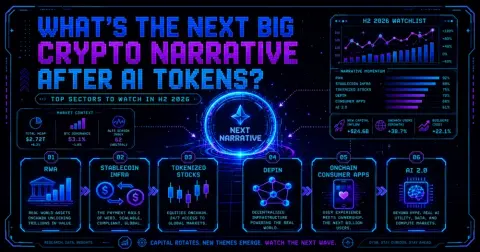
Related: What’s the Next Big Crypto Narrative After AI Tokens? Top Sectors to Watch in H2 2026
What Would Trigger a Concentrated Altcoin Rally?
These top 7 altcoins are unlikely to rise 100% in isolation from market conditions. A sustained rally would probably require several developments:
- Bitcoin stabilizing rather than absorbing most available liquidity.
- Lower real yields or more accommodative monetary policy.
- Continued institutional interest in digital assets.
- Growth in stablecoin supply and on-chain lending.
- Regulatory progress in the United States.
- A shift from speculative narratives toward revenue, tokenization, AI, and infrastructure.
The most important signal would be capital moving simultaneously into several unrelated sectors: DeFi, tokenization, decentralized AI, and derivatives infrastructure. Until that happens, the market is more likely to reward individual winners than lift every altcoin.
FAQ
Can any of these altcoins realistically rise 100% in H2 2026?
Yes, but smaller-cap assets such as AAVE, TAO, and ONDO require much less additional market value to double than SOL or HYPE. They also carry greater liquidity, dilution, and execution risk.
Why were Ethereum and XRP excluded?
ETH▲$1,761.17 and XRP▲$1.13 did not make it onto the list because both are large-cap assets that would require substantial institutional inflows to produce a 100% gain.
Which selected altcoin has the strongest fundamentals?
Hyperliquid currently has the strongest direct revenue profile. Aave has the most established DeFi lending model, while Chainlink has the broadest institutional infrastructure thesis.
Which altcoin is the highest-risk candidate?
Bittensor is the highest-risk choice because decentralized AI is difficult to value and TAO faces significant future emissions. Its smaller market capitalization also gives it substantial upside during a speculative AI rotation.
Does a strong project automatically make its token a good investment?
No. A protocol can gain users and revenue while its token underperforms because of weak value capture, excessive valuation, or large supply unlocks. Token economics matter as much as product adoption.