The Senate has unanimously passed a resolution urging that Sam Bankman-Fried’s sentence not be commuted “under any circumstances.” We break down the details.
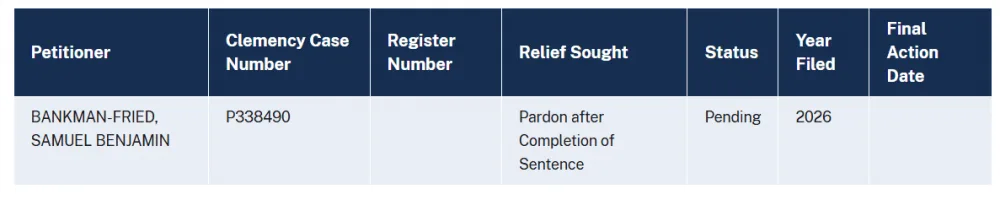
The resolution prohibits a pardon or sentence reduction, though it carries no legal force. The initiative was backed by Senators Cynthia Lummis and Ruben Gallego, who lead the Digital Assets Subcommittee.
Hot topic: Bitcoin Price Can Drop Below $53K and Still Hit $500K, PlanB Says
It affirms the Senate’s position: Sam Bankman-Fried’s sentence is just and “serves the interests of justice.” But it’s a political statement–not a binding order on President Donald Trump.
Bankman-Fried was sentenced to 25 years in prison in 2024 for defrauding FTX customers of more than $8B. In June 2026, a federal court rejected his appeal. Bankman-Fried continues to claim FTX was solvent and calls his sentence unfair.
Contents
Why the Senate Voted Unanimously Against SBF’s Pardon
The resolution was introduced on June 17–nine days after Bankman-Fried filed his official pardon petition. Lummis said the former FTX CEO is “trying to evade the consequences of his sentence.” Gallego noted that SBF “has shown no remorse” and continues to portray himself as a victim. Both senators emphasized that the FTX case is one of the largest financial frauds in US history.
Despite the resolution, it carries no legal weight. The Constitution gives the president pardon power, and Congress cannot override it. Still, the unanimous vote is a rare bipartisan signal that even crypto-friendly senators won’t defend the FTX founder.
Read more: The Darkest Days in Crypto History — 5 Market Crashes That Changed the Industry Forever
Bitcoin and a ‘Royal Pardon’: Can Trump Forgive SBF?
President Trump has previously said he doesn’t plan to pardon Bankman-Fried.
“I wouldn’t want to get involved in such high-profile cases,” he said in January.
That said, Trump has already pardoned several crypto figures: Silk Road founder Ross Ulbricht, the BitMEX co-founders, and Binance CEO Changpeng Zhao.
Bankman-Fried has been serving his sentence since 2024. With 25 years, he won’t be eligible for release until at least 2044. His mother, Barbara Fried, has been actively lobbying for his release, hiring Republican consultants and trying to leverage connections in the administration.
But the Senate resolution will likely weaken their position and give Trump political cover to deny the pardon. His only chance is if the president decides to ignore the Senate’s message.
The Senate resolution against an SBF pardon is more than a political gesture. It sends a signal that even under a pro-crypto administration, serious financial crimes won’t be forgiven. That matters as lobbyists push the CLARITY Act, which aims to create clear digital asset regulation in the US.
Learn more: The Next FTX? Crypto Exchange Risks Are Rising Again in 2026