Crypto ATMs were one of the first linkages between cash and cryptocurrency and enabled many who lacked bank accounts to purchase cryptocurrency.
What began as a niche idea in the early 2010s has since expanded into a global network of kiosks, which can be found in convenience stores, shopping malls, and other venues. There were nearly 38,000 worldwide in early 2025, with the majority located in the United States.
Contents
- Crypto ATM Industry in 2026: From Expansion to Rapid Decline
- Why Crypto ATMs Are Being Shut Down Across the US and Europe
- Regulatory Crackdown: US States and Europe Tighten Control
- Crypto ATM Operator Collapse and Market Exit Trends
- How Crypto ATM Scams Actually Work in 2026
- Why Regulators Consider Crypto ATMs High-Risk Infrastructure
- US vs Europe: Different Approaches to Crypto ATM Regulation
- What Happens Next for Crypto ATMs in 2026 and Beyond
- FAQ
Crypto ATM Industry in 2026: From Expansion to Rapid Decline
How Crypto ATMs Grew Into a Global Cash-to-Crypto Infrastructure
This ease of use, allowing users to convert cash into Bitcoin and other cryptocurrencies in minutes, helped create a global cash-to-crypto network before most regulated cryptocurrency exchanges existed.
Why 2024–2025 Marked the Peak of Crypto ATM Adoption
The period of 2024-2025 was the industry peak. Crypto trading activity and retail interest in cryptocurrency continued to grow. Operators continued to place machines in North America and parts of Europe, with thousands of consumers using the kiosks, which were an initial source of digital currency.
Read Also: US May Ban Bitcoin ATMs to Fight Fraud
However, regulators and consumer protection agencies started highlighting fraud with crypto kiosks, and these machines moved from being seen as a convenient on-ramp to being associated with security and compliance issues.
The Turning Point: Rising Fraud and Regulatory Pressure
Other setbacks affected scams’ economic impact. According to the U.S. Federal Trade Commission, more than $65 million was lost to scams originating from Bitcoin ATMs in the first half of 2024. Regulators and law enforcement also opened investigations and stepped up overall oversight and regulation.
By 2025, the FBI reported nearly $390 million in losses tied to cryptocurrency kiosk scams, a trend that would later fuel concerns over crypto ATM scams 2026.
The trend accelerated the crypto ATM crackdown and intensified discussions around crypto ATM regulation in both the United States and Europe, contributing to the broader crypto ATM decline now affecting the industry.
| Metric | Peak Period (2024–2025) | 2026 Trend |
| Global Crypto ATM Network | Nearly 38,000 kiosks | Gradual decline in active machines |
| Consumer Adoption | Strong growth | Slowing demand in regulated markets |
| Regulatory Oversight | Increasing | Significantly stricter compliance requirements |
| Fraud-Related Concerns | Rising | Major focus for regulators and law enforcement |
| Industry Outlook | Expansion phase | Consolidation and market restructuring |
Why Crypto ATMs Are Being Shut Down Across the US and Europe
Surge in Crypto ATM Scams and Financial Losses
Network effects from the increasing number of kiosks were also observed, with an increase in fraud occurring as well. In the first half of 2024, victims of Bitcoin ATM scams reported over $65 million USD in total losses to the U.S. Federal Trade Commission (FTC), a nearly 10-fold increase from 2020 levels.
As of 2025, there have been over 13,400 complaints submitted to the Federal Bureau of Investigation involving cryptocurrency ATMs, with more than $388 million lost. This has fed into a continued crypto ATMs crackdown and calls for greater regulation.
Victim Targeting: Elderly Users and Social Engineering Attacks
The FTC says consumers aged 60 and older make up a disproportionate share of Bitcoin ATM losses, reflecting the rise in reported Bitcoin ATM fraud cases.
Read Also: EU Targets Russia in 21st Sanctions Package — Banks and Crypto Platforms Directly in the Crosshairs
Many impersonation schemes have involved scammers pretending to be bank workers, government officials, or tech support staff who instruct victims to deposit cash into crypto kiosks. This has led to a focus on elderly crypto ATM scams.
Law Enforcement Concerns: AML Violations and Irreversible Transactions
Cryptocurrency kiosks have been recognized as an especially high-risk payment channel. In 2025, the Financial Crimes Enforcement Network warned that cryptocurrency ATMs enable fraudulent activity and other suspicious transactions.
Unlike payments by bank transfer, crypto payments are normally irreversible, and recoveries of stolen funds are usually impossible. Inadequate compliance and monitoring are some of the major reasons why regulatory bodies have been enforcing stricter AML crypto ATM rules and why crypto ATMs are being shut down in some US states and European nations.
Regulatory Crackdown: US States and Europe Tighten Control

New Licensing Rules and Transaction Limits Imposed on Operators
Due to the recent fraud surge, some U.S. states have mandated licenses and regulations for cryptocurrency kiosks, requiring disclosures, scam warnings, consumer protections, and transaction limits on amount and frequency to prevent victim loss.
California legislators cited the $1,000 maximum transaction limit for crypto kiosks as a model for nationwide consumer protections, believing that greater restrictions could influence more crypto ATM compliance laws.
States Moving Toward Bans
In 2026, Indiana became the first state in the United States to ban cryptocurrency kiosks statewide due to fraud risks, stating that victims of crypto scams were persuaded to deposit cash into crypto ATMs.
A similar law was later introduced in Tennessee, and other states considered bans, furthering the crypto ATM shutdown trend amid debate on crypto ATM bans US Europe.
Europe’s Stricter AML Compliance and Kiosk Monitoring Policies
In Europe, too, authorities have focused mainly on regulation. The EU’s MiCA regulation brought in common-market rules for crypto service providers across the 27-nation bloc, as well as new anti-money laundering rules for digital asset firms.
For anti-money laundering (AML) purposes, changes to the regulations would require kiosks with crypto ATMs to identify clients more rigorously and pay closer attention to transactions. These changes come at a cost of compliance, and the crypto ATM market in Europe is also in decline.
Crypto ATM Operator Collapse and Market Exit Trends

Bankruptcy of Major Operators and Shrinking Networks
Other industry weaknesses became apparent later. In May 2026, Bitcoin Depot, North America’s largest Bitcoin ATM operator, filed for Chapter 11 bankruptcy and announced the closure of approximately 9,700 Bitcoin ATMs. In the filing, Bitcoin Depot cited variable regulations, transaction limits, and increased compliance costs as the reasons for the closures.
It was seen as one of the starkest signs of the ongoing crypto ATM industry crisis, with Coin ATM Radar data showing that in 2025 and 2026, the global total of crypto kiosks continued to decline amid an industry-wide decrease in kiosk numbers.
Increasing Compliance Costs and Business Model Breakdown
On the other hand, profitability is becoming harder to maintain because much stricter identity checks, transaction limits, fraud monitoring, and reporting are mandated by regulations that the companies have to follow.
The pressure came in the form of regulatory action. The total cost of regulatory compliance and enforcement actions made the business model unsustainable, contributing to the crypto ATM collapse 2026.
Why Physical Crypto Infrastructure Is Becoming Unprofitable
The economics at crypto kiosks have also changed due to compliance costs, a shrinking network, and improved protection against fraud, narrowing the margin.
Crypto ATMs also face competition from compliant exchanges and mobile applications that offer a greater range of services at lower prices; the shift from physical to digital infrastructure has led to a decline in the existence of large networks of crypto ATM decline in many cases.
How Crypto ATM Scams Actually Work in 2026
Impersonation Scams
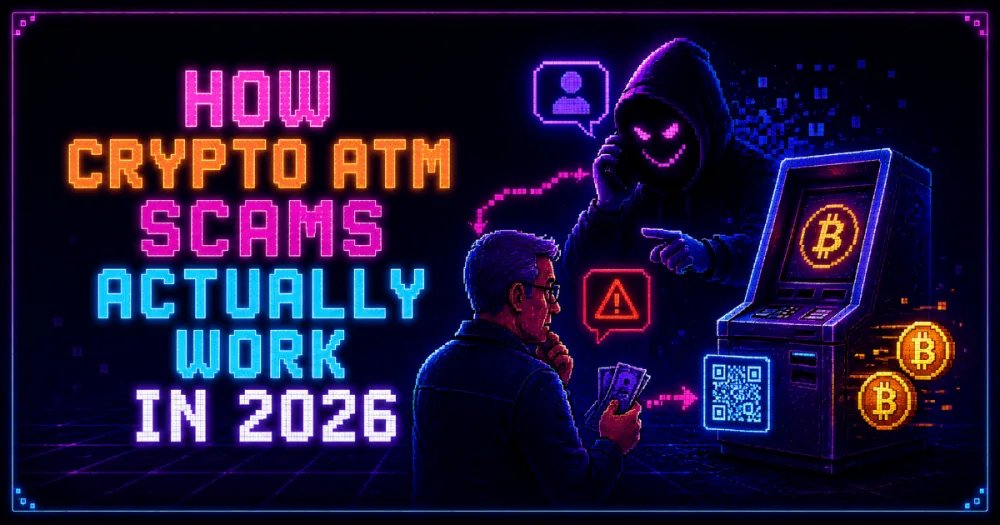
The most common types of crypto ATM scams start with social engineering. According to the FBI and the FTC, in one type of scam, scammers pose as bank employees, police officers, government employees, or technical support staff and then trick the target into believing funds are in danger or that their device has been compromised. The target is told to withdraw cash and deposit it in a crypto ATM.
The cryptocurrency is directed into wallets controlled by the scammer, leaving many crypto ATM scam victims unable to recover their funds. This is the method of operation of the majority of crypto ATM scam victims, many of whom are senior citizens.
QR-Code Based Fraud and Remote Social Engineering
Many scams involving a QR code will have the victim sent a code for a wallet that the scammer asks them to scan at the kiosk before making a deposit; the funds will then go directly to the scammer’s wallet.
Criminals tend to keep the victim on the line for the duration of the transaction, directing them step by step while discouraging them from seeking confirmations outside the transaction. Social engineering crypto ATM scam schemes have become one of the industry’s most popular forms of fraud.
Why Crypto ATMs Are Preferred by Criminals vs Exchanges
Police say that the quick, cash-based nature of crypto exchanges makes them attractive to criminals, because once the cryptocurrency is sent, it is very difficult to reverse the transaction.
Officials continue to raise alarms about the cash to crypto fraud risk of the kiosks, which offer fewer opportunities for on-the-spot detection and rejection than a bank branch.
| Common Crypto ATM Scam Type | Typical Method Used by Criminals |
| Impersonation Fraud | Criminals pose as banks, police, government agencies, or tech support |
| QR-Code Scam | Victims scan a wallet QR code supplied by the fraudster |
| Remote Social Engineering | Scammers stay on the phone and guide victims through the transaction |
| Emergency Payment Fraud | Victims are told their funds are at immediate risk |
| Cash-to-Crypto Transfer Scam | Cash is converted into cryptocurrency and sent to a criminal-controlled wallet |
Why Regulators Consider Crypto ATMs High-Risk Infrastructure
Lack of Real-Time Fraud Prevention Systems
Regulators explain that once the payments are made, there is little opportunity to halt payments linked to scams; customary financial institutions would be able to halt suspicious transfers, while cryptocurrency transactions are fast and often cannot be reversed. In 2025, FinCEN issued a notice about these risks and scams related to crypto kiosks.
Authorities say that scammers often sit with victims, walking them through the transaction step-by-step in real-time, and this is part of the reason for crypto ATM crackdown.
Weak Identity Verification Compared to Exchanges
While most operators check customer identities, the controls at kiosks are regarded by regulators as less rigorous than at exchanges.
Exchanges typically combine know your customer checks with transaction monitoring and automated transaction risk detection systems. As a result, authorities continue to push for stricter KYC requirements crypto ATMs.
Cash-to-Crypto Anonymity and AML Blind Spots
Regulators remain concerned about the conversion of cash into digital assets. FinCEN has warned that crypto kiosks are increasingly used in scam payments and other illicit activity when anti-money laundering controls are insufficient.
Authorities continue to strengthen AML crypto ATM rules and broader financial regulation crypto kiosks efforts as they address these compliance risks.
US vs Europe: Different Approaches to Crypto ATM Regulation
US: State-Level Bans vs Federal Oversight Gaps
The United States has a piecemeal regulatory framework for cryptocurrency kiosks. Anti-money laundering regulations are mainly enforced by federal agencies such as FinCEN, while most consumer protection regulations exist at the state level, resulting in a patchwork of federal and state regulations across the United States.
In 2026, Indiana passed a statewide cryptocurrency kiosk ban, and Tennessee joined with similar legislation, strengthening the pressure on crypto ATM regulations US.
Europe: Compliance-First Model Under AML Frameworks
In contrast, Europe has focused mainly on supervision, with the EU MiCA regulation establishing pan-European rules for crypto service providers and other legislation strengthening anti-money laundering measures such as customer due diligence and transaction monitoring.
The model has influenced crypto ATM regulations Europe, which stresses compliance, transparency, and risk management.
Impact on Global Crypto Kiosk Operators
In addition, differences among markets with respect to the licenses to be obtained, information to be supplied and operational oversight may apply.
Most companies are scaling back plans to expand because of increased oversight and growing crypto ATM restrictions across major markets.
| Regulatory Area | United States | Europe |
| Primary Approach | State-level enforcement and restrictions | Compliance-focused regulatory framework |
| Key Regulators | FinCEN, state regulators, attorneys general | European Commission, ESMA, AMLA, national regulators |
| Licensing Requirements | Vary by state | Increasingly harmonized under MiCA |
| AML Controls | Federal AML obligations with state-level differences | Unified AML standards across member states |
| Recent Trend | Transaction limits, restrictions, and state bans | Enhanced monitoring, KYC, and compliance requirements |
| Impact on Operators | Regulatory fragmentation and legal uncertainty | Higher compliance costs but clearer rules |
What Happens Next for Crypto ATMs in 2026 and Beyond
Will Crypto ATMs Disappear Completely or Evolve?
Nevertheless, few crypto ATMs have been decommissioned, and large numbers of crypto kiosks are still operating, according to data from Coin ATM Radar, though installation of new crypto ATMs has slowed considerably.
The industry’s future likely depends on whether it adapts to stricter compliance and anti-fraud requirements. The debate around Bitcoin ATMs disappearing US Europe continues, but recent regulatory actions suggest that authorities are increasingly focused on reform rather than outright prohibition.
Shift Toward Regulated On-Ramp Exchanges Instead of Kiosks
At the same time, consumers are increasingly using regulated exchanges and mobile applications, which tend to have lower fees, more stringent identity verification, and more financial services available than physical kiosks.
Read Also: US SEC Names Digital Assets a Strategic Priority
Considering how high regulatory requirements are, a move towards supervised digital onboarding channels is likely, and should prove to be one of the most important developments for crypto ATMs 2026 and the digital asset market as a whole.
Possible “Survival Niche” for Compliant ATM Providers
Nevertheless, likely there will be some markets where banking access and regulated exchanges do not yet exist, where success depends on improved compliance and monitoring programs and on consumer protection measures.
This may not lead to a return to boom levels of growth, but instead a smaller, more regulated market. However, even as crypto ATMs decline, there may be a limited but sustainable role for service providers who can navigate the increasing regulation.
FAQ
Are Crypto ATMs Being Banned Everywhere?
No. Most jurisdictions are adopting regulations instead of banning it outright. A number of U.S. states have responded by moving to prohibit the use of crypto kiosks.
Why Are Authorities Concerned About Crypto ATMs?
Regulators and police note increased losses from scams, the risk of money laundering, and the difficulty of recovering funds after completion of a transfer.
Are Crypto ATMs Still Legal in Europe?
Yes. Cryptocurrency ATMs are legal in most European countries but are subject to stricter licensing, customer verification, and surveillance requirements.
Why Do Scammers Frequently Use Crypto ATMs?
Fraudsters may use the speed and irreversibility of cryptocurrency transactions to pressure victims into sending money to the scammer before they can recover it.
Do Crypto ATMs Have a Future?
A diluted form of the industry could continue if compliance levels are raised and consumer protections are improved. Operators who meet those requirements could serve niche markets without crypto alternatives.