Prediction markets are once again making headlines for scandal. Researchers have linked short-term Polymarket contracts to bitcoin price manipulation.
Researchers from Stanford University and Singapore Management University identified a vulnerability in Polymarket’s five-minute bitcoin (BTC) price prediction markets. The contracts allow bets on whether BTC▲$62,630.00’s price will be above or below a set level in five minutes.
Hot topic: Bitcoin Price Can Drop Below $53K and Still Hit $500K, PlanB Says
Since settlement is based on Chainlink (LINK) price data at the window’s close, traders have an incentive to influence the spot market just before settlement.
The authors analyzed activity from July 2024 and found sharp spikes in spot market orders before settlement, followed by rapid price reversals. They estimate the scheme redistributed about $1.28 million from retail traders to manipulators.
Contents
How Polymarket Manipulation Works and Why Bitcoin Is Vulnerable
Researchers studied contracts where traders bet on whether bitcoin’s price would be above or below a set level in five minutes. The contracts settle based on Chainlink price data at the window’s close. That creates an incentive for large players to influence the spot market just before settlement. Analysis showed sharp spikes in spot orders seconds before the window closed, followed by rapid price reversals–a classic sign of a crypto market manipulation.
The authors stressed that prediction markets aren’t inherently vulnerable. The main issue is the short five-minute window, which makes settlement predictable. Extending the contract to 15 minutes almost entirely eliminates the effect, the study found. Alternative settlement methods, such as time-weighted average price, could also reduce risks.
Read more: Bitcoin Reclaims $65K — What’s Next for the Crypto Market in the Second Half of July?
Prediction Market Growth and Regulatory Context
The study comes as prediction markets hit record volumes. In June 2026, combined Kalshi and Polymarket trading volume exceeded $44B, driven by the FIFA World Cup. World Cup winner markets generated more than $5.4B in total volume–$4.25B on Polymarket and $1.2B on Kalshi.
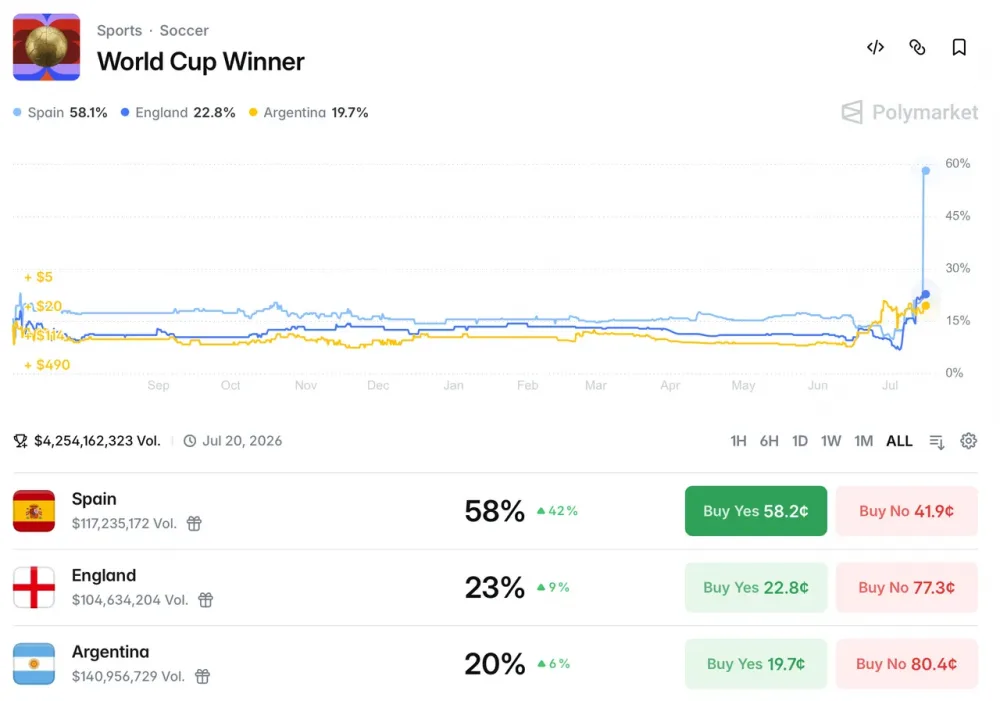
At the same time, the sector faces growing regulatory pressure. Several US states have sued Kalshi and Polymarket over unlicensed sports betting. The CFTC argues that federally regulated event contracts fall under its exclusive jurisdiction–not state gambling laws.
Cases are moving through federal courts, and conflicting appellate rulings could push the US Supreme Court to decide whether states or the CFTC have primary oversight authority over prediction markets.
Learn more: Top 5 Prediction Markets Compared — Polymarket, Kalshi, Manifold