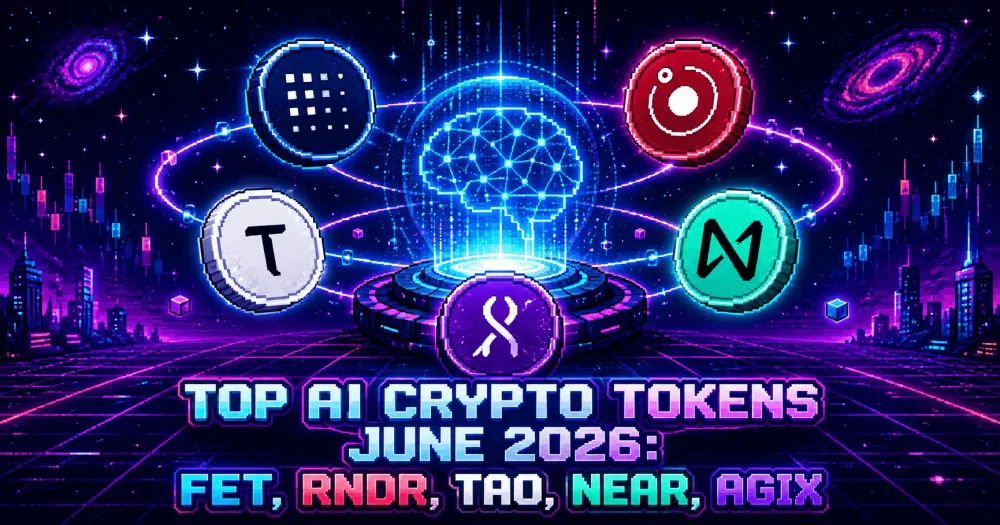
The top AI crypto tokens in June 2026 are no longer just speculative tickers attached to a buzzword. The sector now includes AI agent infrastructure, decentralized compute, subnet marketplaces, data networks, and layer-1 blockchains trying to support artificial intelligence applications at scale. The narrative remains powerful, but the market has become more selective.
FET▲$0.1892, RNDR, TAO▲$215.61, NEAR▲$2.04, and AGIX each represent a different version of the crypto AI trade. FET is tied to the Artificial Superintelligence Alliance and AI-agent coordination. RNDR, now more widely tracked as RENDER▲$1.61, is linked to decentralized GPU rendering and AI compute. TAO powers Bittensor’s subnet economy. NEAR is a broader blockchain that has leaned heavily into user-owned AI. AGIX now needs special treatment because SingularityNET moved into the ASI/FET merger structure, making old AGIX exposure different from simple standalone token exposure.
For investors searching for top AI crypto tokens, the main question is which project has real AI demand, strong infrastructure, clear token mechanics, deep liquidity, and a reason to survive after the hype cycle cools.
Contents
- AI Crypto Market Snapshot June 2026
- 1. FET: Artificial Superintelligence Alliance
- 2. RNDR / RENDER: Decentralized GPU Compute
- 3. TAO: Bittensor and the Subnet Economy
- 4. NEAR: User-Owned AI and Scalable Infrastructure
- 5. AGIX: Legacy SingularityNET Exposure
- Top AI Crypto Tokens Compared
- How to Choose AI Crypto Tokens
- Key Risks in AI Crypto
- Are AI Crypto Tokens Still Worth Watching?
- Final Verdict
- FAQ
AI Crypto Market Snapshot June 2026
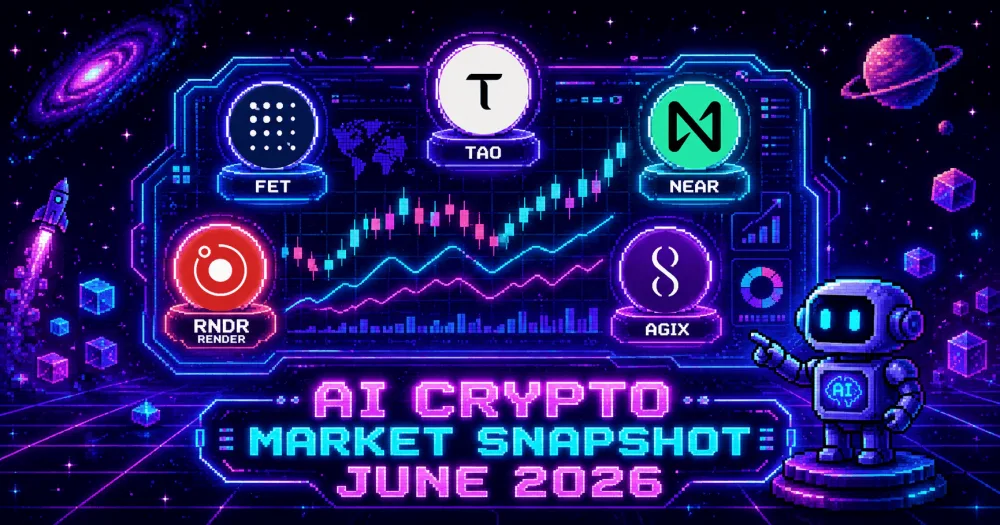
AI tokens are trading in a difficult but active market. Bitcoin dominance remains high, many altcoins are still under pressure, and capital is rotating quickly between narratives. That makes the AI crypto sector volatile. Strong projects can still fall when the wider market turns risk-off.
As of mid-June 2026, CoinMarketCap data shows FET trading around $0.19, RENDER near $1.68, TAO around the $260 range, and NEAR near $2.50. CoinGecko places AGIX around $0.08–$0.09 with relatively small market activity, while SingularityNET’s official focus has shifted toward the broader Artificial Superintelligence Alliance integration.
These numbers can move quickly, but they show the current shape of the market. TAO remains the largest premium AI-native asset by price per token. RENDER still carries a major AI compute narrative. NEAR has broader layer-1 liquidity. FET is the main traded symbol for the ASI alliance. AGIX is best viewed as a legacy or migration-related asset rather than a clean large-cap AI token.
| Token | Main AI Theme | Approx. June 2026 Market Position | Key Question |
|---|---|---|---|
| FET | AI agents and ASI infrastructure | Mid-cap AI token near $0.19 | Can the ASI alliance turn narrative into usage? |
| RENDER | Decentralized GPU compute | Top-100 style AI compute asset near $1.68 | Can real AI/rendering demand support token value? |
| TAO | Bittensor subnets | High-value AI protocol token near $260 | Can subnets prove paid external utility? |
| NEAR | User-owned AI and scalable apps | Large layer-1 near $2.50 | Can AI become more than a branding layer? |
| AGIX | Legacy SingularityNET / ASI migration | Small legacy token market | Is exposure better through FET/ASI instead? |
1. FET: Artificial Superintelligence Alliance
FET is one of the most important top AI crypto tokens because it now represents the public market face of the Artificial Superintelligence Alliance (ASI). The alliance brought together Fetch.ai, SingularityNET, and Ocean Protocol under a larger vision for decentralized AI. That makes FET more than an old Fetch.ai token; it is now tied to a broader attempt to build AI agents, data services, and open AI infrastructure.
The FET narrative is strongest when the market cares about autonomous agents. If AI agents become useful in trading, scheduling, data exchange, automation, or machine-to-machine coordination, FET could benefit from renewed attention. The project’s challenge is proving that these systems generate sustained on-chain demand rather than only speculative interest.
In June 2026, FET remains under pressure compared with its strongest cycle highs. That does not make it irrelevant, but it means the market is demanding evidence. The token needs usage, integrations, and visible ASI ecosystem growth to justify its place among the top AI crypto tokens.
FET Strengths and Risks
FET has a strong narrative because it combines several AI crypto projects under one alliance. That gives it brand power, developer resources, and a clearer story than many smaller AI tokens. It also benefits from the search demand around AI agent crypto projects.
The risk is execution. Mergers can create confusion, token migration issues, uneven branding, and unclear user demand. If the ASI alliance sounds impressive but does not produce active products, FET may trade like a narrative asset rather than an infrastructure token.
2. RNDR / RENDER: Decentralized GPU Compute
RNDR, now commonly tracked as RENDER, is one of the clearest decentralized AI compute tokens in the market. Its core idea is to connect users who need GPU power with providers who have available compute resources. Originally known for rendering workloads, Render has become part of the broader AI infrastructure conversation because AI models need enormous compute capacity.
The appeal is straightforward. AI growth has created a global hunger for chips, GPUs, cloud capacity, and rendering power. If decentralized networks can supply useful compute at competitive rates, tokens like RENDER may have a real role beyond hype.
In June 2026, RENDER trades well below its strongest market-cycle excitement, but the AI compute narrative remains alive. The token’s long-term case depends on actual network usage, demand for GPU workloads, and whether decentralized compute can compete with centralized cloud providers.
Related: Best Memecoins to Buy in June 2026: Data-Driven Look at the Most Traded and Trending Tokens
RENDER Strengths and Risks
RENDER has a practical story. Unlike abstract AI tokens, it points to a clear resource: GPU capacity. That makes it easier for investors to understand why demand might exist. It also connects naturally to AI, gaming, design, visual effects, and metaverse-style workloads.
The risk is competition. Centralized cloud providers are powerful, and decentralized compute must prove reliability, pricing, latency, and ease of use. If users prefer traditional cloud tools, token demand may lag behind the story.
3. TAO: Bittensor and the Subnet Economy
TAO is one of the most distinctive top AI crypto tokens because Bittensor attempts to build a decentralized machine intelligence network through subnets. Each subnet can focus on different services, models, data tasks, inference, or AI-related outputs.
The reason TAO attracts attention is its ambition. Instead of one app or one compute marketplace, Bittensor tries to create an incentive system where useful machine intelligence can be rewarded. That makes it one of the most watched decentralized AI crypto projects in the market.
In June 2026, TAO is still volatile. CoinMarketCap AI updates show sharp moves around the $220–$260 range, with the market repeatedly asking whether subnets can generate real, repeatable revenue. That is the central issue. If Bittensor subnets prove paid utility, TAO may keep its premium. If activity relies too much on internal emissions and narrative demand, the valuation becomes harder to defend.
TAO Strengths and Risks
TAO’s strength is that it is different. Bittensor has a deep community, strong mindshare, and a technical structure that appeals to investors looking for more than another AI branding play. Its subnet model creates room for many experiments under one token.
The risks are complexity, governance disputes, subnet quality, and proof of real external demand. If users cannot clearly see which subnets generate value, TAO may remain difficult to price. A complex project can attract loyal believers, but it can also confuse ordinary investors.
4. NEAR: User-Owned AI and Scalable Infrastructure
NEAR is not always grouped with pure AI tokens, but it belongs in this comparison because it has made user-owned AI a central part of its current direction. NEAR is a scalable layer-1 blockchain with a broader application ecosystem, and that makes it different from narrower AI coins.
The investment case is that NEAR may support AI applications, chain abstraction, user-owned data, and consumer-friendly crypto tools. If AI apps need fast blockchain infrastructure, identity, payments, or user-controlled agents, NEAR has a plausible role.
In June 2026, NEAR has shown AI-linked momentum, with market updates pointing to rallies tied to decentralized AI narratives.
The key issue is whether that attention translates into products users actually need. A large layer-1 can attach itself to AI, but the market will eventually ask how much revenue, activity, and token demand AI creates.
Related: Top Solana DEXs: Jupiter, Raydium, Orca Compared
NEAR Strengths and Risks
NEAR has stronger base-chain liquidity and broader infrastructure than many smaller AI coins. That can help during market rebounds because investors already know the project and exchanges already support it. It also has room to absorb new narratives without relying on one product.
The risk is dilution of focus. NEAR is a blockchain first, not a single-purpose AI network. If AI becomes only a marketing layer, it may not deserve the same multiple as more AI-native assets. The project must show that AI activity creates real network demand.
5. AGIX: Legacy SingularityNET Exposure
AGIX is the trickiest name on this list. Historically, SingularityNET was one of the best-known AI crypto projects, and AGIX was its token. But after the Artificial Superintelligence Alliance merger process, AGIX is no longer a simple standalone large AI token story. AGIX holders have been directed through migration paths into the broader FET/ASI structure.
That means AGIX should not be treated the same way as FET, RENDER, TAO, or NEAR. It may still trade on some data platforms and exchanges, but liquidity and market relevance are much thinner than before. CoinGecko and CoinMarketCap data show AGIX trading at a small scale compared with the main AI leaders.
The important point for readers is clarity. Searching for AGIX in June 2026 can lead to outdated assumptions. Investors should check whether they are looking at legacy AGIX, migrated FET/ASI exposure, or an exchange-specific listing. The AI story behind SingularityNET still matters, but the cleanest current market exposure may sit closer to the ASI/FET structure than old AGIX.
AGIX Strengths and Risks
AGIX retains historical recognition because SingularityNET helped define the early AI crypto category. It also remains connected to the broader ASI story through migration and alliance history.
The risk is confusion. Legacy tokens, migration ratios, delistings, low volume, and inconsistent exchange support can make AGIX harder to trade safely. Anyone considering it should check liquidity, contract details, and official migration information first.
Related: Top 10 Crypto Wallets (May 2026): Hot & Cold Options Reviewed
Top AI Crypto Tokens Compared
The top AI crypto tokens are not interchangeable. Some are infrastructure plays. Some are compute plays. Some are ecosystem plays. Others are legacy migration assets that require extra care.
| Token | Best Use Case Narrative | Investor Appeal | Main Risk |
|---|---|---|---|
| FET | Autonomous AI agents and ASI coordination | Broad alliance narrative | Execution and migration complexity |
| RENDER | GPU compute for AI and rendering | Clear real-world resource demand | Cloud competition and network adoption |
| TAO | Decentralized machine intelligence subnets | Unique AI-native architecture | Subnet utility and valuation complexity |
| NEAR | User-owned AI on scalable blockchain rails | Large ecosystem and AI positioning | AI narrative may outpace usage |
| AGIX | SingularityNET legacy and ASI migration | Historical AI brand recognition | Low liquidity and migration confusion |
For most readers, FET, RENDER, TAO, and NEAR are the more practical names to watch. AGIX belongs in the discussion because of its history and search demand, but it should be approached with extra caution.
How to Choose AI Crypto Tokens
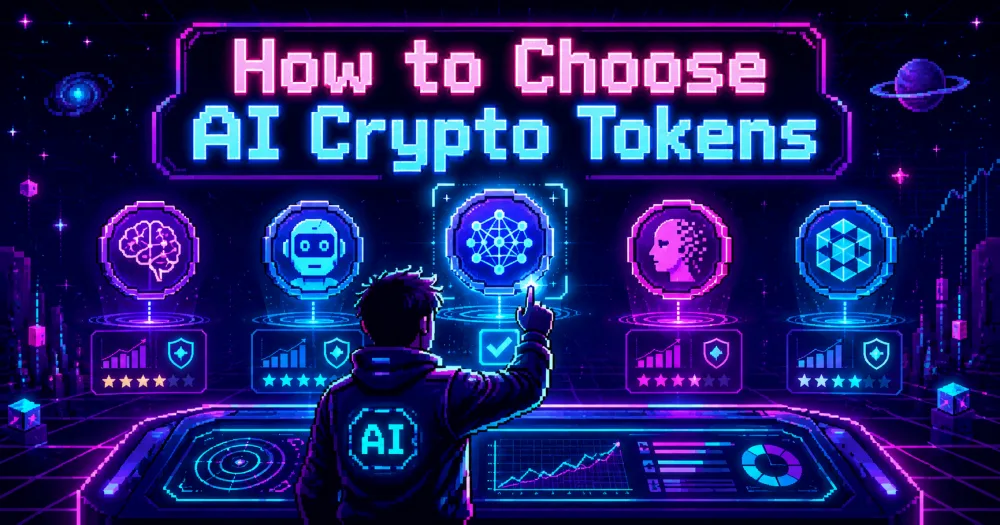
Choosing among the top AI crypto tokens starts with understanding what kind of AI exposure you want. A compute token is not the same as an agent token. A subnet economy is not the same as a layer-1 blockchain. A legacy migration asset is not the same as a liquid market leader.
A practical checklist helps:
- Look for real usage, not only AI branding.
- Check liquidity, market cap, and exchange depth.
- Understand token utility before buying.
- Watch whether revenue comes from users or emissions.
- Avoid old tickers without checking migration status.
- Compare AI crypto market cap against actual adoption.
This approach matters because the AI narrative attracts weak projects. Some tokens add “AI” to branding without solving an AI problem. Others may be real but still overpriced. The strongest projects should make it clear who uses the network and why the token matters.
Related: Top 5 Altcoins for the Next 10-100x Crypto Bull Run in 2026: High-Potential Crypto Picks
Key Risks in AI Crypto
AI crypto can move fast because it sits at the intersection of two volatile markets: artificial intelligence and digital assets. When AI equities rally, crypto traders often search for blockchain versions of the same theme. When altcoins fall, AI tokens can drop harder than large-cap assets.
The main risks include:
- Narrative risk if AI hype fades.
- Liquidity risk on smaller tokens.
- Token migration confusion.
- Weak connection between project usage and token demand.
- Competition from centralized AI platforms.
- Regulatory pressure around data, compute, and financial products.
Investors should also watch for token unlocks, emissions, and incentive programs. A project can be technically interesting while still producing poor token returns if supply grows faster than demand.
Are AI Crypto Tokens Still Worth Watching?
AI crypto tokens are still worth watching because the underlying theme is real. AI needs compute, data, automation, agents, payments, coordination, and marketplaces. Blockchain can play a role in some of those areas, especially where open access, incentives, and ownership matter.
The problem is that not every AI token captures that value. Some projects may build useful tools while their tokens remain weak. Others may rally hard on narrative before usage catches up. This gap between technology and token value is the biggest challenge in the sector.
The best AI crypto investments in 2026 will likely be those with visible demand, strong liquidity, credible teams, and token designs linked to actual usage. That does not remove risk, but it helps separate infrastructure from hype.
Final Verdict
The top AI crypto tokens in June 2026 show how broad the sector has become. FET represents the ASI alliance and AI-agent infrastructure. RENDER focuses on GPU compute. TAO gives investors exposure to Bittensor’s subnet economy. NEAR offers a scalable layer-1 angle on user-owned AI. AGIX remains relevant historically, but its current role is complicated by migration into the FET/ASI structure.
The sector still has promise, but it is no longer enough to buy anything with AI in the name. Investors need to compare usage, liquidity, token mechanics, migration status, and whether real demand supports the story.
AI will likely remain one of crypto’s strongest narratives in 2026. But the winners will need more than a narrative. They will need products, users, and token models that survive when hype fades.
FAQ
What are the top AI crypto tokens in June 2026?
The top AI crypto tokens to watch in June 2026 include FET, RENDER, TAO, NEAR, and AGIX. Each represents a different part of the AI crypto market, from agents and compute to subnets, layer-1 infrastructure, and legacy AI-token exposure.
Is FET the same as ASI?
FET is closely tied to the Artificial Superintelligence Alliance and the ASI migration structure. FET became the main traded symbol for the alliance process, while AGIX and OCEAN were assigned migration ratios into FET/ASI.
Is RNDR the same as RENDER?
RNDR is the older ticker many traders still use, while RENDER is the newer Solana-based version used by the Render ecosystem. Many market pages now track the token as RENDER.
Why is TAO important in AI crypto?
TAO powers Bittensor, a decentralized AI network built around subnets. Its importance comes from the attempt to reward useful machine intelligence through a crypto incentive system.
Is AGIX still a major AI crypto token?
AGIX is historically important, but in June 2026 it should be treated carefully because of the Artificial Superintelligence Alliance migration. Investors should check whether they are dealing with legacy AGIX or FET/ASI exposure.
Are AI crypto tokens risky?
Yes. AI crypto tokens are risky because prices depend on market sentiment, token liquidity, real usage, competition, emissions, and whether AI demand actually connects to token value.