BIP-110 is one of the most controversial Bitcoin proposals of 2026. Formally called the Reduced Data Temporary Softfork, it would impose one year of consensus-level limits on arbitrary data embedded in Bitcoin transactions. Supporters see the upgrade as protection against blockchain spam. Critics see censorship, technical risk, and a dangerous precedent for Bitcoin governance.
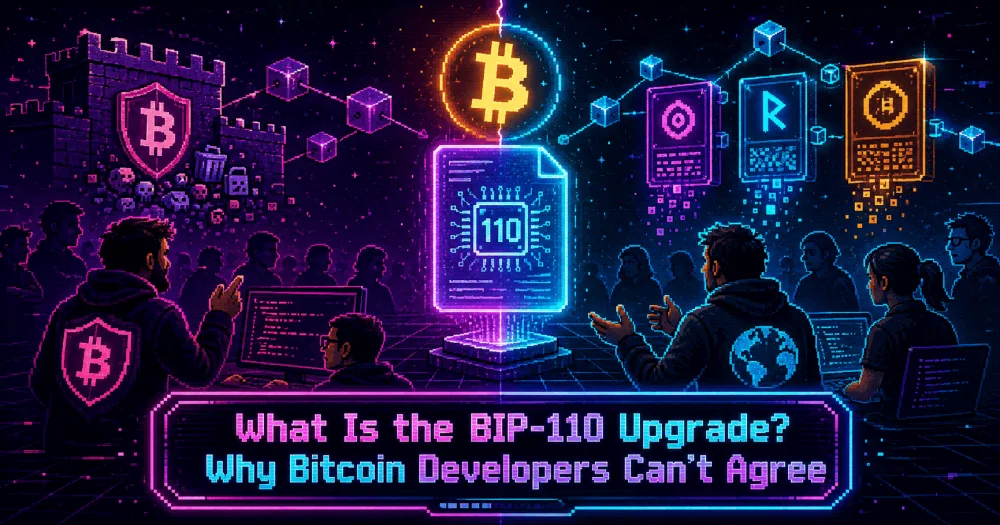
Bitcoin developers are arguing over whether the protocol should distinguish between monetary activity and other valid transactions.
Related: Top July 2026 Crypto Updates: Crypto Market at a Breaking Point — Is Another Crash Coming?
Contents
What Is BIP-110?
BIP-110 is a proposed Bitcoin soft fork written by the pseudonymous developer Dathon Ohm, with the original draft and technical advice credited to Luke Dashjr. The bitcoin improvement proposal was assigned in December 2025 and later marked “Complete.” This means the specification is complete, but the Bitcoin network upgrade has not been approved yet.
Simply put, BIP-110 is a proposal to temporarily limit large data payloads and several data storage methods that rely on Taproot.
What Is a Bitcoin Improvement Proposal (BIP)?
A Bitcoin Improvement Proposal is a formal document describing a possible technical, procedural, or informational change. A BIP can define wallet standards, networking behavior, or a bitcoin protocol upgrade.
Publication does not prove consensus. Miners, nodes, developers, and businesses still decide whether to support a bitcoin upgrade.
Why Was BIP-110 Introduced?
The trigger was Bitcoin Core 30’s relaxation of default OP_RETURN relay limits. Supporters argued that policy filters were already being bypassed through witness data and other structures, making stronger consensus rules necessary.
The goal of bitcoin BIP-110 is to push block space back toward payments because nodes bear lasting storage costs while miners receive only a one-time fee.
How BIP-110 Works
How does BIP-110 work? For roughly one year after activation, new transactions would face seven additional consensus restrictions.
BIP-110 would limit most new scriptPubKeys to 34 bytes while allowing OP_RETURN outputs up to 83 bytes. It would restrict many data pushes and witness arguments to 256 bytes, block spending through undefined witness or Tapleaf versions, prohibit Taproot annexes, cap Taproot control blocks, disable OP_SUCCESS opcodes, and reject Tapscripts that execute OP_IF or OP_NOTIF.
Coins created before activation would be grandfathered. When the temporary bitcoin soft fork expired, the restrictions would stop unless another proposal extended them.
Why Was BIP-110 Proposed?

The BIP-110 debate reflects a conflict over what Bitcoin block space is for. One side views the network as sound money and a payment system. The other argues that valid bitcoin transactions should compete through fees without developers judging their purpose.
The Rise of Ordinals, Runes, and BRC-20
Ordinals appeared after Taproot made it practical to place large inscriptions inside discounted witness data. Users began attaching images, text, and files to individual satoshis.
BRC-20 tokens then used Ordinals-style inscriptions to create transferable balances. The Runes protocol introduced a more efficient fungible-token system but also increased demand for block space during major launches.
These systems created new markets and miner revenue while becoming a major Bitcoin use case.
Related: BitMart Is Shutting Down: Why the Crypto Exchange Is Closing and What Users Must Do Now
Concerns Over Blockchain Spam
Supporters call much of this activity blockchain spam because it consumes scarce block space without transferring BTC▲$62,630.00 conventionally. They argue that files belong on Nostr, IPFS, BitTorrent, cloud platforms, or dedicated chains.
BIP-110 would not eliminate all data storage. The bitcoin proposal instead raises the cost and complexity of inscriptions while declaring large arbitrary data unsupported.
The Impact on Bitcoin Nodes and Transaction Fees
Every full node validates the chain, while archival nodes also retain historical blocks. Larger bitcoin transactions increase bandwidth, storage, synchronization, and validation demands.
Congestion can raise fees when inscriptions compete with payments. Supporters say this harms ordinary users and makes nodes more expensive to operate.
Opponents answer that Bitcoin already has a fee market and a fixed block-weight limit. Miners choose the highest-paying valid transactions. In their view, demand is not spam merely because some users dislike it.
Why Bitcoin Developers Can’t Agree
Why Bitcoin developers can’t agree comes down to conflicting definitions of neutrality, decentralization, and acceptable intervention. Both sides claim to protect Bitcoin but identify different threats.
Arguments in Favor of BIP-110
Supporters argue that the BIP-110 upgrade would reduce data abuse, protect node resources, and preserve Bitcoin’s monetary focus. Fees compensate miners once, while node operators bear continuing storage and bandwidth costs.
They also say policy filtering is insufficient because miners can include transactions directly. A bitcoin protocol upgrade would make restrictions enforceable by participating nodes rather than optional within individual mempools.
Its one-year duration would provide time to measure results and develop a longer-term approach.
Arguments Against BIP-110
Critics argue that BIP-110 changes valid rules to suppress unpopular users. If transactions pay fees and obey current limits, developers should not decide whether their purpose is worthy.
The restrictions are broader than Ordinals. Some Taproot, Miniscript, presigned transaction, and future scripting constructions could be affected. The specification acknowledges unlikely cases in which newly created outputs could become temporarily difficult or impossible to spend.
Opponents also reject the activation mechanism. Invalidating non-signaling blocks without broad miner and economic support could split the chain instead of delivering a bitcoin upgrade.
The Debate Over Bitcoin’s Neutrality
Why is BIP-110 controversial? Bitcoin neutrality can mean two opposite things.
For supporters, neutrality means protecting permissionless money from non-monetary data that crowds out payments. For opponents, it means enforcing objective rules without judging why users transact.
This Bitcoin governance conflict asks whether technically valid uses may be restricted because of their external costs.
How BIP-110 Could Impact the Bitcoin Ecosystem

Impact on Ordinals, Runes, and BRC-20 Tokens
BIP-110 would severely disrupt common Ordinals methods by limiting large witness payloads and several Taproot techniques. BRC-20 tokens depend on Ordinals infrastructure and would face similar disruption.
The Runes protocol could also be affected where transactions rely on OP_RETURN or infrastructure that assumes current behavior. However, the 83-byte OP_RETURN allowance means not every Rune transaction would become invalid.
Developers could find workarounds, split data, use secondary layers, or migrate elsewhere. Bitcoin BIP-110 would obstruct these systems rather than guarantee their disappearance.
What It Means for Bitcoin Users
Standard BTC payments should generally continue working. Pre-activation UTXOs would be grandfathered, reducing the risk that existing coins become trapped.
Users of advanced Taproot scripts, Miniscript policies, presigned transactions, inscription tools, or token protocols would need to check compatibility. Exchanges and wallets would also need policies for deposits and withdrawals if competing chains emerged.
Potential Effects on Miners and Node Operators
Miners supporting BIP-110 could lose inscription-related fees but gain a chain with less data-storage activity. Miners rejecting it could continue processing currently valid transactions if their chain retained economic support.
Node operators would choose which rules to enforce. BIP-110 nodes would reject some blocks accepted by ordinary Bitcoin Core nodes. That matters only if enough miners, exchanges, wallets, and users recognize the same chain.
Will BIP-110 Be Activated?
Activation remains uncertain and unlikely to occur smoothly. Bitcoin Core has not adopted the BIP-110 implementation, and visible miner support remains far below the required threshold.
Current Community Support
As of July 27, 2026, current-period signaling was roughly 3%, compared with the 55% threshold. The rate changes with every block, but it shows no broad miner coalition behind the bitcoin network upgrade.
Some Bitcoin Knots users and OCEAN-connected miners support BIP-110, while critics reject the restrictions, activation method, or both.
The Activation Process
BIP-110 uses a modified BIP9 process. Miners signal with version bit 4. Reaching 1,109 signaling blocks within a 2,016-block period would lock in the upgrade.
Without voluntary lock-in, mandatory signaling is scheduled for blocks 961,632 through 963,647. Enforcing nodes would reject non-signaling blocks, lock in no later than block 963,648, and activate at block 965,664, expected around September 2026.
The rules would remain active for 52,416 blocks, approximately one year.
Read more: Can Bitcoin Crash to $20K in 2026? What Could Trigger a Historic Crypto Market Collapse
Possible Scenarios for Adoption
A sudden rise in miner and economic support could produce broad activation, although current signaling makes that improbable.
A second scenario is minority activation. BIP-110 nodes reject the dominant chain and continue on a smaller fork with limited hash rate and liquidity.
A third is retreat or revision, leaving existing Bitcoin rules unchanged.
What Comes Next for Bitcoin?
Could BIP-110 Change Bitcoin Development?
BIP-110 could make future bitcoin upgrade debates more cautious. Developers may demand clearer economic support before attaching mandatory activation to a controversial bitcoin soft fork.
It could also encourage narrower alternatives: optional node policies, better pruning, data-availability layers, or scripting changes that separate payments from storage.
What Investors Should Watch Next
Investors should monitor miner signaling, Bitcoin Knots adoption, major mining pools, exchange contingency plans, and any changes before block 961,632. The central risk is whether incompatible rules create confusion over which chain markets recognize as Bitcoin.
Transaction fees and miner revenue also matter. If inscription activity declines, pressure for the BIP-110 upgrade may weaken. If congestion returns sharply, support for restrictions could grow.
FAQ
What is the BIP-110 upgrade?
BIP-110 upgrade is a proposed one-year consensus change called the Reduced Data Temporary Softfork. It would restrict large data fields and several scripting techniques used for arbitrary storage.
Is BIP-110 already active?
No. It is complete as a specification but has not activated. Miner signaling remains far below its 55% voluntary threshold.
Is BIP-110 a hard fork or soft fork?
It is designed as a bitcoin soft fork because upgraded nodes would enforce stricter rules while old nodes could still recognize compliant blocks. Poor coordination could nevertheless create a minority chain split.
Would BIP-110 eliminate Ordinals and BRC-20 tokens?
Not necessarily. It would obstruct common methods used by Ordinals and BRC-20 tokens, but developers could seek workarounds or move activity elsewhere.
Why Bitcoin developers can’t agree on BIP-110?
They disagree over whether arbitrary data is harmful spam or a legitimate fee-paying use of block space. They also dispute the technical risks, activation method, and meaning of Bitcoin neutrality.