The stablecoin infrastructure race is shaping up to be one of the most interesting competitions in the global payments space. Stablecoins no longer sit on crypto exchanges only.

Banks, fintechs, card networks, and multinationals want infrastructure to issue, store, convert, send and receive digital dollars.
This has created a new class of competitors. Stripe is building an end-to-end stack around Bridge and Privy, Circle is building around USDC▲$0.9999, Mastercard has acquired BVNK, Visa has developed its own stablecoin platform, and Fireblocks is providing underlying infrastructure for hundreds of financial companies. The winner of this competition may not necessarily be whoever owns the largest stablecoin, but rather whoever can make stablecoins invisible.
Read more: Bank of America, Citi and Goldman Sachs Join 21-Firm Push for 2027 Stablecoin Launch
Contents
- What Is the Stablecoin Infrastructure Race?
- Stripe and Bridge — The Strongest Full-Stack Contender
- Circle — Building Infrastructure Around USDC
- Mastercard and Visa Bring Stablecoins Into Traditional Payments
- Fireblocks — The Infrastructure Under the Infrastructure
- Paxos and Ripple Target Different Parts of the Market
- Rain and Zero Hash Could Win Specialized Layers
- Why Banks Could Reshape the Market
- Who Is Winning the Stablecoin Infrastructure Race?
- Final Thoughts
- FAQ
What Is the Stablecoin Infrastructure Race?
The stablecoin infrastructure race is the competition to design and deliver the software and financial rails connecting blockchain-based money with traditional finance.
A complete stablecoin stack can include issuance, wallets, compliance, fiat conversion, blockchain transfers, liquidity, merchant acceptance, cross-border payments, cards, treasury, and reporting. With few companies controlling all layers, the strongest competitors are looking to expand their reach beyond a single product.
Stripe and Bridge — The Strongest Full-Stack Contender
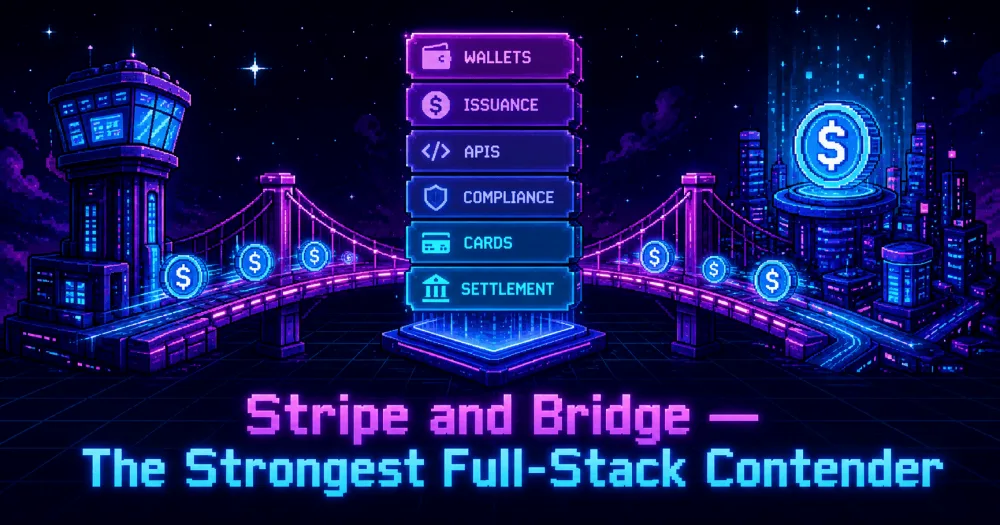
Stripe has arguably the most straightforward path to winning the stablecoin infrastructure race.
Its biggest move so far was acquiring stablecoin infrastructure company Bridge and embedding its technology throughout Stripe’s payments stack.
Bridge provides orchestration between fiat, blockchains, and stablecoins. Its Open Issuance platform allows businesses to create and manage their own stablecoins.
Meanwhile, Stripe’s acquisition of Privy gives it wallet infrastructure.
Together, these services allow businesses to accept stablecoins, create wallets, move between fiat and digital currencies, issue stablecoins, and launch stablecoin-backed cards. Stripe’s biggest advantage is its distribution: millions of businesses already use its conventional payment infrastructure and may be more open to adopting stablecoin options.
Circle — Building Infrastructure Around USDC
Circle started out as the company behind USDC but is becoming a much broader financial infrastructure provider.
Its ecosystem now includes USDC, EURC▼$1.14, interoperability tools, developer infrastructure, and Circle Payments Network. Arc, its Layer 1 blockchain, currently operates in private mainnet ahead of a September 16 public launch. Circle Payments Network connects banks, payment providers, and digital-asset companies to stablecoin-based cross-border payments, merchant payments, payouts, and treasury transfers.
Circle’s strongest advantage in the stablecoin infrastructure race is its existing liquidity. USDC can already be found on numerous exchanges, wallets, DeFi protocols, fintech platforms, and multiple blockchains. However, competitors are eager to issue their own branded stablecoins, so Circle has to prove it can be infrastructure for the wider market rather than just for USDC.
Mastercard and Visa Bring Stablecoins Into Traditional Payments

Mastercard made one of the sector’s biggest moves by acquiring BVNK in August 2026.
BVNK already provided enterprise stablecoin infrastructure connecting digital currencies with banking rails. Businesses can use its platform for wallets, conversions, payments, and cross-border settlement.
Mastercard can now combine that technology with one of the world’s largest conventional payment networks.
Visa is pursuing a similar strategy.
Its stablecoin settlement program has expanded across multiple blockchains. In July 2026, Visa launched (in beta for select clients) the Visa Stablecoin Platform providing infrastructure for institutions to mint, hold, and transfer digital money.
Related: Stablecoin KYC Rules Should Not Cover P2P Transfers, Blockchain Association Warns
The card networks have a huge advantage in the stablecoin infrastructure race: they already connect banks, merchants, fintechs, and consumers globally.
Stablecoins therefore do not need to replace Visa or Mastercard. They could simply become another settlement rail inside their networks.
Fireblocks — The Infrastructure Under the Infrastructure
Fireblocks takes a different approach.
Rather than building a consumer stablecoin brand, it provides payment infrastructure and stablecoin issuance technology to banks, PSPs, fintechs, and crypto companies.
Fireblocks says it processes more than $200 billion in monthly stablecoin volume across more than 300 clients.
Its biggest advantage is neutrality.
If USDC grows, Fireblocks can support USDC infrastructure. If banks launch their own stablecoins, Fireblocks can support those as well. If companies need several stablecoins and blockchains, it can provide the technology connecting them.
Paxos and Ripple Target Different Parts of the Market
Paxos is strong in stablecoin issuance.
It already issues PayPal USD and provides infrastructure that allows companies to create customized stablecoins without having to build reserve management, minting, redemption, and compliance systems themselves.
Its regulatory position also strengthened after Paxos converted its U.S. trust company into an OCC-supervised national trust bank.
That puts it in direct competition with Bridge for companies which want to launch their own stablecoins.
Ripple focuses more heavily on cross-border payments.
Its strategy combines Ripple Payments, RLUSD▲$0.9999, and support for external stablecoins. Instead of assuming one stablecoin will dominate every market, Ripple can route payments through different digital assets and currencies depending on liquidity and geography.
Its long-standing relationships with financial institutions give it a natural advantage in international settlement.
Rain and Zero Hash Could Win Specialized Layers
Not every successful company has to control the whole stack.
Rain is particularly strong in stablecoin-backed cards that connect stablecoin balances with conventional merchant networks.
Zero Hash provides infrastructure that allows financial platforms to add crypto and stablecoin services without having to operate the underlying blockchain systems.
These companies demonstrate why the stablecoin infrastructure race is unlikely to result in one monopoly. Instead, different providers can dominate issuance, wallets, cards, and settlement.
Read More: Stablecoins Are No Longer Just Crypto Liquidity — Are They Becoming the New Financial Rails?
Why Banks Could Reshape the Market
Banks are also entering the competition.
A consortium of more than 20 financial institutions, including Bank of America, Citi, Goldman Sachs, and Deutsche Bank, is preparing a dollar stablecoin targeted for 2027. Other banks are exploring stablecoins and tokenized deposits.
However, banks still need infrastructure – most financial institutions have little incentive to build wallet systems, blockchain integrations, liquidity routing, compliance tools, and issuance technology from scratch.
That is an opportunity for Bridge, Fireblocks, Paxos, BVNK, Zero Hash, and similar providers. Bank-issued stablecoins could therefore strengthen the companies supplying the underlying technology.
Who Is Winning the Stablecoin Infrastructure Race?
There is no single winner yet, but several positions are becoming clear.
Stripe and Bridge currently have the strongest full-stack strategy. Stripe brings merchant distribution, Bridge adds issuance and orchestration, and Privy provides wallet infrastructure. Meanwhile, Visa and Mastercard have the strongest traditional distribution. If stablecoins become another payment rail rather than replacing payments altogether, both networks could become major beneficiaries. Circle has the strongest stablecoin-native network effect. USDC already provides global liquidity and adoption while Circle builds more infrastructure around it. Fireblocks may be the strongest neutral infrastructure provider: it can benefit regardless of which stablecoin, blockchain, bank, or fintech ultimately succeeds.
Paxos, Ripple, Rain, BVNK, and Zero Hash can each build large businesses around individual parts of the stack.
The stablecoin infrastructure race may therefore produce several winners rather than one company dominating the competition.
Final Thoughts
The biggest change in the stablecoin infrastructure race is that competition is moving beyond the stablecoins themselves. Businesses increasingly care about what they can actually do with digital money.
Stripe and Bridge currently have perhaps the broadest strategy. Visa and Mastercard have unmatched traditional payment distribution. Circle controls one of the most important stablecoin networks, and Fireblocks provides infrastructure beneath much of the industry.
The ultimate winner may be the company that can hide all this complexity behind one API.
FAQ
What is the stablecoin infrastructure race?
The stablecoin infrastructure race is the competition among payment companies, fintechs, crypto firms, and financial networks to build technology for stablecoin issuance, wallets, payments, settlement, compliance, and conversion.
Which company is leading stablecoin infrastructure in 2026?
Stripe and Bridge currently have one of the broadest end-to-end offerings. Circle, Fireblocks, Visa, Mastercard, and Paxos are also major competitors.
Why did Mastercard acquire BVNK?
BVNK provides stablecoin infrastructure for wallets, conversions, payments, and cross-border settlement. Mastercard completed its acquisition in August 2026.
Can banks build their own stablecoins?
Yes. Banks can develop stablecoin infrastructure internally or use providers such as Paxos, Bridge, Fireblocks, and other enterprise blockchain companies.
Will stablecoins replace Visa and Mastercard?
Not necessarily. Visa and Mastercard are integrating stablecoins into existing payment and settlement networks, so stablecoins could become another rail beneath the card networks rather than replacing them.