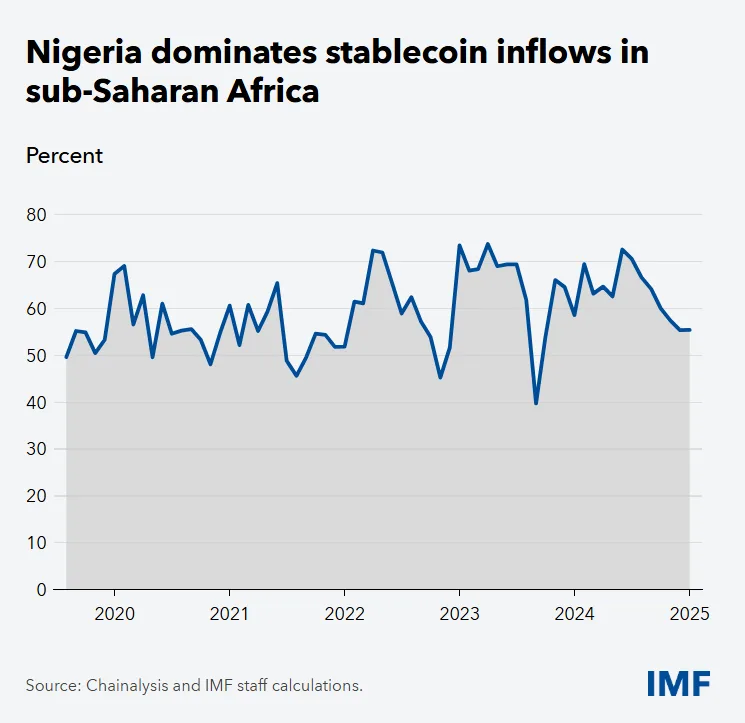
Nigeria stablecoin share has reached 60% of inflows in sub-Saharan Africa, raising new concerns over currency control, the IMF said.
Nigeria’s use of dollar-pegged stablecoins is moving beyond a payments workaround and into a policy concern for the IMF, as the country dominates stablecoin flows across sub-Saharan Africa.
In a June 16 country focus note, Axel Schimmelpfennig, the IMF mission chief for Nigeria, and Bo Zhao, an economist in the fund’s Strategy, Policy, and Review Department, said Nigeria has become a meaningful market for stablecoins.
Read also: Bitcoin Price Risks Pullback as Institutions Hold Back, Analysts Warn
As the IMF noted, Nigeria received about $59 billion in crypto inflows between July 2023 and June 2024, referring to Chainalysis data. The country also ranked second globally in Chainalysis’s 2024 crypto adoption index and sixth in 2025.
Within sub-Saharan Africa, Nigeria accounts for roughly 60% of stablecoin inflows since 2019, the IMF said.
Why Nigerians Are Using Stablecoins
The IMF explained that using stablecoins allows Nigerian residents and businesses to get their remittances and make international payments via crypto wallets less costly than with conventional means.
The organization noted that the average cost of sending $200 to sub-Saharan Africa remains around 9% of the transaction value, above the global average of 6%, citing World Bank data.
Domestic pressure also pushed users toward stablecoins as the naira weakened sharply in 2023 and 2024, inflation stayed high, and access to foreign currency remained constrained, the IMF noted.
Digital Dollarization Risk
Although the IMF admitted that stablecoins can support faster payments, trade and financial inclusion, wider use may also weaken monetary control, the organization warned.
Because most stablecoins are denominated in dollars, heavy use can resemble a digital form of dollarization, which can reduce demand for the naira and weaken the effect of domestic monetary policy, the IMF argues.
The organization thinks that Nigeria should focus on stronger oversight, better data on naira-stablecoin conversions rather than trying to suppress stablecoin use outright.
Read more: Why Stablecoins Are the New Global Payment Layer in 2026: The Shift in Global Finance