The two largest stablecoins are no longer in direct competition. Their roles have diverged, according to a Dune report.
Tether’s USDT has become the dominant instrument for on-chain payments, while Circle’s USDC has taken the lead in decentralized finance. Together, they account for about 83% of the $315B stablecoin market.
Hot topic: Retail Now Bullish as Bitcoin Rallies, But That’s the Problem, Analysts Say
The study covered more than 200 stablecoin tokens across various blockchains. Dune analysts emphasized that a stablecoin’s use case depends on the network and specific scenarios.
Contents
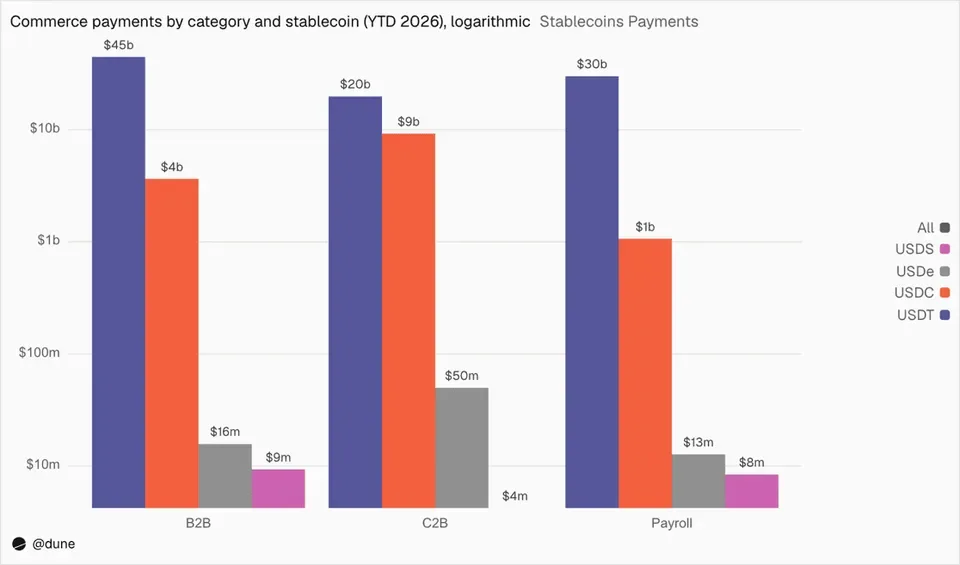
USDT Wins in Payments: $95B vs. $14B for USDC
According to Dune, USDT▲$0.9991 processed about $95B in identified commercial payments in the H1 of 2026. USDC▲$0.9999, by contrast, handled just $14B. In B2B payments, USDT’s share is even higher: $44.2B of a total $48B.
The key factor behind USDT’s dominance is the Tron network. About 93% of USDT supply on Tron is held in regular wallets, not exchanges–indicating use for remittances and everyday payments. USDT on Tron has become a tool for fast, cheap cross-border transfers, especially in regions with unstable national currencies.
Read more: USDT vs EU Regulation — Why Tether Is Facing Legal and Compliance Challenges in Europe
USDC Dominates DeFi: $2.6T on Base and Leadership in On-Chain Trading
USDC has become the backbone of decentralized finance (DeFi). In June 2026, USDC transfer volume on Base reached about $2.6T, with $1.6T on Ethereum. Average daily USDC turnover on Base was roughly 20 times its supply, reflecting active use in trading and DeFi protocols.
USDC serves as trading collateral on Base and collateral for perpetual contracts on HyperEVM. Unlike USDT, which is used by centralized platforms on Ethereum as a settlement asset, USDC has become the primary tool for interacting with decentralized exchanges and lending protocols.
Read more: USDC Crypto Future — Can USDC Become the Leading Stablecoin in 2026?
Record Transaction Volumes and Regulatory Context
According to Visa Allium, adjusted stablecoin transaction volume hit a record $1.79T in June 2026–up 63% from May and slightly above the previous record of $1.78T set in February.
USDC accounted for the bulk of transaction volume at $1.21T, or 67%, while USDT contributed $576B, or 32%. Base was the most-used network at 31.5% of total volume, nearly tied with Ethereum. Tron ranked third with $320B, about 18%.
The record growth confirms the expanding real-world use of stablecoins–from payments to DeFi and cross-border transfers.
Stablecoins also received a regulatory boost in the US with the 2025 GENIUS Act, which created the first federal framework for payment stablecoins. A new entrant, Open USD (OUSD), has entered the market backed by more than 140 companies, including Visa and Mastercard.
Learn more: These US Banks Now Support Bitcoin & Stablecoins in 2026 — Full Breakdown of Crypto Banking Access