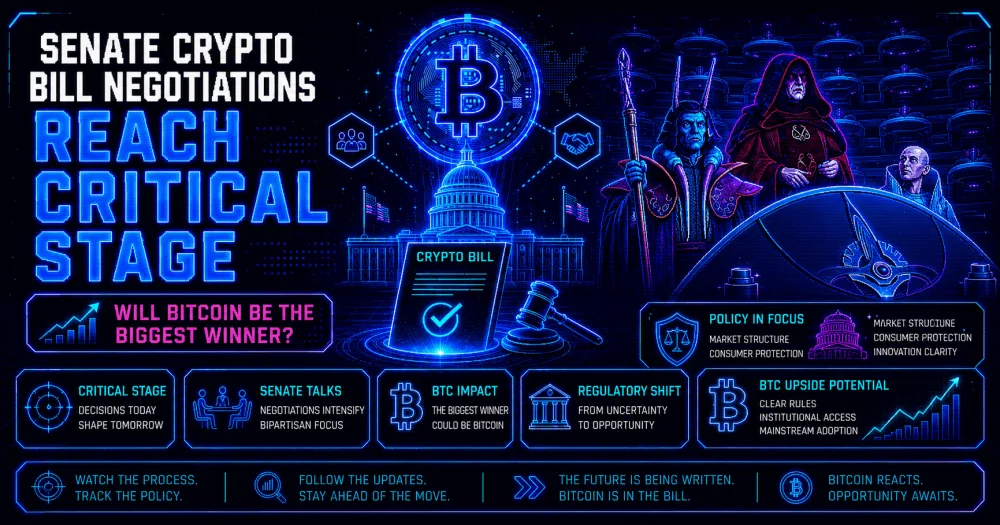
The US crypto regulatory environment is at a critical juncture. Two Senate committees have approved market-structure frameworks, but a full Senate vote on the crypto bill is yet to happen. With the state work period set to begin on August 10, negotiations could have far-reaching implications for trading, custody, token issuance, and institutional demand for several years to come.
Contents
- Why Senate Crypto Bill Negotiations Have Reached a Critical Stage
- What Is the CLARITY Act and Why It Matters for Crypto
- The Biggest Sticking Points in Senate Negotiations
- How the Crypto Bill Could Impact Bitcoin
- Which Crypto Sectors Could Benefit the Most?
- Possible Market Scenarios After the Senate Vote
- What Investors Should Watch Next
- FAQ
Why Senate Crypto Bill Negotiations Have Reached a Critical Stage
Why the Senate Vote Has Become the Biggest Crypto Catalyst of July
The House of Representatives passed H.R. 3633, the CLARITY Act, by a 294–134 vote on July 17, 2025, with 78 Democrats joining Republicans in support. The Senate Banking Committee later advanced its amended version of the bill by a 15–9 vote on May 14, 2026, sending it for the full Senate’s consideration. It remains to be seen whether Senate leaders will secure the necessary votes for the full Senate to approve the measure. Traders are speculating that a floor agreement in the Senate could create a strong bullish reaction in Bitcoin near key technical levels.
Read more: How the CLARITY Act Could Reshape US Crypto Trading
What’s Holding Up the CLARITY Act Negotiations
The negotiations concern ethics, DeFi, stablecoin rewards, investor protection, anti-money-laundering (AML), and regulatory discretion, as well as the jurisdiction of the Securities and Exchange Commission (SEC) and the Commodity Futures Trading Commission (CFTC). Banking oversees securities, while Agriculture has jurisdiction over the CFTC.
The companion bill from the Agriculture Committee would create a CFTC framework for digital commodity spot markets. Its definitions must align with those in the Senate version of the CLARITY Act.
Why Lawmakers Are Racing to Reach a Deal Before the August Recess
The Senate’s state work period begins on August 10 and will end on September 11. The later date means that any legislation adopted before the recess will enter the Senate’s busy fall schedule, which is dominated by the midterm elections.
As of July 17, no floor vote had been scheduled, and markets were waiting for amendments, commitments from Senate leadership, and a sign that a 60-vote supermajority was in sight.
What Is the CLARITY Act and Why It Matters for Crypto

The Bill’s Main Goals for Digital Asset Regulation
The CLARITY Act would create a federal digital-asset market-structure framework. The proposed law would classify digital assets and establish disclosure and registration requirements while also preserving antifraud authority and enhancing customer protections, according to its supporters. Critics of the bill argue that it will undermine securities-law protections for investors.
The CLARITY Act’s value to crypto traders and investors will be determined by the extent to which it enhances asset-class infrastructure and enshrines certain regulatory authorities.
How the CLARITY Act Would Split Oversight Between the SEC and CFTC
Securities, including those issued in primary offerings, would be under the jurisdiction of the SEC.
The CFTC would oversee digital commodities, including regulating trading venues that offer registered spot trading platforms. The agencies would retain their existing policy, enforcement, and rate-setting responsibilities, but they would be required to consult with each other.
The lawmakers will have to determine when a token ceases to be an investment contract and begins to function as a commodity. Bitcoin’s status as a commodity is not in question, as the CFTC has consistently held this view.
What Changes for Crypto Exchanges, Token Issuers and Investors
Exchanges and other crypto trading venues could gain from the clarity provided by federal registration, recordkeeping, customer-protection, and dispute-resolution rules. Brokers would be subject to customer identification, transaction monitoring, sanctions, and AML regulations. The bill would also impose similar requirements on covered settlement organizations.
Issuers would benefit from a formalized fundraising framework that does not completely absolve them of potential liability under securities laws. Investors would receive consistent disclosures, and crypto-native banks would benefit from the chance to serve as conventional financial intermediaries.
A federal framework could reduce risks for banks and make it easier for them to provide custody, settlement, and derivatives-clearing services to crypto market makers.
Related: US Gaming Groups Demand Ban on Sports Prediction Markets in CLARITY Act
The Biggest Sticking Points in Senate Negotiations

The Ethics Provision Fueling the Latest Political Battle
Senator Elizabeth Warren is pressing for a revised ethics rule that would prevent family members and staff from profiting from dealings with agencies under her oversight. Senator Warren requested updated financial disclosures from President Donald Trump on July 16, just before the Senate voted on the CLARITY Act.
The dispute centers on whether members of Congress and their staff should be restricted in their ability to issue, promote, buy, or sell digital assets. The resolution to this dispute could have far-reaching implications for the cryptocurrency industry. A narrow rule prohibiting lawmakers from profiting from their official duties may not satisfy Democrats, whereas a broad rule banning all family members and staff may prove too restrictive for Republicans.
Why Bipartisan Support Remains Uncertain
While the House of Representatives was able to muster a bipartisan majority, any significant legislation in the Senate requires the support of 60 members. This means that Republicans will need to secure the support of Democrats who are likely to demand a stronger ethics framework, improved consumer protections, enhanced national security, and more stringent DeFi regulations.
The committee’s 15–9 approval of the CLARITY Act indicates that the bill enjoys broad support among senators, but it also highlights the number of senators who would oppose it. In theory, every senator could support the general principles of crypto regulation while strongly objecting to the specific language in the measure. Additionally, each senator could provide one vote on amendments while withholding another on the final vote.
What Happens if Lawmakers Fail to Reach an Agreement
Failure to finalize the deal before the August recess would cause further delays. The two parties could reconvene in September, but there may not be enough time to complete the process.
Without passage of the CLARITY Act, securities laws, commodity laws, banking laws, tax laws, and state laws would continue to apply to crypto trading and asset issuance. The SEC and the CFTC will still be able to enforce their respective regulations, but Congress is unlikely to intervene in the jurisdictional dispute between the agencies. Bitcoin prices would initially react negatively to the news, but liquidity and institutional adoption will be more important factors over time.
Related: Trump Sells Early Access to Truth Social Posts — Banks and Hedge Funds Get a Few Seconds’ Advantage
How the Crypto Bill Could Impact Bitcoin
Why Regulatory Clarity Is Considered Bullish for BTC
Bitcoin does not have a company or executive team that issues or maintains the product. As such, the Senate crypto bill would indirectly benefit BTC▲$62,630.00 by providing clarity on the regulations applicable to custodians, exchanges, banks, brokers, and asset managers.
By reducing uncertainty, the Senate approval of a crypto bill would increase the BTC liquidity pool and alleviate some of the regulatory pressures on spot trading venues. It is difficult to predict how much the Bitcoin price would rise as a result of such a development, but it would have a major impact on the demand infrastructure for the asset.
Could Institutional Demand Accelerate After the Bill?
Institutional investors currently have several ways to invest in Bitcoin, including exchange-traded funds (ETFs), futures contracts, custodial accounts, and direct ownership of the digital asset.
A new law that creates additional custodial, execution, and reporting options for institutional investors could boost demand for the asset in the long run.
The effect would not be immediate, as large institutional investors typically wait for regulatory clarity before adopting new technologies or investment vehicles. Implementation of the crypto bill could take place over a period of months or even years.
How Bitcoin Reacted During Previous US Crypto Legislation
Although the House of Representatives approved the CLARITY Act on July 17, additional legislative steps will be required before the bill can be implemented. Lawmakers must finalize the details of the bill, the Senate must vote on it, the House must reconcile any differences, and the President must sign it into law. Even then, it will take time for the changes to take effect.
Which Crypto Sectors Could Benefit the Most?
Bitcoin and the Spot ETF Ecosystem
Bitcoin may benefit directly from a Senate vote on a crypto bill. Unlike other digital assets, BTC’s status as a commodity is not in dispute. Exchanges, custodians, market makers, trading desks, and asset managers can all benefit from a stable spot-market framework.
Bitcoin spot ETFs would benefit from increased trading liquidity and lower custody costs. Flows from institutional investors would also be impacted by factors such as ETF outflows, reduced liquidity, mining industry sales, and liquidations.
Layer-1 Blockchains and Utility Tokens
Layer-1 blockchains and utility tokens have the potential to benefit significantly from the introduction of a crypto bill.
The proposed law would provide a pathway for raising capital from the onset of a project’s development and transitioning to commodity-market infrastructure as the underlying technology matures and achieves critical mass. Similarly, well-crafted crypto disclosures would enable credible utility-token offerings to raise funds without triggering securities laws.
On the other hand, weak definitions could take advantage of superficial decentralization and enable promoters to launch fraudulent initial token offerings (ITOs). Lawmakers will need to develop appropriate regulations that distinguish between decentralized networks and traditional private placements.
Crypto Exchanges, Custodians and Tokenization Projects
US-based exchanges and custodians could benefit from the proposed law since it would remove regulatory uncertainty at the federal level.
Additionally, this bill could facilitate the process of tokenization for many blockchain projects, as custodians, settlement organizations, asset managers, and even commercial banks can develop their own custodial, settlement, and reporting solutions for crypto assets with clearer guidance. Exchanges and custodians can benefit from increased institutional adoption while also complying with heightened regulatory requirements.
Possible Market Scenarios After the Senate Vote
Scenario 1: The Bill Advances With Bipartisan Support
A bipartisan Senate vote would be seen as the most positive scenario for crypto. Bitcoin would be able to test resistance levels once again, as traders incorporate the reduced regulatory risk into their pricing models. The most crucial factor for crypto prices would be the voting pattern, which would indicate whether institutional investors are more enthusiastic about the outcome. If the Senate vote coincides with increased spot trading volumes and ETF inflows, the BTC price could surpass the resistance level.
BTC would outperform other cryptocurrencies if the final Senate vote favored Bitcoin infrastructure while leaving other asset classes exposed to regulatory uncertainty.
Scenario 2: Negotiations Continue Into the Fall
Failure to complete the negotiations by the end of August would have mixed effects on the price of Bitcoin.
Event-driven traders may take profits while waiting for additional developments, but selling pressure would ease once it becomes clear that negotiations are continuing. Bitcoin will once again be driven by macro trends, including those related to the Federal Reserve, ETFs, spot liquidity, and on-chain supply-demand dynamics. Extra time spent negotiating could lead to improvements in the legislative text, or it could lead to its indefinite postponement.
Scenario 3: The Legislation Stalls in Congress
Setbacks in the legislative process would have negative implications for crypto markets, particularly for equity-linked tokens and spot exchanges that rely on a federal commodity definition for their survival.
Bitcoin would also experience selling pressure as traders unwind bullish positions, but this decline would be less severe than the decline that would follow for spot trading venues and custodians that lack the same level of institutional infrastructure. On a broader level, Bitcoin’s value would be negatively affected if the legislative defeat occurs in conjunction with intensified enforcement actions, banking restrictions, ETF outflows, and a shift to the risk-off market.
What Investors Should Watch Next
Key Senate Milestones Before the August Deadline
Analysts believe that a floor agreement, combined Banking and Agriculture language, amendments, statements from Senate leaders, and votes cast by Democratic members would be worthwhile indicators to watch. Senators will begin the process of amending the bill, and a cloture filing will signal to the market that the Senate leadership is prepared to move ahead with the vote.
Senate approval of the bill would not make it law, as the revised text would still need to be approved by the House of Representatives.
Statements From Lawmakers and the White House
Statements made by Senator Tim Scott, Senator John Boozman, Senator Cynthia Lummis, and the Democratic senators involved in the negotiations, as well as the Senate leadership, will provide insight into the formation of the legislative coalition. Furthermore, statements made by Senator Elizabeth Warren and other critics about ethics will indicate whether a consensus can be reached.
The President’s administration supports a digital-asset-friendly policy. Nonetheless, the President’s comments will have limited impact on the legislative process, as the administration does not have a controlling interest in the Senate or the House.
Bitcoin Price Levels That Could React to Legislative News
BTC’s price reacted positively to the recent developments in the House, climbing to an intraday peak of $64,800 before settling at $62,900 on July 17. Thus, there is potential for a similar increase if the long-awaited news regarding crypto regulation emerges soon. The immediate resistance for bitcoin is around the $65,000 level. A successful legislative outcome that includes increased spot trading demand can potentially propel the price higher still, up to the $68,000 and $70,000 levels.
The first crucial support level is at $60,000, followed by $58,000. If the price fails to hold above $65,000 after a breakout attempt, it will be necessary to watch out for further weakness. Conversely, if the price manages to remain above $60,000 following disappointing news, it will be a positive sign.
FAQ
What Is the CLARITY Act?
The CLARITY Act is a U.S. cryptocurrency regulation proposal that aims to establish a comprehensive framework for regulating digital assets. The act would impose disclosure and registration requirements while also preserving antifraud authority and enhancing customer protections.
Has the Senate Passed the CLARITY Act?
The CLARITY Act has not been passed by the Senate. The Banking Committee approved the measure in May 2026, with a 15–9 committee vote. The next step is for the full Senate to consider the bill.
When Can the Senate Vote on the Crypto Bill?
The date for the floor vote in the Senate has not been announced. Lawmakers are under pressure to finalize the bill before the start of the state work period on August 10.
Would the CLARITY Act Make Bitcoin a Security?
The Senate’s CLARITY Act is unlikely to label Bitcoin as a security. The bill would provide much-needed clarity for crypto custodians, exchanges, brokers, and other intermediaries.
Is the Senate Crypto Bill Bullish for Bitcoin?
A bipartisan Senate vote would be the most bullish outcome for crypto, but it is not guaranteed. The final text of the legislation, as well as macroeconomic factors such as the Federal Reserve’s policies and on-chain dynamics, will shape the outlook for Bitcoin.
What Can Derail the Bill?
Ethics, DeFi, stablecoin rewards, and investor protection, as well as SEC and CFTC jurisdiction over crypto, could derail the bill. The passage of the CLARITY Act is unlikely without bipartisan support in Congress.
Will Bitcoin Be the Biggest Winner?
Among all digital assets, Bitcoin is expected to be the biggest winner due to its strong regulatory tailwinds. Lack of crypto regulatory clarity can affect the asset’s price, but it does not rule out the possibility of a rally elsewhere.