Decentralized governance is entering a perilous era. For years, the default assumption was that something controlled by tokens, smart contracts, and on-chain voting could not be the responsibility of any particular company or individual. Regulators and courts are now challenging that status quo.
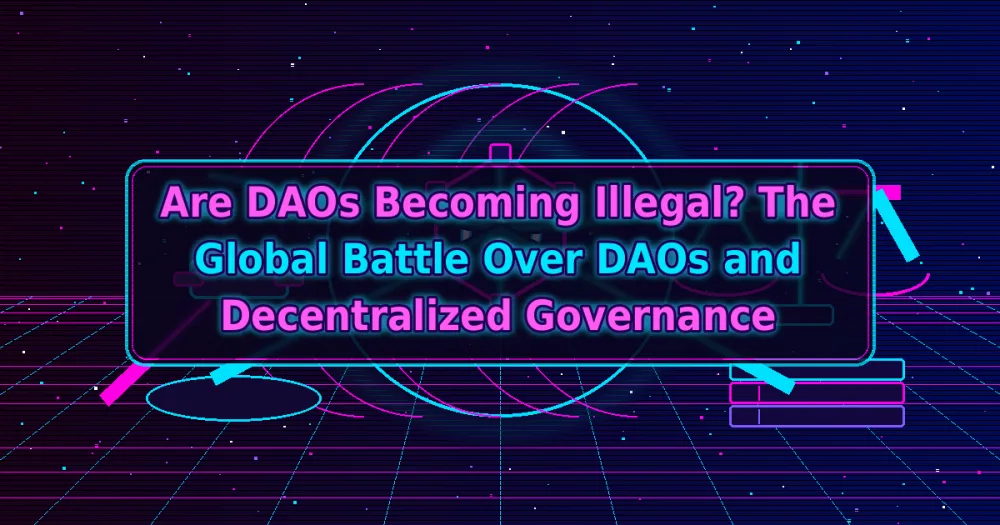
This is an uncomfortable reality for DAOs governed by token voting. Regulators are asking who benefits, who controls the interface, and who can stop illegal activity. The answers will decide which DAOs survive and which get delisted.
Contents
- Why Are DAOs So Hard to Regulate?
- Decentralized Governance and DAO Legal Status
- Why Are Regulators Targeting DAOs?
- Legal Wrappers Are Eating the DAO Space
- DAOs That Are More Likely to Be Targeted by Regulators
- DAOs That Are Safer from Regulators
- Who Can Be Held Responsible for a DAO’s Activities?
- Are DAOs Becoming Illegal?
- Final Thoughts
- FAQ
Why Are DAOs So Hard to Regulate?
A DAO is a decentralized autonomous organization. What that means in practice can differ dramatically from one DAO to the next.
Some DAOs primarily serve as governance structures, allowing community members to vote on upgrades to a protocol. Other DAOs have far fewer members but use a token and voting mechanism to create the appearance of community control.
Some DAOs have a charitable purpose, while others govern for-profit protocols, trading venues, lending platforms, tokenized treasuries, and investment vehicles.
This decentralization makes it difficult to determine which legal entity, if any, a DAO should be classified as. A DAO typically lacks a central board of directors, a management structure, a physical headquarters, an official company formation, and direct oversight of operations or finances. And yet a DAO can control billions of dollars in smart contract treasury assets.
The challenge is that most existing laws are written with legal entities in mind. DAOs seek to operate outside these structures, but not always successfully.
Decentralized Governance and DAO Legal Status
The most important lesson from recent enforcement actions is that decentralized governance makes it harder for a project to claim any single entity is in control, but it does not make a DAO immune to legal action.
The CFTC’s enforcement action against Ooki DAO, which resulted in a DAO entity being fined for facilitating unlawful trading activity, should serve as a warning to every DAO that plans to launch derivatives products or operate a trading venue. The CFTC determined that it was reasonable to treat the DAO as a commodity trading entity under the Commodity Exchange Act, making the DAO itself subject to penalties and trading restrictions.
The SEC’s BarnBridge DAO enforcement action also shows that many DAOs operate in legal gray areas when it comes to securities laws. The SEC obtained a settlement against BarnBridge DAO and its founders for conducting unregistered securities transactions.
Finally, Lido DAO illustrates why token-weighted decentralized governance can be dangerous in court. A U.S. court allowed a lawsuit to proceed on the theory that a “general partnership” theory applied to Lido DAO. This is not a ruling that all token holders are partners or that all DAOs create token holder liability. But it shows that the unwrapped DAO model can have real legal consequences.
Why Are Regulators Targeting DAOs?
Regulators are targeting DAOs because of the real-world activities controlled by governance tokens.
| DAO Activity | Legal Risk |
|---|---|
| Perpetual futures or leveraged trading | Derivatives regulation |
| Lending and fixed-yield products | Securities or investment company rules |
| Token sales and staking products | Securities law |
| Treasury investment pools | Fund regulation |
| Interfaces that route trades | Broker, exchange, or AML concerns |
| Anonymous financial activity | Sanctions and anti-money laundering risk |
This does not mean any DAO with one of these elements faces immediate legal consequences. But these activities greatly increase the chances that a regulator will examine the organization structure and operations behind the DAO.
Related: How KelpDAO Lost $292M: Inside 2026’s Biggest DeFi Hack and What Went Wrong
Is a DAO Illegal in the United States?
DAOs are not illegal in the United States, but the U.S. presents one of the more hostile regulatory environments for decentralized organizations.
U.S. regulators have chosen to deal with DAOs through enforcement actions and judicial decisions rather than by clarifying the status of DAOs through legislation. As a result, a DAO can be classified as an unincorporated association, a general partnership, a securities issuer, a commodity trading entity, or another legal entity depending on the circumstances.
This enforcement-driven approach has major implications for DAOs using decentralized governance. A token-weighted voting mechanism may provide plausible deniability, but it rarely provides full insulation from liability. A governance token may facilitate community coordination while also creating obligations and expectations that regulators, investors, or lenders will not ignore.
The U.S. has also pioneered several potential solutions. Most notably, Wyoming’s DUNA statute enables DAOs to use a decentralized unincorporated nonprofit association model that provides a legal framework for asset management and community governance.
Are DAOs Illegal in the UK or Europe?
The UK’s recent action on DAOs is arguably more interesting than the U.S. approach. The Law Commission of England and Wales completed a preliminary review of DAOs and concluded that there was no immediate need for legislation to create a new DAO-friendly legal entity.
This does not mean DAOs are safe in the UK or that English law does not apply to DAOs. It means the Law Commission did not find a pressing need to create a new DAO-specific law. Existing English laws related to partnerships, unincorporated associations, trusts, and commercial agencies may already be sufficient to regulate DAOs depending on the case.
Europe is in a similar situation. MiCA represents a major step forward for crypto legislation, but few people believe it answers every question about DAO regulation. If a DAO lacks a formal legal structure or has no issuer, promoter, depositary, or controlling entity, European regulators may still look closely at the DAO’s operations.
In practice, individual DAO contributors, promoters, or interface providers can be held liable for DAO actions. Legal commentators in Germany and other European countries have noted that a lack of a controlling legal entity can lead to unincorporated association liability in some cases.
Is There a Future for DAOs in Asia?
There is no singular approach to DAO regulation in Asia. Some jurisdictions are developing legal frameworks that can accommodate DAOs and other decentralized entities. Others focus on crypto exchange licensing, token offering rules, stablecoin regulation, and AML requirements.
Japan, Singapore, and Hong Kong are crypto-friendly jurisdictions, but none of them are eager to embrace “DAO” as a default solution to all forms of decentralization. If a DAO wants to operate in any of these jurisdictions, existing securities laws, derivatives laws, and fund regulations may still apply to on-chain activities.
At the same time, several Asian law firms have pioneered structuring approaches that enable a DAO to operate as intended while reducing legal risks. These often involve using a company, foundation, or association in a crypto-friendly jurisdiction as the official governing entity for a DAO.
Overall, Asia may become one of the most interesting regions for future DAO law. With pragmatic regulation and creative private-law structuring, Asia could develop sophisticated approaches to decentralized governance.
Legal Wrappers Are Eating the DAO Space
One of the most important trends in DAO development is the rapid rise of legal wrappers: official legal entities that provide protection and regulatory clarity for DAOs.
A legal wrapper can take many forms. Some wrappers give a DAO the status and protections of a nonprofit, while others provide limited liability protection.
| Legal Wrapper | Why DAOs Use It |
|---|---|
| Wyoming DUNA | Provides a legal framework for decentralized unincorporated associations |
| Marshall Islands DAO LLC | Gives DAOs limited liability protection |
| Cayman Foundation | Foundational entity for many DAOs |
| Swiss Foundation | Popular among DAOs that want a charitable structure |
| Traditional company | Provides liability protection for interface organizations |
The primary value of a legal wrapper is that it provides a regulatory back door for DAOs that want to operate as specified by their community while reducing exposure to liability or scrutiny.
A DAO with a legal wrapper can still allow token holders to vote on grants, product development, and treasury spending, but those community members typically have far fewer personal liabilities if regulators examine the DAO’s activities.
Related: BonkDAO Governance Attack Drains $20M in BONK From Treasury
DAOs Without Wrappers Are Particularly Dangerous
There are few reasons for optimism when it comes to unwrapped DAOs.
A pure or unwrapped DAO has no legal entity serving as a wrapper for its operations and assets. That can be dangerous for contributors, investors, employees, and users.
Most notably, an unwrapped DAO places far greater liability exposure on individual community members. If a regulator or court determines that an unwrapped DAO operates as an unincorporated association or partnership, individuals who interact with the DAO may face personal liability for its actions.
That is why decentralized governance without legal structure is becoming much harder to defend.
DAOs That Are More Likely to Be Targeted by Regulators
Not all DAOs are same when it comes to regulatory risk. A DAO that operates a derivatives trading venue is more likely to be targeted than a DAO that facilitates charitable donations.
Several common factors can add legal risk:
| Risk Factor | Description |
|---|---|
| No legal wrapper | Increases the likelihood that the DAO will be treated like an unincorporated association or partnership |
| Active financial products | Creates exposure to securities, commodities, banking, or fund regulations |
| Concentrated voting power | Reduces the effectiveness of decentralized governance |
| Identifiable core team | Increases exposure to control arguments |
| Token marketing | Can create securities-law liability |
| Treasury investment activity | Can create fund-like liability |
| Front-end control | Increases exposure as an exchange or broker |
DAOs most at risk tend to combine several of these factors. A DAO voting on grants is far less likely to encounter regulatory issues than a DAO voting on derivatives market maker rewards.
DAOs That Are Safer from Regulators
At the opposite end are DAOs that combine strong decentralized governance with risk-reduction measures.
| Stronger Feature | Description |
|---|---|
| Clear legal wrapper | Reduces member liability exposure |
| Real decentralization | Makes it harder to identify one controlling entity |
| Transparency | Reduces risks created by information asymmetry |
| Limited financial activity | Reduces exposure to financial regulations |
| Strong disclosures | Helps set realistic user expectations |
| Separate service providers | Clarifies responsibility for interfaces and development |
| Compliance planning | Reduces unexpected enforcement challenges |
A wrapper is not always necessary if the DAO’s structure provides equivalent disclosure, decentralization, and liability limitations. But a DAO cannot realistically claim to be decentralized if it lacks meaningful on-chain governance.
Who Can Be Held Responsible for a DAO’s Activities?
One of the most interesting DAO questions is whether individual token holders can be personally liable for DAO activities.
At the moment, it is unclear whether, and to what extent, a passive token holder can be personally liable. Most regulators are more concerned with founders, developers, and other controlling entities.
That being said, civil lawsuits can involve theories of partnership or unincorporated association liability. If a lawsuit succeeds, it could create real risks for anyone who has participated in or contributed to a DAO.
In practice, active voters, delegates, multisig signers, founders, and large contributors are far more likely to be held personally liable for DAO actions.
This matters because rational token holders may become less willing to participate in decentralized governance if voting can create personal liability.
Are DAOs Becoming Illegal?
DAOs are not becoming illegal, but the lazy approach to DAO construction is becoming illegal. The assumption that a project can tokenize a group of people, let them make decisions on an Ethereum smart contract, and avoid all regulation is becoming increasingly unrealistic.
Decentralized governance is not magical immunity from liability or enforcement. If a DAO launches an unregistered trading venue or investment fund, regulators will investigate it. If the DAO violates sanctions laws or engages in illegal activity, the people behind the DAO may be held responsible.
What makes decentralization so interesting is that it enables certain forms of control without the appearance of control. It can create a system where no single individual controls an exchange, but token holders vote on exchange governance.
When a regulator looks at such a system, they may bring enforcement actions against token holders who voted for a particular upgrade or transaction. They may also limit that responsibility to the individuals and entities that actually operate the product or service.
The next frontier for DAOs involves creating sophisticated structures, clear disclosures, and reliable off-chain operations that reduce risks for everyone except the individuals who control the protocol, facilitate anonymous transactions, or operate on-chain interfaces.
This is not the end of the DAO experiment. It is the end of the lazy approach that prioritized decentralization for the wrong reasons.
Final Thoughts
DAOs are not becoming illegal, but decentralized governance is being forced into a more serious legal phase.
The projects most likely to survive will use legal wrappers where needed, plan a regulatory strategy, implement proper disclosures, reduce front-end and treasury risks, and make clear who is responsible for which parts of the system.
That may feel less pure than the original DAO ideal. But it is also more durable. The future of DAOs will not belong to projects that pretend no one is responsible. It will belong to projects that make decentralized governance real enough, transparent enough, and legally structured enough to survive scrutiny.
FAQ
Are DAOs illegal?
No. DAOs are not automatically illegal. However, a DAO can face enforcement if it operates regulated financial activity without proper compliance.
Is decentralized governance a legal shield?
No. Decentralized governance can reduce centralized control, but it does not make a DAO immune from securities, commodities, sanctions, AML, or civil liability.
Can DAO token holders be personally liable?
Passive token holders are less likely to be targeted, but active voters, delegates, multisig signers, founders, and large contributors can face higher liability risk.
What is a DAO legal wrapper?
A legal wrapper is an official legal entity used to give a DAO clearer legal status, reduce member liability, manage assets, sign contracts, and satisfy regulatory requirements.
Which DAOs face the most legal risk?
DAOs that operate derivatives markets, lending products, investment funds, anonymous financial tools, or heavily marketed token products face the highest risk.