The recent $292 million loss at KelpDAO has ripples through the crypto community. Everything seemed fine at first glance. Yet the structure processed a request that appeared legitimate, obeyed protocol, and then unlocked assets meant to stay locked.

On that day, April 18, 2026, the breach set roughly 116,500 rsETH in motion. Because of what happened to KelpDAO, nearly three hundred million vanished.
Contents
- What Went Wrong in the KelpDAO 292 Million Dollar Breach?
- The Real Entry Point RPC Nodes and Infrastructure Compromise
- The Part Fake Cross-Chain Messages Played in the Hack
- Contagion Effect: How the Hack Moved Through DeFi
- How $292 Million Was Lost in a 2026 DeFi Breach
- Security Incident Handling and Emergency Control Steps
- System Failures in DeFi Infrastructure
- KelpDAO Hack Insights Shape DeFi Approach
- Future of DeFi Security Implications
- FAQ
What Went Wrong in the KelpDAO 292 Million Dollar Breach?
Exploit Timeline: April 18 2026
Out of nowhere, systems near the bridge took hits. After that, traffic got jammed up on purpose, steering checks through broken RPC paths. With fake confirmation slipping through, the bridge treated a shady cross-chain signal as real. That mistake let rsETH slip out.
Attackers Minted 116,500 rsETH Out of Thin Air
Out of nowhere, fake rsETH showed up without anything backing it. Usually, when tokens move across chains, there is either something locked or taken away on the starting side. This time, the system acted like that trigger happened – even though it did not.
At first glance, the hack didn’t show up on the blockchain. Because hidden transfers looked like normal activity. Not until later did patterns start to stand out. What seemed routine was actually theft in disguise. Only after close inspection did the truth become clear.
Most folks missed the trick since the final transfer seemed fine. Right after getting its required verification, the system acted exactly how it should. Trouble began much before that step – inside the layer feeding data to the code.
Related: Bitcoin DeFi Protocol Echo Loses $816K After Admin Key Hack
The Root Cause of the Attack
What Went Wrong With The LayerZero DVN Setup
One wrong step broke everything. Not the code, but how they checked it. A single checkpoint had the power to say yes. This made trust hang on just one line. When that line bent, so did the whole system. Risk grew faster than safeguards ever could.
The Danger of 1-of-1 Verifier Architecture in DeFi Bridges
One unique checker moves quickly yet brings risk. Should a lone validation method unlock money, hackers just break one version of the truth. Safety across chains comes from separate agreements. Relying on a solitary proof path misses the point.
Why Valid Transactions Can Still Be Fraudulent
The KelpDAO incident shows that correctness can still lead to error. Though the system followed its logic step by step, deception hid inside the data flow. A signal arrived that seemed legitimate on paper, yet carried lies beneath. What broke things? Reliance on outside input already under attack. Trusting something flawed from the start pulled everything down.
| Failure Point | What Happened | Why It Mattered |
|---|---|---|
| RPC node compromise | Attackers manipulated infrastructure used to read blockchain data | The verifier received false information while the on-chain transaction still looked valid |
| DDoS-driven failover | External RPC routes were disrupted, pushing the system toward compromised fallback paths | A backup mechanism became part of the exploit path |
| 1-of-1 DVN setup | One verifier path was enough to approve the cross-chain message | The bridge had a single point of failure |
| Fake cross-chain message | The bridge accepted a forged event as legitimate | rsETH was released without real backing on the source side |
| Unbacked rsETH creation | Around 116,500 rsETH entered circulation without proper collateral | The token became dangerous for lending and liquidity markets |
| Collateral contagion | rsETH interacted with DeFi protocols after the exploit | The hack spread beyond KelpDAO into wider DeFi risk systems |
| Emergency response | Funds were frozen, protocols reviewed exposure, and governance actions followed | DeFi needed human intervention to contain a supposedly automated system |
| Main lesson | Cross-chain systems need independent verification and stronger infrastructure security | Audited contracts are not enough if the verification layer can be corrupted |
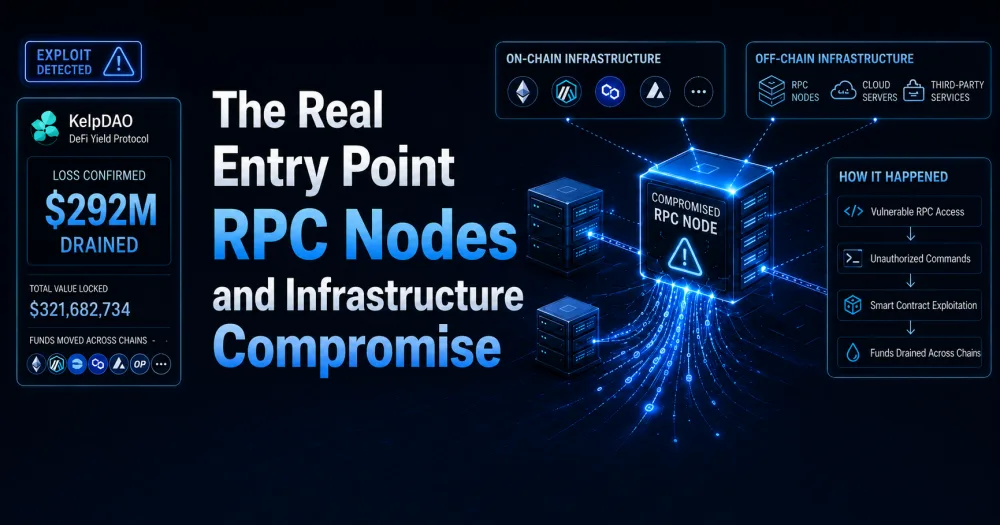
The Real Entry Point RPC Nodes and Infrastructure Compromise
How the Attackers Breached the RPC Systems
Off-chain setups were where things really began. Systems watching the blockchain – like RPC networks – attracted the cyber-criminals. A dishonest report from one of these nodes could trick a verifier into signing incorrect information, leaving the receiving chain none the wiser.
DDoS Strategy and Forced Failover Manipulation
Sharpness came from the DDoS twist. Normal RPC routes broke under pressure, pushing traffic sideways. When sidetracked paths carried hidden damage, backup plans turned dangerous. Safety layers started working against the system. What should guard opened doors instead?
Why Off-Chain Systems Are Becoming the Fragile Part of DeFi
Most DeFi claims to run without trust. Yet bridges lean on outside parts – RPC services link them forward. Relayers push messages through cloudy paths. Developer devices touch code daily. Monitoring watches quietly from afar. People manage nodes by hand each day. KelpDAO proved that even clean audits break when inputs lie. False data brought collapse, not bugs.
Related: What Is Crypto Cybersecurity? The Ultimate Guide to Protecting Digital Assets
The Part Fake Cross-Chain Messages Played in the Hack
How Forged Verification Data Triggered Fund Release
Wrong chain proof never mattered. Getting the bridge to believe a transfer happened – that was enough. After the fake confirmation moved along the expected route, the money was unlocked on the receiving end. Fake signal, real payout.
The Phantom Burn Problem in Cross-Chain Systems
A glitch made it seem like tokens vanished into thin air. Though nothing real was destroyed or secured off-chain, the system behaved as though it had. What looked balanced on paper hid a missing foundation underneath. Numbers stayed clean even as support quietly faded away.
Why Message Validation Failed at the Verification Layer
One broken view was enough for the system to fail. Because of that, trust shifted where it should not have. Proof never came straight from the original chain. Instead, a middle layer spoke on its behalf. That gap? That is what breaks most DeFi bridges.
KelpDAOS Design Led to One Critical Weakness
Centralization Risks in Decentralized Verifier Networks
It takes more than words to prove decentralization. Even if a bridge talks like it is spread out, everything might hinge on just one attester instead. One single route for data flow could hold the whole thing together. Just one group running operations changes the picture completely. During the KelpDAO breach, reliance was narrowed down too much.
Trade-Offs Between Scalability and Security in Bridge Design
Speedy approvals, cheap transfers, fewer steps – these are what bridge crews aim for. Yet chasing them might weaken checks. Thin validation opens gaps. Safety slips when pace wins. Goals count, sure. But not at the cost of solid proof.
What Multi-DVN Setups Would Have Prevented
Breaking into a system with multiple DVNs still can happen. Yet every extra verifier means another separate barrier to cross. Big bridges cannot skip backup layers. At that scale, having more than one layer isn’t extra – it’s just the baseline.
Contagion Effect: How the Hack Moved Through DeFi
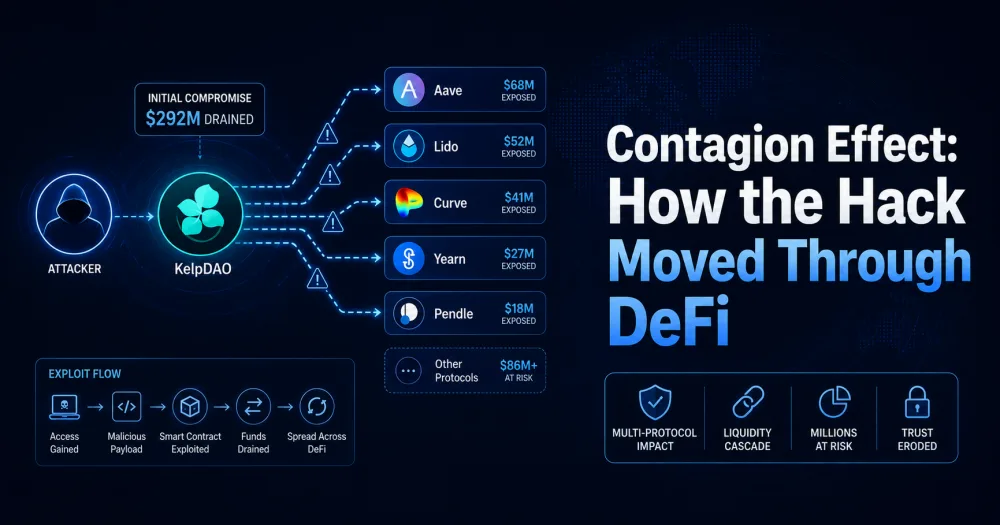
Impact on Lending Protocols Like Aave and Collateral Risk
Breathing fresh air into the room wasn’t an option after KelpDAO got hit. When fake rsETH slipped out, lending setups began wobbling like loose shelves. Poison spreads fast here – loans carry it, pools drink it in, leverage fans the flames.
How rsETH Turned into Risky Collateral
One moment it was fine, next – doubt crept in. RsETH used to stand for clean access to restaked value. Then came the breach, shifting things. Some tokens now carried uncertainty. Protocols relying on full backing started hesitating. Trust broke where certainty mattered most.
Related: Top 5 DEX Wallets in 2026: Which Crypto Wallet Is Best for DeFi and Swaps?
Liquidity Panic Hits DeFi Markets
Speed beats meetings every time. When risk shows up, traders act first – selling off shaky positions, while lenders quietly pull back. Protocols hesitate, weighing delays like fragile switches. What hit KelpDAO wasn’t just theft – it turned into pressure on every linked part of DeFi.
| Stage of the KelpDAO Hack | What Happened | Impact on DeFi |
|---|---|---|
| Infrastructure compromise | Attackers gained access to systems connected to cross-chain verification | The exploit began before any visible on-chain attack |
| RPC manipulation | Compromised RPC routes supplied false blockchain data | The verifier was pushed toward a fake version of chain activity |
| DDoS attack | Normal RPC providers were disrupted | The system failed over to compromised infrastructure |
| Fake message approval | A fraudulent cross-chain message passed verification | The bridge treated a non-existent event as real |
| rsETH release | Around 116,500 rsETH was released without proper backing | KelpDAO suffered a roughly $292M loss |
| Collateral shock | Unbacked rsETH entered DeFi markets | Lending protocols faced collateral and bad-debt risk |
| Emergency containment | Funds were frozen and protocols reviewed exposure | Human governance became necessary to limit contagion |
| Industry lesson | Bridges need stronger verification and monitoring | Cross-chain security became a top DeFi priority |
How $292 Million Was Lost in a 2026 DeFi Breach
Comparison with Other Major 2026 Exploits
Out of nowhere, the KelpDAO breach turned into the largest DeFi exploit of 2026 – its scale tipped the scales. Not just about money vanishing, mind you. Because it targeted core systems, ripple effects hit hard. Confidence took a blow when trust in asset bridging wavered.
Restaking mechanisms felt pressure, too. Cross-chain flows slowed as doubts spread. Nearly three hundred million dollars gone has reshaped how safety is seen. Infrastructure cracks suddenly mattered more than headlines.
Bridge Hacks Vs Smart Contract Exploits
Most times, a flaw in just one system gets exploited through smart contracts. Moving between blockchains is what puts DeFi bridges at risk. When that link breaks, damage spreads fast – large pools of value sit trapped right where attackers strike.
Related: Crypto in Asia: Why South Korea Is Doubling Down on the Crypto Market in 2026
Why Cross-Chain Infrastructure Remains the Biggest Risk Vector
Who decides how events on Chain A reach Chain B? That’s the core problem cross-chain setups face. Relying on thin layers of verification creates risk. So does depending on shaky node connections. When safeguards are slim, attackers take notice. The bridge turns into a magnet for exploits.
Security Incident Handling and Emergency Control Steps
Freezing Attacker Funds Through Arbitrum Security Council
Mid-response, steps unfolded on Arbitrum – funds tied to the attacker were locked down fast by its Security Council. Damage got limited, true, though not erased. What stood out more? A quiet conflict under the surface of DeFi hummed louder now. Safety moves shield people, sure, but they also expose spots that feel too much like control. Centralized cracks start showing when urgent power is used.
Protocol Pauses and Emergency Governance Actions
Looking back, each protocol checked its assets, cash reserves, one after another. Holding off on moves, waiting for votes – those steps turned into shields. If chains break across networks, touching multiple systems, people must step in and talk it through.
DeFi United Recovery Coordination
When things broke down, everyone had to step in – code writers, guards, decision makers, even hardware runners. Turns out, quick thinking matters just as much as clean programming when everything wobbles at once.
System Failures in DeFi Infrastructure
Why Human-Operated Nodes Are Now Targets for Attacks
These days, hackers go after individuals along with digital setups instead of focusing only on code agreements. Machines used by builders, active connections, remote procedure call entry points, access rights in online storage spaces, plus oversight tools have become pieces inside DeFi’s safety boundaries.
Centralized Control Within Decentralized Frameworks
What happened showed control where there should have been freedom. People thought they were using an open system, yet trust rested on just one checkpoint. True independence means separate teams, varied information paths, and one break does not shut everything down.
Flaws in How Blockchains Connect
One chain pulls information into another through cross-chain setups. When cryptographic proof isn’t backing these imported details, reliance shifts elsewhere. Verification gaps appear if no solid, separate agreement confirms the truth. This gap – where confidence leaks out – is how intruders slip in.
KelpDAO Hack Insights Shape DeFi Approach
Need for Multi-Layer Verification and Redundancy
Most future bridges will rely on multiple checks done separately. A single verifier must not have the power to unlock huge amounts of value. When something goes wrong along one route, the system waits, questions the result, or asks for extra approval.
Cross-Chain Invariant Monitoring Matters
When protocols run, someone must watch if numbers make sense in real life, not just on paper. Should the rsETH amount grow but the support stay flat, warnings ought to fire right away. This kind of check looks at whether what’s issued lines up with actual deposits and actions back on the main chain.
Moving From Trust-Based to Cryptographic Validation Systems
One way out lies in tougher crypto checks over time. Instead of relying only on trusted RPC sources, light clients help – so do validity proofs along with separate verifications. A broken link in the setup should never be enough to bring down security.
Future of DeFi Security Implications
Will Bridge Architecture Survive the Next Generation of Attacks?
Survival of the fittest might shape what stays in bridge design. After the KelpDAO breach, systems could lean into tougher verification rules instead. Resilience may come from smarter backup setups this time around. Honesty about dangers might finally get more room to grow.
Institutional Trust and Real World Asset Impact
When something goes wrong, banks and creators of real-world asset tokens feel it. Trust comes from knowing what’s behind a token plus seeing how it moves. Should hackers fool bridge systems with fake data, big money steps back until rules tighten up. Verification becomes non-negotiable.
Is DeFi Safer Now Or Just Harder To Understand?
Safety shows up unevenly across DeFi. While contract checks got better, risks spread wider – hitting bridges, systems, how choices are made, and what backs value. What happened at KelpDAO proved one thing: weak spots now live outside the software itself.
FAQ
What Happened to KelpDAO?
A breach hit KelpDAO’s rsETH bridge mid-April in 2026. Fake verification records allowed unauthorized access that pulled out roughly 116,500 rsETH. Instead of valid signatures, manipulated data cleared the transfer. The system mistook the signals for legitimate approval. While checks existed, they failed under altered inputs. Roughly half a day passed before detection slowed the leak.
How Did KelpDAO Lose 292 Million Dollars?
Around $292 million vanished from KelpDAO when its bridge trusted a fake signal. Not long after, an exploited RPC node opened the door wider. The system switched paths under pressure, but that move played right into the attacker’s hands. Instead of blocking harm, checks along the way actually helped it spread.
Was the KelpDAO Hack Due to a Smart Contract Bug?
Wrong. What broke wasn’t some typical code flaw inside a smart contract. Instead, it collapsed because outside systems failed to talk properly across chains.
What Is DVN Failure?
A single broken path allowed fake data through when DVN protection fell short. Because the network lacked backup checks, trust collapsed easily. One weak link opened the door instead of blocking it.
Why Did KelpDAO Get Hacked?
A single point of failure opened the door – kelpDAO’s lone verifier fell through weak RPC safeguards, while a flood of fake traffic triggered backups that played right into the attacker’s hands.
What Lesson to Learn Is There About Risk And Trust for DeFi?
Start thinking differently. Security in DeFi now goes beyond checked code. Bridges must have their own checks. Stronger systems are better protected. Watch the core rules constantly. Build setups that question what seems true.