One step at a time, South Korea moves past seeing digital coins as just toys for shoppers. In 2026, the nation links its bustling trade scene to strict rules and real banks.
Because of this shift, any talk about Asian crypto must start in Seoul.
Contents
- South Korea’s Position in Asia’s Cryptocurrency Scene
- South Korea’s Ongoing Role in Crypto Markets in 2026
- South Korea's Rising Use of Cryptocurrency?
- Cultural and Technological Factors Shaping Adoption
- Government Rules Influence Crypto Markets
- Comparing Approaches to Cryptocurrency Regulation
- Major Cryptocurrency Exchanges and Systems in South Korea
- Security and Compliance Standards in Crypto Exchanges
- How Big Buyers Affect Market Steadiness
- South Korea Crypto Market Trends 2026
- Risks and Challenges in South Korea's Cryptocurrency Market
- FAQ
South Korea’s Position in Asia’s Cryptocurrency Scene
Out of nowhere, South Korea’s crypto scene grabs attention – tiny crowd, massive sway. When won-linked trades shift, fewer coins often follow close behind. New trends pop up there first, hinting at where money flows in Asia long before others catch on.
South Korea’s Ongoing Role in Crypto Markets in 2026
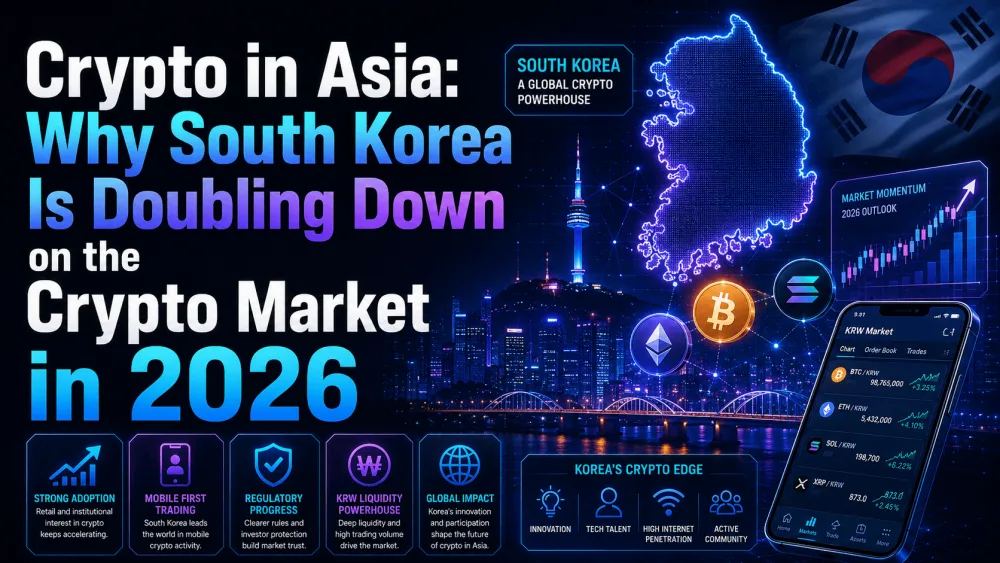
Still central, South Korea thrives on engaged users and deep exchange liquidity, while rules shift slowly from limits toward controlled entry. Led by platforms like Upbit, Bithumb, Coinone, Korbit, and Gopax, the scene sees dominance split mainly between Upbit and Bithumb for domestic trading flow.
Government Rules and Views on Cryptocurrency
South Korea keeps tight control over crypto, though things are moving again. Not looking to mirror overseas exchanges anymore. Instead, local systems take priority now – clear money trails matter here. Safety around customer funds has become a bigger deal lately. Rules must support expansion, yet prevent past mistakes from repeating themselves. Since mid-2024, the Virtual Asset User Protection Act has set terms on deposit handling, separating assets, blocking shady trades, plus oversight of service providers.
South Korea’s Rising Use of Cryptocurrency?
Every day, choices shape crypto adoption in South Korea in 2026 more than excitement ever could. Phones handle money tasks without effort. Speed matters when placing trades. Video games build their own cash systems now. Behavior shifts because tools change what feels normal.
Many Everyday Investors Trade Cryptocurrency
Frenzy defines retail crypto trading in Korea. When new coins appear, people jump fast – herd instinct takes over, piling into identical picks. Sharp swings follow, yet volume grows too. Movement feeds movement; chaos brings its own weight.
Read more: South Korea’s Tax Agency Tightens Grip on Non-Custodial Crypto Wallets
Bitcoin and altcoin demand rise in Korea
Bitcoin trades grab attention in South Korea, yet the country’s strongest market voice usually shows up elsewhere. Come May 2026, XRP▲$1.13 paired with won beats both Bitcoin and Ether in trade size across top Korean platforms, according to CoinDesk.
Cultural and Technological Factors Shaping Adoption
South Korea sees blockchain grow thanks to speedy web connections. Gamers there often embrace new tech early. Paying digitally feels normal for most people. Apps come first in daily routines. Because of these patterns, the shift toward decentralized systems moves more quickly.
Influence of Mobile Trading Apps and Exchanges
Trading platforms in Korea do more than just match buyers with sellers. Getting listed in won might shake up the whole scene.
South Korea Backs Crypto Through Rules
Just because South Korea allows crypto doesn’t mean anything goes. Rules now tighten around exchanges, banks, plus token creators – clarity steps in where gaps once sat. Open access stays, yet under watchful eyes.
Government Rules Influence Crypto Markets

Starting in South Korea, crypto rules kick off with anti-money laundering sign-ups, verified bank accounts, and then the 2023 user protection law. Firms running exchanges have to safeguard the money people put in, keep client funds apart from company cash, watch for odd transactions while getting ready in case systems fail or cyber-thieves strike.
Licensing and Compliance for Exchanges
Pressure rides on South Korea’s crypto platforms – banks watch closely, regulators lean in. Meeting rules means keeping won access, pulling steady allies along. Each checkpoint shapes who stays in motion.
Investor Safeguards and Tax Rules
At the heart of the new rules stands safeguarding those who invest. Crackdowns focus on rigged markets, fake listings, shaky storage, and missing details. Taxes remain a delicate topic, yet digital money steadily slips into standard finance.
Regulation Shapes Institutional Involvement
One step at a time, the FSC laid out how companies might reach virtual assets by 2025. Beginning with tightly managed exit options, it slowly opens doors for select big investors to test entry. Progress unfolds through careful phases set by the regulator.
South Korea Compared to Asia’s Crypto Markets
Nowhere is the Asian crypto scene more split than it is today. Japan moves slowly, tied up in rules. Singapore feels crisp, built for big players. Hong Kong dreams of becoming a doorway. China shuts down local trading. What stands out in Korea is how regular people keep markets moving.
Comparing Approaches to Cryptocurrency Regulation
Still, Japan plays it safe with tight currency rules. Protection comes first, though adding new tokens takes time. Not far off, Korea also draws firm lines – speed changes the game there. Because of the pace, shifts in Korean digital coin trends stand out more.
China Limits Trade While Korea Keeps Markets Open
Out in the open, China moved most of its public crypto actions beyond borders. Meanwhile, Korea went a different path – rules around licensed trading platforms, ties to banks, and constant monitoring. This setup makes it easier to track what Koreans want.
Singapore and Hong Kong Vie for Crypto Hub Status
Speed drives Korea’s edge. What sets it apart? A marketplace that feels more than thinks, moves fast instead of waiting.
South Korea Remains Central in Retail Cryptocurrency Activity
Out here in Korea, trading sticks around since cryptocurrency blends into regular money moves. Not local platforms but the flow of won plus a taste for riskier plays turns this market into something few others have managed. A place where small investors keep things running, not by accident but habit.
| Market | Regulatory Approach in 2026 | Retail Access | Institutional Direction |
|---|---|---|---|
| South Korea | Open but tightly supervised | Allowed through compliant local exchanges | Gradual access through regulated corporate and institutional frameworks |
| Japan | Conservative and rule-heavy | Allowed through licensed exchanges | Moving toward stronger financial-market style oversight |
| China | Restrictive mainland ban | Crypto trading remains heavily prohibited | Focus is on state-controlled digital finance and strict enforcement |
| Singapore | Institution-first regulation | Retail promotion is limited | Strong focus on tokenization, stablecoins and licensed providers |
| Hong Kong | Regulated hub model | Allowed through licensed platforms | Expanding licensed exchange liquidity and virtual asset services |
Major Cryptocurrency Exchanges and Systems in South Korea

Seoul is the centre of crypto liquidity in Asia again because of its setup. Banks here link easily to digital assets, thanks to existing money systems. Trading platforms aren’t just big – they follow tighter oversight. Rules around holding funds feel more solid than in many places. People using these tools know what they’re doing, which adds momentum.
Dominant Local Exchanges And Their Market Share
First thing most global traders check still sits at the Korean platform Upbit, even as the Bithumb exchange holds steady in second place in Korea. Nearly all Korean trading activity flows through these two, Kaiko notes in its latest report – close to 96 percent by volume. The dominance shows no sign of fading, according to their analysis.
Related: Best Crypto Exchange Platforms in the US 2026 — Picks for Fees, Liquidity, and App Access
Global Exchanges and Their Presence in Korea
Here’s how it plays out: global platforms handle derivatives and overseas cash flow, while also managing cross-market gaps. Yet when it comes to KRW-based spot trades, everything ties back home – local availability often sparks fresh movement even in familiar coins.
| Exchange | Market Role in Korea | Main Strength | Why It Matters |
|---|---|---|---|
| Upbit | Dominant local exchange | Deep KRW liquidity | First venue to watch for Korean crypto market trends |
| Bithumb | Major retail competitor | Strong local user base | Often confirms Korea-led altcoin momentum |
| Coinone | Smaller regulated exchange | Selective listings | Adds depth beyond the top two platforms |
| Korbit | Long-running Korean exchange | Compliance focus | Important for institutional-style market structure |
| Gopax | Smaller domestic platform | Niche liquidity | Shows consolidation pressure in Korean exchanges |
KRW Trading Pairs and Liquidity Strength
Most trading in South Korea happens using the won. This cuts out extra steps when buying digital assets. Instead of converting first, people move money straight into orders. Local markets react faster since prices connect directly to bank balances. Even without big American-style investment funds, Korean activity shapes trends across smaller coins.
Security and Compliance Standards in Crypto Exchanges
In 2026, clearer records and stronger checks will be expected at trading platforms. Instead of resembling a gambling counter, systems might start looking more like quiet pipes moving value behind the scenes.
Institutional Crypto Interest Grows in South Korea
Next up, Korea’s financial world dives into crypto. Banks, along with public companies and big-money traders, now check ways in fast – but not too fast. The goal? Step carefully so things don’t spiral.
Banks in Korea Explore Cryptocurrency
Most banks control who gets official accounts. Beyond that comes holding assets digitally, turning stocks into tokens, clearing trades safely, and managing risks carefully. Firms in finance still move slowly when buying directly.
Corporate Blockchain and Web3 Investments
Out of Seoul come giants who’ve mastered gadgets, play, shows, plus online flow. This background gives their Web3 bets weight.
ETFs Funds and Institutional Crypto Exposure
Out in 2026, talk shifts toward just how deep into ETFs, funds, and on-balance-sheet crypto South Korea might step. According to CoinDesk, the Financial Services Commission has been weighing guidelines – ones that could let qualified public companies put no more than 5% of their equity capital into leading digital assets.
How Big Buyers Affect Market Steadiness
Deepening liquidity might follow when institutional crypto adoption grows across Asia. Slower money moves in once funds plus public companies step through capped entry points. Clearer reports come along, alongside steadier trade handling instead of wild swings. South Korea faces another twist – retail players guessing at big trades could spark front-running games.
South Korean Traders Affect Global Crypto Prices
It happens fast when Korean investors move. Their deals bunch up in certain coins. That flow shows on world markets. A surge in a smaller coin gets seen everywhere. Money moving through South Korea shifts things. When activity spikes there, others watch closely.
Related: What Is Crypto Cybersecurity? The Ultimate Guide to Protecting Digital Assets
Korean Crypto Kimchi Premium Explained
Out of nowhere, prices for cryptocurrency in South Korea sometimes climb above global levels – a gap known as the Kimchi premium. At times, Bitcoin has sat roughly 2% to 3% higher there, according to recent analytics data.
High Volatility Meets Retail Trading Patterns
Out of nowhere, price swings in Korea tend to trail new coin launches, whispers online, chatter on forums, or quick shifts out of Bitcoin toward less-known coins. Though things might seem stretched thin at times, there’s still function beneath the chaos.
Altcoin Rallies and Market Cycles Affected
Out of nowhere, rising KRW activity has been grabbing attention worldwide. Spreads stretch wider as market players adjust. Momentum pulls offshore participants into motion. Online chatter tags the move with Seoul’s name.
Social Media Shapes How Communities Trade
Out of nowhere, chatter spreads across Telegram chats. On X, posts multiply fast. Videos pop up on YouTube just as quickly. Forums light up with discussion threads. Even leaderboard rankings start shaping opinions. In mere hours, a stock symbol turns into something people talk about. This rapid pace lets South Koreans set crypto trends early.
South Korea Crypto Market Trends 2026
South Korea’s push into crypto by 2026 isn’t just chasing digital coins. Behind it sits artificial intelligence shaping new online spaces. Think game worlds where ownership shifts to players. Picture real things turned into digital shares. Finance gets rebuilt, quietly, piece by piece. Technology stitches these threads together, not luck. Progress shows up in code, not speeches.
Rise of AI and Web3 Initiatives in South Korea
Out of nowhere, AI-driven cryptocurrency aligns with South Korea’s tech path. Thanks to a strong footing in chips, online games, digital platforms, and app culture, local investors find pull toward assets tied to processing power, information flows, and machine learning coins.
Growth of DeFi and On-Chain Trading
On the edge of change, DeFi hasn’t matched KRW markets yet. Still, tech-savvy folks now tap blockchain via digital wallets alongside official gateways.
NFT and Gaming Ecosystem Development
Out of nowhere, Korea’s game scene offers NFTs to actual users. When things click, digital stuff ties into gameplay, fan networks, even movie-like brands.
Expansion of Tokenized Assets and Real-World Asset Integration
Security tokens plus wider blockchain investing shaped recent FSC talks about upcoming changes.
Risks and Challenges in South Korea’s Cryptocurrency Market
One step ahead, South Korea might set the pace for crypto use across Asia in 2026. Yet, doubts remain in the air despite progress. Rules drag behind change, moving slower than needed. A few big exchanges hold most activity, creating tight control points. When global pressures hit, ripple effects grow fast. Still, momentum builds from quiet shifts beneath the surface.
Regulatory Uncertainty and Policy Changes
One step ahead isn’t about approval – it’s about pace. South Korea allows crypto trades in 2026, if done on official platforms. Shifting ground shows up in taxes – when they hit matters. Listing rules shift under quiet pressure. Firms face tighter boundaries. Exchanges carry more weight now that in the past years.
Market Manipulation Worries
Worries swirl around fake listings, lifeless tokens, and memes that lack real function. Come 2026, talks at the FSC turn toward stricter rules for what gets listed – think required trading activity, limits on immediate selling after launch.
Too Much Focus on Retail Trading
Should big investors move too cautiously, reliance on short-term traders could persist in Korea – those quick to exit once markets shift. Unstable conditions might keep chasing away nimble players if steady capital lags behind. When turbulence hits, these traders often vanish, leaving gaps. Slow build-up of institutional funds means others must fill the space, at least for now.
Global Economic Shifts Impact South Korea’s Cryptocurrency Trading
When big economic shifts happen, South Korea’s crypto traders might keep busy – yet their willingness to take chances could shrink. Markets hum along even when skies darken. A squeeze on global money often cools bold moves. Activity remains, though hunger for risk fades. Tougher times whisper caution into trades. Even steady hands grow pickier. Pressure builds quietly beneath surface motion.
FAQ
South Korea Crypto Market Significance?
Out of South Korea comes a steady stream of KRW moving through markets. Lively participation by individual traders fuels constant activity on homegrown platforms. Because so much trading happens there, shifts in Bitcoin prices often trace back to what’s unfolding locally. Altcoin movements follow similar patterns when Korean volumes spike. Regional mood around digital assets tends to bend where Seoul’s flow leads.
Is Crypto Legal in South Korea in 2026?
Trading digital money works if firms follow the rules. Authorities watch activity using anti-money-laundering checks, bank ID systems, controls on service providers, plus laws that guard individuals.
How Korean Traders Affect Global Crypto Markets?
Waves of trading tend to cluster. A surge in KRW moving into one asset catches eyes worldwide – others might join simply because they notice the shift.
What Are the Biggest Crypto Exchanges in South Korea?
Biggest players? Upbit, then Bithumb. After those two come Coinone, Korbit, and Gopax. When it comes to Korean trading volume, Upbit, along with Bithumb, still dominates.
South Korea Crypto Investment Outlook?
Strong adoption might pull people in, yet shaky premiums could shake them loose. Sharp swings often follow when rules shift, or listings spark movement.
South Korea Among Asia’s Crypto Markets?
Among these places, Japan plays it safer than the others. While Singapore leans heavily on official frameworks, Hong Kong follows a similar path through structured systems. China still keeps tight limits in place. A different rhythm emerges in South Korea, where everyday traders wield real influence.