By 2026, the difference between Bitget vs BingX is structural. Both platforms target a similar audience: frequent traders, derivatives users, copy-trading participants, and people looking beyond the largest crypto exchanges. Yet both have distinct identities.
Bitget presents itself more as a broad trading framework. It emphasizes derivatives, platform-token benefits, proof-of-reserves disclosures, and an integrated exchange model. BingX, by contrast, builds its appeal around social trading, copy trading, accessible futures tools, and an interface designed to feel less intimidating.
The better choice depends on trader type. Bitget may fit users focused on frequent trading, lower fees, and derivatives. BingX may suit traders who value copy-based strategies, straightforward execution, and community-driven trading. A universal answer would be convenient. Crypto rarely does convenient.
Related: Crypto Exchange Battle 2026: Gemini vs MEXC — Where Do Traders Prefer to Trade?
Contents
- Bitget vs BingX in 2026: The Core Difference
- Table 1: Bitget vs BingX Quick Comparison
- Which Exchange Has Lower Trading Fees?
- Bitget Spot Trading Feels Like a Wider Market Hub
- Futures Trading: Two Platforms, But Bitget Scales Better
- Copy Trading: BingX Feels Organic, Bitget Feels Polished
- Security and Proof of Reserves: Trust Is the Product
- Regulation and Geographic Access
- User Experience: BingX Is Simpler, Bitget Offers More Options
- Table 2: Which Trader Type Should Choose Which?
- Strengths and Weaknesses
- Risk Management Is More Important Than the Logo
- Final Verdict: Bitget or BingX — Which One Is Better?
- FAQ
Bitget vs BingX in 2026: The Core Difference
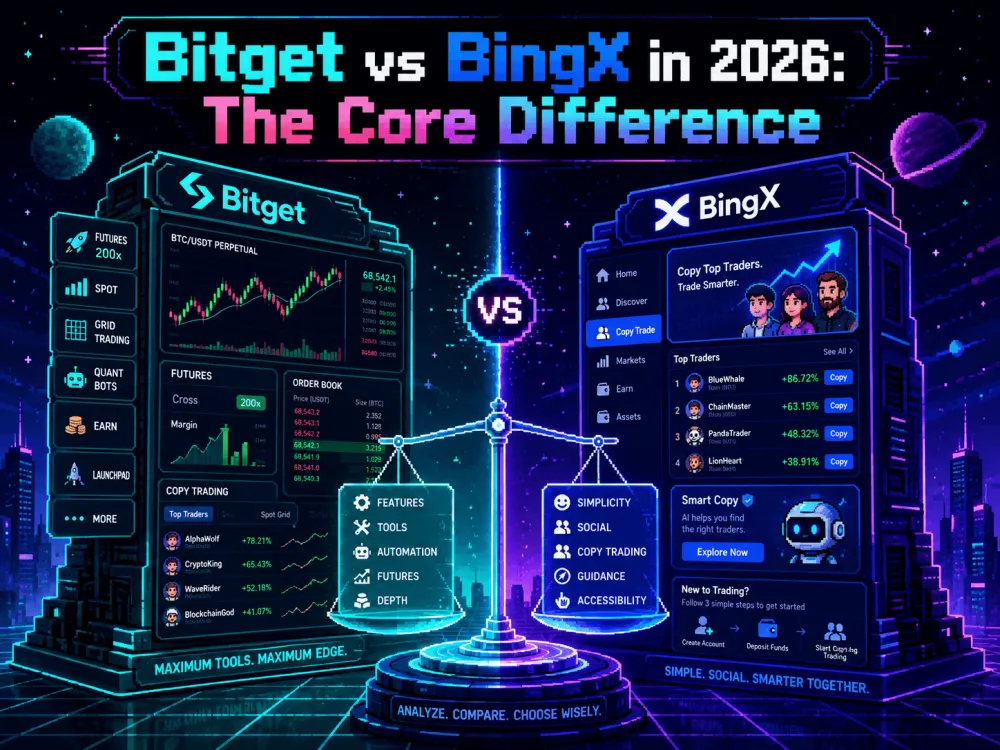
Bitget and BingX share many basic features. Both support spot trading, futures trading, copy trading, proof-of-reserves reporting, and mobile access. The distinction is not basic availability, but priority.
Bitget leans toward depth. Spot markets connect naturally with futures, copy trading, automated tools, platform-token incentives, and reserve transparency. This structure suits experienced users or traders who expect to grow into a broader platform over time.
BingX feels more focused on usability. Its social-trading design makes strategy discovery and trade replication easier. Instead of pushing users into a dense trading environment, it lowers the entry barrier and makes guided participation feel more natural.
That difference matters. Not every exchange improves when packed with features. A strong platform is not the one with the most buttons, but the one least likely to turn small mistakes into expensive lessons.
Table 1: Bitget vs BingX Quick Comparison
| Category | Bitget | BingX | Practical Takeaway |
|---|---|---|---|
| Best for | Active traders, derivatives users, copy traders | Social traders, copy traders, newer futures users | Bitget feels deeper; BingX feels more accessible |
| Spot trading | Broad market access and stronger trading-hub feel | Solid spot access with simpler navigation | Bitget has the stronger all-in-one structure |
| Futures trading | More advanced derivatives-focused environment | Easier futures access for less technical users | Bitget feels better for scale |
| Copy trading | Mature system with more risk controls | Core brand strength and social-trading identity | BingX feels more organic here |
| Fees | Competitive, especially for active users | Clear and generally competitive | Bitget may appeal more to fee optimizers |
| Proof of reserves | Regular reserve reporting | Merkle Tree proof-of-reserves reporting | Both know transparency is now expected |
| Platform feel | More tools, more complexity | Cleaner, more guided experience | Choose based on experience level |
| Main risk | Complexity and overuse of features | Copy-trading overconfidence | Different roads to the same cliff |
Which Exchange Has Lower Trading Fees?
For active traders, small fee differences grow quickly. A casual spot buyer may barely notice them. A futures trader placing frequent orders absolutely will.
Bitget often looks more attractive for active users, especially where platform-token discounts, campaigns, or volume-related conditions apply. Its futures pricing tends to stay competitive against major alternatives.
BingX keeps pricing relatively straightforward. For many retail traders, the difference may matter less than execution quality, supported pairs, spread behavior, and how easy the platform feels during volatile periods.
What matters beyond listed fees:
- Spreads during volatile periods
- Funding rates on perpetual futures
- Slippage on larger orders
- Withdrawal fees
- Whether discounts require holding a platform token
A low-cost fee schedule is useful. But poor execution can turn cheap trading into expensive trading with better branding.
Related: Crypto Exchange Battle 2026: KuCoin vs OKX — Where Do Traders Prefer to Trade?
Bitget Spot Trading Feels Like a Wider Market Hub
For spot trading, Bitget feels more like a broader market hub. It offers access to many assets and connects spot activity with the rest of its ecosystem. The platform’s strength is not only buying and selling tokens, but how spot markets sit beside futures, copy trading, automated tools, and account-level incentives.
BingX remains useful for spot traders who want straightforward tools. Still, its identity leans less toward pure spot-market depth and more toward social trading, copy trading, and accessible derivatives.
Long-term holders should treat both platforms carefully. Buying through an exchange is practical. Keeping assets there indefinitely is a different decision. By 2026, self-custody is no longer fringe thinking. It is basic operational hygiene.
Futures Trading: Two Platforms, But Bitget Scales Better
Futures trading is where both exchanges become more serious. Bitget has a clearer derivatives identity and fits users who want more active position management, higher flexibility, and deeper engagement with market structure.
BingX also supports futures trading and may feel easier for users entering derivatives through copied trades or guided features. That accessibility helps newcomers, but it can also encourage risk-taking before users fully understand the consequences.
The danger is not that BingX is simple. The danger is that futures are never simple, even when the interface acts friendly.
Copy Trading: BingX Feels Organic, Bitget Feels Polished
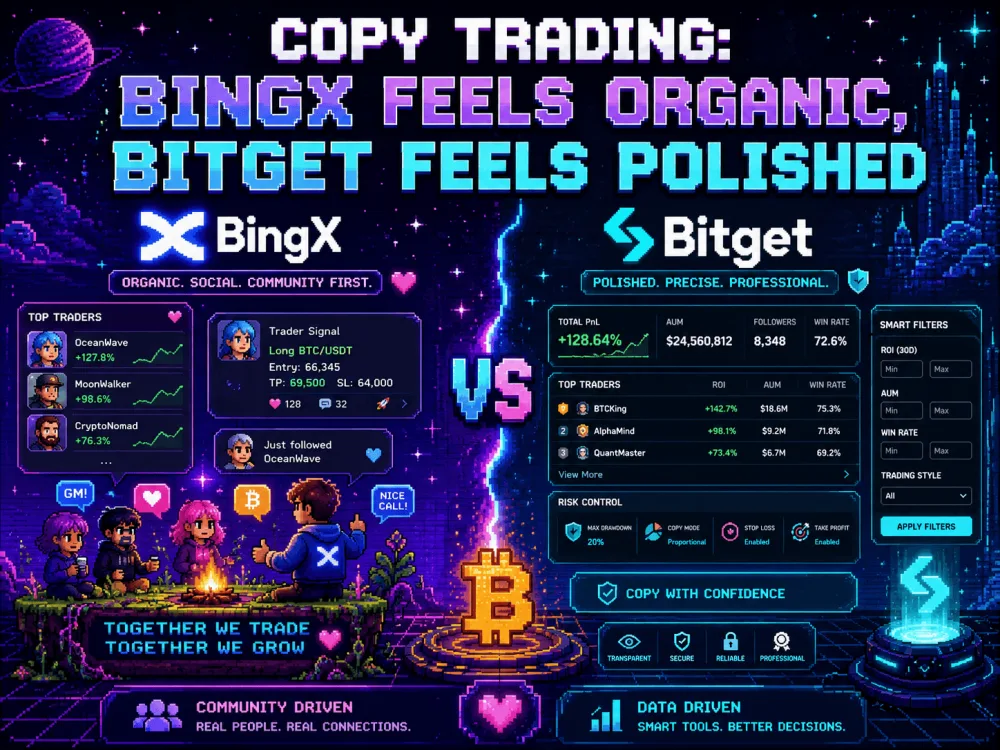
Copy trading is one of the most important battlegrounds between Bitget and BingX.
BingX has made social trading central to its identity. It helps users discover traders, follow strategies, and participate through shared decision-making rather than isolated analysis. For newcomers, this can reduce the feeling of being thrown into the market alone.
Bitget also has a mature copy-trading framework. It offers trader filtering, leverage settings, exposure limits, and more structured risk controls. That may appeal to users who want to mirror trades but still keep more direct control over downside risk.
The core point is simple: copy trading does not remove responsibility. It changes the question from “Which trade should I make?” to “Which trader should I trust?” That is not automati3cally safer. Sometimes it is just anxiety with a username attached.
Read more: Crypto Exchange Battle 2026: Binance vs Bybit — Where Do Traders Prefer to Trade?
Security and Proof of Reserves: Trust Is the Product
After FTX, reserve transparency became a baseline expectation. Exchanges that fail to show credible proof of reserves now face immediate suspicion.
Bitget publishes reserve disclosures and promotes its protection-fund messaging as part of its trust framework. BingX publishes Merkle Tree proof-of-reserves information and presents asset backing as a core transparency feature.
This is progress, but it is not the whole answer. Proof of reserves can show assets, but traders still need to think about liabilities, legal structure, custody segregation, liquidity, and day-to-day operational risk.
Reserve transparency is a doorway. It is not the entire building.
Regulation and Geographic Access
By 2026, regulation matters more than it did during the earlier exchange boom. Traders now care not only about fees, leverage, and coin listings, but also whether a platform can keep operating in their region without sudden restrictions.
Bitget and BingX both serve global audiences, yet local rules shape access. Futures trading, copy trading, fiat services, promotional campaigns, and identity requirements can vary by jurisdiction.
A feature shown on a website is not always available to every user. Crypto exchanges love global branding. Regulators love narrowing that branding into paperwork. Both facts can exist at the same time.
User Experience: BingX Is Simpler, Bitget Offers More Options
BingX offers a clearer path for users drawn to social trading. Its interface feels friendlier, especially for people who hesitate to build strategies from scratch. It is more approachable, but some users may eventually outgrow it.
Bitget is more flexible. It may take more time to understand, but experienced traders get more room to shape strategies. When fees, derivatives, copy trading, automation, and ecosystem depth matter, that added complexity becomes practical.
The decision comes down to what kind of friction feels more acceptable: learning friction or limitation friction.
Table 2: Which Trader Type Should Choose Which?
| Trader Type | Better Fit | Why |
|---|---|---|
| Beginner testing copy trading | BingX | Easier social-trading experience |
| Active futures trader | Bitget | More advanced derivatives environment |
| Fee-sensitive trader | Bitget | Better optimization potential |
| Casual spot trader | Tie | Interface preference matters more |
| User who wants many tools in one place | Bitget | Broader platform structure |
| User who wants simplicity | BingX | Cleaner guided experience |
| Risk-conscious long-term holder | Neither as storage | Use exchanges lightly and move holdings off-platform |
| Copy-trading user who wants more controls | Bitget | More granular risk-management feel |
Strengths and Weaknesses
Bitget Strengths
Bitget’s main strengths are its derivatives focus, mature copy-trading environment, competitive fee potential, broad ecosystem, proof-of-reserves reporting, and protection-fund messaging. It fits users who want more control and can handle a denser trading setup.
Bitget Weaknesses
Bitget can feel more complex for casual users. Some benefits may depend on platform-token usage, promotions, or account conditions. More tools also mean more ways for inexperienced traders to make mistakes. Like any centralized platform, it still requires custody trust.
BingX Strengths
BingX has a strong social-trading and copy-trading identity. Its interface is more approachable, futures and spot access are solid, and its proof-of-reserves reporting supports the transparency story. It suits users who want guidance rather than full independence.
BingX Weaknesses
BingX’s main weakness is the false confidence that copy trading can create. Social performance can encourage herd behavior, and advanced users may eventually want deeper controls elsewhere. Custody and platform risk remain present.
Risk Management Is More Important Than the Logo
The mistake is not comparing exchanges. The mistake is assuming that choosing one means full trust is justified. A better question is not “Which platform looks safest?” but “How much exposure should any exchange get?”
Smart traders in 2026 tend to follow several rules:
- Keep only active trading funds on exchanges
- Withdraw long-term holdings to self-custody
- Test withdrawals before they matter
- Avoid excessive leverage during market stress
- Do not blindly copy traders based only on recent ROI
This applies whether the platform is Bitget, BingX, Binance, Coinbase, OKX, or another exchange. Comparison is useful. Exchange worship is how people end up typing angry posts at 3 a.m.
Final Verdict: Bitget or BingX — Which One Is Better?
Bitget is better suited for frequent traders, derivatives users, and people who want broader platform functionality. It offers more depth, more tools, and more flexibility. For users comfortable with risk management, that makes it the stronger active-trading platform.
BingX is better suited for traders who prioritize social trading, copy trading, and a simpler entry point into futures and strategy-following. It may be easier to start with, especially for users who prefer guided trading rather than building every decision manually.
Overall, Bitget looks like the more complete trading platform. BingX looks like the more accessible social-trading platform. The choice depends less on universal superiority and more on whether the trader values control or simplicity.
For serious active traders, Bitget has the edge, while for copy-trading-first users, BingX remains highly competitive. For long-term holders, however, neither should replace self-custody.
FAQ
Is Bitget better than BingX in 2026?
Bitget is better for active traders, derivatives users, and people who want broader platform integration. BingX may fit users who prioritize copy trading and straightforward social interaction.
Is BingX good for copy trading?
Yes. Social and copy trading are central to BingX’s platform design. Still, users should review lead traders carefully and avoid relying only on previous performance.
Which exchange has better fees, Bitget or BingX?
Bitget often looks stronger for frequent traders because fee reductions can compound over time. BingX remains competitive and simpler, but Bitget may offer better optimization for active users.
Are Bitget and BingX safe?
Both publish proof-of-reserves data and offer standard exchange security tools. However, both are centralized exchanges, so long-term asset storage on either platform still creates custody risk.
Which platform is better for beginners?
BingX may suit beginners better because of its simpler interface and social-trading features. Bitget becomes more relevant once a trader wants more tools, deeper control, and a broader trading setup.