DePIN is crypto tied to real machines: GPUs, storage drives, hotspots, sensors, and networks. The question “what is DePIN” matters in 2026 because blockchain is becoming an incentive layer for infrastructure.

Contents
- What Is DePIN in Crypto?
- How DePIN Combines Blockchain and Real-World Infrastructure
- Types of DePIN Projects
- Why DePIN Could Explode in 2026
- Top DePIN Crypto Projects to Watch
- DePIN vs Traditional Infrastructure
- Benefits of Investing in DePIN Crypto Projects
- Risks and Challenges Facing DePIN
- How to Invest in DePIN Projects
- Why AI and DePIN Are Closely Connected
- FAQ
What Is DePIN in Crypto?
DePIN Meaning Explained
The basic DePIN meaning is “decentralized physical infrastructure networks”. People supply hardware, the protocol verifies useful work, and contributors earn tokens. That is “DePIN crypto.”
How Decentralized Physical Infrastructure Networks Work
A device joins a network, performs a service, and receives rewards when that service is verified. The work can be storage, computing, wireless coverage, mapping, or data collection.
Why DePIN Is Becoming a Major Web3 Narrative
The “DePIN narrative 2026” is growing because investors want measurable usage: devices, traffic, compute jobs, fees, and customers. That makes it a cleaner “Web3 infrastructure” story.
Related: Top 5 AI Crypto Coins to Watch in May 2026
How DePIN Combines Blockchain and Real-World Infrastructure
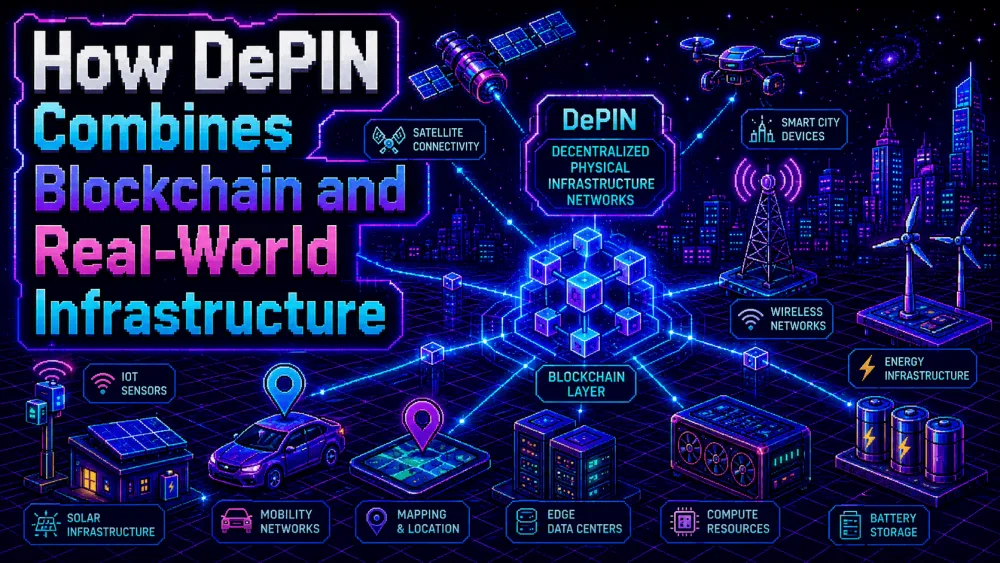
Blockchain does not produce bandwidth or run GPUs. It coordinates ownership, payments, verification, and incentives. That is why decentralized infrastructure crypto can turn hardware into open markets.
The Role of Token Incentives
Token incentives persuade operators to buy devices, maintain uptime, and supply resources. Rewards must follow useful work, not empty emissions.
Physical Hardware Connected to Blockchain Networks
DePIN needs physical hardware: servers, GPUs, routers, antennas, storage drives, sensors, dashcams, or energy devices. This makes DePIN crypto projects harder to build, but more grounded.
Why Decentralization Matters for Infrastructure
Infrastructure is usually owned by a few large companies. DePIN spreads ownership across many operators, giving users broader access and contributors a share in the network.
Types of DePIN Projects
Not all DePIN coins belong in one basket. Storage, wireless, compute, energy, and mapping projects have different economics, so research should focus on demand and usage.
Decentralized Wireless Networks
Wireless DePIN projects reward people for deploying hotspots or connectivity devices. Helium is the best-known example, but coverage matters only when real data usage follows.
Decentralized Storage Platforms
Decentralized storage platforms use distributed providers instead of one cloud company. Filecoin is the main name here because AI, media, archives, and apps all need storage.
GPU and AI Computing Networks
GPU networks are the hottest DePIN category because AI teams need expensive compute. This is where AI and DePIN connect directly, with Render, Akash, and io.net building open compute markets.
Read more: The Next Solana? Emerging Blockchain Projects Gaining Massive Attention
Energy and Smart City Infrastructure
Energy and smart city DePIN projects can track energy data, coordinate devices, or support urban sensors. Regulation and hardware deployment make this category slower.
Mobility and Mapping Protocols
Mapping protocols reward users for collecting road, traffic, or location data. They challenge centralized map platforms, but their value depends on accurate, fresh, and fraud-resistant data.
Why DePIN Could Explode in 2026
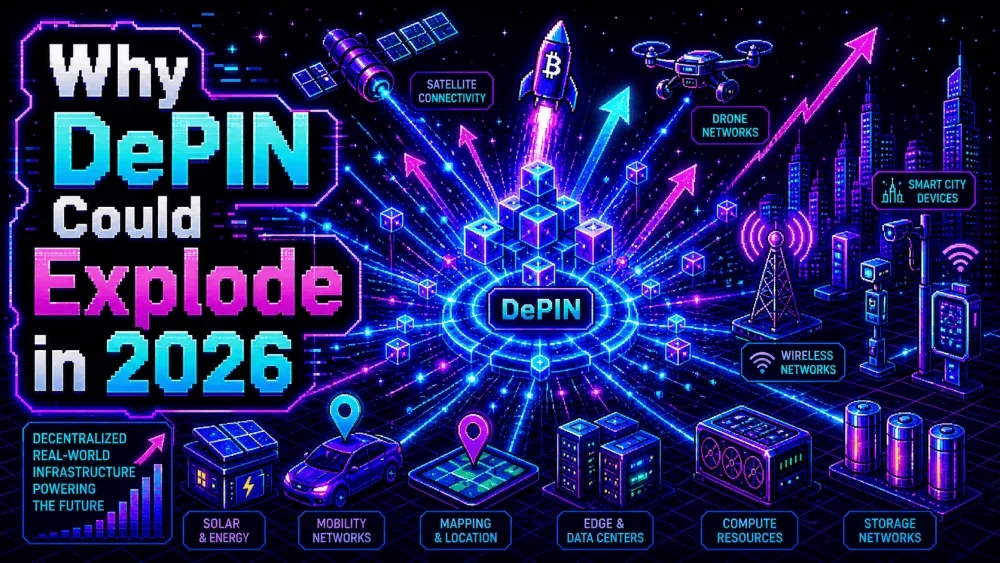
DePIN could become a major 2026 theme because infrastructure demand is rising. AI needs GPUs, apps need storage, users need bandwidth, and companies want lower costs.
The AI Boom Is Increasing Infrastructure Demand
AI has made computing a bottleneck. DePIN networks may not replace Big Tech clouds, but they can serve users who need cheaper, flexible, or open access.
Rising Interest in Real-World Crypto Utility
The market is tired of empty token stories. DePIN gives crypto a product-led angle by showing devices, compute sold, storage used, traffic, and paying users.
Institutional Attention Toward DePIN Projects
Institutions understand cloud, telecom, AI compute, and data markets better than abstract Web3 ideas. If the best DePIN projects show revenue and reliability, they can attract serious capital.
Lower Costs Compared With Traditional Infrastructure
Traditional infrastructure needs a large upfront investment. DePIN spreads cost across independent contributors, from GPU owners to storage providers and hotspot operators.
The Growth of Tokenized Physical Assets
DePIN fits the rise of tokenized physical assets. Storage, bandwidth, compute, wireless coverage, and energy data are real resources that tokens can turn into programmable markets.
Top DePIN Crypto Projects to Watch
The top DePIN tokens are not always the newest names. Strong projects need useful supply, paying demand, clear token utility, transparent metrics, and a reason to be decentralized.
Filecoin (FIL)
Filecoin is one of the original DePIN networks. It focuses on decentralized storage and uses FIL▲$0.8062 as its economic layer. Its bull case is rising data demand, especially from AI and media.
Read more: Filecoin (FIL) Price Prediction 2026 – Bullish Scenario, Risks & ROI Potential
Render (RNDR)
Render is still widely searched as RNDR, although the ecosystem has shifted toward RENDER▲$1.61 after migration. It connects GPU suppliers with users who need rendering, AI media, and compute-heavy work.
Helium (HNT)
Helium is the flagship decentralized wireless network. HNT rewards operators for supporting coverage, but long-term value depends on real wireless usage, not only hotspot count.
Akash Network (AKT)
Akash is a decentralized cloud marketplace where users rent compute from providers. AKT has gained attention as AI developers search for flexible infrastructure.
io.net and Emerging AI Infrastructure Coins
io.net represents the newer wave of AI infrastructure coins. It focuses on decentralized GPU supply for machine learning and AI workloads, but investors must separate usage from branding.
DePIN vs Traditional Infrastructure
DePIN is not automatically better than traditional infrastructure. Centralized providers still lead in support, compliance, and reliability. DePIN must win on cost, access, transparency, or resilience.
Centralized vs Decentralized Systems
Centralized systems are easier to control because one company manages hardware, pricing, and support. Decentralized systems are messier, but they let many participants build and own the network.
Cost Efficiency and Scalability
DePIN can be efficient when it uses idle resources such as spare GPUs, unused storage, or local hardware. But cheap supply is not enough; utilization creates value.
Transparency and Community Ownership
DePIN can make rewards, emissions, governance, and activity more visible. Community ownership can build loyalty, though conflicts between operators, users, developers, and holders remain possible.
Security and Reliability Comparison
Traditional providers offer contracts and support. DePIN relies on proofs, redundancy, staking, reputation, and penalties. The best networks make decentralization invisible.
Benefits of Investing in DePIN Crypto Projects
DePIN Investing offers exposure to AI, cloud alternatives, storage, wireless, and Web3 infrastructure. It is high risk because tokens can fall even when the network is useful.
Exposure to AI and Web3 Growth
DePIN sits between AI demand and Web3 infrastructure. If compute, storage, and decentralized data services keep growing, useful projects may benefit.
Passive Income Opportunities Through Node Participation
Some DePIN networks let users earn rewards by running hotspots, storage nodes, servers, or GPUs. It is not guaranteed income: hardware cost, electricity, uptime, rewards, and token price matter.
Long-Term Infrastructure Adoption Potential
The long-term case is that DePIN becomes part of the stack for AI, telecom, storage, mapping, and energy. If that happens, leading networks could become real service platforms.
High-Growth Market Narrative for 2026
The story is easy to understand: AI needs GPUs, apps need storage, and users need networks. That gives DePIN market energy for 2026, but hype is not adoption.
Risks and Challenges Facing DePIN
DePIN is promising, but the physical world is difficult. Hardware breaks, regulation changes, rewards fluctuate, and large companies control much of the market.
Regulatory Uncertainty
Some DePIN networks touch regulated areas such as telecom, energy, mobility, and data collection. Rules vary by country, so a model that works in one market may face limits in another.
Hardware Deployment Challenges
Hardware deployment is slow and expensive. Devices must be bought, shipped, installed, maintained, and upgraded. Location matters too, especially for wireless and mapping.
Token Volatility and Market Cycles
Token volatility can hurt operators and investors. If rewards fall, suppliers may leave; if rewards are too high, inflation can dilute holders.
Competition From Big Tech Companies
Big Tech already owns cloud platforms, data centers, AI infrastructure, and customer relationships. DePIN must offer an edge in price, access, openness, or resilience.
How to Invest in DePIN Projects
Buying DePIN tokens requires more than following a trend list. Investors should analyze demand, supply, tokenomics, hardware economics, and competition.
Best Exchanges to Buy DePIN Tokens
The best exchanges to buy DePIN tokens depend on the asset and region. FIL, HNT, AKT, and RENDER are easier to find on major platforms, while newer DePIN coins may start smaller.
How to Research DePIN Fundamentals
Start with one question: Who pays for the service? Then study active devices, paid usage, uptime, customers, fees, supply quality, and hardware economics.
What Metrics Matter Most for DePIN Coins
For storage, track stored data and retrieval demand. For compute, check GPU use and job volume. For wireless, traffic matters more than coverage. Also watch emissions, unlocks, fees, and supplier profitability.
Common Mistakes New Investors Make
The biggest mistake is buying the label instead of the network. A project can say AI, DePIN, and Web3 without adoption. Investors also ignore unlocks and weak demand.
Why AI and DePIN Are Closely Connected
AI and DePIN are connected because AI is becoming an infrastructure race. Models need GPUs, storage, bandwidth, and data pipelines. DePIN offers open markets for those resources.
GPU Demand and Decentralized Computing
GPU demand is the clearest link. AI training and inference require expensive hardware, and decentralized compute networks try to unlock underused GPUs.
AI Data Storage Needs
AI creates huge storage needs. Datasets, media, logs, model files, and archives all need space, making decentralized storage relevant for users who want less cloud dependence.
The Rise of AI-Powered Blockchain Infrastructure
AI-powered blockchain infrastructure may include compute markets, model hosting, data verification, agents, and machine payments. DePIN can supply the machines behind them.
Why Investors Compare DePIN to Early Cloud Computing
Investors compare DePIN to early cloud computing because both change infrastructure access. Cloud made servers on demand; DePIN tries to make distributed physical resources open markets.
FAQ
What Is DePIN?
DePIN means decentralized physical infrastructure networks. It uses tokens to coordinate GPUs, storage servers, hotspots, sensors, and mapping devices.
What Is DePIN Crypto Used for?
DePIN crypto is used for rewards, payments, staking, governance, and access to infrastructure services.
What Are The Best DePIN Projects to Watch?
Filecoin, Render, Helium, Akash Network, and io.net are among the best DePIN projects to research across storage, GPUs, wireless, cloud, and AI infrastructure.
Are DePIN Coins Risky?
Yes. DePIN coins face token volatility, hardware costs, weak demand, regulation, and Big Tech competition.
Why Are AI and DePIN Linked?
AI and DePIN are linked because AI needs compute, storage, and bandwidth. DePIN networks try to supply those resources through decentralized markets.
How Should Beginners Approach DePIN Investing?
Beginners should study real usage, tokenomics, supply growth, hardware economics, and customer demand before buying.