In 2026, major crypto exchanges are delisting more tokens than ever and putting risk labels on assets that once would have been left alone. The reason is a structural shift as crypto exchanges now face tighter regulation. That creates a growing fear that a bad listing might cause legal, reputational, and operational damage.
Contents
- Why Token Delistings Are Accelerating
- The New Compliance Rule: If It Looks Like a Problem, It Becomes One
- MiCA Is Reshaping European Listings
- Stablecoin Delistings Are the Template
- Privacy Coins Face the Harshest Treatment
- Securities Risk Still Drives U.S. Delistings
- Low Liquidity Is Now a Bigger Red Flag
- Monitoring Tags Are the Warning Shot
- Dead Projects Are Losing Their Free Ride
- Tokenomics Are Under More Scrutiny
- Derivatives Listings Add Another Layer of Risk
- Regional Delisting Will Become Normal
- What Delistings Mean for Investors
- What Projects Need to Do to Stay Listed
- Are Delistings Bad for Crypto?
- The New Listing Era
- FAQ
Why Token Delistings Are Accelerating
Token delistings used to happen mostly when a project died or suffered an exploit. Today, the bar has moved. Crypto exchanges are also removing tokens because of:
- Regulatory uncertainty
- Weak compliance documentation
- Unclear issuer structure
- Suspicious trading activity
- Poor development progress
- Privacy features
- Unstable tokenomics
- Regional licensing rules
This is a major change. A token can still have an active community and decent daily volume but lose its listing if the exchange decides the risk is no longer worth the trading fees.
For investors, that means exchange listings are becoming less permanent. For projects, it means getting listed is not the finish line. Staying listed is now the harder part.
Read more: Donald Trump Made $1.4B from His Own Crypto Holdings: What’s Next for Trump Crypto Profits?
The New Compliance Rule: If It Looks Like a Problem, It Becomes One
The biggest driver behind delistings is compliance. Crypto exchanges are being forced to act more like regulated financial platforms, not neutral marketplaces where anything can trade.
That changes how exchanges think. A token is no longer evaluated only by demand. It is evaluated by questions like:
| Exchange concern | Why it matters |
|---|---|
| Is the token potentially a security? | Could trigger enforcement or registration problems |
| Is the issuer identifiable? | Regulators may expect disclosures and accountability |
| Does the token have privacy features? | AML teams may see it as harder to monitor |
| Is liquidity too thin? | Easier manipulation and worse user execution |
| Is the project still active? | Dead projects create user-protection risk |
| Are token unlocks extreme? | Large dumps can damage market integrity |
| Is the asset compliant in every region? | Exchanges may need geofencing or delisting |
This is why token delisting is becoming more common. Crypto exchanges no longer ask only whether an asset is popular. They ask whether the asset is defensible.
MiCA Is Reshaping European Listings
Europe’s MiCA framework is one of the clearest examples of the new delisting era. MiCA creates a unified regulatory regime for crypto-asset service providers, stablecoin issuers, and crypto-asset offers across the EU.
For crypto exchanges, the practical impact is brutal: if a platform wants to serve European clients, it must fit inside the MiCA framework. If a listed asset does not fit, the exchange may restrict or remove it for EU users.
Stablecoins show this clearly. In the European Economic Area, several exchanges have restricted or delisted non-compliant stablecoins to align with MiCA rules. Kraken, for example, delisted multiple stablecoins for EEA clients, including USDT▲$0.9991, DAI▲$0.9998, PYUSD▲$1.00, RLUSD▲$0.9999, TUSD, USDD▲$0.9991, USDS▲$0.9998, EURT, and UST.
This is not just a stablecoin story. It shows how regional regulation can reshape exchange listings even when global demand remains strong. A token can be liquid worldwide but still become unavailable in one major jurisdiction.
Related: What MiCA Still Doesn’t Solve — Europe’s Biggest Crypto Regulation Problems
That creates a new market reality: “listed globally” no longer means “available everywhere.”
Stablecoin Delistings Are the Template
Stablecoin delistings matter because they show how crypto exchanges will likely handle future regulatory uncertainty.
Instead of waiting for a legal disaster, exchanges now move earlier. They restrict pairs, block regional trading, disable deposits, phase out buying and selling, or leave withdrawals open while removing active markets.
This is the template:
| Step | What exchanges often do |
|---|---|
| Risk identified | Asset is reviewed internally |
| Regional issue found | Trading may be restricted by country |
| Compliance deadline approaches | New buys or deposits may be blocked |
| Formal delisting announced | Trading pairs are removed |
| Exit window opens | Users can sell, convert, or withdraw |
| Full support may end | Remaining assets may be converted or withdrawal-only |
This matters beyond stablecoins. The same pattern can apply to privacy coins, low-liquidity tokens, tokens named in lawsuits, assets tied to sanctioned activity, or projects that fail exchange review standards.
Privacy Coins Face the Harshest Treatment
Privacy coins are particularly vulnerable on centralized crypto exchanges. Monero, Zcash, Dash, and Horizen have all faced major exchange restrictions or delistings in recent years.
The problem is obvious. Privacy-focused assets are designed to reduce transaction visibility. This is exactly what their users want, but it also makes it more difficult for exchanges to monitor suspicious activity. And they must carry out that monitoring to satisfy regulators.
This does not mean privacy coins will disappear. They may migrate toward decentralized exchanges or smaller, offshore venues.
Related: What’s Wrong with Dogecoin? Why the Biggest Memecoin Keeps Crashing in 2026
For crypto exchanges seeking licenses, privacy coins are often a headache. Their trading fees are rarely worth the regulatory questions.
Securities Risk Still Drives U.S. Delistings
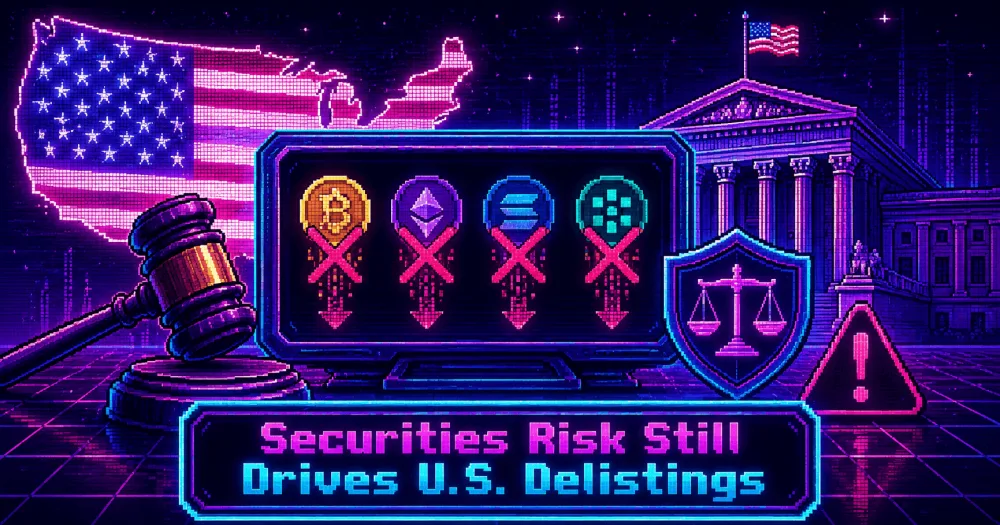
In the U.S., securities law remains one of the biggest delisting triggers. When regulators argue that certain tokens are securities, exchanges often reassess whether supporting those assets is worth the risk.
The SEC’s 2023 actions against Coinbase and Binance created a major shock because multiple tokens were named in legal complaints. Robinhood later moved to delist Solana, Cardano, and Polygon in response to the regulatory pressure around those assets at the time.
The U.S. approach has shifted since then, but the practice stands. If a token becomes legally challenged, exchanges would remove it immediately to mitigate their own risks rather than wait for a court ruling.
Low Liquidity Is Now a Bigger Red Flag
Crypto exchanges also delist tokens for simpler market reasons: nobody trades them.
Low liquidity creates several problems. It widens spreads, worsens execution, makes price manipulation easier, and damages the exchange’s market quality. It can also trap users in positions they cannot exit without heavy slippage.
During bull markets, small tokens can survive because speculative demand keeps volume alive. During weaker markets, many of those same assets collapse.
That is why crypto exchanges increasingly review trading volume and liquidity depth. A token may still have a market cap on paper, but if real trading is thin, the listing becomes dead weight.
Monitoring Tags Are the Warning Shot
Binance’s Monitoring Tag is a useful example of how the new delisting process works. Tokens with this label are considered higher-risk than ordinary listed assets and are subject to more frequent reviews.
The tag does not automatically mean a token will be removed. But it is a warning. Binance says tokens may receive this status because of factors such as higher volatility, legal and regulatory concerns, poor liquidity, unethical conduct, weak development activity, or failure to meet listing standards.
This is important because delistings are becoming less sudden. Crypto exchanges now often create a warning stage before removal. A token may first receive a risk tag, then lose margin support, then lose certain trading pairs, and finally be delisted if conditions do not improve.
For investors, a monitoring tag should not be treated as cosmetic. It is the exchange saying: this asset is now on probation.
Related: Why Is ONDO Crypto Still in a Downtrend in 2026? Here’s What’s Holding It Back
Dead Projects Are Losing Their Free Ride
Another reason crypto exchanges are delisting more tokens is that many old projects are not active enough anymore.
A project may still have a token but no real development. Exchanges increasingly look at whether the team ships updates, maintains code, communicates with users, resolves technical issues, supports chain upgrades, and responds to exchange requests.
If the project team disappears, the token becomes a liability. The exchange may be left supporting deposits, withdrawals, swaps, forks, wallet maintenance, and user questions for an asset whose own developers barely show up.
That used to be tolerated. Now it is less likely to be.
Tokenomics Are Under More Scrutiny
Crypto exchanges are also paying closer attention to tokenomics. This is especially true for newer altcoins, memecoin launches, unlock-heavy tokens, and projects with concentrated insider allocations.
Bad tokenomics can create severe trading risk. If a small float trades on exchanges while insiders hold a large locked supply, a future unlock can crush the market. If liquidity is artificial, the token can collapse once incentives dry up.
Exchanges do not want to be blamed when retail users buy into a chart that was structurally designed to dump on them. That does not mean they catch every bad token. They don’t. But the tolerance for obvious trash is lower than it was.
The casino is still open. It just has more cameras now.
Derivatives Listings Add Another Layer of Risk
Spot delistings are only part of the story. Crypto exchanges also delist futures contracts, margin pairs, copy-trading products, earn products, and leveraged token markets.
This matters because derivatives can amplify losses. If liquidity dries up in a futures contract, the exchange may face poor index pricing and forced liquidations. If a token becomes too volatile or too thinly traded, derivatives support becomes dangerous.
That is why exchanges may remove derivatives before removing spot trading. Futures delisting is often the first serious sign that an asset is losing institutional-quality support.
Regional Delisting Will Become Normal
One of the biggest changes is that delisting is no longer always global. A token may remain available in Asia but not Europe. It may be available offshore but not in the U.S. It may be tradable on decentralized exchanges but not on regulated centralized platforms.
This creates a fragmented market. Users in different regions may see different asset lists, different stablecoin options, different leverage limits, and different withdrawal rules.
For crypto exchanges, this is annoying but manageable. For token projects, it is dangerous because losing access to one major region can reduce liquidity everywhere.
Liquidity is connected. Cut off enough markets, and even a globally listed token can start looking fragile.
What Delistings Mean for Investors
A token delisting does not always mean the project is dead. Sometimes it means the exchange is exiting a jurisdiction, removing a pair with weak volume, or reducing legal exposure.
But investors should treat delisting risk seriously. Once a token is delisted from a major exchange, it may suffer lower liquidity, worse pricing, weaker market-maker support, lower visibility, and a sharper confidence hit.
Before holding smaller altcoins, users should check:
| Risk signal | Why it matters |
|---|---|
| Monitoring or warning tag | Higher delisting risk |
| Falling trading volume | Weak market demand |
| Few exchange listings | Less liquidity backup |
| Weak development activity | Project may be fading |
| Regulatory exposure | Asset may be restricted by region |
| Heavy unlock schedule | Future sell pressure |
| Thin order books | Harder exit during volatility |
The main mistake is assuming that a listing on a major exchange guarantees permanence. It does not.
What Projects Need to Do to Stay Listed
For token projects, the new rules are clear. Exchanges want fewer excuses and more evidence.
Projects need active development, transparent tokenomics, clean legal documentation, responsive teams, reliable wallet infrastructure, real liquidity, honest communication, and a credible compliance posture.
The worst strategy is silence. If an exchange asks for documentation, technical updates, ownership details, or legal clarification, slow answers can become fatal. A project that cannot explain itself looks risky even before anything goes wrong.
In the old market, hype could get a token listed. In the new market, discipline keeps it listed.
Are Delistings Bad for Crypto?
Delistings are painful, but not always bad. Some remove dead assets or protect users from broken infrastructure. Others help exchanges comply with laws that are no longer optional.
The problem is that delistings can also reduce user choice, push activity offshore, hurt legitimate privacy tools, and concentrate liquidity in a smaller number of compliant assets.
That is the trade-off. Crypto wanted mainstream access. Mainstream access comes with rules, paperwork, surveillance, licensing, and risk committees. Not exactly cypherpunk poetry, but here we are.
The New Listing Era
Crypto exchanges are delisting more tokens because the market has matured and the free-for-all phase is ending. Regulation is tighter. Compliance teams have more power. Liquidity is more selective. Dead projects are easier to spot. Regional rules are harder to ignore.
This does not mean altcoins disappear. It means the gap between serious assets and weak listings gets wider.
The next wave of exchange-listed tokens will need more than hype. They will need legal clarity, real trading depth, transparent teams, functional products, and defensible token design.
For users, the lesson is: do not treat exchange listings as a safety stamp. A listing means the token passed a review at one point in time. A delisting means that review changed.
And in 2026, those reviews are getting much less forgiving.
FAQ
Why are crypto exchanges delisting more tokens?
Crypto exchanges are delisting more tokens because of stricter regulation, weak liquidity, low development activity, unclear token status, privacy-coin concerns, unstable tokenomics, and higher compliance risk.
Does a token delisting mean the project is a scam?
Not always. A token can be delisted because of regional regulation, low trading volume, technical issues, or exchange risk management. However, delisting is still a serious warning sign.
What happens when a token is delisted?
Usually, trading is suspended first. Users may be given time to sell, convert, or withdraw the asset. In some cases, withdrawals remain open after trading ends. In rarer cases, support may end completely after a deadline.
Are privacy coins more likely to be delisted?
Yes. Privacy coins face higher delisting risk on centralized crypto exchanges because their privacy features can create compliance, AML, and sanctions-monitoring concerns.
How can investors spot delisting risk early?
Watch for monitoring tags, falling volume, thin liquidity, weak development updates, exchange warnings, suspended deposits, regional restrictions, and removal of futures or margin pairs.