A growing number of crypto treasury firms are moving past simple accumulation and leaning into strategies that look more like trading desks than balance sheets.
Public companies that built crypto treasuries by raising cash to buy Bitcoin and other altcoins, also known as digital asset treasuries (or DATs), are starting to change course.
A new report from Galaxy Digital describes the move as “DAT 2.0,” where firms are expected to “generate business value like any other company” instead of relying on token prices to do the work. The change comes as Bitcoin’s rally cools and the premium these stocks once traded at has largely disappeared.
The change comes as Bitcoin’s rally cools and the premium investors once paid for these stocks fades. Shares of many of these firms now sit close to the value of the crypto they hold, a reset from 2025 when investors were willing to pay well above net asset value to get exposure.
Read more: Ethereum Treasury Firm Ether Machine Scraps Nasdaq Listing
From HODL to Stake
More than 100 companies now hold crypto on their balance sheets across at least 27 tokens, according to Galaxy Digital, with Bitcoin still making up over 75% of total exposure.
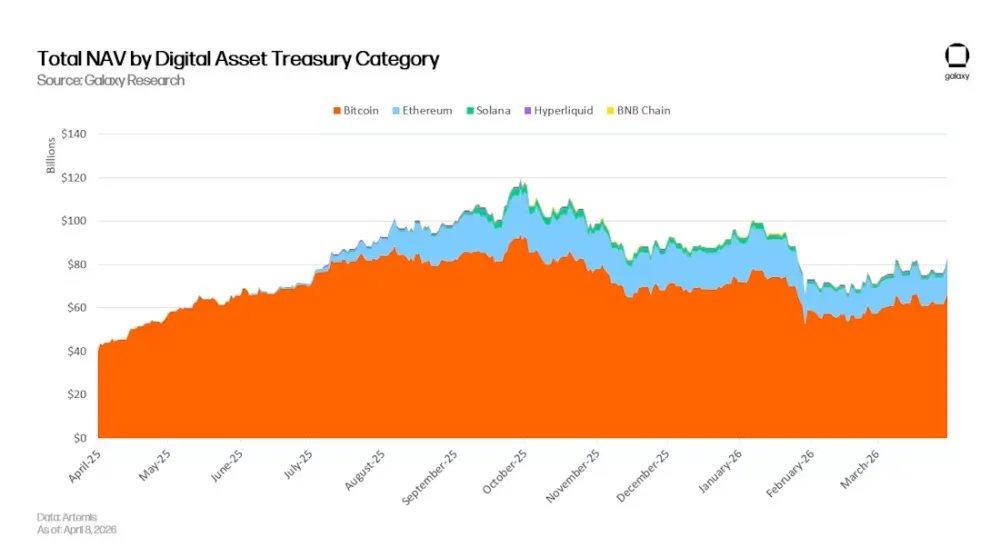
The original idea setup is starting to break now as some firms have already sold portions of their holdings. In some cases they sell crypto to fund buybacks or cover debt, a shift that underscores how dependent the model was on rising prices.
The next phase looks more like asset management than passive holding. Instead of just holding tokens, firms are starting to treat them as productive assets. As Galaxy Digital puts it, the goal is “treating the treasury as a productive asset instead of a static one.”
That starts with staking. On proof-of-stake networks, Ethereum (ETH▲$1,761.17) yields about 3% annually and Solana (SOL▲$82.41) around 7%, offering a baseline return even when prices are flat.
Management Costs
From there, it gets even more complex. Firms can run validator infrastructure, capture transaction fees and MEV, or deploy capital into DeFi strategies like lending and liquidity provision.
Even simpler trades are part of the mix. Basis trading has historically delivered roughly 5% to 15% annualized returns in stronger markets, according to the report.
In the end, future treasury firms may end up “specializ[ing] in the professional trading, storage, and procurement of sovereign block space,” Galaxy Digital wrote, adding that the next generation of DATs will need to function more like operating businesses.