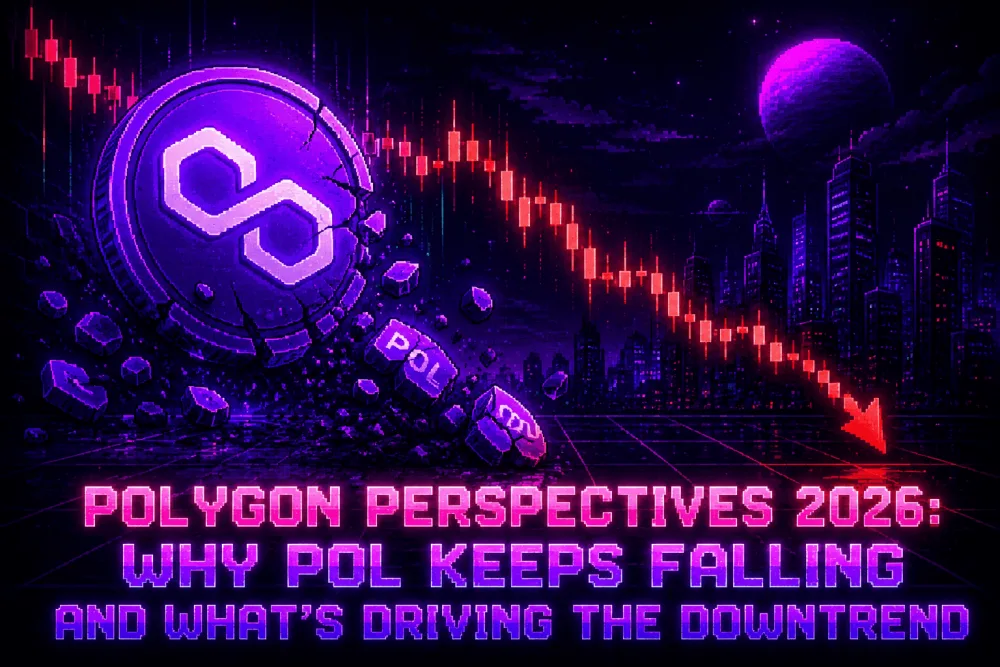
Polygon was facing pressure at the start of 2026 after migrating from MATIC to POL▲$0.0735. The technical migration went smoothly, but investors were asking whether the token model would drive utility.
Contents
- Polygon (POL) in 2026: Market Overview and Current Price Action
- Why Is Polygon (POL) Still Falling in 2026?
- Fundamental Challenges Behind POL’s Downtrend
- Macro and Market Factors Pressuring POL Price
- Is Polygon Losing Its Competitive Edge in 2026?
- Polygon Price Prediction 2026: Bearish or Recovery Scenario?
- Investor Outlook: Should You Hold or Avoid POL in 2026?
- What’s Next for Polygon (POL)?
- FAQ
Polygon (POL) in 2026: Market Overview and Current Price Action
How POL Has Performed Since the Transition From MATIC
As part of Polygon 2.0 vision, POL was declared as the native gas and staking token of the network.
However, the downtrend has continued as the asset has lagged behind some other Ethereum scaling cryptocurrencies. This has seen analysts place a focus on waning retail interest along with speculation as the reason behind is Polygon falling in the current cycle.
Key Price Levels and Recent Market Trends
POL remained near multi-year lows for most of 2026’s Q1 and Q2 after resistance levels were not broken. POL was trading 90% lesser than its all-time high on listing on CoinGecko, and had bearish structures on most higher timeframes.
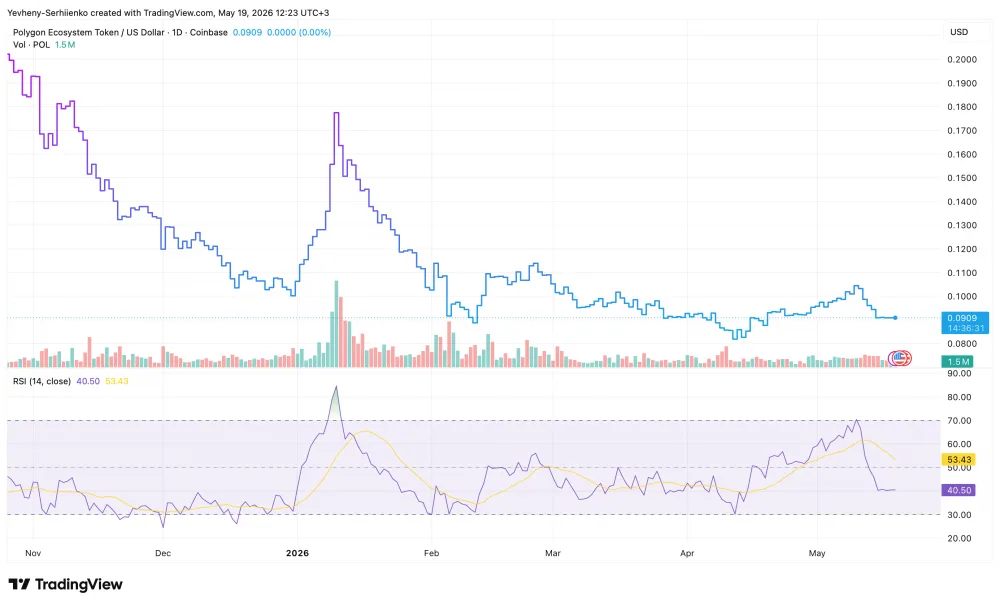
Bitcoin dominance and other large-cap coins resulted in limited upward movement in Polygon price prediction 2026 of mid-cap Layer-2 coins, as traders worried about the ecosystem’s growth stagnating.
Related: Top Crypto Deals of 2026 That Shook the Market — Biggest Moves You Need to Know
Trading Volume, Liquidity, and Market Sentiment
POL trading volume was volatile in 2026, dropping after spikes due to changes in its ecosystem. However, this was a period of lower liquidity than previous bull runs, and the most recent statistics show a downward trend in weekly trading volume and transaction growth.
This has resulted in comments, such as those in the report POL price analysis 2026, that with Arbitrum, Base, and Optimism being adopted, Polygon needs to differentiate itself in the Ethereum Layer-2 ecosystem.
Why Is Polygon (POL) Still Falling in 2026?
Weak Market Demand and Reduced Retail Interest
Retail interest around Polygon remained weak compared to earlier bull-run cycles, with diminished trading and social media activity leading to less speculative POL interest during the wider recovery.
Other narratives explaining why is Polygon falling center around lower retail participation across mid-cap altcoins and are not specific to Polygon.
Layer-2 investments were also affected as traders rotated capital into Bitcoin and spot ETF products. Many traders were looking for Bitcoin exposure and had a weaker Polygon crypto forecast 2026.
Read more: Top 5 Altcoins Whales Are Buying Aggressively in May 2026
Impact of Ethereum Layer-2 Competition (Arbitrum, Optimism, Base)
The Ethereum scaling sector became increasingly crowded as Layer-2 competition escalated, with Arbitrum strengthening its DeFi position, Base expanding through Coinbase integration, and Optimism continuing its Superchain growth.
Other analysts said some of Polygon’s first-mover advantages were lost as liquidity and developers have spilled over into competing layer-2 blockchains.
This put greater emphasis on narratives concerning Arbitrum vs Polygon and other rollups such as Optimism vs Polygon, as TVL growth and user activity largely drove investor involvement.
Token Migration Effects and Investor Uncertainty
The switch from MATIC to POL was controversial despite its wide support on crypto exchanges. Polygon has stressed that POL is important to its vision for Polygon 2.0. Investors questioned whether the switch would impact demand for the tokens or the protocol’s long-term value capture.
Read Also: Ondo Price Prediction 2026: Can ONDO Reach a New All-Time High or Collapse?
It also explored the MATIC to POL migration impact on tokenomics and staking rewards, as well as inflation compared to other Layer-2 projects.
Declining On-Chain Activity and Network Usage
However, on-chain data showed that by 2026, network momentum was waning, with analysts finding that active wallets, the number of new transactions, and DeFi activity in Polygon ecosystem did not grow as quickly as in other Ethereum scaling networks.
As Polygon network activity declined, overall sentiment became negative, with investors looking for ecosystems that maintained better liquidity retention and user growth.
Fundamental Challenges Behind POL’s Downtrend
Ecosystem Growth Slowdown and Developer Activity
Despite being one of Ethereum’s largest scaling ecosystems, Polygon’s growth slowed as its markets became competitive with other Ethereum Layer 2 networks, and developers began to fragment to other cryptocurrency ecosystems, such as Base, Arbitrium, and Optimism.
Reports tracking blockchain developers suggest that the Ethereum scaling activity is relatively distributed across multiple chains rather than being centralized.
There was also skepticism within the greater Polygon ecosystem about whether Polygon would be able to maintain its share of the market despite such investments in zk and AggLayers.
TVL Outflows and DeFi Shrinkage on Polygon
Activity in decentralized finance (DeFi) on Polygon considerably decreased compared to prior peaks, with total value locked (TVL) far below all-time highs set during the 2021-2022 DeFi bull run and with liquidity increasingly moving away to competing ecosystems.
Concerns around Polygon TVL outflows also intensified as investors compared the network’s DeFi growth with faster-growing Layer-2 ecosystems, since weaker DEX volumes continued pressuring sentiment around POL.
Token Utility Concerns After Rebranding
The transition from MATIC to POL was part of the larger Polygon 2.0 initiative, which intended to expand its use as a token for staking, governing, and securing multiple chains within the ecosystem. Polygon described POL as the native asset of its multi-chain system.
Read Also: Polygon Brings KYT Checked Private Payments to Stablecoins
Despite this, investors had limited common ground on whether they would extract value for a long time or use the token, and POL price analysis 2026 suggested stronger signs of long-term demand for the ecosystem.
Macro and Market Factors Pressuring POL Price
Crypto Market Cycles and Bitcoin Dominance
The wider crypto market did not help POL’s case as Bitcoin dominance, a measure of Bitcoin’s market cap in relation to that of the entire crypto market, remained high throughout the cycle per TradingView and CoinMarketCap, and liquidity in mid-cap altcoins and Layer 2 tokens was limited at the time.
The dynamic also reduced speculative demand in Ethereum scaling ecosystems and continued to define the wider Polygon crypto forecast for 2026.
Risk-Off Sentiment in Altcoin Markets
Due in part to macroeconomic uncertainty and reduced retail activity, altcoin investors were less enthusiastic about the ecosystem compared to Bitcoin and large-cap tokens, and continued a period of weakness in the Layer-2 sector.
Polygon (POL) downtrend, in particular, may be indicative of the situation across the whole space, alongside optimism and improvements in the ecosystem failing to drive momentum, lacking a strong appetite for altcoins across the crypto market.
Regulatory Pressure and Institutional Capital Flow
Regulatory uncertainty continued to dominate institutional crypto flows, with the SEC providing clarity on staking, token classifications, and how it regulates crypto assets for much of 2025 and 2026, alongside new Senate digital asset legislation during this period.
Around the same time, institutional capital remained heavily invested in Bitcoin products after the approval of multiple spot BTC▲$62,630.00 ETFs in the United States, leaving less room for assets such as POL and continuing to influence Polygon price prediction 2026.
Is Polygon Losing Its Competitive Edge in 2026?
Comparison With Leading Layer-2 Networks
The Ethereum Layer-2 ecosystem stayed competitive, with Arbitrum, Base, and Optimism growing their ecosystems as other competing networks on L2BEAT saw the fastest growth in TVL and in user activity in 2025 and 2026.
As such, this trend has ignited active debates of Arbitrum vs Polygon and Optimism vs Polygon, where DeFi dominance is a key consideration.
Strengths Still Supporting the Polygon Ecosystem
Polygon continues to have one of the most meaningful infrastructure footprints among Ethereum scaling projects, supporting gaming, NFTs, and enterprise apps, and expanding its zk-based scaling strategy and architecture known as AggLayer.
Several market observers still believe Polygon retains long-term infrastructure relevance despite weaker token performance.
“The internet was never meant to operate on a single blockchain. The future will require many interconnected chains, and AggLayer is designed to unify them without fragmenting liquidity.” — Marc Boiron, CEO of Polygon Labs
However, some analysts believe renewed liquidity and user growth would help soften these Polygon ecosystem challenges.
Strategic Partnerships and Enterprise Adoption
To increase visibility, Polygon partnered with payment, tokenization, and consumer companies and platforms, including Reddit and Nike, which previously integrated Polygon’s infrastructure into their blockchain-based projects, diversifying Polygon’s presence beyond just DeFi applications.
Although these partnerships have yet to reverse negative sentiment around POL, they are differentiating Polygon from many of its Layer-2 counterparts.
| Network | Main Strength | Weakness in 2026 | DeFi Position |
| Polygon | Enterprise adoption, AggLayer | Slower ecosystem growth | Weakening |
| Arbitrum | Strong DeFi ecosystem | High competition pressure | Strong |
| Optimism | Superchain expansion | Lower retail traction | Stable |
| Base | Coinbase integration | Younger ecosystem | Rapidly growing |
Polygon Price Prediction 2026: Bearish or Recovery Scenario?
Base Case Scenario for POL Price Movement
Most observers expect POL to be heavily influenced by trends in the rest of the cryptocurrency market through early 2026. Nevertheless, as of May 2026, coin trackers CoinMarketCap and CoinGecko report that POL is worth between $0.09 and $0.10, which is over 90% below its all-time high of around $1.29.
Also, daily trading volumes were in the $40-50 million range, lower than the highs observed in previous periods of bull markets.
Polygon price prediction crypto 2026 is a gradual recovery, as it is important to analyze if the network can attract more users, total value locked, and developer activity amid a growing wave of L2 competition.
Bullish Recovery Case – What Would Need to Change
The bullish trend would require deeper capital rotation in altcoins and improvement in on-chain metrics in Polygon ecosystem. For those following POL price analysis 2026 trends, active addresses, DeFi liquidity, and the growth of AggLayer adoption within the ecosystem would be a key focus in determining whether the trend is sustainable.
A meaningful demand for Ethereum scaling in the next market cycle could benefit Polygon even further; CoinCodex estimates POL price could be between $0.20 and $0.30 in a more bullish market cycle.
Bearish Scenario and Risk of Further Decline
The bearish case remains competition from rival ecosystems like Arbitrum, Base, and Optimism. If Polygon loses market share and activity within the DeFi space, even with the upgrades, POL may remain at or near cycle lows.
Many Polygon crypto price predictions have signaled that the cryptocurrency has a increased risk of dropping below a key support level of $0.09, leading it to retrace to an earlier level of support of $0.08. The $0.09-$0.10 zone was recently flagged as a key area by market analysis site CoinMarketCap.
Investor Outlook: Should You Hold or Avoid POL in 2026?

Long-Term vs Short-Term Investment Perspective
Near-term sentiment around POL remains negative, as POL currently trades well below cycle highs, and traders continue cautious towards its momentum, the pace of ecosystem growth, and increasing competition in the Ethereum Layer-2 ecosystem.
However, according to current data from CoinMarketCap, POL is still more than 90% below its all-time high.
Long-term investors still view Polygon as a relevant infrastructure project due to enterprise partnerships, ZK-development focus, and the AggLayer strategy.
Read Also: Meta USDC Payouts Bring Facebook Creators to Solana, Polygon
The question of is Polygon a good investment 2026 will largely depend on whether the project can restore stronger network activity and liquidity growth during the next market cycle.
Key Signals to Watch Going Forward
Major indicators for POL price analysis 2026 are active addresses, total value locked (TVL) recovery, stablecoin inflows, and developer activity and participation in the ecosystem, indicating greater demand in POL ecosystem and positive price movement in the crypto market.
Other signals that market participants pay attention to include AggLayer adoption and Ethereum Layer-2 market share, along with developer retention on Polygon versus other L2 ecosystems like Arbitrum and Base. Sustainable progress in these areas may have a more meaningful effect on investors’ mood than price movement alone.
Risk Management Strategies for POL Holders
Risk management continues to be key for POL holders amid continuing volatility in altcoin markets, with analysts advising against excessive exposure to speculative Layer-2 coins and to watch key support levels in bearish trading sessions.
For retail investors, scaling into positions is sometimes preferable to aggressive trading. With the outcome of Polygon (POL) downtrend still unknown, diversification and wise position sizing remain strategies for limiting downside risk.
What’s Next for Polygon (POL)?
Final Assessment of Downtrend Drivers
By 2026, a number of factors will destabilize Polygon, including an overall slow growth of users in the ecosystem, decreased use of DeFi, and the emergence of other Layer 2 providers: Arbitrum, Base, and Optimism.
Additionally, wider market conditions led Bitcoin and other large-cap assets to outperform Layer-2 tokens, while data from CoinMarketCap in 2026 showed that POL was still trading over 90% off its all-time high.
Read Also: Top Ethereum Gas Fee Solutions in 2026: How Cheap Is ETH Now?
A larger question of why is Polygon falling could also be linked to a lack of clarity around demand for Polygon’s token beyond the MATIC-POL migration, and Polygon continued to build out its AggLayer and zk-based infrastructure. Investors are still looking for evidence of network growth and meaningful value capture.
Future Catalysts That Could Reverse the Trend
Improved sentiment around POL may naturally occur if Ethereum adoption grows, altcoins return to the center of the crypto economy, or DeFi liquidity on Polygon network improves.
AggLayer adoption and enterprise partnerships, along with on-chain activity, will also be carefully observed by analysts of the extensive Polygon crypto outlook.
If Polygon network can successfully scale its own cross-chain infrastructure play, alongside recapturing users and developers, it may still recover some of its rank in Ethereum Layer-2 landscape.
FAQ
Will Polygon recover from its downturn in 2026?
Recovery is still possible if the conditions are right, as long as Polygon can return to a path of achieving network growth with user activity, liquidity, and sentiment across the Ethereum scaling networks.
What caused Polygon’s price weakness in 2026?
Weak retail demand, increased competition from other Layer-2 ecosystems, slower ecosystem development, and weaker crypto market conditions for risk assets such as mid-cap altcoins were some of the reasons.
Is Polygon still developing its ecosystem?
Yes. Polygon has continued to build out its zk-based infrastructure, AggLayer strategy, and enterprise partnerships even as the token has weakened. The network is still in operation.
How does Polygon network compare to other Layer-2s?
While Polygon remains one of the largest Ethereum scaling ecosystems, it has lost market share relative to competing Layer-2 solutions, such as Arbitrum, Base, and Optimism, particularly with respect to DeFi usage and user activity as competition has strengthened.
Which metrics are most important for investors?
Investors have generally looked at active addresses, total value locked, developer activity, and liquidity growth of the ecosystem as metrics that indicate the longer-term health of the network rather than short-term variations in price.