Though interest in stablecoin infrastructure remains and Plasma crypto project, including Tether backing and allowing USDT▼$0.9996 transfers, had seen more bullish news this week due to gameplay expansion of its own Plasma One infrastructure into new games, it hasn’t been enough to stem bearish sentiment behind Plasma network overall.
Contents
- Why Is Plasma (XPL) Crypto Crashing This Week?
- The Biggest Reason Behind XPL’s Price Drop: Token Unlocks
- Weak Trading Activity Is Adding More Pressure
- Is Anything Fundamentally Wrong With Plasma?
- Plasma Tokenomics Explained
- Plasma Price Prediction 2026–2027
- Can XPL Recover After This Week’s Crash?
- Is Plasma (XPL) Worth Buying After the Drop?
- FAQ
Why Is Plasma (XPL) Crypto Crashing This Week?
XPL Extends Its Downtrend Despite Strong Stablecoin Narrative
Instead, traders have focused on XPL token unlock, which increased the circulating supply. Further selling by early participants was expected as well, so price weakness continued despite the fundamentals having not changed considerably.
Is This a Normal Correction or the Start of a Bigger Sell-Off?
Whether this correction is just a retest or the start of a larger sell-off is difficult to say, with the most recent drop coinciding with one of the largest Plasma unlocks to date, making it impossible to disentangle technical weakness from the influx of additional supply.
For now, why is XPL crashing and why is Plasma crypto down appear to be driven mainly by tokenomics rather than weakening fundamentals. Investors are still hopeful that the unlocked tokens will be absorbed quickly by the market, or it may take longer, negatively affecting Plasma crypto price.
| Factor | Current Status | Potential Impact on XPL |
| Token unlock | 1 billion XPL recently unlocked | Higher circulating supply may increase selling pressure |
| Trading volume | Lower than previous sessions | Weaker buying interest can slow recovery |
| Open interest | Relatively subdued | Limited speculative demand reduces momentum |
| Stablecoin ecosystem | Development continues | Supports the long-term fundamental outlook |
| Future vesting | Additional unlocks scheduled through 2026 and beyond | New supply may continue influencing market sentiment |
| Market sentiment | Cautious after the recent correction | Recovery depends on demand absorbing newly released tokens |
The Biggest Reason Behind XPL’s Price Drop: Token Unlocks
What Happened in This Week’s XPL Token Unlock?
The decline trigger was the most recent, scheduled XPL token unlock. Tokenomist data indicates that Plasma unlocked another batch of vested tokens on the release schedule of the ecosystem distribution, adding more liquid supply.
This was not a sudden issuance of units to investors, but had long been part of the project’s public vesting schedule.
Scheduled unlocks are not uncommon in other crypto projects and are usually very volatile since traders are looking to buy or sell based on the unlocked supply. This was an important factor in the recent Plasma token unlock.
How New Supply Creates Selling Pressure
However, much of the demand could be negatively affected by the fact that early investors, contributors, or ecosystem participants may be selling some or all of their tokens once they become transferable, even if a small amount of their tokens have actually been released to exchanges.
The most recent XPL price analysis has been about how much of the new liquidity can be absorbed. Token unlocks aren’t always followed by sustained price drops, but they tend to be associated with short-term volatility and are being watched by traders for how they are absorbed in the future.
Upcoming Unlocks That Traders Should Watch
According to the latest Tokenomist vesting schedule, Plasma may produce a majority of its new circulating supply through future unlocks, wherein the circulating supply provided for ecosystem allocations would represent most of the future circulating supply being released. Plasma has a token release calendar.
Read More: Will Crypto Market Recover by End of 2026? 5 Factors That Could Decide Crypto’s Future
If you are interested in XPL crypto news, keep in mind that these unlocks are likely to remain important market events. Examining trading patterns around unlock dates is an effective way to determine if the selling pressure is subsiding.
Weak Trading Activity Is Adding More Pressure
Falling Trading Volume and Open Interest
In the last 24 hours, XPL’s trading volume was down 6.2% to $61.65 million, and its open interest was around $112.3 million, according to CoinGlass.
At the same time, derivatives activity has remained relatively muted, offering little support for a sustained recovery, market trackers have found.
Few traders are using heavy volumes of leveraged trades to make their bets, and if they don’t increase their level of participation, this means that recovering will become more difficult, because small sell orders become more important.
Why Buyers Are Waiting on the Sidelines
Other cryptocurrency market trackers have listed that XPL came under pressure after additional vested tokens became available for circulation, as well as weakness in other altcoins.
A lack of a short-term driver has also deterred buying, with market commentary suggesting that the latest price rise was not accompanied by high-volume trades nor by derivatives positioning or technical breakouts to get many players involved.
They may instead wait for more volume confirmation or for some signs that all the selling tied to unlocks has been digested.
Key Support and Resistance Levels
Plasma crypto price on the one-week chart shows $0.08042 as the current price, with a 7-day decline of 2.54%. Current movement and trading volumes from major price aggregators suggest support might occur at around $0.080, while further selling pressure may lead to support in the $0.078-$0.075 price range.
The first resistance area is $0.082, which was reached multiple times this week. A major resistance zone sits around $0.084 to $0.086, with most of the recent upward movements stopping at this level.
A breakout above this range would require an increase in trade volume, while a move below the $0.078 zone could strengthen the bearish scenario in the short term. Both levels are closely monitored in XPL price analysis trends.
| Market Indicator | Latest Signal | What It Suggests |
| Trading volume | Declining | Lower buying activity and weaker market participation |
| Open interest | Relatively low | Limited speculative positioning in derivatives |
| Selling pressure | Elevated | Recent token unlocks continue weighing on sentiment |
| Buyer behavior | Waiting for confirmation | Traders prefer stronger volume before entering new positions |
| Key support | $0.080, then $0.078-$0.075 | Areas where buying interest could emerge |
| Key resistance | $0.082, then $0.084-$0.086 | Levels that need to be reclaimed for stronger bullish momentum |
Is Anything Fundamentally Wrong With Plasma?

Plasma’s Stablecoin-Focused Vision Remains Intact
Regardless, it remains to be seen if these changes will affect the base trade-offs and vision of Plasma. Plasma chain remains an EVM-compatible Layer 1 for stablecoin payments, built on fast settlement and cheap transfers. The official Plasma documentation still describes the chain as an infrastructure for the transfer of global stablecoins.
The ecosystem is still active, as Tether Wallet lists Plasma as one of the available networks to transfer USDT. The chain for sending stablecoins is now integrated into Trust Wallet, indicating continued development despite Plasma crypto weak incentives.
Tether’s Long-Term Support Explained
Tether’s involvement with Plasma should not be overstated as Tether’s CEO Paolo Ardoino provided funding in early funding rounds together with Bitfinex, and this funding did not guarantee XPL success. The project raised funds from Framework Ventures and other investors before the public token sale.
Although USDT is the primary fiat of Plasma network and is supported by the Tether Wallet, Tether does not protect the network from market volatility.
Plasma One and Ecosystem Growth Updates
Plasma One has evolved into a stablecoin payment application, allowing for deposits, transfers and yield earning as well as a Visa card spend interface for 150+ countries.
The project has expanded further with the launch of an Android version and added wallet integration. Current XPL crypto news looks at the development of the ecosystem, alongside short-term market forces acting on the token.
Plasma Tokenomics Explained
Current Circulating Supply vs. Total Supply
As of late July 2026, XPL circulating supply stands at approximately 2.69 billion. Plasma does not specify a maximum supply of its token under tokenomics model. While tokenomics data providers report that the supply is uncapped, more tokens are minted according to the project’s supply schedule.
This is important in the context of Plasma crypto price because only a portion of the planned token supply has been released for trade while the rest is locked up.
Vesting Schedule Through 2026
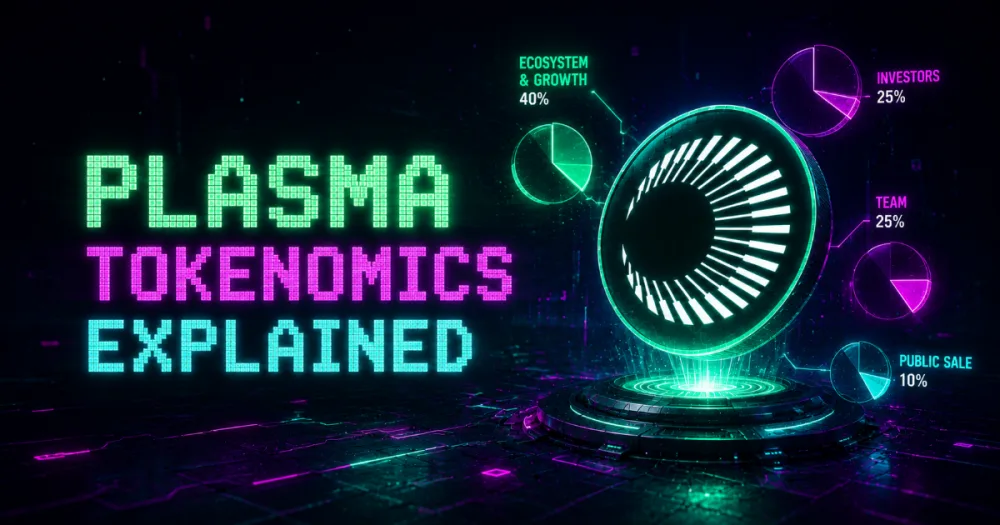
The currently applicable vesting schedule allocates Plasma tokens in four main categories: Ecosystem & Growth (40%), Team (25%), Investors (25%), and XPL Public Sale (10%). While most of these allocations are distributed as part of a cliff-based vesting schedule rather than continuous linear vesting.
Read More: Why Is XRP Underperforming? 3 Reasons Ripple Still Can’t Catch Up With the Crypto Market
Scheduled unlocks are expected to last through 2026. A large portion of supply is also expected to be released into circulation through the Ecosystem & Growth allocation. However, the full vesting period goes beyond 2026, so other unlocks should also be considered.
Why Future Unlocks Could Continue to Impact XPL
This does not necessarily mean that selling pressure increases as additional unlocks occur, since the amount of tokens that can be available to sell at a given time is subject to various factors, for example, the liquidity in the market and the behavior and demand of investors.
Given that any initial Plasma token launches will likely still be years in the future, the effect of token supply on Plasma pricing will be a key component of any XPL forecast 2026 narratives, alongside the network’s activity and unlock dates.
Plasma Price Prediction 2026–2027
Bullish Scenario
Bullish factors include continued mass Plasma stablecoins adoption, limited dumping of tokens allocated in future unlockings, and sustainable Plasma ecosystem growth.
If the number of transactions and trading volume on the blockchain increases in the future, or the demand for the stablecoin exceeds its issuance, bullish sentiment may spread and support the price.
However, if we assume this scenario, XPL’s price could rise to the $0.15-$0.20 range by the end of 2026 according to Plasma coin price prediction models, and if adoption increases and overall crypto market conditions improve, you could see XPL in the $0.20-$0.30 range in 2027.
Base Scenario
Under the base case, Plasma continues to update the ecosystem, but periodic token unlocks limit upside growth, leading to steady network growth without sustained price increases for the long term.
Popular for now XPL price prediction expects the price to hold at around $0.10-$0.15 for most of 2026. However, if adoption improves and sell pressure from unlocked assets decreases, the price could increase to $0.15-$0.22 in 2027.
Bearish Scenario
On the bearish side, future unlocks may continue adding sell pressure on the market, and slower stablecoin adoption may drag XPL down. The coin may also face pressure from weak trading volume, or an entire altcoin market correction should buyers suspend purchases around the time of unlocks.
Using the same prediction model, the highest and lowest estimates for Plasma price prediction are between $0.05 and $0.08 for 2026 and below $0.10 for 2027 unless there is a bull run.
Can XPL Recover After This Week’s Crash?

Catalysts That Could Trigger a Rebound
While recovery is possible, it will likely be demand-driven rather than technical. The biggest positive catalyst is continued Plasma stablecoin ecosystem adoption in the form of broader Plasma One usage and increased on-chain transaction volumes.
The project is also expanding XPL utility through staking, network incentives, and payment and remittance services.
Another factor for investors to monitor is whether the market can absorb the new supply. When the selling pressure subsides and the network continues to gain acceptance, will XPL recover may not depend on token supply. If the altcoin market sees a general recovery, it will also have a positive effect on XPL crypto.
Risks That Could Push the Price Even Lower
The biggest immediate risk, however, is inflation from token dilution. The most up-to-date vesting trackers suggest that unlocks are planned beyond July and new supply will continue to enter circulation. However, if demand does not increase correspondingly, these unlocks may put downward pressure on price.
Competition is also an issue, as Plasma targets a market already served by USDT networks Tron and Ethereum with important liquidity and number of users.
If Plasma struggles to maintain transaction volume, its recovery may take longer than anticipated, despite the underlying technical advantages.
| Potential Recovery Catalysts | Key Downside Risks |
| Growing adoption of the Plasma stablecoin ecosystem | Ongoing token unlocks increasing circulating supply |
| Higher on-chain transaction activity | Selling pressure if demand remains weak |
| Expanded use of Plasma One and payment services | Low trading volume and limited market participation |
| Growth of staking and network utility | Strong competition from established USDT networks |
| Broader recovery across the altcoin market | Slower-than-expected ecosystem adoption |
Is Plasma (XPL) Worth Buying After the Drop?
Opportunities for Long-Term Investors
The investment case for long-term Plasma holders ultimately still comes down to their execution relative to the price drop that has occurred. The project promises to be an infrastructure provider for stablecoin payments, while XPL has a variety of use cases around securing and participating in the network.
Other features promised in official documents included future staking rewards and a system of fee-burning, which would offset some of the token’s inflation.
The question whether is Plasma a good investment depends on each investor’s thesis on the long-term perspective of stablecoin adoption. For investors who are able to tolerate volatility, this price drop may well be a buying opportunity, though the long-term thesis depends on ecosystem development, adoption, and execution.
Short-Term Risks Traders Should Consider
Short-term price impacts could also be from the unlocking of 1 billion XPL previously locked to participants in the U.S. public sale in July 2026, as well as other planned unlocking events. Increased liquidity of tokens traded, even without the entirety of all unlocked tokens being placed on exchanges, has the potential to impact prices downward.
Read More: What Is VIRTUAL Crypto? Why It’s Becoming the Top AI Token on Robinhood Chain
As such, XPL crypto may remain highly sensitive to changes towards trading volume, liquidity, and future unlock schedules, indicating that unless the demand for the new supply is strong enough, volatility may persist as the project continues growing.
FAQ
What caused the latest decline in XPL?
The price drop was due to a scheduled token unlock that increased the number of tokens in circulation, along with a drop in trading volume and risk-adverse sentiment.
How often does Plasma release new tokens?
Vesting is not immediate but occurs in stages after the initial unlock. Future Plasma token unlocks are planned beyond 2026 according to the public allocation plan for the project.
Does the recent price drop affect Plasma’s development?
There is no public indication that the correction has disrupted the roadmap, with ecosystem development, wallet integrations and stablecoin-focused infrastructure continuing in an otherwise difficult market.
What should investors monitor over the coming months?
The most important indicators will be the next unlocks, volume, on-chain activity and adoption of the ecosystem, which together will give a better picture of whether demand meets supply.
What are the biggest risks facing Plasma?
Top risks include continuing sell pressure from future unlocks, slow user adoption, intense competition from other stablecoin projects, and overall cryptocurrency market trends.