XRP▲$1.13 is at a crossroads in 2026. Both the Ripple company and the XRPL ledger are seeing increased institutional involvement, but the XRP token struggles to move beyond the $1 barrier and faces shrinking ETF demand.
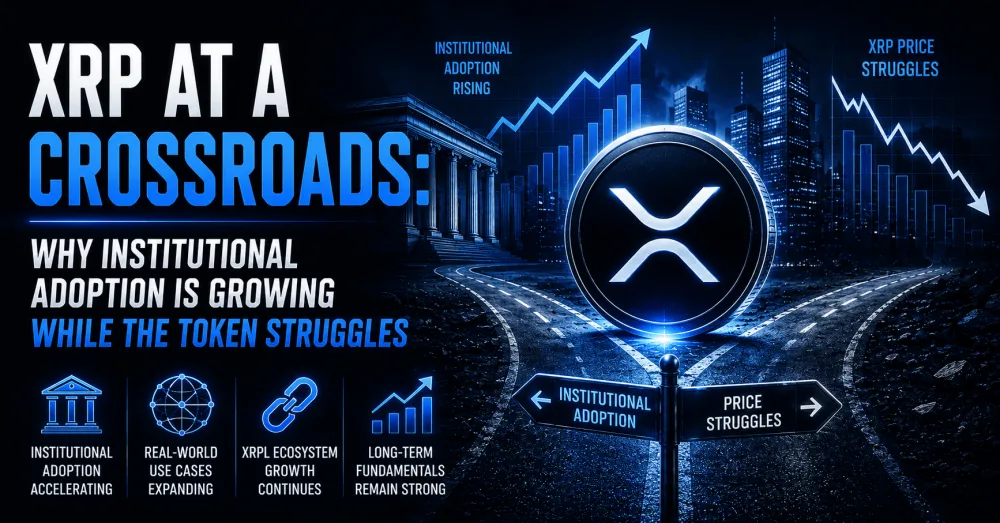
The disconnect between the fundamentals of XRP’s institutional adoption and token performance highlights one of the most important questions in the space today: can institutional-level blockchain adoption fail to create commensurate demand for the associated token? Here’s why XRP institutional adoption in 2026 may proceed to affect the price, based on capital, liquidity, token utilization, and other variables.
Contents
- XRP at a Crossroads: Why Institutional Adoption Is Growing While the Token Struggles
- XRP Institutional Adoption Is Growing — But What Does It Mean for XRP?
- XRP ETFs: Institutional Demand Is Showing Signs of Weakness
- XRPL Is Expanding While XRP Struggles
- RLUSD Could Be the Missing Piece in Ripple’s Institutional Strategy
- XRP Whales Are Accumulating as the Market Weakens
- Why Is XRP Struggling Despite Stronger Fundamentals?
- Regulation Could Become XRP’s Next Major Catalyst
- XRP Bull Case vs. Bear Case: What Comes Next?
- What XRP Investors Should Watch Now
- XRP at a Crossroads: Adoption vs. Token Demand
- FAQ
XRP at a Crossroads: Why Institutional Adoption Is Growing While the Token Struggles
XRP Is Testing the $1 Level as Institutional Interest Cools
XRP is consolidating around the $1 level, with XRP ETF inflows in 2026 also cooling. One of the biggest challenges for XRP is that its institutional adoption is failing to manifest itself in increased demand for the token – despite the obvious advantages that the asset has over the competition.
Related: XRP Blockchain Updates: 5 Major XRPL Changes That Could Transform XRP’s Future
Why XRP’s Market Performance No Longer Matches the Adoption Story
XRPL is clearly enjoying increased institutional adoption – but for now, this appears to be occurring primarily at the level of the ledger. With few obvious mechanisms for turning this into increased demand for the token, XRP appears to be at risk of seeing its price get “shackled” to the growth story.
The Key Question: Is XRP Adoption Actually Creating Token Demand?
XRPL institutional transaction volume is growing, but it is not clear how this directly affects demand for XRP. For now, the utilization and value capture potential of the broader ecosystem outweigh the direct token utility, which is a critical consideration for institutional investors.
XRP Institutional Adoption Is Growing — But What Does It Mean for XRP?
How Ripple Is Building an Institutional Payments Infrastructure
Ripple is diversifying into areas of custody, liquidity and broader institutional payments, but the growth of the company’s business lines does not necessarily translate into increased demand for XRP.
Read more: Why Is XRP Underperforming? 3 Reasons Ripple Still Can’t Catch Up With the Crypto Market
XRPL’s Role in Tokenization and On-Chain Finance
XRPL is being marketed as a settlement layer for tokenized assets and institutional financial applications. The growth of this space and its adoption by institutional players could create indirect demand for XRP.
Why Institutional Use of XRPL Does Not Automatically Mean More XRP Demand
While increased adoption of XRPL means more transactions on the blockchain, this does not necessarily translate into increased demand for XRP – and there are reasons why institutional investors may prefer to use the ledger in other ways.
XRP ETFs: Institutional Demand Is Showing Signs of Weakness
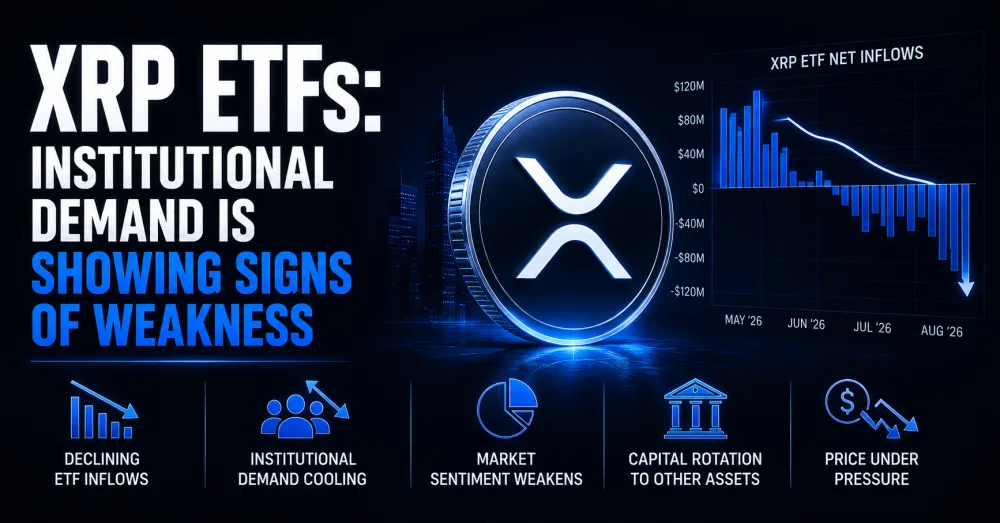
XRP ETF Inflows Have Fallen Sharply in August
A look at the inflows/outflows for XRP ETFs in 2026 reveals a worrying trend. Inflows were still positive every week for most of the month, but the figure had fallen by nearly 40% from early-August levels.
Why ETF Flows Matter for XRP Liquidity and Market Sentiment
ETF inflows reveal a critical weakness in the institutional investment thesis for XRP. On a fundamental level, the flows represent liquidity for the market. More importantly, they indicate the degree to which institutional investors are interested in buying and holding the asset.
Is the Recent Weakness a Temporary Slowdown or a Structural Shift?
A few weak weeks for XRP ETF inflows are not necessarily a reason for concern – but the weakness needs to be put into context. A prolonged period of weak inflows alongside strong flows for crypto-linked products would be a worrying sign.
How XRP ETF Demand Compares With Earlier 2026 Flows
Earlier this year, XRP ETF inflows were much stronger. They were still positive in early August, but the figure began to fall sharply in the middle of the month.
XRPL Is Expanding While XRP Struggles
What the Latest XRPL Upgrade Adds
XRPL has been making strides to facilitate institutional finance. The recent upgrade enables confidential transactions, which adds appeal for institutional players. However, this has limited impact for the XRP token, which remains a settlement-layer asset.
Confidential Transfers and the Push Toward Institutional Use
The ability to make confidential transactions on XRPL will enable the ledger to support a wider range of institutional financial applications while also helping businesses to maintain compliance.
Tokenized Assets, RLUSD and Growing XRPL Activity
The recent increase in activity on XRPL is being driven by tokenized assets and RLUSD▲$0.9999, which enable new financial applications and increase liquidity. The popularity of the latter is in part due to its role as a stable asset for transactions.
Read more: XRP Whales Keep Buying While Ethereum Signals Deeper Capitulation, On-Chain Data Reveals
Why Network Growth Has Not Translated Into Stronger XRP Momentum
XRPL’s value capture potential is rising, but this does not necessarily translate into increased demand for XRP – especially if the activity is dominated by RLUSD.
| Factor | Positive for XRPL/Ripple | Direct Impact on XRP Demand |
|---|---|---|
| XRP ETFs | Expands regulated investor access | High |
| Institutional payments | Strengthens Ripple’s financial infrastructure | Medium |
| XRPL tokenization | Increases network activity and use cases | Medium |
| RLUSD growth | Expands the stablecoin ecosystem on XRPL | Low to Medium |
| Whale accumulation | Reduces liquid supply if held off exchanges | Medium to High |
| Regulatory clarity | Lowers barriers for institutional participation | Potentially High |
RLUSD Could Be the Missing Piece in Ripple’s Institutional Strategy
Why Ripple Is Building a Stablecoin Ecosystem Around XRPL
RL USD can serve as a bridge to institutional adoption. It enables payments settlement while also facilitating more sophisticated financial applications without directly tying the user to XRP.
How RLUSD Could Increase Activity on the XRP Ledger
The value capture potential of RLUSD is driving its adoption, which should result in increased transaction volumes on XRPL. It appears likely to act as a catalyst for tokenized asset markets as well.
Does RLUSD Strengthen the Case for XRP or Reduce Its Role?
RL USD enables more institutional users to engage with the XRPL ecosystem, which creates value for the network. However, it may also end up being a substitute for XRP in some respects.
The Difference Between XRPL Adoption and XRP Adoption
Adoption of the XRPL ledger and XRP token represent two different phenomena. While they often intersect, it is important to distinguish between the two.
XRP Whales Are Accumulating as the Market Weakens
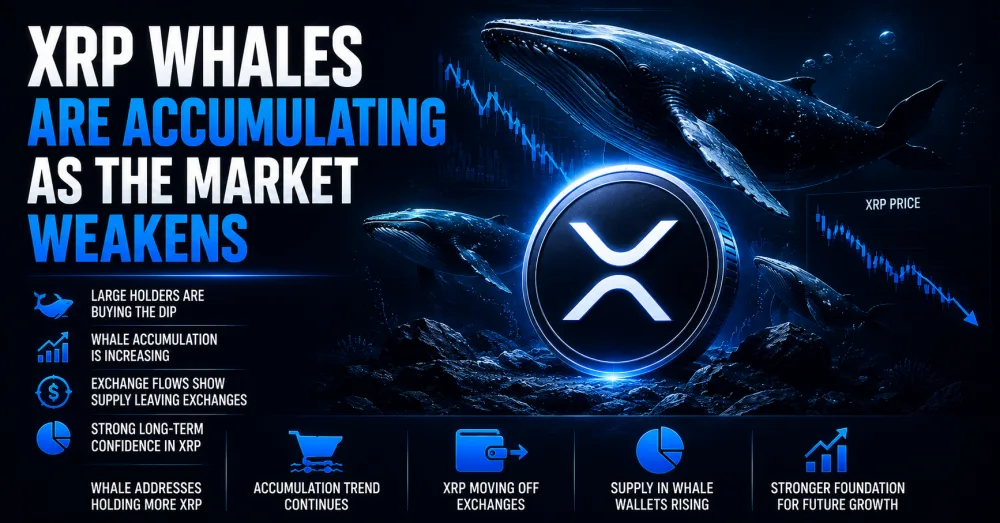
What Recent Whale Activity Says About XRP Sentiment
XRP whale accumulation 2026 can serve as an indicator of broader market sentiment, but it rarely provides definitive insights. In particular, large whale buys can often be countered by bigger sells at the right time.
Exchange Flows Point to Changing XRP Supply Dynamics
XRP whales are selling large amounts of the asset on exchanges. While such selling can be indicative of bearish sentiment, a similar pattern can also occur at the end of a bull market.
Can Whale Accumulation Offset Weak Institutional Flows?
Large whale buys can certainly have a positive effect on the price, but they should be evaluated in context. In particular, sustained institutional buying of XRP-linked assets should also be factored in.
Why Is XRP Struggling Despite Stronger Fundamentals?
Institutional Adoption Does Not Guarantee Token Price Appreciation
Even on a fundamental level, institutional adoption of a blockchain does not necessarily lead to increased demand for its native token. Demand dynamics must also be taken into account.
Capital Rotation Is Working Against XRP
One reason why token adoption may fail to translate into higher prices is capital rotation – in particular, institutional capital that moves from one asset to another in search of yield.
XRP’s Large Market Cap Makes Sustained Rallies More Difficult
From a technical perspective, the size of the XRP market cap is an impediment. A given amount of capital will have a smaller impact on the price of a larger asset.
Read more: XRP Price Explosion Ahead? Analyst Says the Next Major Repricing Could Start Within Months
The Gap Between Ripple’s Business Growth and XRP Utility
The business growth of Ripple threatens to outpace the value capture potential of the XRP token. In particular, institutional investors may favor the former without necessarily buying XRP.
Regulation Could Become XRP’s Next Major Catalyst
What the CLARITY Act Could Change for XRP
The proposed CLARITY Act aims to establish clearer regulatory guidelines for digital assets and related matters. For XRP, it could reduce barriers for institutional adoption by providing clarity regarding jurisdiction and regulatory matters.
Why Regulatory Certainty Matters for Institutional Investors
Many major institutional investors were hesitant to invest in any crypto assets for the simple reason that they did not want to take on regulatory risk. With clearer rules, some of them may feel empowered to take bigger positions.
Could New Rules Unlock Additional XRP Investment Products?
The introduction of clearer regulations for crypto assets may lead to the creation of additional XRP investment vehicles. As a result, it could become a critical XRP regulatory catalyst 2026.
Regulatory Delays as a Risk for the XRP Narrative
Regulatory uncertainty has been a major obstacle for institutional adoption of crypto assets. Delays in adopting new regulations can undermine confidence and prolong the timeline before new investment vehicles arrive.
XRP Bull Case vs. Bear Case: What Comes Next?
Bull Case: ETFs, XRPL Growth and Institutional Adoption Reinforce Each Other
The bull case for XRP is based on a combination of factors, including the potential for ETF-linked demand, ongoing XRPL tokenization and increased institutional adoption. The best-case scenario involves sustained inflows into XRP ETFs, increasing institutional buying of XRPL-related assets and stronger demand for XRP itself.
Bear Case: Adoption Grows Without Creating Enough XRP Demand
The bear case scenario is much simpler – it involves growing institutional adoption of XRPL without a corresponding increase in demand for XRP, as many institutional investors opt for other settlement-layer assets.
The Neutral Case: XRP Remains Stuck Between Adoption and Weak Capital Flows
A neutral scenario would see little change, with XRP range-bound in the short term despite improvements to the fundamentals. In other words, the token would remain in “adoption mode” with few changes to the capital flows.
What XRP Investors Should Watch Now
XRP ETF Inflows and Outflows
Changes to the net inflows for XRP ETFs represent a critical factor in assessing the strength of institutional demand.
XRPL Transaction Activity and Tokenized Assets
Investors should track developments in terms of XRPL utilization, particularly tokenized asset markets.
RLUSD Supply and Usage
Investors should watch the supply and utilization of RLUSD, as its popularity has the potential to impact demand for other XRPL-related assets.
Whale Accumulation and Exchange Balances
Changes to the supply of XRP on exchanges can often have ramifications for the price.
Regulatory Developments and Institutional Partnerships
New institutional partnerships and regulatory changes can have a major impact on the outlook for the token.
XRP at a Crossroads: Adoption vs. Token Demand
Why XRP’s Institutional Story Is More Complicated Than It Looks
The growing institutional adoption of the XRP Ledger is a positive development for the ecosystem, but it is important to understand the implications of this trend.
The Three Signals That Could Confirm a Stronger XRP Narrative
The key signals that could help establish a stronger link between XRPL adoption and XRP demand involve inflows into XRP ETFs, increased utilization of the ledger, and regulatory clarity that reduces the risks for institutional investors.
What Would Need to Change for Institutional Adoption to Lift XRP?
For now, institutional adoption of XRPL rarely leads to increased demand for XRP. If this were to change, it would require one of several catalysts that would increase institutional buying of the token.
FAQ
Is XRP Institutional Adoption Growing In 2026?
Yes, though it is currently unclear how this trend will affect the demand for XRP.
Why Is XRP Struggling Despite Institutional Adoption?
XRPL can gain users without the equivalent increase in demand for XRP, which causes adoption and price to diverge.
Can RLUSD Increase XRP Demand?
RL USD has the potential to increase the liquidity and transaction volume for XRPL, which in turn could affect the demand for XRP.
Are XRP ETF Inflows Still Important?
Yes, because they reflect the degree of institutional interest in the asset.
What Could Trigger the Next XRP Rally?
A combination of renewed ETF inflows, increased utilization of XRPL, stronger demand for XRP, and more institutional partnerships would be ideal.