Nowhere is the fallout clearer than in how trust eroded fast when promises met reality. By 2026, the blend of loud political voices and digital money dreams had begun collapsing under its own weight.
A movement once praised as changing everything now stumbles through scandal after misstep. Instead of empowerment, many saw flash and failure masked as progress. Fame offered no shield from loss. Hype faded. Real damage stayed.
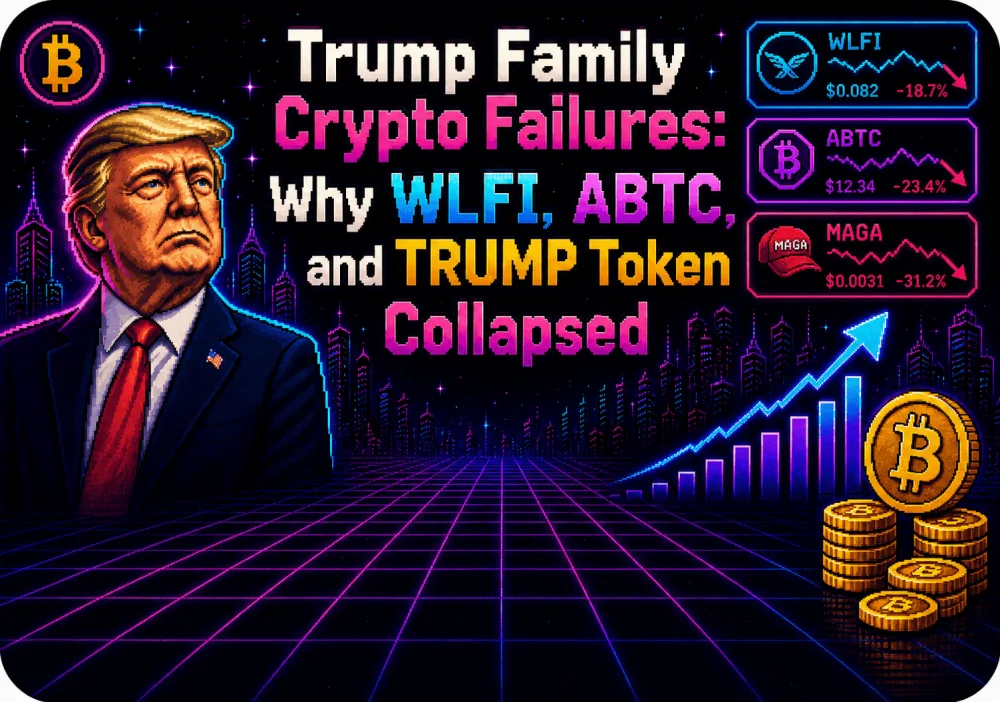
One year after bold promises at the 2025 swearing-in, things look very different by early May 2026. Instead of growth, the digital assets tied to Trump – World Liberty Financial, American Bitcoin, and the TRUMP token – face sharp drops. What began with fanfare now struggles to hold value.
Confidence has drained away from political crypto tokens overall, along with trading activity. Behind the scenes, support seems to have faded just as fast. Markets reacted coldly, leaving little room for recovery. By this point, most see these ventures as hollow echoes of earlier claims.
Contents
The Dramatic Collapse of World Liberty Financial
World Liberty Financial appeared near the end of 2024 with big words about helping those left out by banks. Its aim was clear – to offer something different from old-school finance systems, built without central control. Instead of relying on one power, it leaned on open networks.
The idea sparked interest among people tired of usual banking rules. From the start, it framed itself as more than just another money platform. Yet its promises raised questions at the same time they drew attention.
Read more: Trump Shifts Stance on Prediction Markets: “The US Shouldn’t Stay on the Sidelines”
By May 2026, though, people recognize the project more for its imploding token and team conflicts than any real money function.
The Blacklisting Debate and the Conflict with Justin Sun

A surprise disclosure about the foundational code marked the beginning of the end for WLFI▼$0.0570 cryptocurrency. By April 2026, trouble emerged when Justin Sun – well-known in digital currency circles and once linked to the venture – took legal action targeting those running WLFI. The claim is that a concealed tool buried in the software lets select insiders lock up users’ funds without their consent.
Sun said the Trumps took more than 2.9 billion tokens from his projects, worth about $900 million at the time. That action broke a core rule in DeFi: what code allows should stand – no exceptions.
Related: Top 3 Justin Sun Controversies: Scandals, Feuds, and Their Impact on Crypto Markets
Afterward, huge amounts of funds started vanishing fast. In systems meant to run without control, being blocked by one group kills the whole point. Once someone holds the power to freeze assets, it stops being open finance – it becomes like a shadow bank instead.
WLFI Token Price and 2030 Lock Up
One glance at the WLFI token price shows complete collapse. Once near fifty cents in the private sale, it now sits at just five and a half cents – down more than 82%. Retail investors face an even harsher reality because of what some call the Vesting Trap: a governance vote left token owners stuck: lose everything or keep holdings locked straight through to 2030.
Nowhere to go, the assets sit frozen – WLFI breathes without moving, technically alive yet stuck beyond trade.
American Bitcoin ABTC The Nasdaq Mining Disaster
One step beyond DeFi, WLFI shifted gears when the family backed American Bitcoin (ABTC) for heavy-duty mining operations. Touted on the Nasdaq as a benchmark for domestically produced Bitcoin, its promise cracked early. Now, it ranks among the market’s top targets for short sellers.
The Debt Spiral with Leveraged Collateral
What sank ABTC crypto wasn’t just risk – it was deep dependence on leveraged borrowing. By early 2026, almost $75 million in stablecoin loans came through the Dolomite protocol. Backed by their own governance tokens, along with freshly mined Bitcoin holdings, stood as security for those debts. Then markets turned, also pushing collateral values down sharply during that period. Suddenly facing a margin call, yet unable to cover it – selling hardware would’ve been the only option.
On May 4, 2026, ABTC stock sits at $1.21 – down an eye-watering 94% since its peak after the election. Because it had been viewed as a signal of how politics might shape cryptocurrency trends, the drop sent tremors through the digital asset world.
ABTC Crypto News and May Earnings Preview
One step ahead of the May 6 report, whispers spread about promises made on Bitcoin holdings that do not match reality. Numbers fall short, yet costs keep rising, dragging confidence into freefall. Big money moves out fast, shifting weight toward companies less stretched thin. Talk now runs through back channels – bankruptcy looms, some say, while others bet the exchange cuts ties first. What stands today may not stand tomorrow, especially when trust evaporates before facts arrive.
Trump Token Plummets After Rapid Rise and Fall
One wrong turn led many into MAGA’s web – a gamble dressed up as innovation. Not useful, never meant to be – just hope wrapped in code. Some walked away lucky when 2025 closed its books. By next year, empty accounts told another story: dreams crushed under digital promises too loud to question.
From Record Peaks to Forgotten Files
Back in January 2025, the TRUMP token climbed to $73.43 – its highest point ever. Suddenly, everyone wanted a piece of it; politics met crypto in wild fashion. Yet once attention faded, interest started slipping away just as fast. Instead of pushing forward, the Trump family turned toward WLFI, their newer project.
With that shift, momentum died almost overnight. Now, the value sits near $2.81, down by 97 percent. Billions vanished, mostly from everyday investors who held on too long. When prices depend on fame alone, risk hides behind every headline.
Pump and Dump Claims
Most of the money from early Trump digital collectibles ended up in private companies run by his relatives, close to three-quarters. Liquidity for those tokens never really settled. Instead, funds flowed where oversight was minimal, leaving investors holding unstable assets.
Nowhere near the excitement before, people are now calling it a classic case of inflating value, then walking away. Instead of growing stronger, the group around this token had faded into silence by 2026, dragging hopes down with it.
Related: Top 5 Richest Crypto Billionaires in 2026: Who Dominates the Blockchain World?
Trump Crypto Projects Did Not Succeed
Looking back at the collapsed crypto ventures from 2025 into 2026, one thing stands out – power grabs disguised as innovation. These weren’t accidents caused by chance or timing; instead, their foundations cracked under dishonest designs. Built on shaky logic, sold with false promises, they targeted those least able to afford loss. Behind flashy claims hid systems meant to benefit insiders first.
Conflicts of Interest and Regulatory Risks
One big reason things fell apart was the lingering debate around Trump’s cryptocurrency ties to overseas interests. Through 2026, lawmakers dug into half a billion dollars flowing from groups tied to the UAE into Trump’s digital currency ventures. Because rules hung in uncertainty, large financial firms stayed cautious – exactly what kept the widespread acceptance they’d talked about out of reach. With no support from established investors, those initiatives floated on unpredictable swings in trading mood.
Centralization vs. DeFi Values
Openness matters most to those who trust crypto. Instead of sharing control, these blockchain efforts leaned on family ties – handing power to close relatives called “ambassadors.” Because access stayed locked behind closed doors, fans began seeing it as hollow mimicry. What emerged carried the label of cryptocurrency yet acted nothing like one. Risks remained, but freedom vanished where structure took its place.
The Impact of Famous People Losing Money in Crypto on Future Markets
Out of nowhere, shaky confidence hit the crypto world in 2026 after big-name projects fell apart. A venture tied to both past and sitting political leaders crumbled – suddenly, trust took a nosedive across the board. People stopped getting excited about digital money, instead watching it more closely, waiting for another misstep. The whole idea of jumping into cryptocurrencies just feels riskier these days.
Investor Doubt Amid Rug Pull Fears
These days, people often mention “rug pull” when talking about Trump crypto. Though the family claims the projects fell prey to a “coordinated deep-state attack on the blockchain,” what actually shows up in transaction records paints another picture entirely – insider sales appear common, progress seems absent, and enriching insiders clearly outweighs building something lasting.
Market Shifts and Political Token Trends
Out of nowhere, prices dropped hard in 2026 – especially for coins tied to politicians. While something like Ethereum or Solana holds ground through actual function, assets such as TRUMP or WLFI depend entirely on online mood shifts. Once chatter soured after those government-related controversies emerged, support beneath them collapsed fast. A sudden silence replaced the noise; nothing held them up anymore.
Read more: Tether Freezes $344M USDT on TRON as Sun Sues Trump-backed WLFI
Trump Crypto Projects: Real or Fake?
Is Trump crypto real or just another trick? People argue about it online all the time. These ventures say they’re official businesses, at least on paper. Still, when you look closer – through the lens of trust and duty – they don’t hold up so well.
Secret lists lurk behind the scenes – access that lets someone halt money flows raises serious alarms. A hidden pathway to lock up assets? That kind of power smells wrong. Anyone could get caught in it without warning. Control like that undermines trust completely. Freezing wealth from the shadows isn’t oversight, it’s dominance. Quiet mechanisms with big consequences tend to abuse silence. Power unchecked often ignores rules. When freezing happens unseen, fairness vanishes.
A few wallets tied to creators grabbed tokens way below what others paid. It looks like those close to the launch got early access without paying full value. Some buys happened at tiny portions of the market rate. People involved in building the project may have had unfair advantages when purchasing. Early movement shows insiders spent much less than regular buyers. Those behind it possibly secured assets before wider release.
Security gaps show up in WLFI despite loud promises about unbreakable protection. Not one outside audit backs those strong claims – just repeated red flags spotted by experts who looked under the hood.
Whitepapers light on detail tend to echo rallying cries instead of laying out engineering blueprints. Though packed with vision talk, they skip hard numbers. What sounds like innovation sometimes masks a lack of code. Behind sweeping claims sits minimal architecture. Fancy phrases cover missing mechanics. Not specs, but slogans move the narrative forward. Details dissolve into broad promises. Clarity gets lost in ideological framing.
Trump Coin Outlook Beyond 2026

When the 2026 midterms draw closer, brief spikes might still pop up in predictions for Trump coin value – yet behind those flashes lies lasting harm to its reputation. After WLFI fell apart, followed by ABTC and then the TRUMP token itself, one truth stands clear: no fame can cover weak financial foundations or hidden dealings.
What sticks around after all this noise is a shift in how people see celebrity-led digital money – not as revolutionary, but as chaotic experiments leading straight into tighter rules. That stretch once called the “Trump era” in crypto won’t be recalled for innovation, but rather for loud bets that crashed hard under scrutiny.
Out here, broken promises pile up behind empty slogans. A blockchain watches none of that – no party badges, no speeches. What moves it is cold logic, working scripts, money flowing where rules allow. Skip any one piece here, chase noise instead, and the results turn predictable. The machine stays neutral while dreams crash on its edge.
The Technical Architecture Behind the Collapse
One step into the WLFI meltdown means looking at what powers devs kept under lock – those admin keys. Blockchain sleuths found something odd: the smart contract ran on a multi-signature setup. Two votes from five possible signers could slam the brakes on any user account. A single move, total stop.
Hidden inside the software, a quiet danger sat unnoticed – built into tricky layers of digital middlemen. For the ABTC coin, trouble began when they reused Bitcoin holdings again and again to secure different debts at once. Energy markets surged in 2026, pushing oil rates sharply upward. Mining grew too costly under that pressure. They sold off key Bitcoin assets just to stay afloat. That move triggered what now looks inevitable – a slow collapse already underway.
FAQ
One day, maybe someone will look back at this differently. For now, nearly every expert lines up against it. Down almost all the way since its highs, its price tells a clear story. A flood of new tokens washed out any sense of worth. Some still bet on luck instead of logic. Value does not stick around here. It behaves like dice, not money.
WLFI Crypto Status Update?
A court fight with Justin Sun over blocked tokens worth nearly a billion dollars is still ongoing. Until 2030, the majority of individual investors can’t touch their holdings – trading or leaving isn’t an option.
ABTC Crypto Failure Reasons?
That situation stemmed from borrowing too much against assets, losing value. When shares started falling, the firm had already taken out huge loans using them plus Bitcoin as collateral. Instead of stabilizing things, those debts made everything worse. Cash flow dried up fast under that pressure. What followed was a dramatic drop – the stock lost most of its worth in public trading. Nearly wiped out, down 94 percent on Nasdaq screens.
Is Trump’s Crypto a Scam or Legit?
Though the projects follow legal rules, some call them unfair because of secret controls that favor insiders more than regular buyers. Thinking about putting money into Trump crypto right now might sound appealing, yet risks remain high behind the scenes.
With markets shaking and probes still active around Trump’s crypto efforts that fell apart, most experts say it makes sense to stay away. One wrong move here could ripple out fast – better not jump in at all.