For years, Cardano was seen as sound in design but slow beside faster rivals. But top Cardano developments 2026 are changing this picture, though not through the sharp price surge markets usually demand. Respect still follows the network, even after years of doubts about its pace.

What defines Cardano in 2026 goes beyond ADA▲$0.2088 price action. Governance takes center stage, followed by liquidity, scaling, developer tools, partner chains, and real-world integrations. From its academic roots, one question still matters: can Cardano turn careful design into visible market demand?
Perhaps ADA is shifting shape. Still, the chart does not fully confirm it. The fundamentals look stronger, but the price remains hesitant.
Contents
- Cardano in 2026: A Network Testing Its Path
- Governance Shifts Toward Actual Treasury Choices
- Scaling After Leios and Hydra: The Layer 2 Puzzle
- Better Liquidity and DeFi Conditions
- Cardano Meets AI Payments Through x402
- Developer Tools Are Becoming Easier to Use
- Midnight and Partner Chains Extend the Cardano Narrative
- ADA Shows Signs of Movement?
- ADA Price Paths Beyond 2025
- Cardano Shows Technical Momentum Ahead of Price Movement
- FAQ
Cardano in 2026: A Network Testing Its Path
Patience defines Cardano’s approach. Where competing blockchains prioritized rapid development, rewards, internet culture, or VC-funded expansion, Cardano took a different path. Academically reviewed design, structured validation, decentralization, and sustainable frameworks shaped its progress.
Because of that method, Cardano became resilient. It also became easy to criticize.
By 2026, Cardano’s foundation clearly holds firm. The focus now shifts toward user engagement, liquidity, builder activity, and institutional attention. Infrastructure matters, but infrastructure alone does not create momentum. For ADA to regain motion, conditions must align beyond mere readiness.
Here begins the real shift in Cardano developments in 2026.
Read more: Best Crypto ETF Contracts for 2026: Which ETFs Will Dominate Trading This Year?
Governance Shifts Toward Actual Treasury Choices
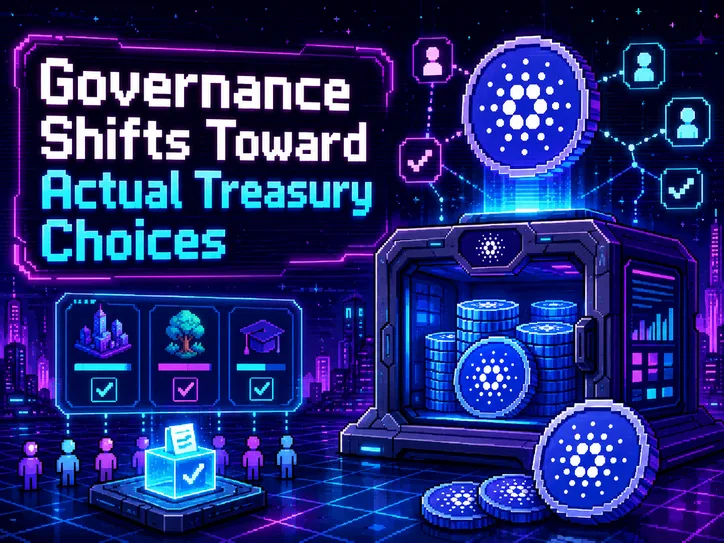
Among the major Cardano developments in 2026, governance stands out. The Voltaire phase is no longer just a theoretical roadmap point. It now faces real scrutiny: can decentralized governance guide treasury choices without slipping into disorder, indifference, or spectacle?
In January 2026, the Cardano Foundation added 220 million ADA to its delegation across 11 DReps, bringing total community delegation to 360 million ADA. This matters because governance gains substance only when influence moves beyond founding groups toward active participants.
Another shift stands out: how the ecosystem handles its finances. By 2026, Cardano’s treasury planning follows long-term goals, including Vision 2030 and measurable ecosystem indicators. Put simply, sustainability matters more than spontaneous funding requests. Structure replaces impulse; outcomes guide allocation.
This supports long-term development, but it also introduces uncertainty. Distributed decision-making can fund essential systems, but it can also produce delays, factions, and complex procedures. Given Cardano’s nature, growth and gridlock may arrive together.
Scaling After Leios and Hydra: The Layer 2 Puzzle
For Cardano, scaling must move from concept to reality if ADA is to break out. By 2026, several critical developments are underway.
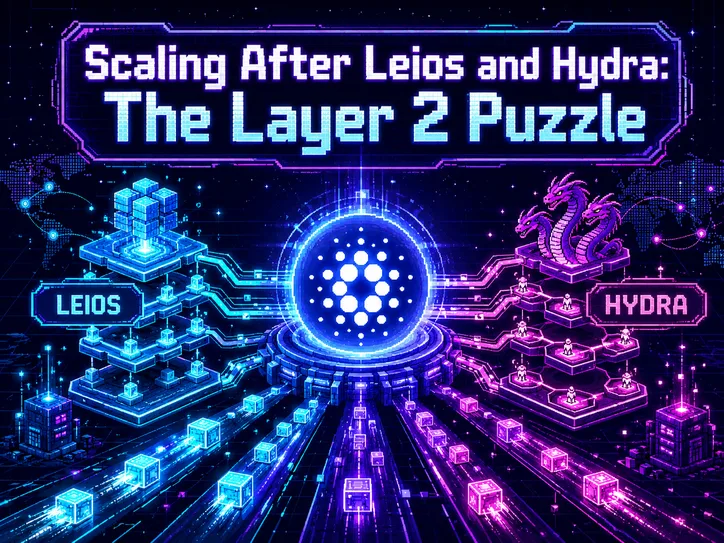
Ouroboros Leios is the headline Layer 1 enhancement. Input Output presents Leios as Cardano’s central base-layer scaling path, using a revised consensus model designed to support higher throughput. Mainnet deployment is targeted toward late 2026.
Hydra exists alongside Cardano as a Layer 2 system based on state channels. It is not built to solve every scaling problem. Its strength lies in fast interactions between known participants, such as payments, gaming, and specific DeFi workflows where rapid confirmation matters.
Another key component is Midgard, described as a permissionless optimistic rollup. Its testnet is expected in late 2026. Open applications may run on Midgard, while Hydra serves defined participant groups. With both in place, Cardano’s scaling approach becomes broader.
The short version: Cardano is not relying on one miracle scaling fix. It is adding multiple layers over time. Careful, deliberate, very Cardano.
Better Liquidity and DeFi Conditions
For Cardano DeFi, a recurring issue has been clear: major participants often stay away because liquidity is not deep enough.
That is why the Cardano Foundation’s 2026 liquidity push matters. In April 2026, an eight-figure amount of ADA was deployed into Flowdesk, a Cardano-based decentralized exchange. The goal was to deepen markets, strengthen stablecoin liquidity for USDA and USDM, and reduce slippage.
This is not flashy, but it is practical. Traders and institutions do not care about theoretical elegance when swaps suffer from shallow pools or poor execution. Improved liquidity can make Cardano DeFi feel less like an isolated corner and more like a serious marketplace.
Cardano’s blockchain data is also now available on Dune, including transactions, staking activity, smart contracts, governance actions, stablecoins, and DeFi activity. This gives researchers, developers, investors, and media better access to observable network behavior.
Transparency does not create growth by itself. But without it, proving growth becomes harder.
Cardano Meets AI Payments Through x402
Among recent Cardano developments in 2026, integration with x402 stands out. The x402 standard supports payments by AI agents and Web3 applications, creating a framework for machine-based value exchange.
In April 2026, the Cardano Foundation confirmed Cardano’s inclusion in the x402 framework through protocol specifications added to the project’s codebase. Masumi’s smart contract logic also gained optional approval, adding capabilities tied to identity, refunds, disputes, decision logs, and registry functions.
This may matter more later than it does now. AI-driven payments remain early, and many projects will exaggerate their potential until the meaning gets sandblasted into dust. Still, the core concept holds: when autonomous software needs to exchange value, confirm outcomes, track choices, or settle records, low-cost blockchains with reliable accounting can play a role.
Cardano wants to be one of those chains.
Developer Tools Are Becoming Easier to Use
Cardano’s developer problem is not a lack of technology. The bigger issue is friction.
Plutus, EUTXO, formal methods, Haskell-style tooling, and Cardano’s overall design are powerful, but they are rarely welcoming to newcomers. Ethereum captured developer attention partly because teams could build quickly, even when the results were held together with vibes and caffeine.
By 2026, Cardano’s infrastructure plans place stronger emphasis on developer experience. Input Output’s funding proposals include improvements to Plutus, automated formal verification, better tooling, performance upgrades, and ongoing maintenance.
That matters because Cardano’s promise of strong reliability only works if building on it demands less than a PhD and therapy breaks.
If Cardano simplifies secure development without compromising its focus on correctness, it gains a real advantage. The balance between accessibility and reliability will shape how developers view the network.
Related: Top 5 Altcoins Whales Are Buying Aggressively in May 2026
Midnight and Partner Chains Extend the Cardano Narrative
Midnight remains one of the most important projects linked to Cardano. Built as a privacy-focused partner chain, it extends the ecosystem beyond the core layer. Instead of operating directly as Cardano mainnet activity, Midnight targets confidential smart contracts and protected data use cases.
This shifts the larger Cardano story. Its future may not depend only on what happens directly on the main chain. Partner chains can let specialized networks use Cardano’s security, settlement, or ecosystem relationships while targeting different markets.
That gives Cardano more surface area: privacy, identity, institutional applications, AI payments, DeFi, and regulated assets.
Fragmentation remains the risk. If activity spreads outward, ADA holders will want clear value capture. Ecosystem growth sounds good. Token demand matters more.
ADA Shows Signs of Movement?
Simply put, Cardano appears stronger on fundamentals in 2026. Even so, ADA lacks clear evidence of sustained upward price movement.
By May 13, 2026, ADA sits near $0.275. That is far from a victory parade. Confidence remains limited, even with upgrades in governance, scaling, liquidity, and application growth.
For ADA to achieve a significant breakout, several factors must align:
Leios and Layer 2 systems need credible delivery. DeFi liquidity must grow enough to attract serious activity. Governance must fund useful work without becoming a swamp. Developers need better tools and clearer incentives. Partner chains and AI payment systems need visible usage. ADA also needs stronger demand beyond staking and speculation.
That is a lot. But it is no longer fantasy.
Cardano’s 2026 foundation is stronger than its price suggests. Still, market value does not come from architecture alone. It comes from active users, liquidity, revenue, narrative, and momentum.
ADA Price Paths Beyond 2025
Bullish Scenario
Progress arrives through Leios, Hydra, and Midgard. Governance funding supports useful infrastructure. Plutus tooling improves. DEX liquidity expands. Builders arrive through x402 and early AI-driven payment use cases. Midnight strengthens the partner-chain narrative.
If these pieces align, ADA may regain attention as a serious infrastructure asset rather than an outdated Layer 1.
Neutral Scenario
Cardano keeps building, but adoption grows slowly. Governance functions, though execution remains messy. Scaling work progresses, yet user growth stays quiet. ADA stabilizes but does not clearly lead the market.
This is the most Cardano-coded outcome possible.
Bearish Scenario
Governance fragments. Treasury support disappoints. Leios or Layer 2 timelines slip. DeFi liquidity remains shallow. Partner chains fail to create visible ADA demand. If coordination weakens and delays pile up, market traction may stall.
In that case, Cardano keeps its devoted community but struggles to persuade broader audiences that it deserves renewed attention.
Cardano Shows Technical Momentum Ahead of Price Movement
Here is the clearest view: momentum is building across Cardano’s ecosystem while ADA’s price remains quiet. Structure often forms before value shows on the chart.
By 2026, Cardano governance is stronger, visibility is clearer, scaling work is advancing, institutional access points are deeper, and practical integrations are expanding. Substance is replacing noise.
Yet ADA still needs proof that market demand exists.
That proof will not come from another roadmap diagram. It will come from active use, deep liquidity pools, rising developer interest, sound treasury management, and clear demand for applications built on Cardano.
Around 2026, Cardano may gain relevance beyond its current circle. But execution still matters. The network cannot keep preaching to the choir forever; even the choir wants better acoustics.
FAQ
What are the top Cardano developments in 2026?
The top Cardano developments in 2026 include stronger governance through DReps, a structured ecosystem funding process, Leios scaling work, Hydra refinement, Midgard rollup development, deeper DeFi liquidity, Dune analytics integration, x402 payment support, and continued Midnight and partner-chain expansion.
Is ADA finally breaking out in 2026?
ADA is showing stronger ecosystem fundamentals in 2026, but the price has not confirmed a major breakout yet. Cardano’s underlying systems are becoming more resilient, while investor interest remains more cautious.
Why does Cardano governance matter?
Cardano governance matters because treasury decisions shape ecosystem development. If governance works well, Cardano can fund infrastructure, tools, liquidity, and adoption without constant outside control. If it fails, delays and political friction may slow progress.
What is Leios in Cardano?
Leios is an upcoming Cardano Layer 1 scaling upgrade designed to increase transaction capacity through a revised consensus model. It is one of the most important technical upgrades in Cardano’s 2026 roadmap.
Can Cardano compete with Ethereum and Solana?
Cardano can compete where trust, structure, governance, and verified correctness matter. It is unlikely to beat Ethereum or Solana by copying their speed-first playbooks. Cardano’s better path is becoming a durable platform for reliable, high-assurance applications.