A quantum computer is not just another, faster computer. Instead of bits that can encode either 0 or 1, qubits can be in superposition, and quantum computers use superposition, entanglement and interference to provide a speedup to certain mathematical problems that classical computers cannot efficiently solve. That is why what is quantum computing has become a security question, and not just a hardware question.
Read Also: Top Solana DEXs: Jupiter, Raydium, Orca Compared

Contents
- 1.What Is Quantum Computing and Why It Matters for Bitcoin
- 2.How Bitcoin Cryptography Works Today
- 3.Can Quantum Computers Actually Break Bitcoin?
- 4.The Realistic Timeline of the Quantum Threat
- 5.How Quantum Computers Could Attack Bitcoin
- 6.Is Bitcoin Really Vulnerable? Breaking Down the Risk
- 7.Post-Quantum Cryptography: The Real Defense Strategy
- 8.How Crypto Industry Is Preparing for Quantum Risk
- 9.Quantum Computing vs Crypto: Hype vs Reality
- 10.Impact on the Crypto Market If Quantum Threat Becomes Real
- 11.Future Outlook: Will Bitcoin Survive the Quantum Era?
What Is Quantum Computing and Why It Matters for Bitcoin
Quantum Computing Explained in Simple Terms
Bitcoin’s threat is smaller, as only part of public key cryptography would be vulnerable to a strongly fault-tolerant quantum computer. Such computers do not yet exist, but NIST and others are already developing post-quantum standards (as adoption of these standards would take years).
Qubits vs Classical Bits: Why Quantum Is Different
Although classical bits can be set to either a 0 or a 1, a qubit can be manipulated with a quantum computer to give different probabilities for the two outcomes. This quantum computing explained narrative helps to understand why, in relation to security, it is often discussed in terms of algorithmic factors rather than chip size.
The catch is that useful cryptographic attacks require error-corrected, fault-tolerant quantum computers, not the noisy computers we have today. This gap is where the debate about the risk of quantum computing Bitcoin lies.
Shor’s Algorithm and Its Role in Breaking Cryptography
A common question, what is Shor’s algorithm, lies at the heart of the quantum threat to Bitcoin because it could theoretically solve the discrete logarithm problems underlying elliptic-curve cryptography.
While Bitcoin is not breakable today, it will become breakable if a large enough quantity of fault-tolerant quantum hardware is built. If so, the question of whether quantum computers can break Bitcoin is no longer scientific; it is an engineering question.
| Concept | What It Does | Relevance to Bitcoin |
| Classical Bit | Stores either 0 or 1 | Used in traditional computing systems |
| Qubit | Can exist in multiple states through superposition | Enables quantum algorithms that may challenge current cryptography |
| Shor’s Algorithm | Solves certain mathematical problems exponentially faster than classical methods | Could theoretically break ECDSA-based digital signatures |
| Grover’s Algorithm | Accelerates brute-force search operations | May reduce hashing security margins but does not directly break Bitcoin |
| Fault-Tolerant Quantum Computer | Uses error correction to perform reliable quantum calculations | Considered necessary for practical attacks on Bitcoin cryptography |
| Post-Quantum Cryptography | Designed to resist both classical and quantum attacks | Viewed as the primary long-term defense strategy |
Grover’s Algorithm and Hashing Limits
Moreover, Grover’s algorithm to perform a brute-force search over an unstructured database is not as damaging to hash functions as Shor’s algorithm is to public-key cryptographic algorithms, as hashing is used for mining and Bitcoin addresses.
However, Grover’s algorithm would (in practice) just erode security margins rather than negate the security completely; that is why what is Grover’s algorithm belongs in the discussion but is not usually thought of as the critical Bitcoin-breaking attack. Shor’s algorithm remains the more serious long-term quantum threat to Bitcoin security.
How Bitcoin Cryptography Works Today

What Is ECDSA and Why Bitcoin Uses It
Bitcoin ownership and transfer rights on the network are managed with the Elliptic Curve Digital Signature Algorithm (ECDSA), a form of public-key cryptography. Core Bitcoin software supports ECDSA using the secp256k1 curve, a design choice made early in Bitcoin network development, which has remained in use since its launch.
A key property of what is ECDSA Bitcoin thesis is that it is a digital signature scheme where no one needs to have or share a private key, which controls access to funds. The signature can be verified by others in the network with the public key, with no changes to the transactions.
Public Keys, Private Keys, and Digital Signatures
A Bitcoin wallet produces a private key, which is the secret piece of information controlling the associated Bitcoins, and a public key, which is mathematically derived from the private key. The public key can be shared with everyone, while the private key must remain secret.
To spend BTC▲$62,630.00, the wallet software creates a digital signature for the transaction using the corresponding private key. The recipient can use the public key to validate the signature without revealing the secret. This mechanism is the basis for public key, private key Bitcoin explained discussions and is used to prove ownership in the network.
Why Bitcoin Addresses Are Secure Today
The majority of modern Bitcoin addresses do not reveal the public key. The most common address formats by default publish a hash of the public key rather than the public key itself. The attacker never has direct access to the underlying key until the coins are spent.
This design helps explain how Bitcoin encryption works: modern addresses typically expose only a hash, leaving unrevealed public keys protected even if quantum computing advances.
Where Vulnerabilities Already Exist
However, not all Bitcoin addresses are equally at risk; pay-to-Public-Key (P2PK) outputs and reused addresses reveal the public key on the blockchain and may be more at risk from quantum attacks than other Bitcoin addresses.
Both for privacy and security, Bitcoin developers and researchers have long discouraged the practice of Bitcoin address reuse. After a public key is revealed as part of the blockchain, a quantum computer with sufficient power could target the public key instead of a hash of it.
This distinction is also relevant when discussing how secure is Bitcoin cryptography, since the vulnerability of a Bitcoin address can vary greatly depending on the type of address, the previous spending history of the address, or whether a specific public key has been revealed on-chain.
Can Quantum Computers Actually Break Bitcoin?
What It Would Take to Break Bitcoin Encryption
In theory, a quantum computer powerful enough to run Shor’s algorithm could derive a private key from a public key, breaking security assumptions behind Bitcoin’s digital signature scheme.
Research by Google has shown that the resources required to attack elliptic-curve cryptography are much smaller than expected, though the hardware required does not currently exist.
In addition, the attacker would need a fault-tolerant quantum computer that doesn’t suffer high error rates while performing complex quantum operations, for the quantum attack on Bitcoin to work, so Bitcoin’s resistance to quantum attacks is not just a question of mathematics anymore. The question becomes whether it is possible to manufacture that hardware in quantity.
Logical Qubits vs Physical Qubits: The Real Bottleneck
One of the most confused concepts in the debate is the difference between physical and logical qubits. Physical qubits are the elementary hardware parts of a quantum processor. Logical qubits, which are error-corrected qubits, are created from multiple physical qubits working together.
This distinction will partly determine whether quantum computers may one day be able to break Bitcoin. A Google paper estimated that breaking elliptic-curve cryptography would require 1,200 logical qubits, but this would likely require hundreds of thousands of physical qubits to implement in a fault-tolerant way.
Despite massive increases in quantum processor raw qubit counts, no architecture yet has shown how to build error-corrected logical qubits at a cryptographically relevant scale, making error correction the largest open problem in the field.
Current Quantum Hardware vs Required Scale
However, current quantum devices are only able to perform calculations on the order of a few hundred physical qubits, not the hundreds of thousands of logical qubits needed to mount an attack on current cryptography standards. For example, IBM has a range of quantum devices on the order of low hundreds of qubits, far below Bitcoin threat model scales.
Read Also: Top 5 Bitcoin Mining Methods: How People Are Still Earning BTC in 2026
Recent assessments by researchers and industry experts indicate that a cryptographically relevant quantum computer would have to far exceed existing hardware performance, fault tolerance, and error correction.
However, even considering Google’s revised estimates, the gap between the number of machines available and that required to threaten Bitcoin remains meaningful.
Why Experts Say “Not Yet”
Consensus is that Bitcoin does not yet face a practical quantum threat, because no existing quantum computer can run Bitcoin’s cryptography at Bitcoin speeds. Observers, including Google, security researchers at NIST, and quantum researchers, have thus described the threat as still hypothetical and many years away.
Simultaneously, experts do not dispute that the threat exists, and the estimated resource requirements steadily decrease yearly, thanks to improved quantum algorithms, error correction, and physical hardware.
Thus, today, most discussions about the quantum threat to Bitcoin and will quantum computers break Bitcoin are about preparation and migration rather than speculation.
The Realistic Timeline of the Quantum Threat
When Could Cryptographically Relevant Quantum Computers Appear?
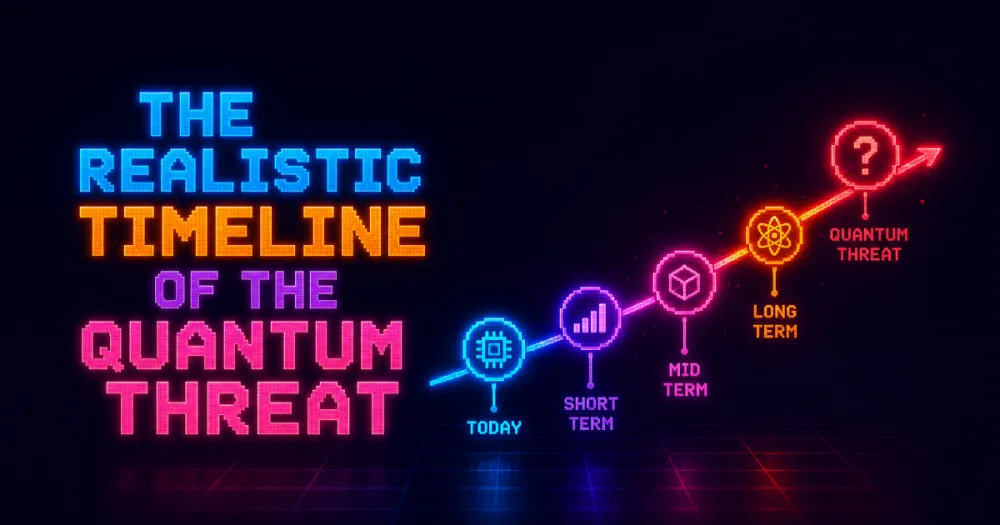
The timeline for the onset of CRQCs is unclear. Most sources conclude that the 2030s or later are likely, assuming error correction is not mastered. NIST, Google, and multiple cybersecurity organizations are supporting post-quantum migration because it takes time to upgrade systems and infrastructure to make them suitable for post-quantum cryptography.
When will quantum computers break Bitcoin is debated, but the more relevant question is how to prepare for such an event.
Why Estimates Range From 10 to 40+ Years
These predictions are difficult because they depend on many uncertain parameters, such as hardware scaling, the progress of error correction, manufacturing advances, and advances in relevant algorithms. These parameters have considerable uncertainty, and small changes in some parameters can alter the prediction considerably.
Despite the downward trend in resource estimates, the effort required to construct fault-tolerant systems suggests that expert estimates of the time to construct a useful quantum computer range from a decade to several decades.
“Q-Day” Scenario: What Happens If It Arrives Early
Q-Day is a term for the day on which quantum computers are powerful enough to break widely used public key cryptographic systems. In Bitcoin specifically, it is a threat to older output public keys and reused Bitcoin addresses.
An earlier Q-Day causes migration across the digital landscape, such as crypto, banks, digital identity systems, and internet infrastructure.
Gradual vs Sudden Risk Models
Most experts view quantum risk crypto market as being incremental in nature, as quantum computing capabilities are anticipated to gradually improve, allowing networks and institutions time to adapt.
While breakthroughs are possible, it is assumed that, if a viable threat to cryptosystems does emerge from the advent of quantum computers, a transition to post-quantum cryptography would be achievable.
| Scenario | Estimated Timeframe | Key Challenge | Potential Impact |
| Current Quantum Systems | Today | Limited scale and error correction | No practical threat to Bitcoin cryptography |
| Early Cryptographically Relevant Quantum Computers | 2030s (optimistic forecasts) | Building reliable logical qubits | Increased focus on migration planning |
| Large-Scale Fault-Tolerant Quantum Computers | 2040s+ (many expert estimates) | Massive hardware and error-correction requirements | Potential risk to exposed public keys |
| Q-Day Scenario | Unknown | Successful execution of cryptographic attacks | Accelerated adoption of post-quantum security |
| Post-Quantum Transition | Before or after Q-Day | Network-wide migration and coordination | Reduced long-term cryptographic risk |
How Quantum Computers Could Attack Bitcoin
Stealing Funds via Private Key Recovery
The type of attack on Bitcoin that appears most in the literature is the attack that can derive some private key from its corresponding public key using Shor’s algorithm. An attacker who has access to a quantum fault-tolerant computer of sufficient size could derive the private key and sign transactions.
Today, no machine exists that could realistically quantum computing hack Bitcoin, and the threat remains theoretical rather than practical.
Risk to Exposed Public Keys
Not all Bitcoin addresses have equal privacy. In many cases, public keys are only revealed when coins are spent. Older outputs and reused addresses differ from other outputs because the associated public keys are published on-chain.
This is the same distinction that is used in Bitcoin security quantum threat discussions, with exposed public keys being the most probable target for attacks if large-scale quantum computers are built, as the extra level of security of hashed addresses is not available.
Mempool Attacks and Transaction Race Scenarios
Other attacks against quantum resistance have assumed the quantum attacker can observe Bitcoin mempool (the place where transactions are held before being confirmed in a block). This attack assumes the user’s public key can still be revealed before the transaction is confirmed.
In theory, an opponent with a sufficiently powerful quantum computer could attempt to determine the private key during this time window and submit a competing transaction.
Read Also: JPMorgan Warns Bitcoin’s Devaluation-Hedge Trade Is Fading — What Does It Mean For BTC Price?
This is often mentioned in contexts of can quantum computers break Bitcoin? However, no quantum computer currently in existence is strong enough to attempt this.
Could Quantum Mining Threaten Proof-of-Work?
Quantum computing may affect mining, but it poses less risk to practical systems than do attacks on digital signatures. Grover’s algorithm offers a quadratic speed-up for brute-force search problems (including some hashing problems).
However, Grover’s speedup is quadratic and not exponential, meaning that quantum computers will not outpace Bitcoin’s Proof-of-Work immediately. Most sources agree that quantum computers pose a bigger threat to Bitcoin than in Bitcoin mining area, as signature-based cryptography is more vulnerable.
Is Bitcoin Really Vulnerable? Breaking Down the Risk

How Much Bitcoin Is Potentially Exposed
Because so much Bitcoin is stored in addresses that are publicly exposed, it is also of interest how the quantum threat to Bitcoin changes when the amount in exposed addresses is considered; quantum security firms and blockchain analysts have reported that affected coins number in the millions, especially in legacy formats or reused addresses.
Nevertheless, exposure does not equal vulnerability, and an attack would still require an elliptic-curve cryptography-breaking quantum computer that has not yet been demonstrated to exist or be feasible in practice.
Dormant Wallets and Satoshi-era Coins Risk
The most discussed targets are dormant wallets from the early Bitcoin days, where many transactions used formats that exposed the public keys, making them a natural target of a quantum threat to Bitcoin.
Coins attributed to Satoshi Nakamoto and other early mining pools amassed dust over several years, and if sufficiently powerful quantum computers are built before those funds are moved to a quantum resistant Bitcoin wallet, they could face greater theoretical risk than modern holdings.
Why Most Modern BTC Is Still Safer Than Headlines Suggest
Many wallets currently in use with Bitcoin hide the public keys until the coins are spent, meaning that not all Bitcoin addresses could be broken if effective quantum attacks were invented. Some media sources ignore this detail, claiming that all Bitcoin would be immediately insecure.
This is one reason that questions like ‘is Bitcoin safe from quantum computers?’ should be subtle, as the operational practices and wallet designs that Bitcoin users are making use of today are different from those in the early BTC years.
Why “Immediate Collapse” Scenarios Are Unlikely
Most researchers expect Bitcoin network to remain intact after a quantum breakthrough, although security researchers suggest that there would be a period of transition before an upgrade during which Bitcoin developers, exchanges, custodians, and users would begin upgrading to quantum-resistant alternatives.
The wider cybersecurity industry is at least beginning to migrate toward post-quantum solutions long before a real quantum risk materializes, and most mainstream assessments of quantum cybersecurity have not expected the crypto market to suddenly collapse overnight due to quantum risk.
Post-Quantum Cryptography: The Real Defense Strategy
What Is Post-Quantum Cryptography (PQC)?
Post-quantum cryptography, quantum-resistant cryptography or quantum-safe cryptography is the study of cryptographic algorithms (or post-quantum algorithms) that are believed to be secure against quantum attack on Bitcoin and, with a similar definition, against an attack by a classical computer.
Unlike current public-key cryptosystems such as RSA or elliptic-curve encryption, post-quantum algorithms are based on cryptographic problems that, so far, are not known to be efficiently solvable by Shor’s algorithm.
Read Also: CryptoQuant: Bitcoin Demand Drops to One of Lowest Levels Since 2019
PQC is viewed as the most practical long-term Bircoin option. Achieving PQC does not aim to stop quantum computing, but instead to replace vulnerable crypto before large-scale quantum computers are practically usable.
NIST Standards and Industry Migration Plans
In 2024, following a years-long international evaluation and competition process, NIST published its first set of post-quantum cryptography standards, ML-KEM, ML-DSA, and SLH-DSA.
Standards will ease migration to post-quantum public-key infrastructure across the digital landscape and will be phased into core infrastructure in place of currently deployed legacy algorithms.
Major tech companies and cloud service providers, as well as government agencies, are well underway in their transition planning, and large tech corporations like Google, Microsoft, and Cloudflare have begun testing and rolling out post-quantum defenses.
How Bitcoin Could Upgrade
The cryptographic primitives Bitcoin relies on are not considered immutable. Like other software, Bitcoin network can be upgraded to a new digital signature scheme if a consensus exists among developers, miners, businesses, and users.
While many researchers have proposed ways to generate quantum-resistant signatures and have made them temporarily co-exist with pre-quantum transaction types, post-quantum Bitcoin security is generally about how to transition the network towards these signatures without causing major disruptions or expenses.
Why Migration Is the Biggest Challenge, Not Technology
Moreover, many security experts explain that deployment of new cryptographic standards is often more difficult than their design, particularly due to the need to upgrade wallets, exchanges, custodians, and payment infrastructure.
This is particularly important for Bitcoin, as some coins sit in inactive wallets, and the owners may never participate in a migration process.
Thus, discussions about how to protect Bitcoin from quantum computing are increasingly seen through the lenses of adoption, governance, and participation, rather than through a list of candidate quantum-resistant algorithms.
How Crypto Industry Is Preparing for Quantum Risk
Bitcoin Core Development and Proposed Upgrades
While quantum resistance has been discussed by Bitcoin developers for years, consensus proposals related to such migration have not been adopted yet. Open discussions are continuing within Bitcoin technical community around migration strategies, new signature schemes, and protecting funds of addresses with exposed public keys.
Developers treat post-quantum cryptography as a more distant, regular engineering problem, continuing research and other activities to ensure that, if quantum computing advances to a degree where current cryptographic assumptions become dangerous, the ecosystem will be ready to respond.
Exchange and Custody Infrastructure Preparation
Exchanges and custodians of large amounts of customer funds will have additional responsibilities, many already track post-quantum cryptographic developments along with general cybersecurity and infrastructure.
Institutional-grade custodians will also need to adopt post-quantum signatures and re-key wallets and key-management software as part of post-quantum Bitcoin security.
Role of Institutional Investors and Regulators
Governments and regulators, as well as institutional investors, are making quantum cybersecurity risk a priority, creating pressure to accelerate the development of post-quantum standards and to plan for migration.
Institutional investors who are considering digital asset class adoption are becoming more attuned to long-term indicators of cryptographic resilience. There is therefore a marked shift towards more risk and compliance-focused discussion of quantum risk crypto market.
Lessons From TLS and Internet Security Migration
The internet has migrated away from legacy cryptographic standards in the past, including the removal of older TLS versions and legacy ciphers. Each of these migrations has taken years despite broad recognition of the need for change.
Similarly, the transition to post-quantum security has often been compared to previous internet security upgrades, with a consensus that early planning, interoperability testing, and gradual adoption work better than a last-minute scramble in reaction to threats.
| Industry Participant | Current Focus | Quantum Preparation Priority |
| Bitcoin Developers | Researching migration paths and new signature schemes | Protocol-level quantum resistance |
| Exchanges | Monitoring post-quantum security developments | Secure customer asset storage |
| Custodians | Evaluating future key-management upgrades | Migration to quantum-resistant signatures |
| Institutional Investors | Assessing long-term cryptographic resilience | Risk management and compliance |
| Regulators | Supporting post-quantum security initiatives | Critical infrastructure protection |
| Technology Providers | Testing post-quantum cryptography standards | Large-scale deployment readiness |
Quantum Computing vs Crypto: Hype vs Reality
Why Media Narratives Tend to Overstate the Risk
Quantum computers are frequently discussed in terms of their ability to break encryption and, less often, for the engineering challenges to build them.
Another consequence of these reports is that it appears that a quantum attack on Bitcoin is imminent, although experts generally believe quantum computers with sufficient power to harm Bitcoin are still far from reality.
Still, there is a large gap between theory and practice. While Shor’s algorithm demonstrated the potential to break some types of cryptography, no quantum computer has performed the meaningful fault-tolerant computations that would be required to attack Bitcoin.
Why Experts Still Treat It as a Long-Term Problem
Though the threat is not immediate, quantum risk is taken seriously because migrating cryptography systems can take years to plan and deploy.
Rather than waiting for a breakthrough, the governments, technology companies, and standards bodies are moving towards post-quantum security.
This is why the question will quantum computers break Bitcoin is often discussed in terms of its long-term security: Bitcoin cannot be broken today, but there are concerns about it because the industry needs to be prepared long beforehand for when quantum computers have become mainstream.
Real Threat vs “Quantum FUD” in Crypto Markets
The relationship between quantum computing crypto security remains a growing focus for NIST, major technology companies, and cybersecurity researchers, even though such quantum computers do not yet exist.
Similarly, there are exaggerations in the market level of quantum danger, such as the claim of quantum computers close to breaking Bitcoin, but those are not based on current hardware or the work of leading quantum researchers. This distinction is important when assessing quantum risk crypto market concerns.
What Would Actually Signal a Real Breakthrough
Achievement of fault-tolerant quantum computation is generally regarded by experts as the first possible qualitative advance, exceeding simple qubit count and requiring not just working quantum error correction but also operating large-scale logical qubits.
Another signal would be the demonstration of large-scale, useful cryptography-relevant workloads on quantum systems. Absent that, the question can quantum computers break Bitcoin, or other cryptography, is purely speculative.
Impact on the Crypto Market If Quantum Threat Becomes Real

Potential Market Shock Scenarios
A solution to a quantum computer that could break current encryption schemes poses an enormous risk in the stock markets for assets with pricing tied to the cryptography’s long-term viability.
Such a breakthrough’s impact would depend on many factors, including whether it was a scientific milestone establishing a theoretical advancement, or a practical demonstration of an ability to attack the cryptographic infrastructure of the real world.
How Bitcoin Price Could React to Quantum Breakthrough News
Financial markets often react to news before events happen, so any news of an important improvement in cryptographically relevant quantum computing would affect Bitcoin quantum computing even before an attack would have been practically feasible.
If the industry also has a credible, clear migration path, meaning that it would be possible to implement post-quantum Bitcoin security measures before a practical attack would happen, price reactions are likely much less dramatic than what one would expect based on only the current circumstances.
Institutional Confidence and Systemic Risk
With institutional adoption now a fact of life in the digital asset ecosystem, long-term security becomes a very real issue. Asset managers and custodians, along with banks and other financial institutions, are now monitoring post-quantum developments as part of a cybersecurity strategy.
Read Also: BitMEX Co-Founder Says AI Bubble Could Drag Bitcoin Price Lower
Distrust of the quantum threat is not unique to cryptocurrencies. Banking systems, digital communications, cloud services, and identity management systems would also be affected, as they all rely on public-key cryptography.
Would Gold or Traditional Finance Be Safer?
Analysts believe that investors can turn to gold and other physical, customary, and secure forms of investment in case of diminishing trust in digital security. Quantum threats are not limited to cryptocurrencies because conventional finance systems also rely on public-key cryptography.
Therefore, any actual occurrence of a quantum risk crypto market event would likely be classified as a broader cybersecurity event, and while different asset classes may react differently, the need for post-quantum protection would run beyond Bitcoin and the crypto market.
Future Outlook: Will Bitcoin Survive the Quantum Era?
Can Bitcoin Evolve to Be Quantum-Resistant?
Bitcoin is not permanently tied to the current cryptographic primitives, and multiple proposals exist for integrating quantum-resistant signature schemes into Bitcoin based on post-quantum cryptography’s recommendations and standards of the National Institute of Standards and Technology (NIST).
This leads to post-quantum Bitcoin security being much more focused on migration and implementation than on technical feasibility; the main problem would be managing a transition between signatures in a decentralized environment.
Likely Scenarios for Network Upgrades
Most proposed upgrade paths have involved the introduction of new transaction types or signature schemes that allow users to spend from existing addresses indefinitely, adding more capabilities as Bitcoin’s evolution progressed.
There has also been discussion of backward-compatible and more ambitious upgrades, in all cases assuming a gradual rollout rather than replacing all existing cryptography in one go.
Role of Governance and Community Consensus
Because no individual company or regulator is responsible for Bitcoin’s network, major protocol changes can require agreement among developers, node operators, miners, exchanges, custodians, and users to be adopted.
While a slow and deliberative governance process, it allows discussion and testing of major changes that may affect Bitcoin security model. It will likely play a major role in any future moment of urgency involving quantum’s impact on Bitcoin security.
Final Balance: Long-Term Risk, Not Immediate Danger
Also, as mentioned in the previous section, sufficiently powerful quantum computers could theoretically break parts of the cryptography used by Bitcoin, but no current quantum hardware is powerful enough to perform such attacks in practice.
For now, the answer to the question is Bitcoin safe from quantum computers can be answered with a qualified yes: quantum computing is a threat that must be prepared for (e.g., migration planning, continued cryptographic research), but it does not seem to pose an immediate risk on a network scale.
FAQ
Can Quantum Computers Hack Bitcoin Today?
No. State-of-the-art quantum computers are far too small and error-prone to break Bitcoin cryptographic primitives in practice.
When Will Quantum Computers Break Encryption?
Nobody knows. Estimates range from the 2030s to several decades later, depending on advances in hardware miniaturization and the scale of quantum error correction that can be tolerated.
Is Bitcoin Safe From Quantum Attacks?
At present, yes. While quantum computing presents a theoretical risk, no known quantum computer is sufficiently powerful for a practical attack.
What Is “Q-Day” in Crypto?
Q-Day, the time at which quantum computers are expected to reach a level of sophistication that would render most widely used public-key cryptographic algorithms insecure, is a theoretical future milestone, not an imminent one.
How Can Users Protect Their BTC?
Users are encouraged to follow general wallet security best practices and not reuse addresses. Users may need to move balances to future address formats if they are specified to be quantum-resistant.