Arcium crypto is not another privacy coin. It is a decentralized confidential computing network that enables the execution of sensitive calculations over encrypted data without disclosing this data to validators, nodes, the cloud, or even Arcium itself. In other words, Arcium is positioned between Solana infrastructure, AI privacy, and programmable privacy for DeFi narratives.

The company behind the protocol calls it an encrypted supercomputer built using secure Multi-Party Computation (MPC).
Read more: Best Solana Tokens to Watch in 2026: SOL Projects With Explosive Growth Potential
Contents
- What Is Arcium Crypto?
- How Does Arcium Work?
- Arcium Architecture Explained
- Key Features of Arcium
- What Is the ARX Token?
- Real-World Use Cases for Arcium
- Arcium Ecosystem and Partnerships
- Arcium vs Other Privacy Crypto Projects: Arcium vs Nillion
- Is Arcium Built on Solana?
- Arcium Roadmap and Future Development
- Is Arcium Crypto a Good Investment?
- FAQ
What Is Arcium Crypto?
What Is Arcium?
Arcium is a parallelized confidential computing network that allows developers to perform calculations on encrypted data, enabling applications to use private information without exposing this data on-chain. Arcium is infrastructure for decentralized confidential computing.
Who Founded Arcium?
Arcium was founded by Yannik Schrade, Julian Deschler, Nicolas Schapeler, and Lukas Steiner. Previously, the team launched the privacy protocol Elusiv on the Solana blockchain.
Why Was Arcium Created?
Blockchain is a public database, but many real-world applications require a certain level of privacy. From DeFi strategies to AI prompts, from health data to payroll processing and analytics – these are critical data points that can rarely be exposed on a public chain. Arcium was created to provide the necessary confidentiality for the data already protected by encryption.
How Does Arcium Work?
What Is Confidential Computing?
In general, confidential computing enables the use of encrypted data for computation while protecting this data from unauthorized access. In crypto, this means that smart contracts can perform certain operations on private data while preserving the integrity of the underlying information.
What Is Multi-Party Computation (MPC)?
MPC provides the foundation for processing confidential information on networks. Essentially, private data is split into secret shares and computed across multiple nodes so that none of them have access to the entire dataset. According to Arcium, its confidential supercomputer design is different from traditional cloud services because it relies on independent nodes, utilizes MPC, and supports verifiable computation.
Related: Aptos Price Prediction: Can APT Outperform Solana and SUI This Cycle?
How Do MPC eXecution Environments (MXEs) Work?
MXEs are configurable confidential computing environments within which encrypted programs are defined and executed. Developers can design and deploy confidential programs within these environments, defining assumptions, cryptographic schemes, performance guarantees, and more. Multiple clusters can be utilized per MXE to provide better scalability and performance.
Why Arcium Calls Itself a Confidential Supercomputer
As mentioned, Arcium aims to become a decentralized infrastructure for encrypted data sharing. A ”supercomputer” here refers to a highly scalable confidential computing network: multiple applications can request these MXEs to perform private computations, thus utilizing a shared pool of encrypted data.
Arcium Architecture Explained
Understanding arxOS
arxOS is a distributed encrypted operating system that coordinates the execution of confidential programs across the Arcium network.
What Are Arcis and Confidential Programs?
Arcis is a Rust-based developer framework and compiler that enables developers to build programs for Arcium infrastructure. Arcis is critical to the whole endeavor because it would let developers actually utilize the benefits of Arcium’s privacy-preserving paradigm.
How Arcium Nodes Secure the Network
Arx operators provide MPC nodes and computation power for the network. Computation customers define the MXEs for execution and pay for the costs associated with computation. Delegators can stake with the operators securing the network and share in their rewards while being mindful of potential slashing conditions. In general, the network has a marketplace for confidential computation.
How Confidential Computation Is Verified
State management and orchestration are conducted on Solana. In other words, the network utilizes Solana’s settlement layer to coordinate and manage computations, enforce rules, organize queues, apportion rewards, order execution, and penalize malicious behavior. In general, Arcium’s verification mechanism is inherently public.
Key Features of Arcium
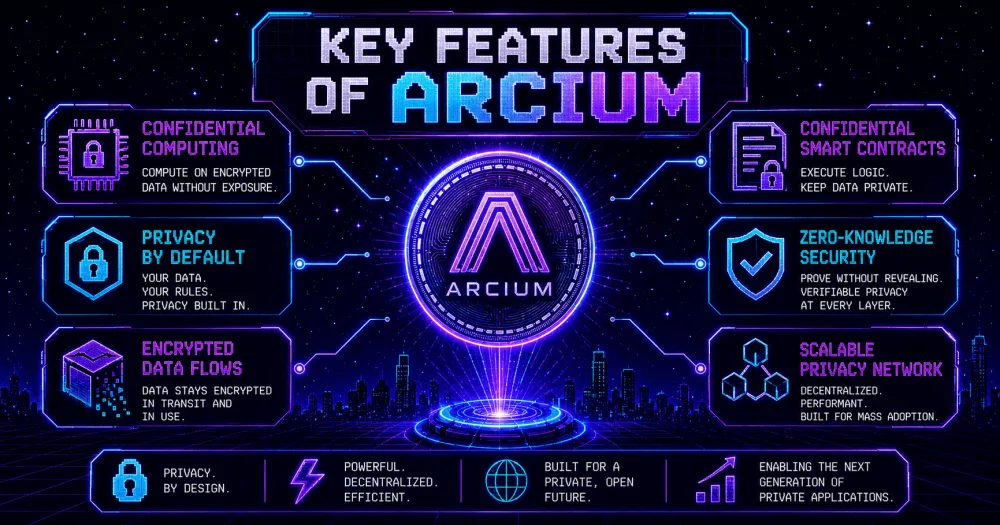
End-to-End Confidential Computing
With Arcium, all data is encrypted, including inputs, intermediate values, and outputs. Essentially, this is a critical distinction from other privacy-focused protocols and blockchains that only hide on-chain activity or certain data points like wallet addresses. Arcium emphasizes the importance of secure logic.
Programmable Privacy for Smart Contracts
With Arcium, organizations can develop smart contracts with built-in privacy features. Possible applications include sealed-bid auctions, private order books, private transfers, games with confidential moves, private compliance checks, and private AI models.
High-Performance Parallel Computation
Arcium’s emphasis on parallel confidential computation is what distinguishes it from other privacy infrastructure. The utilization of MXEs and clusters is crucial for performance, especially considering how performance-sensitive many potential applications for such a system would be. In other words, Arcium would let developers actually deploy something large-scale and useful.
Cross-Chain Compatibility
Solana is the network’s consensus layer for now, but Arcium is not a blockchain itself. The company’s FAQ states that Arcium requires an underlying consensus and data availability layer, making it essentially chain-agnostic.
Related: Bitcoin and Ethereum in Crisis: Can Solana Become the Main Global Payments Network in 2026?
What Is the ARX Token?
ARX Token Utility
The token underlies the network’s staking and governance mechanism and plays a crucial role in its economic design. In general, there is nothing unusual about it, apart from the fact that it does not have a dynamic supply. According to the tokenomics, there is a fixed supply of 1 billion ARX tokens.
ARX Tokenomics Explained
Arcium’s tokenomics are largely defined by staking, governance, fees, and supply distribution. For every computation executed on the network, 70% of fees are distributed to node operators, 20% to recovery nodes, and 10% to the treasury. At the time of writing, 20.88% of the supply was already unlocked, with the remaining 79.12% set to enter circulation over time.
How the ARX Token Supports the Arcium Ecosystem
ARX tokenholders can participate in the network’s governance. Arcium’s design is such that the more capacity a validator provides to the network, the more tokens should be staked to secure better rewards. Additionally, longer locking periods are rewarded with higher voting power. Generally, the entire design is meant to incentivize holders to utilize the token for its intended purpose.
Real-World Use Cases for Arcium
AI seems to be one of Arcium’s central use cases. AI applications can utilize Arcium to process private prompts and data, including documents, code, medical records, and research. In general, most useful AI applications would involve some level of confidentiality, and therefore benefit from being built on Arcium. The acquisition of Inpher, which focuses on confidential machine learning and MPC, supports this narrative.
Private DeFi Protocols
Confidential AI Applications
Private DeFi protocols are another central application for Arcium. The problem with on-chain DeFi is that every transaction is visible and can be traded on, leading to front-running, mimicking, and other forms of attacks. AI-driven trading and analytics would benefit from a similar level of confidentiality, which is why dark pools and other encrypted order book mechanisms are likely to emerge.
Secure Payments and Financial Infrastructure
Similar to DeFi, traditional finance desperately needs more privacy and confidentiality. This includes everything from simple transactions to analytics, where insights are often derived from encrypted and aggregated data. Payments confidentiality, hidden balances, encrypted compliance checks, and private financial data in general can all be facilitated by Arcium.
Enterprise Data Processing
Enterprises need private analytics, fraud detection, risk models, and secure data collaboration. Arcium’s value proposition is that multiple parties can compute together without handing full datasets to one central processor.
Healthcare and Sensitive Data Management
Healthcare is another sector with very specific and strict requirements for data confidentiality. While it is a long tail, the potential value is enormous, as hospitals and insurance companies handle extremely sensitive personal data.
Related: What Is ISOR Crypto? The Oil-Themed Solana Token Everyone Is Talking About in 2026
Arcium Ecosystem and Partnerships
Developer Tools and SDK
Arcium offers documentation and developer tools for building applications on the network. In general, the development of useful and performant applications is crucial for the network to gain actual utility and scale.
Current Ecosystem Projects
The current list of ecosystem projects includes Crafts, Zinc, Umbra, Dinaro, Bench, Streamflow, Melee, Seedplex, Anonmesh, Stealf, Epoch, Flew, Undesk, Hydex, and Pythia. In general, the ecosystem building around Arcium is intended to facilitate the emergence of multiple use cases focused on confidential computation.
Strategic Investors and Backers
Arcium has secured the backing of Greenfield Capital, Coinbase Ventures, Jump crypto, and Solana-focused investors. In 2024, the network secured a $5.5M strategic funding deal, bringing the total capital raised to $9M at the time of writing.
Arcium vs Other Privacy Crypto Projects: Arcium vs Nillion
Nillion and Arcium represent similar visions for decentralized private computation networks. At the moment, Arcium appears to be much more Solana-focused, and it emphasizes the importance of execution environments, confidential programs, and overall application-level encryption.
Arcium vs Secret Network
Secret Network is a privacy smart contract blockchain, whereas Arcium is not a Layer 1. In other words, Arcium can be thought of as infrastructure that is utilized by an application chain, which has benefits for composability and liquidity.
Arcium vs Oasis Network
Oasis Network is another project that is related to confidential computing. However, Arcium is focused on developing MPC-based execution environments within Solana, which appears to be a much more ambitious undertaking than what is being attempted by Oasis.
Arcium vs Aztec
Aztec is a zero-knowledge encryption project that is deeply integrated with the Ethereum ecosystem. Arcium, on the other hand, is focused on developing MXEs and confidential computation, and it is not built on top of Ethereum. While Aztec utilizes zero-knowledge proofs to allow for some level of on-chain privacy, Arcium emphasizes shared state encryption, arguing that it is better suited for shared computation.
Arcium vs Zama
Zama is a project that is focused on developing Fully Homomorphic Encryption or FHE, which is an emerging field in cryptography. With FHE, it is possible to perform arbitrary computations on encrypted data, which is theoretically much more powerful than what is being pursued by Arcium. That being said, FHE is much more computationally intensive and has a steeper learning curve, which puts it at a disadvantage from a practicality standpoint.
Is Arcium Built on Solana?
How Arcium Integrates With Solana
Yes, Arcium is built on Solana. According to the documentation, encrypted computation happens on-chain via the Solana blockchain, whereas Arcium’s nodes are responsible for executing private data computation. In general, the relationship between Solana and Arcium resembles that of Ethereum and other privacy-focused rollups.
Is Arcium a Layer 1, Layer 2, or Infrastructure Layer?
Arcium is best described as an infrastructure layer. It is not a settlement or consensus layer, as it relies on Solana for these functions. From a practical standpoint, Arcium can be seen as a scaling solution that adds additional privacy features, and it is likely to have broader composability with other infrastructure.
Arcium Roadmap and Future Development
Mainnet Launch Plans
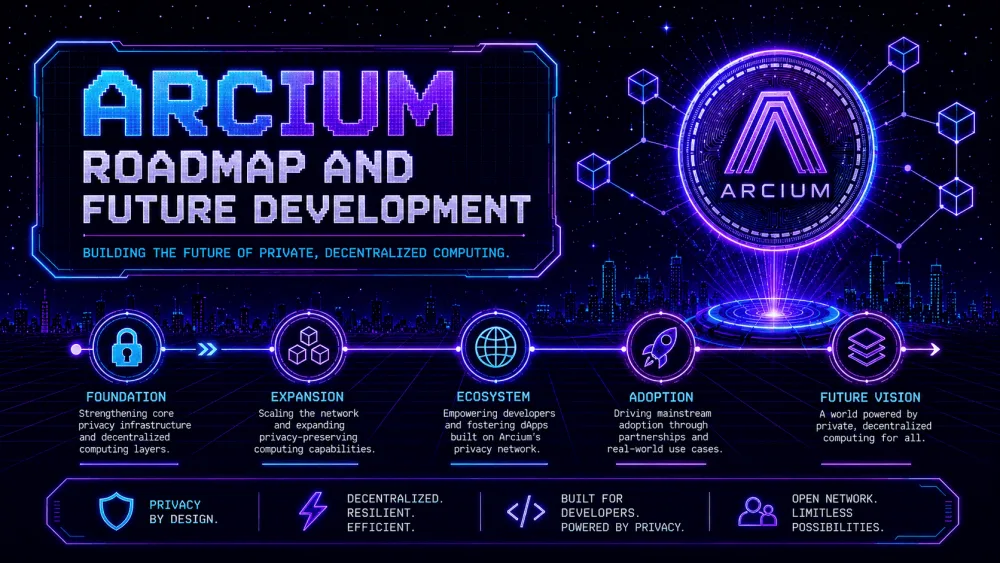
The website mentions Mainnet Alpha, and the roadmap page notes that the Year 1 roadmap is confidential. With that being said, investors should be wary of the difference between infrastructure and hype. Right now, the network is live but has a long way to go before it reaches critical mass.
Upcoming Ecosystem Milestones
The next few milestones include the proliferation of applications built on the network, higher levels of adoption and utilization, better developer tools, nodes, staking, and interactions with Solana. The token launch on June 22 stoked speculation, but the next few months are likely to be more important.
Long-Term Vision for Confidential Computing
The vision is similar to what we are seeing across the space: a better internet that is driven by decentralized infrastructure. Arcium represents one possible future where computation is performed on encrypted data by default.
Is Arcium Crypto a Good Investment?
Growth Opportunities
The bull case for Arcium is predicated on the long-tail nature of the opportunity. Confidential computing has the potential to disrupt industries from healthcare to fintech. At the same time, AI privacy and on-chain DeFi privacy are extremely compelling use cases that represent much more tangible opportunities in the near term.
Potential Risks
The risks associated with Arcium are numerous: complexity, competition, token supply dynamics, regulatory challenges, and lack of product-market fit. Generally speaking, tokens built on highly complex cryptographic primitives struggle to take off, especially when those primitives are not yet battle-tested.
Long-Term Outlook for ARX
The long-term outlook for the ARX token is best measured not in dollars but in actual network performance. More specifically, investors should watch out for total computations on the network, number of applications, staking volume, node performance, Solana adoption, and other indicators.
FAQ
What Is Arcium Crypto?
Arcium crypto is a decentralized confidential computing infrastructure. In general terms, it enables applications to perform calculations on encrypted data via MPC nodes, thus keeping this data private.
What Is ARX Token?
ARX is the governance and staking token for the Arcium platform, with a total supply of 1B tokens, according to the tokenomics overview.
Is Arcium a Privacy Blockchain?
Arcium is a blockchain infrastructure provider, not a privacy coin or a privacy Layer-1.
Is Arcium Built On Solana?
Arcium is a Solana-based protocol.
What Makes Arcium Different?
Arcium emphasizes the importance of performing computation on private data, not just hiding on-chain transactions. The utilization of MXEs and other concepts like arxOS, Arcis, and clusters gives Arcium an edge over competitors, emphasizing the benefits of a multi-layered approach to confidentiality.
Is Arcium Crypto Risky?
ARX is a risky investment due to its volatility, utility value, competitive landscape, and regulatory environment. At the same time, Arcium has the potential to disrupt the blockchain space, and investors who believe in its vision have an opportunity to profit significantly.