The list of crypto exchanges facing EU exit is one of the biggest stories in crypto regulation right now. As new rules take full effect on July 1, 2026, every exchange serving European users must now hold proper authorization under the EU’s Markets in Crypto-Assets framework (MiCA).
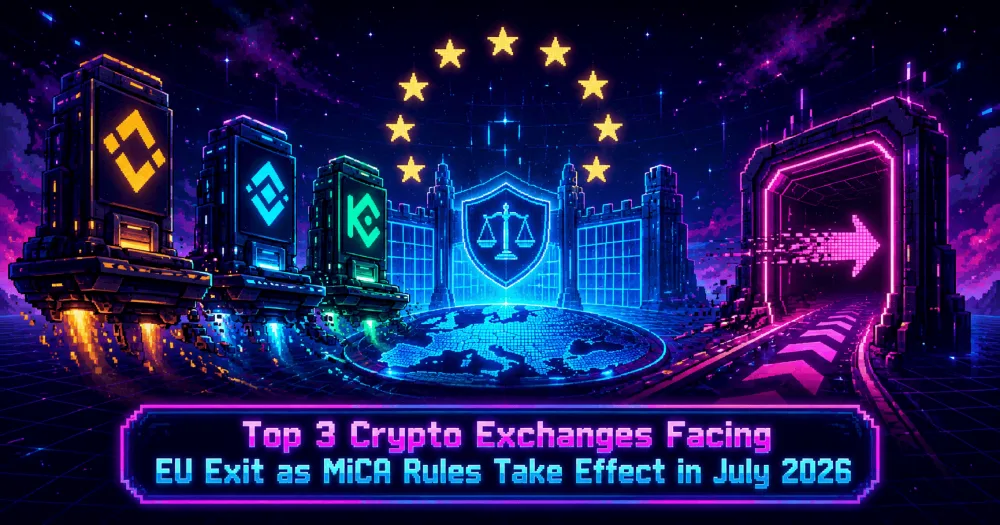
That does not mean every major exchange is leaving Europe. But, for example, Binance faces a disruption of all its EU operations: this exchange failed to secure MiCA approval before the deadline. Bybit has moved into a regulated European structure through Bybit EU. KuCoin is presenting itself as compliant, but still faces the broader pressure that MiCA places on global offshore exchanges.
In short, the top crypto exchanges facing EU exit are those whose European access depends on licensing. While they might have previously held a license in one of the EU member states, this is no longer sufficient under the new MiCA rules.
Related: MiCA Shock on July 1: Over 80% of Europe’s Crypto Firms Still Lack a License — What Happens Next?
Contents
- What MiCA Changes for Crypto Exchanges in July 2026
- Why MiCA Creates an EU Exit Risk
- Top 3 Crypto Exchanges Facing EU Exit Risk
- 1. Binance — The Clearest Case of EU Exit Pressure
- 2. Bybit — Not an Exit Case, but a MiCA Restructuring Case
- 3. KuCoin — Compliance Pressure Under the New EU Standard
- Binance vs Bybit vs KuCoin: Who Faces the Biggest EU Risk?
- What MiCA Means for EU Crypto Users
- Winners and Losers Under MiCA
- Will More Crypto Exchanges Leave the EU?
- Final Thoughts
- FAQ
What MiCA Changes for Crypto Exchanges in July 2026
MiCA turns Europe into a single regulated market. Before MiCA, each county could set its own rules for crypto exchanges. After the transition period ended on July 1, 2026, firms serving EU users need proper EU-wide authorization as crypto-asset service providers.
For exchanges, this changes the basic operating model. They need to meet stricter anti-money-laundering (AML), capital, and cybersecurity requirements.
The crypto exchanges facing EU exit may be unable, unwilling, or too late to meet the new EU compliance threshold. Others may stay only through newly regulated local subsidiaries.
Why MiCA Creates an EU Exit Risk
MiCA does not automatically remove every global exchange from Europe. It does something more precise: it makes unauthorized service illegal.
That creates several outcomes:
- Some exchanges receive a MiCA license and continue operating.
- Some transfer European users to a regulated EU entity.
- Some restrict products or countries.
- Some pause EU services while applying elsewhere.
- Some leave the EU market entirely.
This is why users should treat the phrase crypto exchanges facing EU exit carefully. It can mean a complete exit, a temporary suspension, forced migration, or product restrictions.
For major global exchanges, the pressure is especially intense because MiCA is not just paperwork. It asks regulators to approve governance, ownership, compliance history, internal controls, and customer-protection standards.
Top 3 Crypto Exchanges Facing EU Exit Risk
The three names attracting the most attention are Binance, Bybit, and KuCoin. But each of them is a different case.
Binance has the clearest EU access crisis. Bybit appears to have prepared a regulated EU route. KuCoin sits in the broader category of global exchanges that must prove their MiCA readiness and convince users that access will continue.
That makes this ranking less about panic and more about exposure.
1. Binance — The Clearest Case of EU Exit Pressure
Binance is the most important name among crypto exchanges facing EU exit because it is the world’s largest crypto exchange and has faced repeated regulatory friction across major markets.
Read more: Binance Faces EU Exit: World’s Largest Crypto Exchange Misses MiCA License
The MiCA deadline created a direct problem. Binance failed to secure the necessary EU authorization before the deadline and had to tell users in several EU countries that services would be restricted. That does not mean customer assets vanish. It means Binance cannot keep serving EU users normally without proper authorization.
The company may still try to return through another EU member state. But MiCA has made that harder than the old system. A license from one member state can provide passporting across the bloc, but regulators now coordinate more closely. A failed or withdrawn application in one country can affect trust elsewhere.
Why Binance Is at Risk
Binance’s risk comes from several factors:
- Failure to secure MiCA authorization before the July 2026 deadline
- Regulatory concerns linked to compliance history
- Complex global corporate structure
- Past enforcement actions outside the EU
- Pressure from European regulators to apply strict standards
- Need to pause, restrict, or restructure EU services
For users, Binance’s EU issue is not about whether the exchange is still globally important. It clearly is. The issue is whether it can operate under the EU’s new compliance framework without interruption.
What Binance Users Should Watch
European Binance users should watch for official notices about account restrictions, withdrawal timelines, product availability, and possible migration routes.
The key questions are simple:
- Can Binance secure a new MiCA license?
- Which EU country will handle the next application?
- Will users be moved to a regulated entity?
- Which products will remain unavailable?
- How long will the disruption last?
Among crypto exchanges facing EU exit, Binance is the most serious case because its EU access has already been directly disrupted.
2. Bybit — Not an Exit Case, but a MiCA Restructuring Case
Bybit is often mentioned in MiCA discussions, but it should not be treated the same way as Binance. Its subsidiary, Bybit EU, has positioned itself as a regulated European entity. More specifically, Bybit EU GmbH operates under a MiCAR licence granted by Austria’s Financial Market Authority.
That means Bybit is not simply one of the crypto exchanges facing EU exit in the same hard sense as Binance. The better description is that Bybit shows how global exchanges can survive MiCA by creating a regulated EU structure.
This distinction matters. If an exchange moves users into a licensed EU entity, it is not exiting but adapting.
Why Bybit Still Belongs on the Watchlist
Bybit still belongs in a MiCA risk article because the transition can affect users, products, countries, and liquidity. A regulated EU entity may not offer every product that the global exchange offers. Derivatives, leverage, token listings, promotions, and onboarding rules may all differ under EU rules.
MiCA compliance can make the platform safer and more transparent, but also less flexible. That is the tradeoff.
Read more: Crypto Exchange Battle 2026: Binance vs Bybit — Where Do Traders Prefer to Trade?
What Bybit Users Should Watch
Bybit users in Europe should check whether they are using the correct EU entity, whether their country is supported, and whether products available on the global platform are also available under the EU-regulated structure.
The main questions are:
- Are users being migrated to Bybit EU?
- Which countries are excluded?
- Which products are unavailable under MiCA?
- Are fees, liquidity, or trading pairs changing?
- Are stablecoin and custody rules changing?
Bybit is not the cleanest example of crypto exchanges facing EU exit. It is better understood as a case of MiCA-driven restructuring.
3. KuCoin — Compliance Pressure Under the New EU Standard
KuCoin is another global exchange that appears frequently in MiCA-related discussions. Unlike Binance, KuCoin has been actively presenting itself as prepared for the new compliance environment. Still, it remains relevant because MiCA raises the bar for every exchange serving European users.
KuCoin’s issue is not necessarily a confirmed exit. It is exposure to the same core question facing all global exchanges: can the platform continue serving EU users under the new crypto-asset service provider framework without restriction?
That makes KuCoin one of the crypto exchanges facing EU exit risk only in the broader sense. The risk is not the same as Binance’s immediate disruption. It is a test of licensing, product structure, and regulatory credibility.
Why KuCoin Faces Pressure
KuCoin faces pressure because MiCA forces offshore-style exchanges to look more like regulated financial institutions. That means stronger governance, clearer disclosures, stricter customer rules, and more transparent operations.
Even exchanges that want to stay in Europe may need to adjust:
- User onboarding
- Product availability
- Stablecoin access
- Custody procedures
- Risk disclosures
- Anti-money-laundering controls
- Local entity structure
For KuCoin, the challenge is not only staying accessible. It is proving that its EU-facing operations meet the new standard.
What KuCoin Users Should Watch
European KuCoin users should watch for official MiCA notices, service restrictions, product delistings, country-specific changes, and any shift toward a clearly licensed EU entity.
Key questions include:
- Does KuCoin have the required EU authorization for the relevant services?
- Are users being served by a regulated EU entity?
- Are certain products restricted after July 2026?
- Are stablecoin pairs affected?
- Are deposits, withdrawals, or promotions changing?
KuCoin may not be leaving Europe, but it still operates in a market where MiCA has made casual access much harder.
Binance vs Bybit vs KuCoin: Who Faces the Biggest EU Risk?
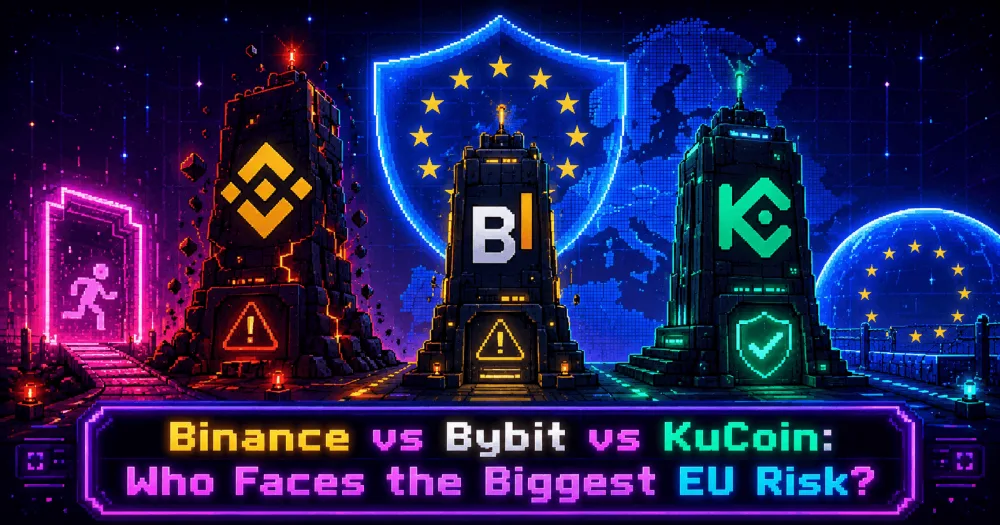
Among Binance, Bybit, and KuCoin, Binance faces the clearest EU exit pressure. Bybit appears to have moved into a regulated EU structure. KuCoin sits in the compliance-pressure category and must continue proving MiCA readiness.
| Exchange | EU Risk Level | Main Issue | Likely Scenario |
|---|---|---|---|
| Binance | High | No MiCA approval before deadline | Service restrictions or temporary EU disruption |
| Bybit | Medium-low | User migration and product differences | Continued EU service through regulated entity |
| KuCoin | Medium | Compliance proof and product alignment | Continued pressure under MiCA rules |
This is why the phrase crypto exchanges facing EU exit should not be applied equally. Binance is the headline case. Bybit is an adaptation case. KuCoin is a compliance-watch case.
Why Binance Is the Biggest MiCA Test Case
Binance matters because of scale. If the world’s largest exchange cannot easily pass MiCA, smaller exchanges should not assume the process is simple.
MiCA is testing whether global crypto platforms can become regulated financial institutions in Europe. That involves more than filing forms. Regulators want to understand ownership, governance, compliance controls, customer protection, cybersecurity, and enforcement history.
For Binance, the EU question is now bigger than one license. It is about whether a global exchange with a complicated regulatory past can convince European authorities that it meets the new standard.
That is why Binance dominates the conversation around crypto exchanges facing EU exit.
Related: Ripple Receives Preliminary MiCA License Approval in Luxembourg
Why Bybit Shows the New Survival Strategy
Bybit shows another path: create a regulated EU entity, secure authorization, and migrate users into the compliant structure.
This may become the dominant survival strategy for global exchanges. Instead of serving Europe from offshore platforms, exchanges will need a serious EU base, approved governance, and products shaped around local rules.
The result may be a less chaotic market. It may also be less open, less flexible, and less exciting for traders who want high leverage or unrestricted product access.
Europe is not banning crypto exchanges. It is forcing them to grow up. Predictably, some will discover adulthood is expensive.
Why KuCoin Reflects the Broader Exchange Problem
KuCoin reflects the broader problem for non-EU-native platforms. Even if an exchange does not face immediate removal, it must now prove it belongs in the regulated market.
That means the EU is no longer a casual expansion zone. It is a compliance-heavy market where exchanges need licensing, local accountability, and clear consumer protection.
For users, this may reduce risk. But for exchanges, it raises costs. For smaller or less prepared platforms, the easiest answer may be to leave.
That is why the number of crypto exchanges facing EU exit may remain high even after the July 2026 deadline.
What MiCA Means for EU Crypto Users

For EU crypto users, MiCA creates both inconvenience and protection.
The inconvenience is obvious. Some accounts may be restricted. Some exchanges may stop accepting EU users. High-risk products could disappear or become harder to access.
The protection is also real. Licensed firms must meet clearer standards. Users should receive better disclosures and stronger custody rules.
What Users Should Do Before an Exchange Exits
Right now, EU-based crypto users should pay attention rather than panic. If an exchange loses EU access, users may need to withdraw funds or migrate accounts.
A practical checklist:
- Read official exchange notices
- Confirm whether the exchange has MiCA authorization
- Check if your country is still supported
- Withdraw unsupported assets early if needed
- Avoid waiting until the final deadline
- Keep records for tax reporting
- Do not rely on social media rumors
For users, the biggest risk is ignoring official notices until withdrawals, products, or account functions become limited.
Winners and Losers Under MiCA
MiCA will likely benefit licensed platforms that prepared early. Exchanges with approved EU entities can absorb users from platforms that missed the deadline. Banks, fintech firms, and regulated crypto brokers may also gain market share.
The losers are platforms that relied on loose access, unclear structures, or delayed licensing strategies.
In the short term, MiCA may reduce competition. In the long term, it may create a more institutional European crypto market.
That may be good for safety. It may be bad for the chaos traders secretly enjoy. Nobody said civilization was fun.
Will More Crypto Exchanges Leave the EU?
Yes, more exits, restrictions, and restructurings are likely. The EU market is large, but MiCA compliance is expensive. Some platforms may decide the cost is worth it. Others may decide Europe is no longer worth the operational burden.
This does not mean crypto in Europe is shrinking forever. It means the market is moving from open-access exchange competition to regulated financial infrastructure.
The next phase will favor companies with capital, compliance teams, banking relationships, and local regulatory credibility.
Final Thoughts
The phrase “crypto exchanges facing EU exit” is accurate, but it needs nuance. Binance is the clearest high-risk case after failing to secure MiCA approval before the deadline. Bybit appears better positioned through a regulated EU structure. KuCoin remains under broader compliance pressure as MiCA forces global exchanges to prove they can meet Europe’s new rules.
MiCA does not kill crypto trading in Europe. It changes who gets to offer it.
For users, the lesson is simple: check licensing, read official notices, and avoid assuming that a global exchange can keep serving EU customers just because it always has.
The EU crypto market after July 2026 will be smaller, stricter, and more institutional. Some users will hate that. Some will benefit from it. But for exchanges, the message is blunt: get licensed, restructure, or leave.
FAQ
What are the top crypto exchanges facing EU exit under MiCA?
The most discussed names are Binance, Bybit, and KuCoin, but their situations differ. Binance faces the clearest EU disruption, Bybit has a regulated EU structure, and KuCoin remains under broader compliance pressure.
Why is Binance facing EU exit risk?
Binance faces EU exit risk because it failed to secure MiCA authorization before the July 2026 deadline, forcing service restrictions or restructuring for EU users.
Is Bybit leaving the EU?
Bybit is not the same kind of exit case as Binance. Bybit EU operates through a regulated European entity, so the main issue is user migration and product differences under MiCA.
Is KuCoin MiCA compliant?
KuCoin presents itself as prepared for MiCA, but EU users should still check official notices, supported countries, licensing status, and product restrictions before relying on continued access.
What should EU users do if their exchange loses MiCA access?
Users should read official exchange notices, confirm whether the platform has MiCA authorization, withdraw unsupported assets if needed, keep tax records, and avoid waiting until account functions become restricted.