At first sight, prediction markets vs sports betting might look similar. Both involve money, belief, odds, and future outcomes. Prices shift when news hits. Some users dive in because they trust their read more than the crowd. The thrill is not just winning; it is proving that insight has weight.

Yet one model differs from the other in key ways. Sports betting is built around games, scores, athletes, and match results. Prediction markets go wider: people exchange value based on what might happen later. Elections, inflation, court rulings, weather events, crypto prices, and policy decisions can all become tradable outcomes.
Prediction markets vs sports betting difference shapes how systems are built, regulated, priced, funded, and used. It also affects their role in the broader crypto landscape.
Read more: Best Prediction Markets APIs for Builders in 2026
Contents
- What Are Prediction Markets?
- What Is Sports Betting?
- Prediction Markets vs Sports Betting: Core Difference
- Regulation: Why the Legal Line Gets Complicated
- Why Crypto Users Care About Prediction Markets
- Key Similarities Between Prediction Markets and Sports Betting
- Key Differences at a Glance
- Are Prediction Markets Better Than Sports Betting?
- What to Watch Before Using Prediction Markets
- What to Watch Before Sports Betting
- Final Thoughts
- FAQ
What Are Prediction Markets?
Prediction markets let people trade contracts about what will happen later. Suppose one asks whether Bitcoin will move above $100,000 before year-end. If that occurs, “Yes” contracts pay a set amount. Otherwise, the claim becomes worthless. Though uncertain, results depend on real-world events.
The number on screen shows what traders currently think will happen. When a “Yes” contract sits at $0.62, the market acts like the event has roughly a 62% chance before costs take a bite.
This is why crypto prediction markets are often called information hubs. News arrives alongside hunches, data, bias, and speculation. A single price forms, shaped by every move. What emerges sits where motives collide.
Popular prediction market topics include:
- Crypto price movements
- Political outcomes
- Economic data releases
- Technology launches
- Legal and regulatory decisions
- Sports, entertainment, and cultural events
Here is what matters most: prediction markets go beyond game outcomes. Almost any future event with a clear result can fit.
What Is Sports Betting?
Sports betting means wagering on sports outcomes. Someone might pick a winning team, the total points scored, or one athlete’s performance. Sometimes the bet is about something small happening during play.
Sports betting odds often come from the bookmaker. Lines shift when cash piles up on one side, helping the operator manage risk. A small margin stays built into the numbers. People placing wagers rarely face off like traders. Instead, they enter a setup run by the sportsbook.
Most users bet on games to profit from better reads on injuries, team strengths, matchups, or public mispricing. Prediction markets cover far wider topics, while sports betting stays close to athletics and entertainment.
Here is the first split in prediction markets vs sports betting: one prices probabilities across broad possibilities; the other focuses on games, props, and final scores.
Prediction Markets vs Sports Betting: Core Difference
What sets them apart is structure.
In prediction markets, like Polymarket or Kalshi, trading happens when users buy and sell event contracts. As buying and selling shift, values change too. The market price becomes the group’s current guess at probability.
In sports betting, users lock in prices set by a bookmaker. Prices can move, but the house typically steers supply, balances risk, and tucks profit into each line.
Truth is, prediction markets feel more like trading. Sports betting leans more toward straight-up wagering.
That does not make prediction markets automatically safer or better. They can guess poorly, lack liquidity, get distorted by outside influence, or hook people into overtrading. But the mechanism is different.
How Pricing Works in Prediction Markets
Prediction market pricing often makes sense once you see the structure. If a contract pays $1 only if an event happens, and people trade it for $0.40, that number points to roughly a 40% implied chance.
This creates a clear prediction market probability model. If someone believes the true likelihood is 55%, paying $0.40 might feel like a bargain. Another person who estimates only 20% could see the same contract as too expensive.
When fresh details hit, prices shift. A legal decision, regulator announcement, athlete injury, exchange listing, inflation print, or Bitcoin ETF update can all move contracts.
Because they gather many guesses, decentralized prediction markets can show what people really think. The price is not merely a bet. It reflects shifting beliefs across a crowd.
How Odds Work in Sports Betting
Different parts of the world use different sports betting odds formats. American, decimal, and fractional odds look unlike one another, but they carry the same basic meaning: payout relative to the amount at stake.
Betting sites build in a cut from the start. Lines are shaped not only by what might happen, but also by where money flows. Though odds may look like fair probability, hidden cost lives inside each number.
One team’s implied chance plus the opponent’s may exceed 100%. That gap is the bookmaker’s margin.
This is why sports betting odds are not quite as transparent as prediction market prices. They show likelihoods, but also mix in house strategy, risk management, and positioning against the crowd.
Related: Polymarket Hit by $2.9M Hack — Prediction Markets Platform Will Compensate Affected Users
Market Scope: One Is Broad, the Other Is Narrow
Whatever has a definite outcome might show up on prediction markets. Crypto rules, central bank decisions, elections, token launches, inflation data, exchange approvals, legal rulings, and weather events can all become tradable questions.
Sports betting is narrower. Games, leagues, athletes, and props tied to athletic events fill out most of the market.
This scope difference explains why prediction markets vs sports betting matters in crypto circles. Blockchain-native platforms can fit into the broader Web3 data ecosystem. Pricing unknowns around technology, policy, market shifts, and regulation becomes possible.
Most people treat sports betting like an entertainment product, even when cryptocurrency is used for deposits or payments. Crypto changes how bets are placed, but not the core purpose.
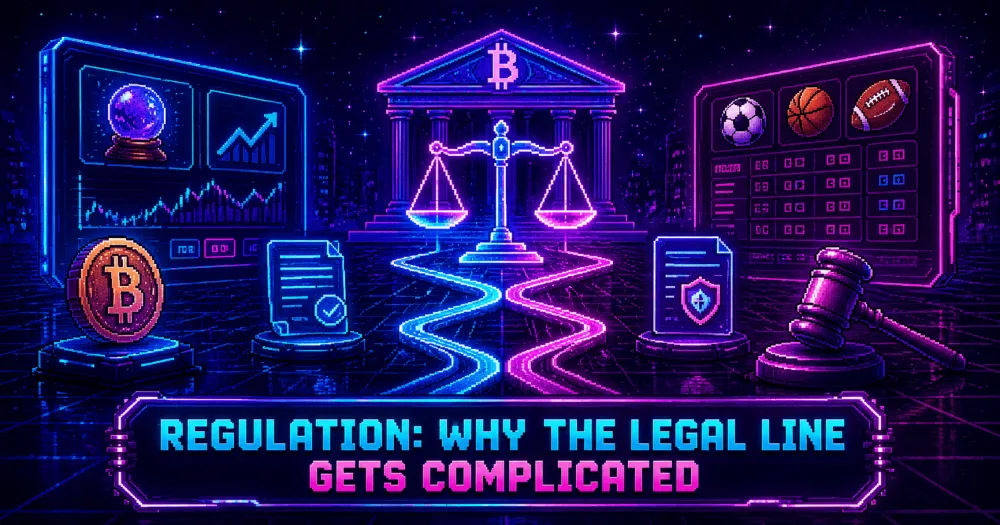
Regulation: Why the Legal Line Gets Complicated

Prediction market regulation depends on setup. Sometimes a platform looks like gambling. Sometimes it looks more like finance. Event contracts may resemble derivatives, wagers, data tools, or information markets, depending on design.
Sports betting regulation is usually more direct. It is treated as gambling or wagering and overseen under sports betting laws.
The tricky part is that some prediction markets cover sports. Once they do, the line blurs. A trade-based market asking whether Team A will win may function like a sports bet, despite using exchange-style contracts.
That is where prediction market legality gets murky. Regulators care less about marketing language and more about how the product works: where users are based, who holds funds, how outcomes settle, and what kind of events are listed.
Crypto prediction markets add another layer. If event contracts are tokenized, decentralized, or settled through smart contracts, oversight may involve financial law, gambling law, commodities rules, consumer protection, or sanctions compliance.
Centralized vs Decentralized Platforms
A single company runs centralized prediction markets. The platform may manage listings, hold user funds, handle disputes, enforce compliance, and limit access by location.
Decentralized prediction markets run on blockchain rails. Smart contracts can handle positions, liquidity, settlement, and payouts. Oracles deliver real-world outcomes into the system. Instead of signing up like normal sites, people may connect wallets.
Spreading control can improve transparency and global access. Yet things go wrong when data feeds break, liquidity is thin, rules are unclear, front ends block users, or nobody knows who decides disputes.
So prediction markets vs sports betting is not only about guessing outcomes. Sportsbooks usually run through one main control point. Blockchain prediction markets may spread power across smart contracts, wallets, oracles, and users.
Liquidity and Market Efficiency
In prediction markets, low liquidity means one large trade can shift odds fast. Prices stay stable only when plenty of users buy and sell regularly. Thin markets can produce misleading probabilities.
In sports betting, liquidity appears through the sportsbook’s willingness to accept bets and adjust lines. Big operators handle volume thanks to scale, risk models, and steady user flow.
When many informed people trade, prediction markets can become sharper. Yet noise creeps in when few take part. A 70% price means less when only a tiny group traded. For serious users, prediction market liquidity matters nearly as much as the headline number.
Settlement: Who Decides the Outcome?
Sports betting results often come down to official scores, league data, or approved stat providers. Outcome hinges on a recognized source, not guesses.
Prediction markets can be more complex. Some questions are easy: “Will Bitcoin close above $100,000 on a specific exchange by a specific time?” Others are messy: “Will a country enter recession?” or “Will a company announce a product launch?”
Precise wording sits at the heart of strong prediction markets. Before trading begins, the market should define the event, deadline, data source, and resolution process.
Wrong words spark arguments. When people argue, confidence decays fast.
User Intent: Information Trading vs Entertainment Betting
Users often approach prediction markets and sports betting with different intent.
Some prediction market users want to hedge risk. A crypto trader might use an ETF-related outcome to balance token exposure. Others jump in when headlines shift, trade macro views, or look for information gaps.
Most sports bettors care about fun, team knowledge, statistical patterns, or live-game action. The activity sticks closely to how they watch sports overall.
The boundary is not sharp. Some prediction market users are just betting. Some sports bettors rely on deep analysis. Still, each system pulls behavior in a different direction.
Risk Profile: Both Can Lose Money Fast
Prediction markets can feel like brain games, yet money vanishes fast when a trader misreads probability, enters too late, ignores fees, or gets trapped in thin liquidity.
Sports betting carries risk because bookmakers build in an edge. Results shift unpredictably, and a few early wins can make someone feel far too sure.
False certainty hits hardest. One person thinks they are gathering insights. Another sees smart risk-taking. Both may just be chasing noise. Confidence means nothing out there. Rude, but efficient.
Related: Kalshi Begins Preparations for IPO — Could Regulators Derail the Prediction Market Platform?
Why Crypto Users Care About Prediction Markets
Crypto users focus on prediction markets because they fit naturally beside digital money systems. Wallet access, stablecoins, smart contracts, automated settlement, and transparent liquidity all make sense in this environment.
Beyond betting-style use, new possibilities emerge:
- Hedging event risk
- Pricing regulatory uncertainty
- Forecasting crypto market catalysts
- Tracking public expectations
- Building decentralized information tools
- Creating market-based signals for DAOs and traders
Prediction markets can help Bitcoin and crypto holders judge what people think about new rules, adoption, macro shifts, or key moments in a blockchain’s growth.
This is why prediction markets vs sports betting matters for crypto. One may evolve into financial information infrastructure. The other tends to stay focused on games and wagers.
Key Similarities Between Prediction Markets and Sports Betting
Just because they differ does not mean they are strangers.
Uncertainty shapes both. Money chasing quick wins shows up in both. Pricing leans on probabilities. Either can pull users too deep when handled without caution. Clear settlement rules matter. So does fair access.
The overlap becomes clearest in sports prediction markets, where event contracts can resemble wagers.
Truth be told, prediction markets are not completely unique. They cover more ground, allow easier trading, and prioritize information flow, yet some look a lot like sports wagers when tied to specific events.
Key Differences at a Glance
| Feature | Prediction Markets | Sports Betting |
|---|---|---|
| Main product | Tradable event contracts | Wagers on sports outcomes |
| Scope | Politics, crypto, economics, weather, sports, culture | Games, athletes, props |
| Price meaning | Often reads like implied probability | Odds include sportsbook margin |
| Market structure | User-driven trading | Bookmaker-controlled lines |
| Settlement | Defined source, oracle, or resolution process | Official sports result or stat sheet |
| Crypto fit | Strong fit with smart contracts and stablecoins | Mostly crypto payments or betting apps |
| Main use case | Information trading and hedging | Entertainment wagering |
Are Prediction Markets Better Than Sports Betting?
Not automatically.
Prediction markets can offer clearer insight than many forecasting tools. Information flows into them from many directions, shaping a shared sense of likelihood over time. Instead of staying isolated, those estimates can help people weigh risk around specific events.
Sports betting can feel more straightforward. Clear events make outcomes easier to settle. Familiar patterns help users move through the product without much confusion.
What really sets them apart is purpose. When the goal is measuring uncertain outcomes across a broad range of events, prediction markets tend to fit better. For wagering on athletic competitions, sports betting fits more closely.
What works best in prediction markets vs sports betting depends on the user’s goal.
What to Watch Before Using Prediction Markets
Start by checking how the question is phrased. Look at whether enough traders are involved to make trading smooth. Costs matter too, so check platform fees. Each site has its own rules, so read them. Find out where results come from and who decides outcomes. Lastly, confirm whether access is allowed in your country.
A good market should answer four questions clearly:
- Which exact event is being forecast?
- Who or what decides the result?
- When does the market settle?
- Can users exit early without losing too much value?
If those answers lack clarity, the market is weaker than it looks.
What to Watch Before Sports Betting
Start smart. Know how odds work where you are. The house always leans its way. Set a money limit. Watch prices shift. Rules change by region, so legality matters.
Sports betting sites are designed to keep users clicking. Quick wagers, live bets, real-time odds, and constant updates push gut reactions over calm thinking.
Not everyone who bets acts without care. Still, the design holds attention on purpose. With each click carrying a price, focus becomes valuable.
Final Thoughts
Prediction markets vs sports betting is a useful comparison because the two seem similar at first glance. Both involve guessing outcomes. Yet each demands a different mindset, shaped by distinct rules beneath the surface.
Sports betting means placing money based on bookmaker odds around games. Prediction markets turn broader crowd expectations into tradable event contracts.
For crypto users, prediction markets may matter most when sizing up unknowns: new rules, Bitcoin adoption, elections, macro shifts, or sudden market catalysts. Still, they work well only when trading is active, settlement is clear, access is legal, and users stay disciplined.
Here is the clean angle: sports betting asks who wins the match. Prediction markets ask how people see the world unfolding next.
FAQ
What is the main difference between prediction markets and sports betting?
The main difference is structure and reach. Prediction markets let users trade contracts on many future events. Sports betting focuses on wagers tied to sports results.
Are prediction markets just another form of betting?
Prediction markets can resemble betting, especially when they cover sports or short-term price moves. Yet they can also act as information markets, hedging tools, and public probability signals when built clearly.
Why do crypto users like prediction markets?
Crypto users like prediction markets because wallets, stablecoins, smart contracts, and automated settlement fit naturally with on-chain systems. They also help price uncertainty around crypto regulation, Bitcoin catalysts, and macro events.
Can prediction markets beat sportsbook lines?
Sometimes, but not always. Liquid prediction markets with informed traders can be sharp. Thin markets can show misleading signals. Sportsbook lines may also be accurate, though they include a bookmaker margin.
Is prediction markets vs sports betting mainly a legal difference?
No. Legal distinctions matter, but the bigger difference is product design. Prediction markets are broad event-contract markets. Sports betting is a narrower wagering product focused on athletic contests.