Kalshi, one of the leading prediction market platforms, is in talks to raise additional capital. If successful, it would surpass rival Polymarket’s valuation.
Kalshi is in talks to raise a new funding round at a $40B valuation, according to the Financial Times, citing sources. The round could close as early as the Q3 of 2026. That would nearly double the company’s $22B valuation from its May Series F round.
Hot topic: Bitcoin Crashes Below $60K for First Time Since October 2024 — What’s Happening in Crypto on June 25
If the deal goes through, Kalshi’s valuation would have grown eightfold in less than a year–significantly outpacing Polymarket’s $15B valuation.
Contents
Prediction Markets: Record Growth for Kalshi and Institutional Interest
In May 2026, Kalshi raised $1B in a Series F round with participation from Coatue, Andreessen Horowitz, Sequoia Capital, Morgan Stanley, and Ark Invest. In October 2025, the company was valued at $5B.
The rapid growth reflects rising institutional interest. According to Dune Analytics, Kalshi’s notional trading volume reached $22.6B in June, and it continues to climb without a single correction since August 2025. Kalshi is outpacing Polymarket in volume: monthly turnover was $17.9B in May compared to Polymarket’s $7.1B.
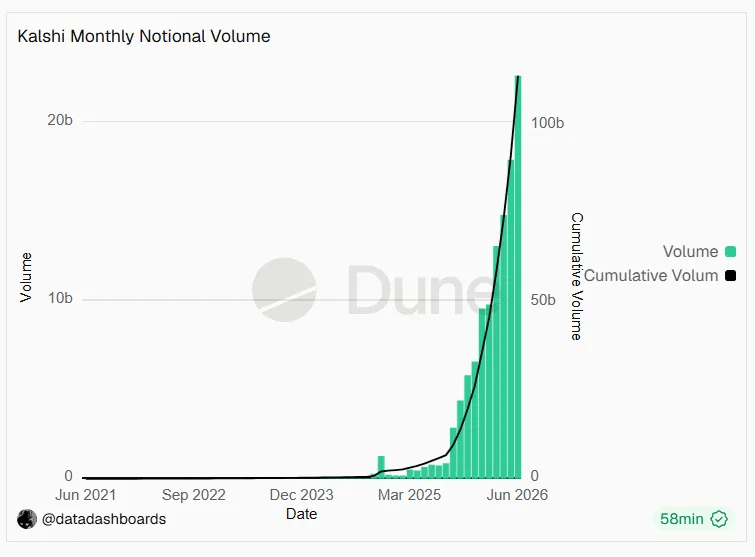
According to The Block, the gap between the platforms is widening. Kalshi is also in early IPO discussions with investment banks, and annualized revenue has surpassed $2B. CEO Tarek Mansour confirmed the company is considering a public listing but not this year. The new round would likely be the last before an IPO.
Read more: Mark Zuckerberg Takes On Polymarket and Kalshi — Meta Is Launching Its Own Prediction Market
Kalshi vs. Illinois: The Fight Over Jurisdiction and Taxes
Amid the funding talks, Kalshi has sued the state of Illinois in federal court over a law signed by Governor J.B. Pritzker. The legislation imposes a 15% tax on gross revenue from sports contracts on prediction markets and taxes crypto transactions. The tax takes effect July 1.
Kalshi argues the state has no right to tax its operations because its contracts are CFTC-regulated futures, not bets. The lawsuit says Kalshi would face criminal penalties if it stops offering sports contracts to Illinois residents or pays the state millions and submits to its regulation.
If courts side with the states, it could limit Kalshi’s operations and weigh on its valuation.
Read more: Best Prediction Markets APIs for Builders in 2026
US Prediction Market Regulation Context
Kalshi’s lawsuit follows similar action by the Trump administration’s CFTC, which last week filed for a preliminary injunction to block the law from taking effect. This is part of a broader national battle between states and the federal government over jurisdiction over prediction markets.
Donald Trump’s administration is actively defending the sector, while states argue the platforms offer unregulated gambling. Lawsuits are ongoing in nearly every federal district, with the issue likely headed to the US Supreme Court.
Learn more: Best Prediction Markets 2026 — Regulated Access, Crypto Liquidity and Risk Filters