The platform’s valuation as of April 20, 2026, stands at $15 billion.
Prediction market platform Polymarket is negotiating a new $400 million funding round at a $15 billion valuation.
Related: Bitcoin on April 20—BTC Trades Near $75,000 Amid Iran Uncertainty
This follows the October round, in which Intercontinental Exchange (owner of the NYSE) already invested $600 million. Including the new tranche, total funds raised could reach $1 billion. Polymarket is also seeking additional strategic investors.
Comparison With Competitor
Polymarket lags noticeably behind its main competitor, Kalshi. In March 2026, Kalshi raised over $1 billion at a $22 billion valuation. Kalshi also leads in trading volume: $13 billion compared to Polymarket’s $10.57 billion.
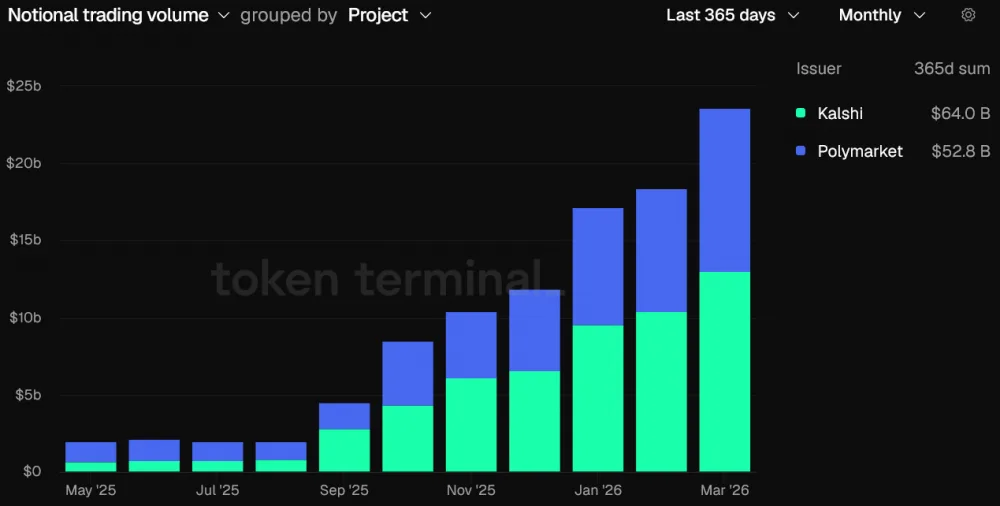
Both platforms are actively growing amid explosive expansion in the prediction market sector. In 2025, total sector trading volume tripled to $51 billion. Bernstein analysts forecast growth to $240 billion in 2026 and to $1 trillion by 2030.
Related: Kalshi to Curb Underage Betting on Prediction Market
Regulatory Risks and Institutional Interest
Despite rapid growth, the sector remains under strong regulatory pressure. In March, Senators Adam Schiff and John Curtis introduced a bill banning sports contracts on prediction market platforms. In response, Polymarket and Kalshi have tightened measures against insider trading and manipulation.
At the same time, interest in the sector from traditional financial players is growing. Nasdaq MRX, Cboe Global Markets, CME Group (in partnership with FanDuel), Charles Schwab, and Citadel Securities have either launched or are considering launching their own prediction market products.
Related: What’s Happening With Prediction Markets in the US—A Look at Recent Initiatives