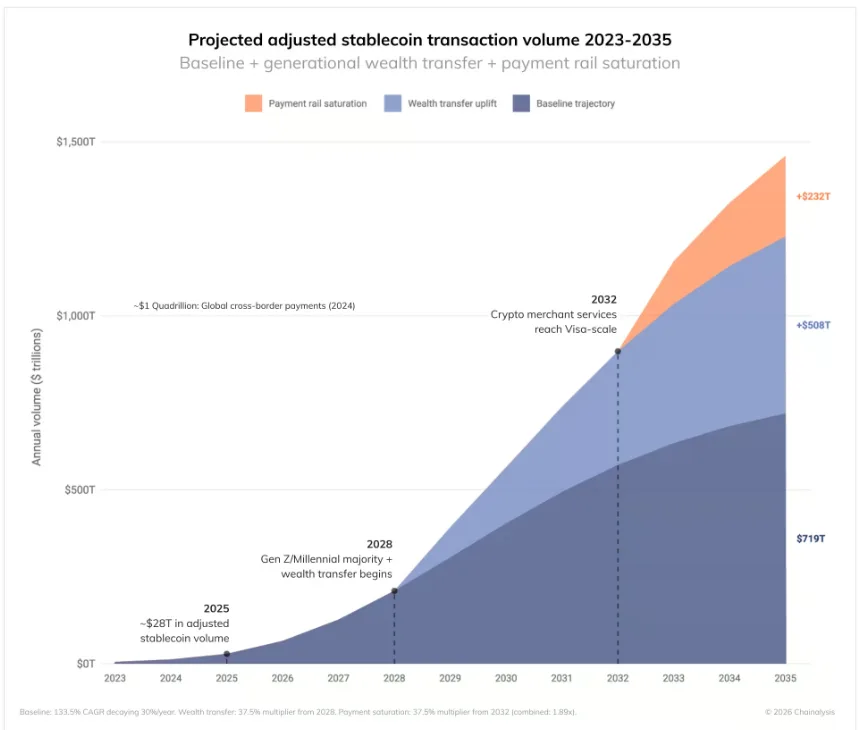
Under a baseline scenario, stablecoin transaction volume could reach $719 trillion, far exceeding current levels.
Chainalysis analysts project that by 2035, real stablecoin transaction volume could grow to $1.5 quadrillion.
Related: South Korea Plans to Regulate RWA and Stablecoins Under Existing Financial Laws

In 2025, stablecoins facilitated approximately $28 trillion in “real economic activity” (excluding exchange trading volumes). According to experts, further growth will depend on two key factors.
“Factor in these catalysts, and our projections change: 2035 volumes could approach $1.5 quadrillion, a figure that would surpass the estimated $1 quadrillion in global cross-border payments today,” Chainalysis said.
Main Growth Drivers
The first factor is the largest wealth transfer in history. Between 2028 and 2048, millennials and Gen Z will inherit up to $100 trillion. These generations are significantly more open to digital assets and inclined to use stablecoins as an everyday tool.
Related: Base Bets on Prediction Markets, Stablecoins in 2026 Roadmap

The second factor is mass integration of stablecoins into merchant payment systems. When crypto payments become seamless and convenient for end users, transaction volumes will rise sharply. AI agent-based commerce could serve as an additional accelerator.
Together, these trends could allow stablecoins to match Visa and Mastercard in transaction volume as early as 2031–2039. Under accelerated technology adoption, parity could occur even sooner.
Related: How to Choose a Crypto Debit Card—2026 Complete Guide
Institutional Interest and Regulatory Backdrop
Large financial players are already actively adapting. Stripe acquired Bridge. Mastercard partnered with BVNK. Standard Chartered projects that stablecoin growth could create up to $1 trillion in demand for US Treasury bonds.
At the same time, regulators continue to study risks. A recent White House study found no significant deposit outflows from the banking system due to stablecoins. Experts note that with proper issuance structure and reserve quality, stablecoins may not compete with traditional banks but rather complement them.
Related: Bitcoin Depot Hack—$3.6M in BTC Stolen After Corporate Wallet Breach Exposes Crypto ATM Risks