Crypto platforms aren’t just for individual traders anymore. They also work with companies, which means a different kind of verification is needed. A business can have several owners, directors, and controlling entities.

KYB verification in crypto helps platforms confirm that a company exists and figure out who actually runs it. These checks also support compliance and risk management before a business gets access to crypto services.
Related: What Is GMGN AI? The Crypto Trading Platform Helping Traders Track Smart Money and Find Memecoins
Contents
- What Is KYB Verification in Crypto?
- Why Do Crypto Platforms Require KYB Verification?
- What Information Is Required for Crypto KYB?
- How Does KYB Verification Work in Crypto?
- What Documents Are Needed for Crypto KYB?
- How Are UBOs Verified During Crypto KYB?
- KYB vs KYC in Crypto: What’s the Difference?
- How Long Does Crypto KYB Verification Take?
- What Happens If a Crypto Business Fails KYB?
- Is KYB Mandatory for Crypto Businesses?
- How Crypto Platforms Use KYB After Verification
- How to Pass Crypto KYB Verification
- FAQ
What Is KYB Verification in Crypto?
KYB is the corporate equivalent of identity verification. Instead of checking just one person, a platform looks at the whole legal entity and the people behind it.
What Does KYB Stand for?
KYB = Know Your Business. It covers the processes used to identify and verify companies before forming a business relationship. A KYB review can include registration details, ownership, directors, and operating activity. Crypto platforms use these findings to decide if the applicant meets their compliance standards.
How KYB Works for Crypto Businesses
KYB checks usually kick off when a company submits its legal and corporate information. The platform cross-checks those details against registries, documents, and other reliable records. Compliance teams then examine ownership and identify the people who control the company. For more complex or higher‑risk applicants, extra checks may be needed before approval.
What Does a Crypto Platform Actually Verify?
A platform first confirms the legal entity exists and is still active. It checks registration numbers, legal names, and incorporation details against official records. The review also looks at directors, shareholders, UBOs, and authorized account representatives. Business activities, operating locations, and expected transaction volumes can influence the final risk assessment.
Why Do Crypto Platforms Require KYB Verification?
Corporate crypto accounts can handle large transaction volumes and operate across multiple jurisdictions. KYB gives platforms more information about customers before providing financial services.
KYB, AML and Financial Crime Prevention
KYB and AML crypto procedures are part of broader anti-money-laundering controls. They help platforms spot companies that might pose elevated financial crime risks. Screening can reveal sanctions exposure, unusual corporate structures, or links to high‑risk individuals. Compliance teams can dig into concerns before allowing substantial transactions.
Why Crypto Platforms Need to Verify Business Ownership
A registered company name doesn’t always reveal who benefits from its activities. Several holding companies can separate an operating business from its ultimate owners. Ownership checks trace that chain until identifiable individuals are found. That kind of transparency makes it harder to hide control behind layers of corporate entities.
How KYB Helps Exchanges Manage Business Risk
KYB for crypto exchanges provides the information needed to build a customer risk profile. The assessment considers jurisdiction, industry, ownership, and expected account activity. Companies with straightforward structures might need fewer checks. Higher‑risk profiles can trigger enhanced due diligence, extra documentation, or account restrictions.
Which Crypto Businesses Typically Need KYB?
Trading companies and institutional investors commonly go through crypto business verification. Market makers, funds, brokers, and payment providers may face similar requirements. Blockchain companies might also need KYB when opening corporate exchange accounts. In practice, almost any legal entity seeking business‑level crypto services can encounter these checks.
What Information Is Required for Crypto KYB?
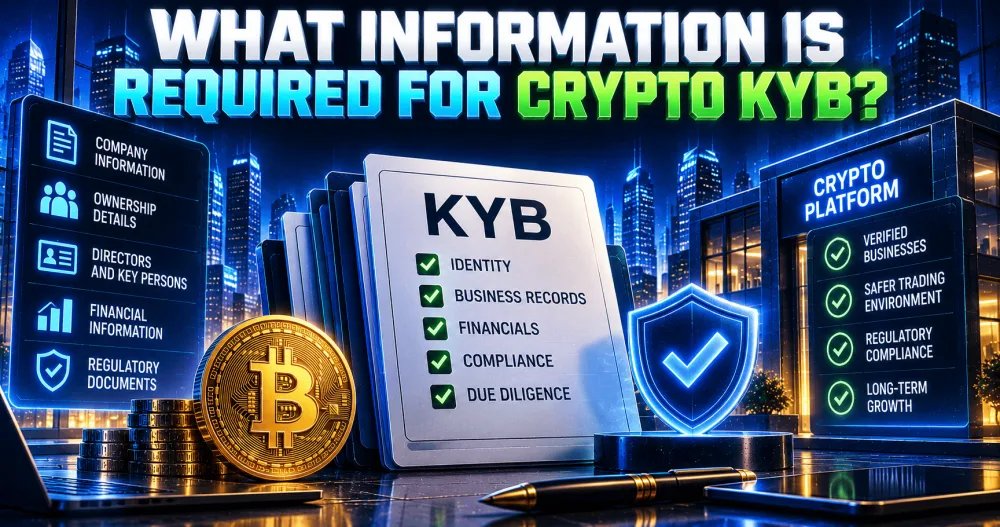
KYB requirements vary by platform, but a few information categories come up often. Applicants should expect questions about registration, ownership, management, operations, and funding.
Company Registration and Legal Details
Businesses usually provide their full legal name, registration number, and incorporation date. The platform may also ask for the legal form and country of incorporation. This helps compliance teams locate the entity in the right records. Any mismatch between what’s submitted and official data can slow things down.
Ownership Structure and UBO Information
Ownership details explain who holds shares in the applicant. Platforms may request ownership percentages and details about intermediate holding entities. UBO verification crypto checks then identify the individuals at the end of that ownership chain. If the structure is complex, a clear corporate chart and extra supporting evidence are often needed.
Directors, Controllers and Authorized Representatives
Directors and senior controllers influence how a company runs. Crypto platforms collect info about these individuals during onboarding. People authorized to operate the account may also need identity verification. Supporting documents help confirm that a representative truly has authority to act for the company.
Business Activity and Source of Funds
Applicants usually describe their products, customers, and why they’re using crypto services. Expected transaction volumes help platforms understand normal account behavior. Companies may also need to explain where deposited funds originate. Clear source‑of‑funds information becomes especially important for large or unusual transfers.
Related: What Is VASP Licensing? Who Needs a Crypto License in 2026
Corporate Address and Proof of Business Operations
Platforms often require a registered address and sometimes an operating address. Recent corporate records, leases, or other acceptable evidence support those details. Compliance teams also check whether the business is genuinely active. This helps separate operating companies from entities that exist only on paper.
How Does KYB Verification Work in Crypto?
The crypto business verification process typically unfolds in stages. Some parts can be automated, while more complex applications need human review.
Step 1: Submit Company Information
The process starts with a corporate application. The company provides registration details, addresses, ownership information, and requested documents. It helps to ensure every field matches official records. Mistakes early on can cause inconsistencies later.
Step 2: Verify the Business Entity
Next, the platform checks that the company is real and legally registered. Corporate registries or equivalent records confirm its current status. Compliance systems compare the information in the application with what’s on file. If records are missing or details don’t line up, more evidence may be requested.
Step 3: Identify and Verify UBOs
The platform traces who truly owns or controls the company. Ownership might pass through intermediate entities. Verifying UBOs often includes personal identification and address information. More documents may be asked for when ownership crosses borders or jurisdictions.
Step 4: Screen the Company and Key Individuals
Compliance screening covers the legal entity and the people connected to it. Platforms check sanctions lists, PEP status, and other risk indicators. A match doesn’t automatically mean a problem. It usually triggers a deeper look or enhanced due diligence.
Step 5: Review the Business and Risk Profile
All the gathered data helps the platform assess the overall relationship. Industry, where the business operates, and typical transaction behavior shape the risk level. If the funding model looks unusual, that may require extra explanation. Higher‑risk clients typically get more scrutiny before final approval.
Step 6: Approve or Reject the Business Account
After the review, the platform decides whether to establish the business relationship. Approved applicants get access to corporate services, sometimes with transaction limits or extra monitoring. If there are unresolved ownership or compliance concerns, the account can be rejected.
Ongoing KYB Monitoring After Onboarding
Approval isn’t necessarily the end. Changes in directors, shareholders, addresses, or business activities can trigger new checks. Platforms may monitor activity and compare it to the expected pattern. Significant changes can lead to updated documents or a fresh review.
Вот компактная таблица, которую можно поставить после блока “How Does KYB Verification Work in Crypto?”:
| KYB Step | What the Crypto Platform Checks | Why It Matters |
|---|---|---|
| Company Information | Legal name, registration number, jurisdiction, address | Confirms the basic identity of the business |
| Business Entity Verification | Corporate registry data, legal status, incorporation records | Shows that the company exists and remains active |
| UBO Verification | Shareholders, ownership chain, ultimate beneficial owners | Identifies the people who ultimately control the company |
| Directors and Representatives | Directors, controllers, authorized account users | Confirms who can legally act for the business |
| AML Screening | Sanctions, PEP status, adverse information | Helps detect elevated compliance risks |
| Business Activity Review | Industry, products, customers, expected transaction volumes | Builds the company’s risk profile |
| Source of Funds | Origin of business capital and expected deposits | Helps assess whether funding activity is consistent and legitimate |
| Final KYB Decision | Overall documentation and risk assessment | Determines whether the corporate account is approved |
| Ongoing Monitoring | Ownership changes, unusual transactions, updated company records | Keeps KYB information accurate after onboarding |
What Documents Are Needed for Crypto KYB?
KYB documents depend on the company type, jurisdiction, and platform, but some categories show up regularly.
Certificate of Incorporation
This confirms the business was legally created. It usually includes the company name, registration number, and incorporation date. Poor-quality scans or incomplete certificates can slow things down.
Articles of Association and Company Extracts
Articles of association outline key governance and legal structure. Current company extracts show directors, registration details, and legal status. Some platforms want one document; others want both. Recent records are especially helpful when a corporate structure is involved.
Related: What Is RST Crypto? Why This New Token Is Suddenly on Traders’ Radar
Proof of Business Address
Business address verification confirms where the company is registered or operates. Platforms can accept different documents depending on jurisdiction and policy. Evidence generally needs to be recent and clearly connected to the legal entity. A virtual or unusual address may lead to further questions in some cases.
Shareholder registers show who owns what directly. Corporate charts help compliance teams see how entities relate. When ownership gets tangled, intermediate companies often need extra records. Well-organized docs make crypto business verification much smoother.
Identification Documents for Directors and UBOs
Key people usually provide passports or other government IDs. Some providers also ask for proof of address. IDs should stay valid during the review period. Clear IDs help link each person to their role in the corporate structure.
When Crypto Platforms Request Additional Documents
Standard KYB paperwork isn’t always enough. Compliance teams may want financial statements, licenses, contracts, or proof of funds. Regulated or unusual businesses can face tougher requirements. Supplying relevant records quickly can prevent delays.
How Are UBOs Verified During Crypto KYB?
Beneficial ownership is a core part of crypto KYB. Platforms need to identify the real people who control or benefit from a corporate account.
What Is a UBO?
UBO means ultimate beneficial owner. It usually refers to the natural person who ultimately owns or controls a legal entity. Ownership can be direct or through other companies. Thresholds and rules vary by regulatory framework.
How Platforms Trace Complex Ownership Structures
Some companies have a single shareholder, so it’s straightforward. Others sit under several holding companies across different jurisdictions. Compliance teams trace each layer and check the supporting records. The process goes on until the true owners behind the structure are clear.
Why UBO Verification Matters for Crypto Compliance
Verifying the ultimate beneficial owner prevents a legal entity from being an anonymous customer. Knowing the real owners helps platforms assess sanctions, corruption, and money laundering risks. It also provides context for business activity and expected transactions. Accurate UBO records strengthen the whole KYB framework.
What Happens When Ownership Information Cannot Be Verified?
If ownership isn’t clear, the platform can’t complete its risk review. Applicants may be asked for shareholder records or more corporate documents. Complex setups might require evidence from several companies. If the ultimate owners remain unverifiable, the platform may decline the relationship.
KYB vs KYC in Crypto: What’s the Difference?
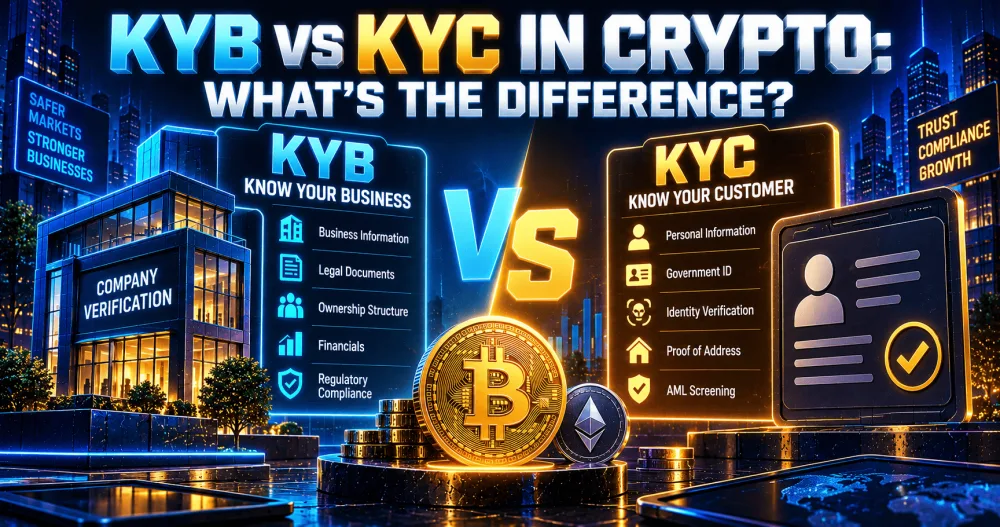
The difference comes down to who’s being verified. KYC focuses on people; KYB focuses on businesses and their structures.
KYC Verifies People, While KYB Verifies Businesses
KYC checks that a person really is who they claim to be. KYB checks that a company exists and operates, including who owns and controls it. Because of that, KYB usually involves more documents than standard personal verification.
Why Crypto Companies May Need Both KYC and KYB
Onboarding often combines the two. The entity goes through KYB, while directors or UBOs do personal verification. Together, they tie the company to the people who control it, allowing risk to be assessed on both sides.
KYB for Businesses vs KYC for Their Owners and Representatives
Registration papers belong to the business side of verification. A director’s passport checks the individual tied to that company. Authorized representatives may also need personal checks before accounts are opened. That’s why corporate onboarding tends to require more information.
How Long Does Crypto KYB Verification Take?
There’s no single timeline in crypto. It depends on the company’s structure, where it’s based, and the quality of the documents.
Related: Top 5 Altcoins for the Next 100x Crypto – Best Crypto to Buy Now 2026
What Determines KYB Processing Time?
If a company is straightforward and has up-to-date records, it can move faster. Easy access to automated registries helps, too. Manual reviews slow things down when automatic checks aren’t conclusive. How quickly applicants respond to questions also matters.
Why Complex Corporate Structures Take Longer
Each extra ownership layer means another verification step. International holding companies bring in more registries and document formats. Some records need translation or extra certification. As complexity grows, identifying the UBO takes longer.
What Can Delay Business Verification?
Missing documents are a big, avoidable delay. Conflicting names, addresses, or ownership percentages raise questions. Expired IDs need replacing. To avoid problems, put everything together carefully before submitting.
What Happens If a Crypto Business Fails KYB?
Failing KYB can block a corporate crypto account. Platforms may also limit existing customers if later reviews raise unresolved issues.
Common Reasons for KYB Rejection
If legal identity or ownership can’t be established, the platform may reject. Unsupported business activity, or types of customers that exceed risk appetite, can also cause issues. Rejection doesn’t automatically mean wrongdoing.
Missing or Inconsistent Company Information
Compliance teams compare data across documents and databases. Different legal names or registration numbers can complicate things. Ownership percentages that don’t add up can trigger concerns. Fix real errors rather than submit conflicting explanations.
High-Risk Jurisdictions and Ownership Structures
Geography matters in many rules. Links to higher-risk jurisdictions get extra scrutiny. Very opaque ownership can raise red flags. Sometimes extra documentation helps, but final approval is platform-specific.
Sanctions, PEP and Adverse Media Screening
Platforms screen companies, owners, and directors against risk data. Sanctions matches require careful checks before onboarding. PEP status can lead to enhanced due diligence, not automatic rejection. Notable adverse information can shape the overall risk picture.
Is KYB Mandatory for Crypto Businesses?
No universal law makes KYB identical for every crypto company. It depends on local AML rules, licensing, and services offered.
How AML Regulations Affect Crypto KYB Requirements
AML rules usually require regulated financial players to know their customers. For corporate customers, that means basic identity, ownership, and control information. These duties shape KYB for crypto firms, with room for extra controls by individual platforms.
FATF Standards for Virtual Asset Service Providers
FATF has guided the global approach to crypto compliance. They push due diligence, record-keeping, and transparency around beneficial ownership. Countries implement these principles in different ways, so how it looks can vary a lot.
How Local Crypto Regulations Shape Business Verification
A crypto provider must follow the rules for its licensed activities. Some places demand detailed customer due diligence for crypto businesses; others rely on broader AML frameworks. Location matters a lot for crypto KYB.
Why KYB Requirements Differ Between Crypto Platforms
Two exchanges can ask for different documents from the same company. Licenses, jurisdictions, and internal risk policies don’t line up exactly. Product types and customer mix can also change what’s needed. Always check a specific exchange’s KYB rules before applying.
How Crypto Platforms Use KYB After Verification
The data collected during onboarding stays relevant throughout the relationship. It helps explain transactions and spot meaningful changes in corporate risk.
Business Account Approval and Access to Crypto Services
Getting through the business verification for a crypto exchange can unlock corporate account features. That might mean trading, custody, settlement, or other institutional services. What’s offered depends on the provider and the jurisdiction. Higher‑risk customers often get tighter access than lower‑risk ones.
Transaction Monitoring and Risk Management
A company’s stated business model sets expectations for normal activity. Platforms compare real transactions to that profile after onboarding. Surprises in volume or unexpected counterparties can trigger extra review. Compliance teams may ask for explanations or newer proof of funds.
Periodic KYB Reviews and Information Updates
Corporate details aren’t carved in stone. Shareholders, directors, and business addresses can change after the initial KYB check. Regular reviews help keep records accurate. You might need fresh registry extracts or up‑to‑date ownership documents during these checks.
When a Crypto Platform May Request Reverification
A big ownership change can kick off a new verification. Shifts in business activity or how transactions look can do the same. Regulatory updates can also create new information needs for existing customers. Reverification lets platforms reassess whether the original risk profile still fits.
How to Pass Crypto KYB Verification
No one can guarantee approval, but being prepared makes the process far smoother.
Keep Corporate Information Consistent
Use the exact legal company name on every document. Matching registration numbers, addresses, and ownership figures helps. Small mismatches cause questions and slow things down. Double‑checking details before you submit cuts down avoidable delays.
Prepare UBO and Ownership Documents in Advance
If there are multiple shareholders, map out a clear ownership chart before applying. Each corporate layer should have documents backing up the stated relationships. Identify the actual ultimate beneficial owners at the end. Getting these records ready ahead of time makes the UBO checks easier.
Use Current and Verifiable Company Records
Fresh documents back up the company’s current status. Registry extracts should show current directors and shareholders whenever possible. Identity documents should be valid and legible. Complete files help both automated checks and manual reviews run more smoothly.
Be Transparent About Your Business Activity and Funds
Describe what the business does clearly so the platform can gauge expected activity. Tone down estimates to what makes sense for the company’s size and model. Explain funding sources with legitimate, verifiable origins. Honest, straightforward answers cut down uncertainty in KYB.
FAQ
What Is KYB Verification in Crypto?
KYB for crypto checks the identity, ownership, and structure of a business customer. Platforms run this before providing many corporate crypto services. The verification can cover the company itself and the people who control it.
Is KYB the Same as KYC?
Not exactly. KYC mainly verifies individuals, while KYB focuses on legal entities. Corporate onboarding often blends both because real people run companies.
Who Needs KYB Verification on a Crypto Exchange?
Companies aiming for corporate exchange accounts usually go through KYB. Think funds, brokers, market makers, and payment firms. Other legal entities may need it too, depending on the services they want.
What Documents Are Required for KYB?
Typical KYB documents include incorporation papers and company extracts. You may also need ownership graphs, shareholder details, and proof of address. Directors and UBOs usually must provide valid photo IDs.
How Long Does Crypto KYB Take?
Processing time varies with how complex the application is. A small, clean setup can move quickly. International ownership or missing documents can slow things down a lot.
Can a Crypto Business Fail KYB?
Yes. If ownership can’t be verified, information doesn’t add up, or the risk looks unacceptable, the check can fail. Some platforms may also reject businesses that don’t fit their internal policies.
Do Crypto Exchanges Verify UBOs?
Many exchanges check UBOs when required by compliance rules. This helps confirm who ultimately owns or controls the company. If ownership is tangled, you’ll likely need a lot of corporate paperwork before it’s done.
Does Law require KYB?
It depends on where you are, who you are, and the platform’s regulatory duties. AML rules often require regulated providers to identify and assess corporate customers. Crypto platforms may impose stricter KYB rules through their own policies.