Dexscreener is a web-based analytics tool that tracks activity on decentralized exchanges (DEXs) and across different blockchains. Instead of functioning as a DEX, Dexscreener collects this trading data from on-chain DEXs and presents it in an easy-to-read format, such as price charts, liquidity information, transaction history, and token data. This is useful for monitoring both established and new tokens.
Contents
- What Is Dexscreener and Why Crypto Traders Use It
- How to Use Dexscreener: Step-by-Step Overview
- How to Find New Crypto Gems on Dexscreener
- How to Read Dexscreener Charts Like a Beginner
- Key Filters on Dexscreener You Should Use
- How to Track Trending Memecoins Before They Pump
- Common Mistakes Beginners Make on Dexscreener
- Pro Tips to Find Early Crypto Opportunities
- FAQ
What Is Dexscreener and Why Crypto Traders Use It
Dexscreener Explained in Simple Terms
For anyone looking for a practical Dexscreener guide, the platform offers free access without requiring registration, making it a popular starting point for traders who want to analyze on-chain markets before interacting with decentralized exchanges (DEX) data.
How Dexscreener Collects Real-Time DEX Data
According to the documentation, Dexscreener collects all market data directly from blockchains using its proprietary indexing stacks that index raw blockchain logs and calculate trading transactions in real time to provide price chart data, pair data analytics, and trader statistics without using any third-party data providers.
Read More: What Is ASNEM Crypto? Why The Black Bull Coin Is Up 130% in 24 Hours
This infrastructure allows users to access real-time crypto charts and aggregate DEX market data, including liquidity, trading volume, price changes, and recent transactions across thousands of trading pairs.
Since all information comes from on-chain data, the site encourages users to do their own research before interacting with any token or smart contract.
Why It’s Essential for Finding Early-Stage Crypto Tokens
New crypto tokens are often traded on DEXs before they make their way to centralized exchanges. Dexscreener allows its users to track On-chain trading pairs immediately after liquidity is added, thus becoming available on DEXs.
Metrics such as liquidity, trading volume, and price action can definitely help find crypto gems early; however, it is important to remember that, considered alone, they are not a surefire way of identifying promising early-stage crypto projects, and should always be considered in conjunction with other due diligence.
| Feature | What It Shows | Why It Matters |
| Price Charts | Live token price movements | Helps monitor market trends and price action |
| Liquidity | Funds available in the trading pool | Lower slippage and easier trade execution |
| Trading Volume | Total value traded over a selected period | Indicates the level of market activity |
| Transactions | Number of buy and sell trades | Shows whether interest comes from multiple participants |
| New Pairs | Recently launched trading pairs | Helps discover newly listed tokens early |
| Trending | Tokens with high market activity | Highlights assets attracting growing attention |
How to Use Dexscreener: Step-by-Step Overview
No Account Needed — How to Access the Platform
One of the biggest perks of Dexscreener for beginners is that the platform is publicly available. Users simply open the website on any modern web browser to view live market data on the supported blockchains. No registration is required for browsing the charts, monitoring trading pairs, or exploring tokens on the site.
Wallets can be optionally connected so that watchlists and preferences can be saved, users can still access all of the main analytics on the platform without linking a wallet.
This makes how to use Dexscreener step by step for beginners straightforward, even for those who have never interacted with a decentralized exchange platform before.
Understanding the Main Dashboard (Trending, New Pairs, Charts)
When the Dexscreener page has loaded, several discovery tools are immediately accessible from the dashboard. The Trending section shows a ranking of tokens based on a proprietary ranking score, relying on values including trading volume, price action, and community engagement. The New Pairs section shows trading pairs created by liquidity added to supported DEXs.
Read Also: Will Crypto Go Back Up in July 2026 or Still in a Downtrend? Market Analysis and Key Signals
From there, selecting a pair opens an interactive candlestick chart with price action, swap history, liquidity, volume, on-chain transactions, and a variety of other on-chain data. As a result, Dexscreener is a crypto charts tool set that allows users to observe trending crypto coins across several blockchain networks from one platform.
How to Search Tokens Using Name or Contract Address
Dexscreener allows searching by token name, ticker symbol, pair address, and smart contract address. According to the official documentation, tokens are indexed as soon as a liquidity pool is created with them, and a transaction for the token is captured on-chain with the protocol, meaning that they do not need to be manually listed to be searchable.
Using a token’s contract address is the safest and most reliable way to search for a specific token, as multiple tokens can have the same name or ticker. Token contract address search is widely used to verify a token and prevent the use of similarly named tokens on other blockchain networks.
How to Find New Crypto Gems on Dexscreener
Using the “New Pairs” Section for Early Launches
The New Pairs page shows trading pairs that have been approved by liquidity being added and on-chain trading starting. According to Dexscreener, these tokens are instantly indexed to allow for new tokens to be discovered without the need to wait for manual approval or be listed on a centralized exchange.
Investors can filter it by blockchain, liquidity, or pair age, making it easier to find projects that suit their investment strategy. This tool will often be the first place to look at before the asset becomes more mainstream in how to find crypto gems early using Dexscreener process.
Tracking Trending Tokens Before They Go Viral
On Dexscreener, Trending ranks tokens against one another based on trading volume, liquidity, transaction count, unique traders, community activity, and verified project information.
Read Also: What Is a16z Crypto and Why It Is Becoming One of the Most Influential Forces in the Crypto Market
The Trending feed can help identify crypto coins that have already created on-chain activity to a measurable degree, avoiding uncertainty caused by social media speculation. However, trending status is subject to market interest and should be used in conjunction with in-depth research to make sound decisions for buying or selling.
Why Early Liquidity and Volume Matter for Spotting Gems
After a launch, advanced token investors look for liquidity in the token, and the trading volume of the token: greater liquidity tends to guarantee less price slippage, while greater trading volume tends to prevent price swings from being caused by one transaction.
Liquidity pool tracking with trading volume analysis can give a better picture of the rise in a market because growing liquidity from regular trades may better signify organic behavior as compared to markets in which a small number of large trades may not be representative.
| Discovery Method | Best Used For | Limitation |
| New Pairs | Finding newly launched tokens | Higher project risk |
| Trending | Identifying growing market interest | May already include pumped tokens |
| Liquidity Metrics | Evaluating trade stability | Doesn’t measure project quality |
| Trading Volume | Confirming active participation | Can increase during short-term hype |
| Transaction History | Spotting consistent activity | Should be analyzed with other metrics |
How to Read Dexscreener Charts Like a Beginner
Candlestick Basics for Crypto Trading
Dexscreener uses TradingView to power its charts, which can be displayed in candlestick, line chart, bar chart, Heikin Ashi, and area chart formats. Candlestick charts are set as the default option for users since they show the coin’s opening price, closing price, highest price, and lowest price for any given timeframe.
If you’re following along with the Dexscreener tutorial, some background on candlestick behavior may be helpful. For example, a series of bullish or bearish candles may give you some idea of sentiment in the market, but candlestick patterns may be less reliable when not corroborated by volume or other indicators.
Understanding Volume, Liquidity, and Market Cap
Besides price action, Dexscreener shows other metrics, including liquidity, trading volume, number of transactions, and FDV (Fully Diluted Valuation). Liquidity is the total dollar value locked in a trading pool and the amount of slippage a trader may experience when making a transaction. Trading volume is the number of buys and sells of a token over time.
Market cap and liquidity tracking should be measured together: a token with deep liquidity and stable trading volume is likely to see a less volatile price compared to one with shallow liquidity and erratic trading volume.
How to Identify Breakout Patterns Early
Breakouts may be signaled by increasing trading volume and transaction counts, as well as the persistence of price movements outside the previous trading range, all of which can be observed in real time on dexscreener and compared across multiple trading pairs on decentralized exchanges.
It is important to note that the breakouts predicted by these indicators are not guaranteed. It may be more effective to combine price breakout detection with volume breakout indicators than to focus on price alone. Furthermore, many traders observe crypto momentum signals, such as increasing participation or rising volume, to confirm the validity of a move.
Key Filters on Dexscreener You Should Use
Price Change Filters (5m, 1h, 24h Momentum)
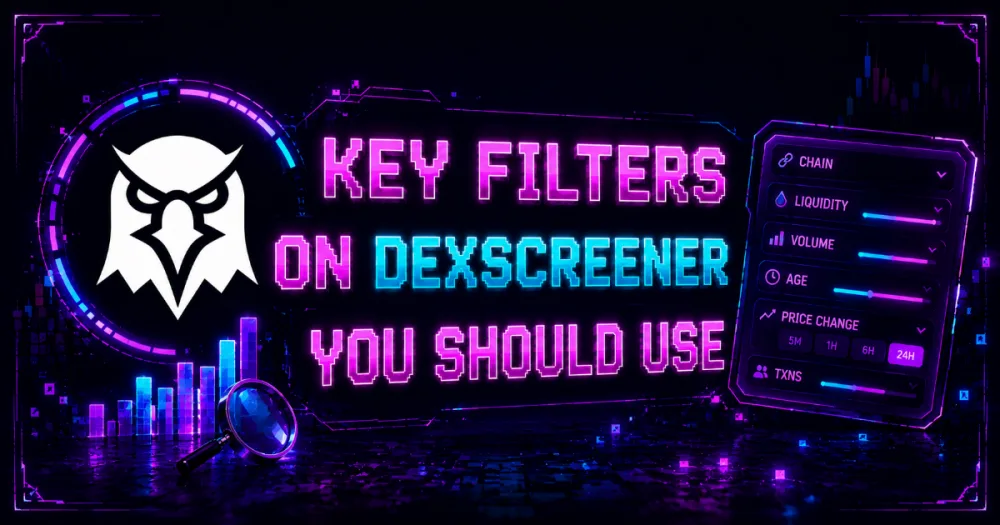
Dexscreener has screener filters for trading pairs, which allow users to filter pairs of assets based on the percentage price change of the trading pair over a 5-minute, 1-hour, 6-hour, and 24-hour time period, to quickly find assets with price volatility or momentum.
Short-term price filters can also be dependent on liquidity and volume. For example, combine rapid price shifting (e.g., every five minutes) with the hourly price trend to distinguish price spikes from early crypto momentum signals building, with the broader 24-hour filter as the context.
Liquidity Filters to Avoid Low-Quality Tokens
Liquidity filters are used to exclude trading pairs that may be illiquid or have little liquidity, making it harder to open or close a position. Dexscreener allows you to filter trading pairs by minimum liquidity, which allows traders to research and trade in more liquid markets with less slippage.
When using a decentralized exchange tracker, liquidity can be considered more important than the most recent price. A price spike with very low liquidity will not be reflected on many charts and may give false signals on a price chart.
Volume and Transaction Filters for Real Demand
Dexscreener includes filters for trading volume along with the number of buy/sell transactions in various timeframes; these filters can be checked alongside price movements to determine whether price changes are accompanied by trading volume.
For example, when a token has a higher trading volume, it is generally believed that more people were involved in the price changes than if the token had a similar price performance but had only a handful of trades. Chart reading is not the only indicator when assessing the new assets situation in decentralized exchanges.
How to Track Trending Memecoins Before They Pump
Why Memecoin Momentum Starts on DEXs
Most memecoins are deployed on DEXs due to the much lower complexity of launching a token with a liquidity pool compared to other types of centralized exchanges. Typically, on-chain trading activity for these coins can be observed first on DEXs before the market moves to other exchanges.
Read Also: What Is the Fortune Crypto 100 Ranking and How Are Firms Chosen?
For memecoins early detection, DEXs provide immediate access to trading pairs, liquidity and market activity through Dexscreener, which aggregates these data in real-time to ease tracking the progress and market traction of newly emerging memecoins.
Monitoring Sudden Volume Spikes and Whale Activity
In addition, large increases in trading volume and transaction counts signal that the token attracts new market demand. Dexscreener shows trading volume and transaction counts of the tokens alongside live trades in order to understand whether a price movement is backed by sustained on-chain activity.
Whales activity tracking and volume trends provide some background, but the presence of large buy orders should not be solely relied upon when looking for buy signals. Professional traders may examine wallet behavior, liquidity growth, transaction frequency, and distribution of holders as indicators.
Using Dexscreener for Hype-Driven Tokens
Memecoin rallies are often driven by social attention rapidly translated to on-chain activity. DEXScreener’s Trending page helps users find the most active markets by ranking tokens based on liquidity, trading volume, the number of transactions, unique traders, and community engagement.
When looking for how to track memecoins on Dexscreener, remember that hype-driven markets are just as likely to reverse as they are to accelerate. It’s also worth considering using more than one indicator to inform your decision-making process, rather than relying solely on short-term price fluctuations.
Common Mistakes Beginners Make on Dexscreener
Chasing Green Candles Too Late
A mistake that beginners make is to buy a token that has just started to surge, without checking if the token is already retracing the price action. Dexscreener allows users to see the tokens that are currently surging, but the price on its own is not sufficient.
Many traders, rather than trading immediately on a single bullish candle, look to the liquidity, trading volume, and the recent market transactional data to tell whether the move is a real buying pressure and not merely a spike.
Ignoring Liquidity Risks and Fake Volume
Tokens with low liquidity may move considerably even with a small amount of capital flowing into or out of the token, making checking liquidity equally important prior to making a trade.
Read Also: Top 10 Crypto X Influencers to Follow in 2026. Best Twitter Accounts for Signals & Insights
Practices such as wash trading and volume spoofing artificially inflate market interest. It is possible to gain more understanding from the values of liquidity, trade count, and trading history than from raw volume statistics.
Relying Only on Charts Without Checking Fundamentals
Technical charts can identify price trends, but cannot determine how a crypto project fits into the cryptocurrency ecosystem, the development of a crypto project, or the overall trustworthiness of a crypto token. A trader should consult official documents, smart contract addresses, and community resources.
This can be achieved through the use of crypto trading tools and conducting independent project research, which allows one to avoid decisions based solely on short-term market movements.
| Warning Sign | Why It Deserves Attention |
| Very low liquidity | Higher slippage and greater price volatility |
| Sudden volume spike | May reflect short-term speculation rather than sustained demand |
| Few transactions despite high volume | Could indicate concentrated or artificial trading activity |
| Missing project documentation | Makes it harder to evaluate legitimacy and long-term goals |
| Price rising without broader market participation | Momentum may fade quickly if buying interest disappears |
Pro Tips to Find Early Crypto Opportunities
Combining Dexscreener with Social Media Signals
Price action on decentralized exchanges may frequently be in correlation with activity on X and Telegram. In analyzing the price, traders may check these sources to gauge whether growing on-chain activity is also being supported by growing community engagement.
More experienced traders often turn to Dexscreener and the project’s social media to verify announcements, token releases, and so on, as social sentiment can provide additional context for the information found in real time on the DeFi charts. However, this still requires traders to do their own research.
Watching Wallet Activity and Early Liquidity Pools
These signals, such as large wallets or new liquidity pools, are often the first on-chain activity observed following a token’s launch. Dexscreener provides up-to-date data on trades, liquidity, and past history, enabling users to monitor such activity just after token launch.
Whale activity tracking can also reveal whether major capital is entering or leaving a market, and individual transactions should be compared to liquidity trends, trading volume, and even who is buying or selling the tokens in order to determine demand.
Building a Watchlist for Fast-Moving Tokens
Users can create watchlists of pairs on whichever supported blockchains they like using Dexscreener. This means they can track promising tokens on multiple chains in a single interface, making it easier to compare price action, liquidity, and volume.
Watchlists allow traders to follow those trends as they develop, rather than only seeing the price spike in pairs. For those looking for the best way to use Dexscreener to spot new tokens, the watchlist of favorite projects can be more effective and informative than repeatedly searching for newly trending pairs.
FAQ
Is Dexscreener Free to Use?
Yes. Most of Dexscreener’s features, like live charts, token search, market analytics, etc., can be used without creating a user account or acquiring a subscription.
Does Dexscreener Support All Cryptocurrencies?
Currently, Dexscreener only tracks tokens traded on supported decentralized exchanges and blockchain networks. Tokens that have an active liquidity pool and at least one on-chain transaction are indexed automatically.
Can I Buy Tokens Directly on Dexscreener?
No. Dexscreener is a market analytics platform, not a trading venue. It contains links to these supported DEXs, where users can connect their eligible wallets and execute trades.
How Quickly Do New Tokens Appear on Dexscreener?
Tokens become eligible automatically when their liquidity is added, and a transaction is executed on a supported DEX. The time before token eligibility depends on indexation speed and the level of network activity.
Is Dexscreener Suitable for Beginners?
Yes. It provides an interface for viewing on-chain market data via token pages, charts, and trading statistics in real-time and makes it easy for the unfamiliar to browse decentralized markets without creating an account.