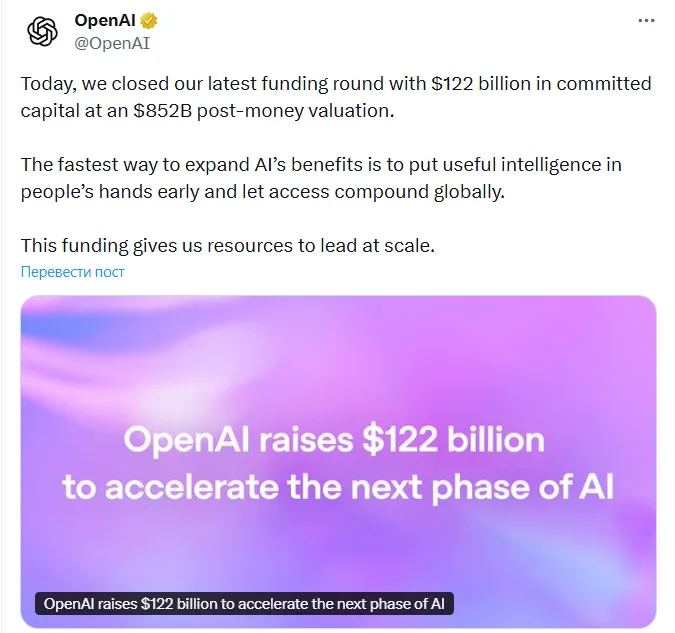
OpenAI closed the largest technology funding round in history, totaling $122 billion.
The post-money valuation reached $852 billion. Amazon, Nvidia, and SoftBank led the round, with significant participation from Microsoft.
The company will use the funds to further scale infrastructure and develop models. OpenAI also opened access to private investors through banking channels, raising an additional $3 billion. It expanded its credit line to $4.7 billion.
Related: Chainalysis Launches “Blockchain Intelligence Agents”
Contents
Key Growth Metrics
OpenAI reported record growth rates. Weekly active ChatGPT users are approaching 900 million. Paid subscribers now exceed 50 million.
The company’s monthly revenue reached $2 billion. One year ago, revenue stood at $1 billion per quarter. In the first year after ChatGPT’s launch, revenue totaled $1 billion for the entire period.
OpenAI emphasized that it is growing four times faster than leading technology giants at similar stages of development, including Alphabet and Meta. More than 40% of revenue now comes from the corporate segment.
Computing as a Strategic Advantage
OpenAI identified access to computing power as a key competitive advantage. The company is actively expanding its infrastructure, working with Nvidia, Microsoft, Oracle, AWS, Google Cloud, and other providers.
Related: ARK Invest sees AI infrastructure market nearing $1.5 trillion by 2030
According to company representatives, infrastructure improvements lower the cost of token generation and create a compounding effect. Cheaper computing enables more powerful products and drives revenue growth.
Jack Dorsey’s View on AI’s Role in Business
Against the backdrop of rapid AI infrastructure development, Block and Twitter co-founder Jack Dorsey stated that artificial intelligence should replace middle management in companies.
In an essay titled “From Hierarchy to Intelligence,” co-authored with Sequoia Capital managing partner Roelof Botha, Dorsey explained Block’s recent reduction of 4,000 employees (out of more than 10,000) not merely as cost optimization but as a fundamental organizational restructuring.
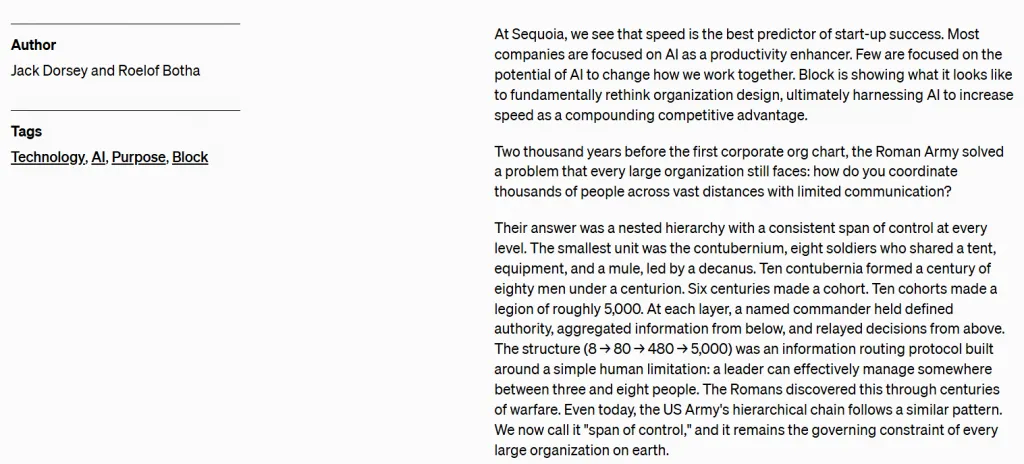
In his view, AI can more effectively perform coordination, information aggregation, and operational decision-making functions that traditionally fell to middle management.
Related: Ripple Integrates AI to Strengthen XRP Ledger Security