Bitcoin mining has shifted from hobby rigs to industrial-scale farms, a move some say could contrast with how AI develops.
Bitcoin mining is going through another reset as weaker prices push older machines offline and global hashrate slips.
Some say it also ties into a bigger shift in how computing power gets organized across industries. Alex Thorn, head of research at crypto mangement giant Galaxy Digital, is drawing a broader parallel beyond crypto.
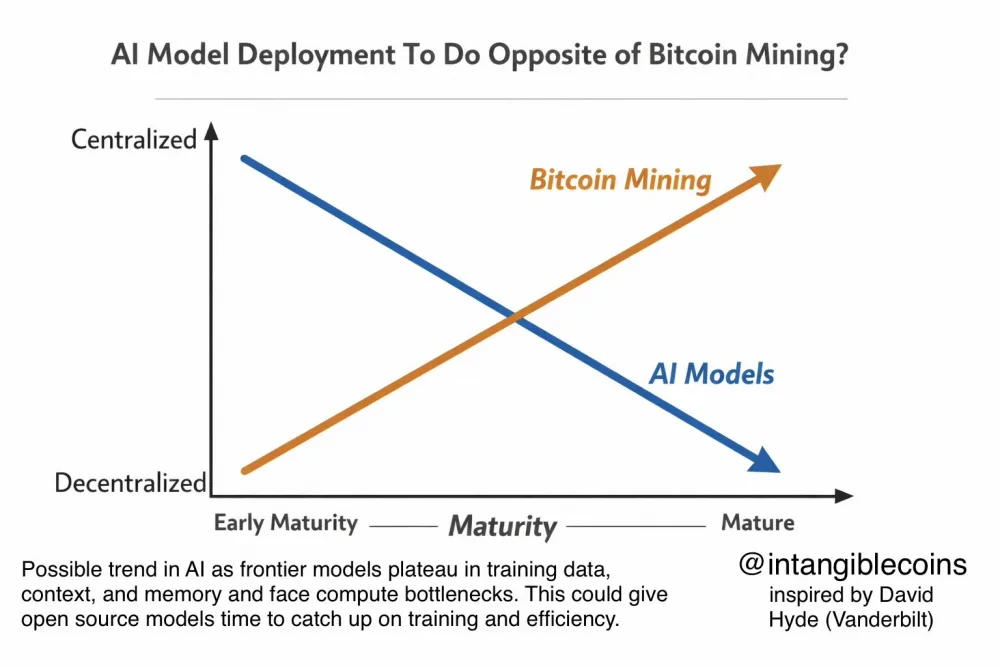
In an X post on April 12, Thorn argued Bitcoin has moved from “many small participants” in its early days to industrial-scale mining farms dominated by specialized ASIC hardware, while AI could be heading in the opposite direction. He wrote:
“AI may follow the opposite path: it started centralized in giant hosted clusters, but as frontier model gains slow (from data scarcity, context limits, and memory bottlenecks) open-source models could close the gap.”
His view is that AI started out highly centralized in massive data centers and hosted GPU clusters. However, the space could gradually shift toward more distributed systems.
Bitcoin Mining vs AI Shift
The idea is that cheaper models, combined with technical limits like memory constraints, could push AI out of centralized infrastructure over time.
Meanwhile, the process of mining Bitcoin has been moving in the opposite direction over time. From broad participation in its early stages to industrial-scale operations dominated by specialized ASIC hardware.
Here’s how to calculate Bitcoin mining profitability.
- Galaxy Digital itself previously also operated Bitcoin mining and hosting through its infrastructure arm.
- At its peak, the company disclosed mining capacity in the range of several exahash per second, though its focus has since shifted toward its Texas-based Helios data center, which is being repositioned toward AI computing workloads rather than pure Bitcoin mining.
The crypto mining map is also dominated by the same big players. For example, the U.S. holds about 37% of global hashrate, followed by Russia at nearly 17% and China at 12%, while the top three still controlled about 65% of the network.