Zcash (ZEC▼$432.50) used to vanish into silence, yet now it roars back louder than expected. A wild surge of 1,482% in twelve months changed how traders see it. Once dismissed as outdated digital cash for niche coders, it transformed without warning.
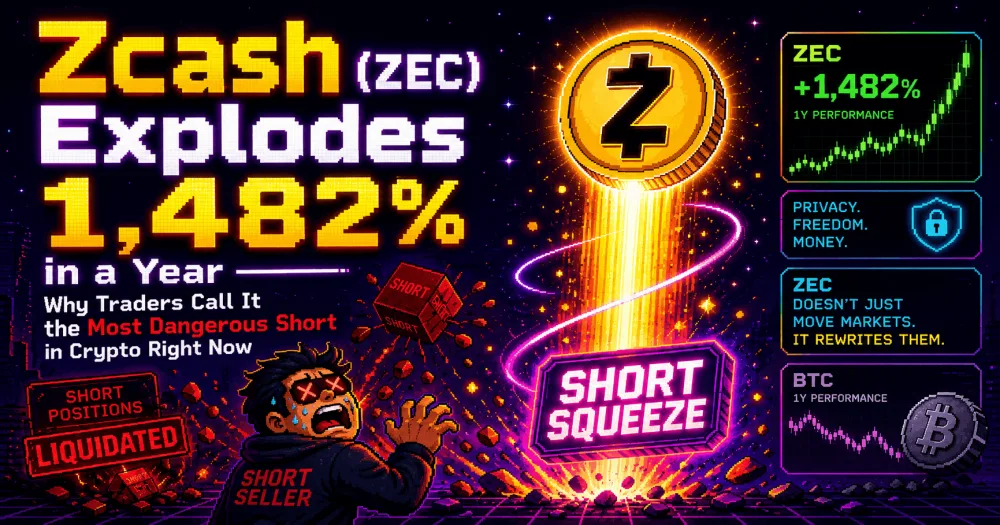
Sharp price swings now unsettle even experienced traders. Those betting against it often find themselves crushed. The rally stands clear, unburdened by gimmicks or crowd noise. While others chase jokes dressed as investments, this one carries weight simply by surviving.
Related: Zcash vs Bitcoin in 2026: Is Zcash a Better Privacy Coin Than Bitcoin for Investors?
Surprise played no role here. Traders were not swayed by nostalgia for vintage coins. What shifted was the mood around secrecy, returning like an echo from older times. Meanwhile, Bitcoin grows more rigid, dressed in suits and boardrooms. On the edges, traders betting against privacy coins keep learning how fragile their tools are when facing something driven by story, scarcity, and conviction.
Some traders now see Zcash (ZEC) as a high-risk bet when going short. This is not about constant gains. Instead, fighting the trend might cost heavily, especially once limited supply meets fast price moves, crowd-driven buying, and strong believer energy all at once.
Contents
- 1.Why Zcash (ZEC) Is Gaining Attention Again
- 2.The “Most Dangerous Short” Setup
- 3.Zcash (ZEC) vs. Bitcoin: The Privacy Trade
- 4.Why the 1,482% Surge Does Not End the Trade
- 5.Arthur Hayes and the Stories That Follow
- 6.How Zcash (ZEC) Stands Out Among Privacy Coins
- 7.Why Shorts Keep Getting Hurt
- 8.The Bear Case Still Exists
- 9.What Comes Next for Zcash (ZEC)?
- 10.Final Takeaway
- 11.FAQ
Why Zcash (ZEC) Is Gaining Attention Again
Years passed with Zcash seeming stuck in the past. A strong tech base did little to help its image. Known by many, built to last, and modeled after Bitcoin’s limited supply, it still missed the wild price surges common today. Instead of excitement, regulators saw problems. Attention went elsewhere. Speedy trends took over: artificial intelligence projects, staked assets, joke currencies, restaking ideas, Bitcoin Layer 2 networks — all replaced fast by something newer just moments later.
Then came a shift, as attention swung back toward privacy.
What seemed like a benefit at first now brings risks. These days, openness in blockchain feels less like freedom. Each digital wallet leaves a trail behind. Mapping every payment has become routine. Each whale, investor, founder, and ordinary user is under watch. Data-tracking firms, trading platforms, automated scripts, competitors, and officials are all looking. Bitcoin pushes back when censors try to step in. Yet privacy does not come built in.
That is where Zcash (ZEC) stepped in. Shielded transactions became its core idea, relying on zero-knowledge math so people can confirm transfers without showing sensitive data. As monitoring tightens, algorithms dig deeper, and big players follow stricter rules, this idea no longer seems odd. Suddenly, it fits.
What once seemed extreme now feels practical. Managing exposure began to make sense.
The “Most Dangerous Short” Setup
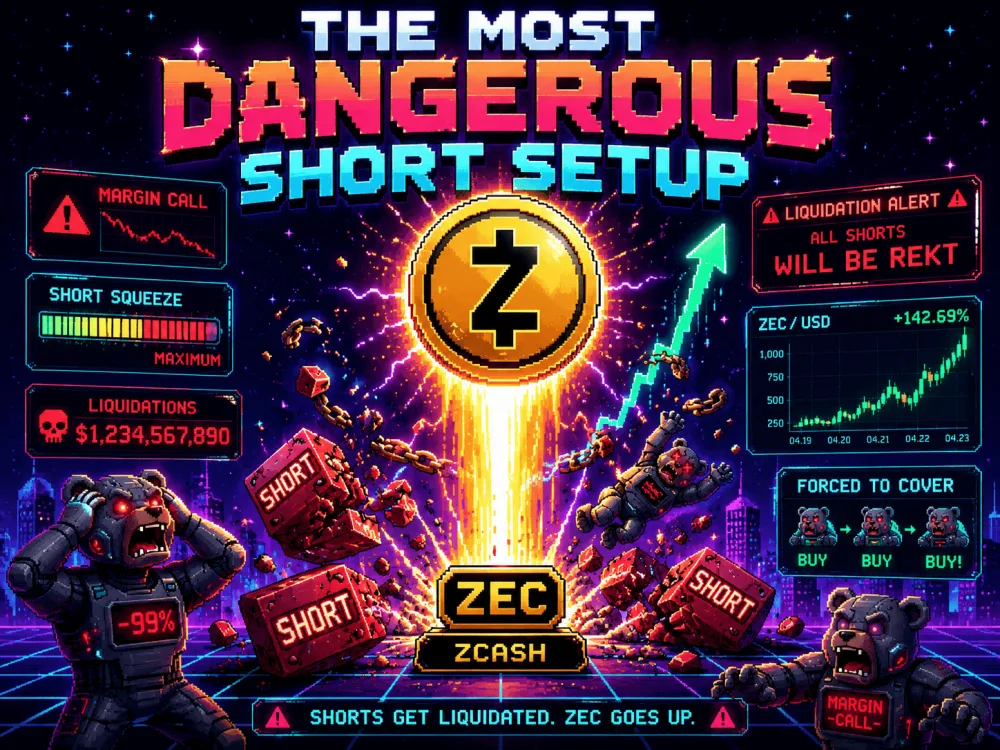
What stops traders from betting against Zcash (ZEC)? Overconfidence gets crushed here. The structure hits hard when pride shows up.
Looking at the numbers, a short might seem logical. ZEC already jumped in price recently. The coin swings wildly without warning. Rules around it remain unclear. Exchanges once removed similar privacy tokens. Building arguments to sell it short comes naturally to many traders, who then feel very sharp.
Hours pass. Suddenly, price shifts 20% in the wrong direction.
Here lies the issue. Zcash (ZEC) does not move only by standard pricing. It shifts because of feedback loops. As price climbs, so does the spotlight. The higher it goes, the louder the noise grows. It pulls in attention, then wallets follow. When wallets pour in, short positions start burning. Burning leads to panic covering. Suddenly, everyone buys just to survive. Lines on screens twist like rubber snapped midair.
This explains the label “dangerous short.” Not because ZEC might be overextended now and then. That likely happens. But because correct analysis means little when forced exits hit before the thesis has time to breathe.
Zcash (ZEC) vs. Bitcoin: The Privacy Trade
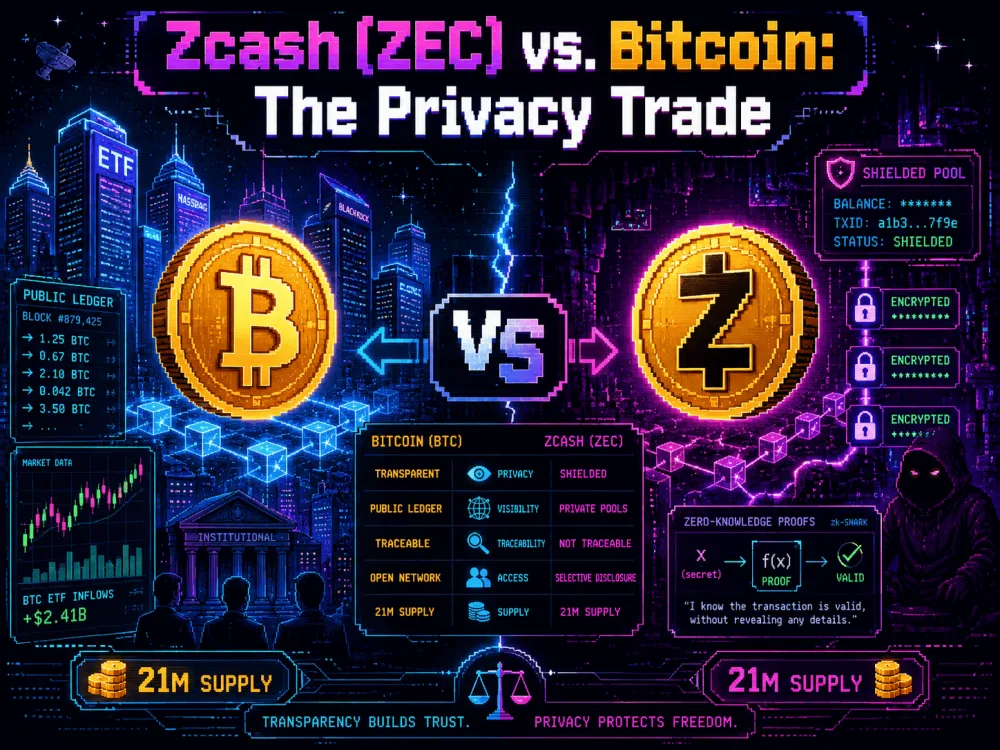
Bitcoin owns how people think about money in crypto. It stands as the go-to store of value, where big players step in first, almost like a measuring stick for everything else moving in the market. Yet here is the twist: its rise has quietly reshaped what it actually means.
Bitcoin is not only for digital rebels anymore. Pension funds hold it. State reserves discuss it. Big banks trade around it. This shift brings wider trust, yet also brings tighter oversight, clearer tracking, and deeper ties to traditional finance.
Zcash (ZEC) steps into the gap for certain traders. It offers clearer edges and stronger beliefs. A different angle emerges where others see noise. Ideals shape its place, not just price. Some watch closely when contrast matters most.
| Feature | Bitcoin | Zcash (ZEC) |
|---|---|---|
| Main role | Digital gold, reserve asset | Private electronic currency |
| Supply model | Fixed supply of 21 million BTC▼$61,724.00 | Fixed supply of 21 million ZEC |
| Default transaction visibility | Public blockchain | Optional shielded transactions |
| Institutional adoption | Strong and growing | Smaller, more speculative |
| Core narrative | Macro hedge, ETF flows, digital scarcity | Privacy, defiance, code-based freedom |
| Main risk | Crowded macro positioning | Regulation, liquidity, volatility |
Not every coin needs to be Bitcoin 2.0. That claim has been heard a million times and rarely means much. Bitcoin claimed the crown long ago when it came to digital gold status. Zcash aims lower than that, yet still sharp in its focus. Privacy might matter more once blockchain blends fully into old-school finance.
The real bet is not on replacing Bitcoin. It is betting people will care about secrecy again. Right now, systems track almost everything. A tool like Zcash (ZEC) could quietly fill the gaps left behind. No revolution promised here — just space for discretion in a transparent world.
It is another kind of deal altogether. Lately, though, this one actually shows results.
Related: Why Is Ethereum Price Still Dropping? ETH Technical Analysis & Market Outlook
Why the 1,482% Surge Does Not End the Trade
One year. A jump of 1,482%. That feels unreal. Most people would doubt such numbers right away because markets rarely sprint like that. But in crypto, minds split. Some laugh it off. Others already worry they are missing out.
The bear case is obvious: gains that came fast might already be behind us. That makes sense. Anyone watching this climb should understand that danger is not small. When prices jump straight up, what follows can hit hard.
But here is the thing: when something ignored wakes up, prices might not follow old rules. Zcash (ZEC) slept through seasons of silence. Should enough traders shift their view, seeing privacy as vital instead of outdated, value could leap past cautious forecasts. Numbers rarely capture that kind of turn.
What turns this move risky for everyone involved? Buyers might stick around too long, caught up in the rush. Sellers could face steep losses trying to beat the trend. Instead of numbers on a page, it feels closer to chaos, with candles swinging like fists.
Arthur Hayes and the Stories That Follow
Some well-known figures started talking up private digital cash again. Thanks to that noise, people — and even major institutions like Grayscale — began glancing back at Zcash (ZEC). Arthur Hayes never shies away from big market stories, often diving headfirst. His spotlight on assets like ZEC pulled it into conversations about privacy coins alongside a few others tagged as elite picks. That chatter lit a slow fuse under interest.
Bitcoin guards your money like a vault when regular currency wobbles. Zcash steps in where Bitcoin might fall short, adding another layer beneath. The idea caught on because it fits neatly inside a single thought. Sound bites stick better when they unfold fast in conversation. A tight phrase can spread further than pages of explanation ever could.
Here is the point: Bitcoin guards against rising prices and government-controlled currency. Zcash (ZEC) tackles what Bitcoin leaves open: too much visibility into transactions.
The truth of the matter might be messier, sure. Yet traders are not chasing flawless logic. What pulls them in is a narrative that shifts the market.
Related: Arthur Hayes Market Outlook 2026: Why He Still Thinks Bitcoin Can Go Parabolic
How Zcash (ZEC) Stands Out Among Privacy Coins
Privacy-focused cryptocurrencies are not exactly fresh news. For years, Monero held the top spot quietly. Yet Zcash plays things differently. While keeping strong privacy tools under the hood, it lets users choose openness when needed. That is an unusual flexibility for this space. A fixed coin limit mirrors Bitcoin closely. Major trading platforms already know the name. Even cautious organizations find it less alarming than many alternatives. Compliance teams sip their coffee slower around this one.
Optionality carries weight here. While Zcash (ZEC) supports hidden transfers, not all transfers need to hide. Some see this as a flaw, arguing it shrinks the pool of private users. Others view it differently: flexibility grows, opening doors to systems bound by rules.
What sets Zcash apart shows clearly here. Not every coin walks the line between radical roots and serious boardrooms so smoothly. Some see it as digital cash with integrity. Others just call it noise. Still, institutions find ways to talk about it without rolling their eyes. Privacy purists nod along too, even if they squint first.
Right now, that might be the balance traders want. The spot between extremes holds attention for a reason.
Why Shorts Keep Getting Hurt
Most people think betting against a powerful asset sounds foolish. Yet when that asset carries momentum, has scarcity built in, pulls more eyes every day, and still trades with uneven liquidity, that is when recklessness learns to dress up like planning.
There are several reasons Zcash (ZEC) shorts are vulnerable:
| Short-Squeeze Driver | Why It Matters |
|---|---|
| Fast upward momentum | Pushes leveraged short positions to unwind |
| Rising open interest | More contracts create more forced-exit fuel |
| Privacy narrative | Helps supporters hold through volatility |
| Limited available supply | Even modest buying can move price quickly |
| Public spotlight | Draws fresh participants into the surge |
| Bitcoin fatigue | Makes alternative digital scarcity stories more attractive |
When pressure kicks in, everything shifts. Instead of cool opinions, short sellers rush, each trying to leave before the others. This scramble turns into urgent purchases. Urgent purchasing acts like wild fuel, loud and reckless.
This is one reason betting against Zcash (ZEC) feels risky. Flawless optimism is not the driver here. Wrong timing turns a sensible bearish move into losses fast. The structure of the market does that.
The Bear Case Still Exists
Just because prices rise does not make danger disappear. In fact, it often makes things worse.
Privacy coins still stir political debate. Since regulators frown on tools that hide payment trails, tension lingers. When oversight tightens, exchanges often step back. Without warning, markets might thin out under mounting scrutiny.
Getting people onboard remains tough. Even with strong tech, a private cryptocurrency might stumble when users leave their funds sitting on exchanges. Using hidden transfers the right way often gets skipped. It does not matter how clever the code is if real behavior does not follow.
Later on, price surges that go straight up tend to hurt those who jump in near the top. When Zcash (ZEC) attracts too much attention too fast, the drop afterward might hit with the same force as the climb before it.
Next, talk about privacy might fade out. These days, crypto traders bounce around like they have had too much coffee. When the spotlight shifts, ZEC may get left behind without much delay.
True, the short can burn you fast. Yet staying long will not shield you by some hidden rule. That difference matters unless your strategy runs on hope and gut feeling alone.
What Comes Next for Zcash (ZEC)?
The next step depends on Zcash holding its ground beyond just price bumps. Not every uptick means lasting value has shifted. A real shift shows up when people start using private transactions more often. Without heavier use of shielding features, momentum fades fast. What counts now is steady flow in trading pools, not spikes alone. Big players watching matters too. If they dip in, confidence grows. Staying central to privacy debates keeps the narrative alive. Momentum sticks only if purpose matches movement.
Right now, things look strong for ZEC. It is sitting above key price points that matter. With more attention on private transactions, interest grows. Big players still dominate Bitcoin’s space. Instead of fading out, Zcash (ZEC) stays strong as a top pick when people want privacy exposure.
Bearish moves follow a familiar route. When momentum fades, those who jumped in late start to worry. Short positions find fresh footing at more attractive prices. Suddenly, regulators speak up — or an exchange makes a move — dragging attention back to old concerns about private currencies.
Whatever the case, Zcash is not just murmuring in the shadows anymore. Now it crackles front and center.
Final Takeaway
Out of nowhere, Zcash (ZEC) surged 1,482%, dragging a once-forgotten privacy coin into sharp focus across crypto circles. This is not just about fond memories fueling momentum. Instead, it thrives where digital anonymity meets growing weariness toward Bitcoin, layered with advances in zero-knowledge proofs, sudden short squeezes, and a hunger among traders for stories that make sense.
That is why so many traders call this one of the riskiest bets against any coin today. Falling? Sure, ZEC might drop. Yet the mix of fast movement, strong belief, heavy borrowing, and sudden spotlight can turn doubt into pain long before prices confirm a downturn.
Right now, Zcash (ZEC) is not hiding anymore. Instead of fading out, it is pushing back hard against those betting down on it, which might be exactly what keeps its momentum alive.
FAQ
What is pushing Zcash higher lately?
Zcash (ZEC) is climbing as trading interest shifts back toward privacy-focused coins. Momentum builds fast once short positions start collapsing. Traders now look closely at what sets certain cryptocurrencies apart, including hidden transaction details. Bitcoin lacks this feature by default, and that gap explains part of why money flows into alternatives like ZEC.
Why do traders call Zcash (ZEC) a dangerous short?
Some traders see Zcash (ZEC) as risky when betting against it because a sudden climb might squeeze those bets fast. As losing short trades close, their exits turn into buying pressure. That extra demand can lift the price further, sparking more forced closures down the line.
Is Zcash more private than Bitcoin?
Bitcoin stands first among crypto reserve assets. Still, Zcash takes a different path by focusing on hidden transactions. What makes ZEC stand out is not that it beats Bitcoin overall. Instead, Zcash (ZEC) offers privacy features Bitcoin does not provide by default.
What is the biggest risk for Zcash (ZEC)?
The biggest risks are government pressure, exchange restrictions, and weak real-world use of privacy features. Sudden shifts also tend to follow big price swings. ZEC can drop just as sharply as it climbs when momentum changes.
Zcash climbed 1,482%. Will it go higher now?
That depends on what happens next. After that kind of move, risk jumps sharply, yet more upside is still possible. Zcash (ZEC) can keep rising if interest in privacy grows while short positions stay trapped. Even then, anyone jumping in now faces wild swings and sudden drops. A move like this rarely plays gentle.